
Road to Sakura
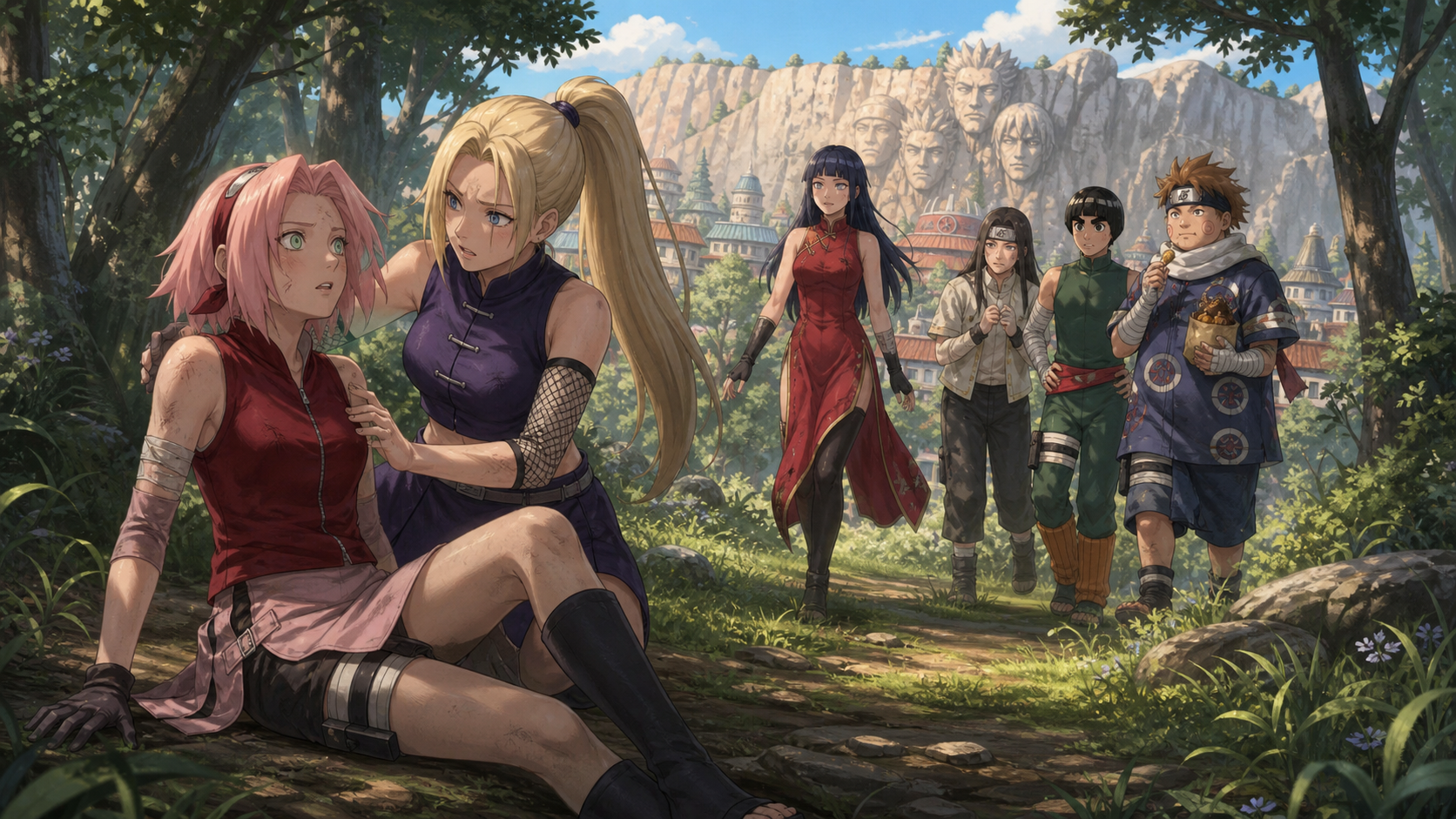
Sakura lands in an alternate Konoha, where Ino’s steady friendship and one family photograph reveal what ordinary home means after loss.
Bottom line
“Road to Sakura” is a strange little movie tie-in that works because Ino treats Sakura’s confusion as a friendship problem before anyone understands the dimensional problem. The jokes come from familiar people behaving wrong, but the episode’s best material sits underneath the comedy. Sakura has landed in a Konoha where her parents are dead heroes, her friends carry reversed traits, and the life she once found embarrassing suddenly looks painfully precious. The episode does not need a war battle to hurt. One family photograph does the job. That restraint saves the detour. Sakura’s fear remains personal, Ino’s loyalty remains practical, and the alternate village exposes loss without borrowing battlefield deaths merely to manufacture another loud emotional climax.
Sakura falls into somebody else’s life
Ino sees Sakura drop from the sky and rushes into the forest instead of waiting for somebody more qualified. That choice matters. Sakura cannot name the village, Naruto, or even her own history after the fall. Ino responds to the medical problem in front of her, checks Sakura’s condition, and brings her somewhere safe. The setup could have treated amnesia as a cheap excuse for chaos. Ino keeps the opening grounded by acting like a friend who knows a head injury deserves care before questions.
The episode number has two identities too
Crunchyroll lists this story as Shippuden Episode 271, while the Naruto official site also identifies the installment as overall animated episode 491. Both labels describe the same broadcast entry. The official Japanese title advertised the Road to Ninja movie connection directly, which explains why the story steps away from the war and borrows alternate-world ideas. The detour is promotional, yes, but “promotional” does not automatically mean empty. The writers use the assignment to test what Sakura notices when her normal social map stops working.
Ino becomes the stable point
The episode belongs to Ino almost as much as Sakura. Ino listens, improvises, gathers their friends, and keeps trying after every reunion makes Sakura more unsettled. Ino does not know that this Sakura came from another reality. From Ino’s perspective, a close friend suffered a frightening accident and now reacts strangely to people she should recognize. That uncertainty makes Ino’s patience more impressive. She offers support without demanding gratitude or turning Sakura’s condition into gossip.
Familiar faces become bad directions
The alternate personalities initially play like a parade of reversals. Hinata acts bold and confrontational. Neji becomes nervous around women. Rock Lee trades loud devotion for a cooler posture. Kiba behaves more like a cat person, and Shino struggles with insects. Chōji watches his appetite while Shikamaru sounds energetic. Each switch gives Sakura another false landmark. She recognizes the face, expects the old relationship, and receives a stranger wearing a friend’s body language.
The comedy needs Sakura’s discomfort
Several reversals are funny because the audience already knows the original cast. The episode also lets the laughter become tiring on purpose. Sakura cannot simply enjoy everybody’s new behavior as a novelty. Every mismatch tells her that memory alone cannot carry her home. The village looks correct, the streets remain familiar, and the people know her name, yet their choices keep refusing her expectations. That gap turns a bright comedy setup into a quiet isolation story.
Hinata’s confidence changes the room
Alternate Hinata does not whisper from the edge of the group. She enters with direct confidence, wears a striking Chinese-inspired dress, and treats Naruto as someone she may openly claim. The design became memorable enough to receive later official game recognition as a “Road to Sakura” costume. The episode does more than put Hinata in different clothes. Posture, eye contact, speech, and social risk all change together. Sakura understands immediately that this Hinata follows another emotional rulebook.
Personality reversal is not character replacement
The strongest reversals preserve a trace of the original person. Ino still organizes care. Sakura still studies the situation and pushes for answers. The friends still gather when they hear someone needs help, even though their habits look wrong. That continuity keeps the world from becoming a sketch show full of random impressions. A changed personality does not erase every bond. The episode suggests that friendship can survive altered presentation, but recognition becomes harder when behavior carries most of a relationship’s history.
Sakura cannot diagnose a dimension
Sakura’s medical training gives her useful instincts, but no ordinary examination explains why an entire village remembers a life she never lived. She suspects memory loss because everyone else agrees on the facts. That response is rational. When one person’s memory conflicts with a whole community, the injured person usually doubts herself first. The episode builds tension from that imbalance instead of making Sakura instantly announce a parallel universe. She needs evidence that exists outside her own frightened recollection.
Naruto’s absence becomes another wrong space
Naruto matters even when he is not standing at the center of the episode. Sakura expects the loud teammate who argues, intrudes, and somehow makes a crisis feel less lonely. The alternate world cannot provide that exact relationship on demand. Other people may know a version of Naruto, but Sakura’s Naruto belongs to the history she lived. Missing him helps define home as a collection of difficult, specific relationships rather than a set of buildings.
The Haruno house changes the joke
The emotional turn arrives when Sakura reaches the Haruno home and finds a family history that does not belong to her. In this world, Kizashi and Mebuki Haruno are honored as heroes who died protecting the village. Their absence gives Sakura a respected identity and a painful household. The parents she complained about in her own life are no longer available for embarrassment, arguments, meals, or ordinary noise. Heroic status cannot replace living parents.
A photograph becomes proof
The family photograph carries more weight than a long scientific explanation could. Sakura sees a record of the alternate family and understands that the village has not merely forgotten details. Another Sakura occupied this life. The photograph gives the world a history independent of the people currently speaking to her. Paper, clothing, poses, and the missing parents establish a reality Sakura cannot dismiss as a shared prank or concussion dream.
Grief arrives without the right memories
Sakura faces an unusual kind of grief. She remembers her parents alive, so she cannot mourn the alternate deaths through shared memories. She still feels the loss because the empty house shows what her counterpart lived without. That borrowed grief makes Sakura reconsider the ordinary family life waiting in her own world. The lesson lands because the episode lets regret emerge from a concrete absence. Nobody needs to lecture Sakura about appreciating her parents.
Ino does not get the full explanation
Ino sees Sakura’s distress but cannot access Sakura’s dimensional context. That limit protects both characters. Sakura does not suddenly deliver a perfect theory, and Ino does not become an all-knowing guide. Ino can offer company, food, routes through the village, and familiar names. She cannot repair a reality mismatch through kindness alone. Support has value precisely because support does not solve everything.
The movie tie-in has a continuity boundary
“Road to Sakura” connects thematically to Road to Ninja: Naruto the Movie and its alternate-reality premise. The episode should not be treated as a normal war-front development or used to rewrite main-series character history. The broadcast placement interrupts the Fourth Shinobi World War, while the content operates as a promotional side story. Calling that boundary clearly helps viewers enjoy the emotional experiment without forcing every reversal into main continuity.
Sakura’s complaints were still real
The episode does not prove that Sakura was wrong to feel irritated by her parents. Families can be loving and annoying at the same time. Kizashi’s jokes and Mebuki’s pressure can wear on Sakura without making either parent disposable. Alternate loss changes the scale of Sakura’s frustration, not the truth that daily family life contains conflict. The mature reading is not “never complain because someone else has less.” The mature reading is that annoyance and love often occupy the same kitchen.
Home requires friction
The alternate village offers Sakura recognition, status, and people who want to help. None of those advantages create belonging. Home includes the exact arguments, habits, disappointments, and repairs that formed her relationships. A smoother family story or a more flattering public identity cannot substitute for lived history. “Road to Sakura” understands that people miss inconvenient details because those details prove a relationship was real.
The visual direction sells almost-normal
The episode’s direction depends on Konoha looking stable enough to invite trust. Streets, homes, uniforms, and faces remain recognizable while performance and costume details disturb the pattern. The visual strategy avoids turning the alternate world into a dark nightmare. Bright familiarity makes each wrong behavior more noticeable. Sakura keeps searching ordinary scenes for the version of life she knows, and the audience performs the same comparison beside her.
The war pause has a cost
Broadcast viewers moved from Kinkaku’s sealing and alliance strategy into a movie-promotion episode with no battlefield continuation. That interruption can frustrate anyone following the war week by week. The complaint is fair. The previous episode ended with Asuma’s threat approaching, and “Road to Sakura” delays that momentum. The detour earns some patience through character feeling, but emotional quality does not erase awkward placement.
A filler label should explain the choice
Viewers following only the main war narrative can skip Episode 271 without losing the next battle’s mechanics. Viewers interested in Sakura, Ino, alternate-world character play, or the Road to Ninja promotional context should watch. “Filler” works as a routing label here, not an insult. The episode has no obligation to advance the war if the directory tells viewers honestly what kind of story awaits them.
Ino and Sakura deserve more ordinary friendship
Naruto often defines Ino and Sakura through rivalry, romance, or combat teamwork. This episode gives them a simpler responsibility: one friend stays beside another through confusion. Ino’s competence comes from attention rather than a finishing move. Sakura’s vulnerability does not erase her intelligence. Their time together shows why the relationship survived childhood resentment and competition. They know how to be irritated with each other and still show up.
What the episode changes for Sakura
Sakura returns from the experience with no new jutsu and no battlefield advantage. She gains perspective on a family she took for granted and on the relationships that make her own world recognizable. That change is modest, private, and believable. A single alternate afternoon should not rewrite her personality. The episode instead creates one sharp memory likely to interrupt the next careless complaint about home.
The episode lets Sakura be disoriented without making her foolish
Everyone around her agrees on a reality she cannot remember. Assuming injury before dimensional displacement is not denial. It is the medically and socially reasonable response. Sakura checks the facts available, revises her theory as contradictions accumulate, and keeps looking for evidence beyond her own fear.
That process respects her intelligence. The audience knows the premise because promotion has already announced an alternate world. Sakura has no trailer inside the story. Her uncertainty becomes part of the loneliness: even accurate memory feels unreliable when an entire community confidently remembers someone else’s life.
Ino practices care without demanding immediate recognition
Sakura cannot return friendship in the familiar way because she does not understand which Ino stands beside her. Ino still protects, guides, gathers help, and absorbs the discomfort of being treated like a near stranger.
She does not make Sakura’s condition prove how important she is. That restraint separates support from possession. Ino wants her friend restored, but she works with the frightened person present instead of demanding that the old relationship perform on schedule. The episode gives their friendship maturity through ordinary patience.
Reversed personalities reveal how much recognition depends on behavior
A face is not enough. Sakura knows Hinata through hesitation, Lee through exuberance, Shikamaru through reluctant intelligence, and Kiba through his partnership with Akamaru. When posture, rhythm, preference, and social risk change, familiar bodies stop functioning as reliable directions.
The reversal shows that character is carried through repeated choices, not only design. Friendship remembers how somebody enters a room, what they avoid, and which embarrassment they are willing to survive.
Alternate Hinata is more than a costume joke
The bolder dress catches attention, but confidence changes the scene before fabric does. Hinata claims space, meets eyes, and speaks desire without the protective distance her usual self maintains. Sakura does not merely see a redesign. She sees a relationship to risk rewritten.
That difference explains why the costume became memorable outside the episode. Styling succeeds when it expresses a behavioral argument. The clothes do not create the personality; they announce that this Hinata expects the room to accommodate her presence instead of hoping nobody notices how much she feels.
The Haruno house refuses the fantasy that heroic parents are better parents
Alternate Kizashi and Mebuki receive honor, public gratitude, and a story larger than domestic annoyance. They are also dead. Sakura’s counterpart can possess a respected name and still come home to absence.
The comparison does not tell Sakura she was wrong to dislike a joke or resist pressure. It shows what status cannot replace. Heroism cannot make dinner, repeat the irritating story, criticize a choice, or repair an argument tomorrow. A prestigious family narrative remains poorer than living people capable of being inconvenient.
Sakura grieves a loss that did not happen to her
She remembers her parents alive, so the empty house does not activate shared memories of burial or final conversation. The grief belongs partly to the alternate Sakura whose place she occupies and partly to the future her own life could lose.
Borrowed grief could become manipulative if the episode used death only to teach gratitude. The photograph keeps it specific. Sakura sees family, not a moral example. Empathy grows because another version of herself lived the absence, not because suffering automatically makes that version wiser.
The photograph is an archive no conversation can overrule
Every person in the village might be mistaken, compromised, or participating in an elaborate deception. The family photograph records a relationship beyond the immediate argument. Clothing, posture, and the preserved moment tell Sakura this world had continuity before she arrived.
That material proof changes the emotional temperature. She is not merely forgotten. She has entered a history where another self belongs more completely than she does. The house knows her face and rejects her memories, which is lonelier than standing somewhere visibly foreign.
Home is not the place where everyone flatters you
The alternate world offers Sakura heroic parents, public sympathy, and friends whose changed traits may seem easier in isolated moments. None of those advantages produces belonging because they were not earned through her lived sequence of mistakes and repair.
Home contains friction with provenance. A familiar complaint recalls previous mornings, arguments, apologies, and expectations. That history can be exhausting without becoming disposable. Sakura misses the precise inconvenience of her own life because inconvenience is one of the textures proving the relationship continued.
Naruto’s absence defines him through the space he normally occupies
Sakura expects intrusion, argument, noise, and the strange reassurance of someone who refuses to let a crisis stay private. Without her Naruto, the village loses a rhythm no alternate acquaintance can reproduce.
The absence protects the episode from making him the solution to Sakura’s story. He matters because their specific shared history helps define her coordinates, not because Sakura requires a boy to explain her own feelings. Missing him becomes one piece of missing home rather than the entire lesson.
A movie tie-in can earn emotion without earning continuity
The episode borrows the alternate-reality premise to prepare viewers for Road to Ninja. That promotional purpose explains the broadcast interruption and the parade of reversed traits. It does not automatically make every event part of the main war chronology.
Routing honestly protects both experiences. Someone following only the Fourth Shinobi World War can skip it. Someone who wants Sakura and Ino friendship, alternate designs, or the film’s thematic doorway can watch without pretending the detour advances Asuma’s return. Value and canonicity answer different questions.
The placement is still rude even when the episode is good
Darui’s battle has just ended and Team 10 is moving toward a reanimated teacher. Pausing for promotional Konoha comedy breaks momentum the war spent weeks rebuilding after anniversary recaps.
The episode earns attention through its own emotional center; it does not retroactively make scheduling graceful. Fans are allowed to resent the interruption and still find the photograph devastating. Quality should not be used to dismiss the viewing experience created by placement.
RaeRae’s verdict
“Road to Sakura” is badly placed but emotionally smarter than the movie-tie-in label suggests. The alternate personalities produce uneven comedy, and the war interruption remains annoying. Ino’s steady care and the Haruno family photograph give the episode a real center. Sakura does not learn that family must be perfect. She learns that ordinary conflict belongs to a living relationship, and heroic absence cannot argue back, make dinner, or embarrass her tomorrow.
RaeRae’s call
“Road to Sakura” works because it refuses to confuse heroic absence with a better family. Ino’s patient care and one photograph teach Sakura that home is built from specific people who remain alive enough to irritate, answer, and repair.
Episode details and viewing routes
- Official episode reference: Naruto Official episode guide
- Licensed episode route: Crunchyroll licensed episode page
Next on the road
Episode 272 returns to the battlefield with “Mifune vs. Hanzō.” The story shifts from Sakura’s alternate home to a confrontation built around samurai discipline, old poison, political memory, and the difference between a leader who kept his conviction and one who surrendered his own name to fear.