
Golden Bonds
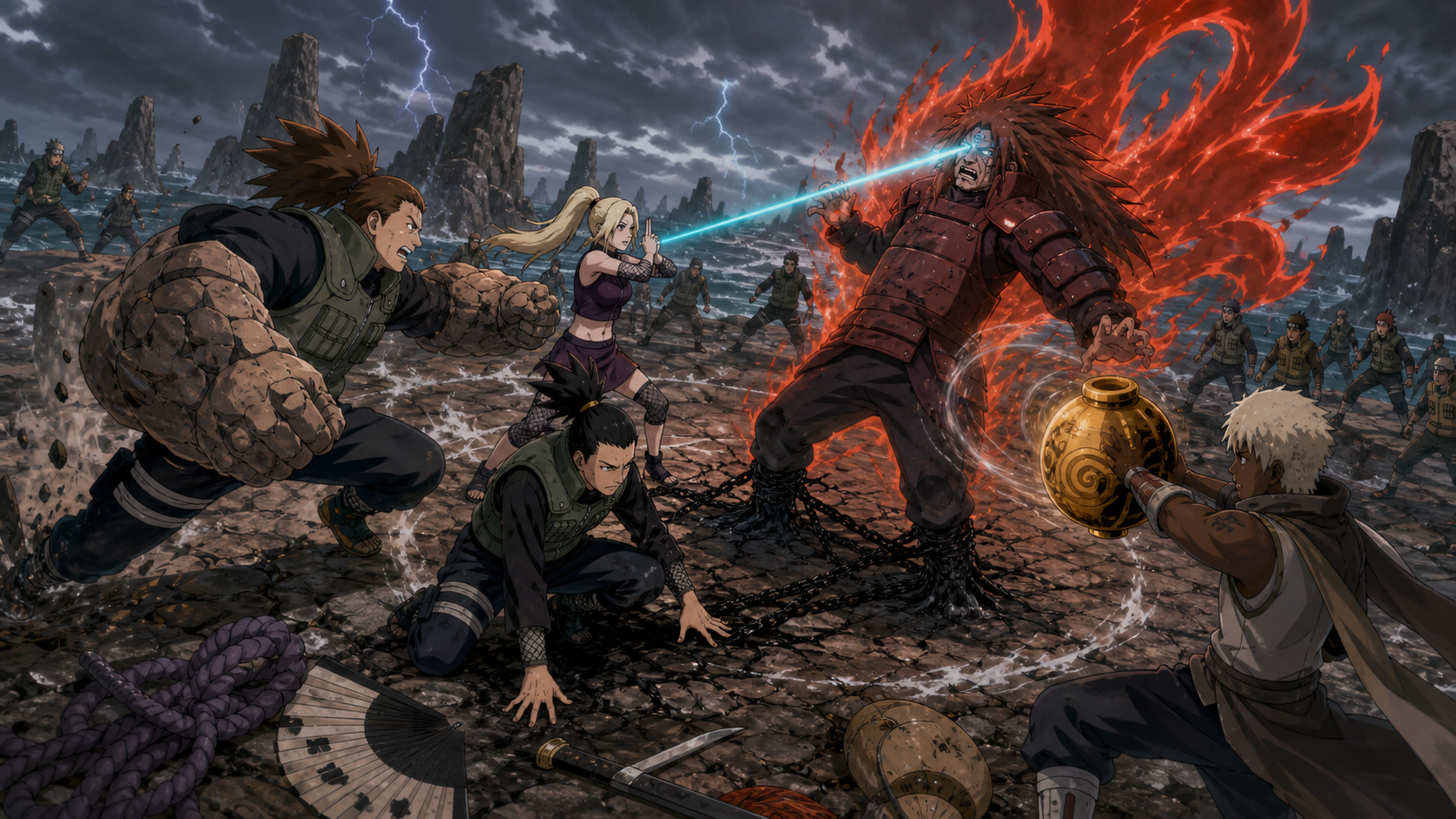
Ino-Shika-Chō turns three limited techniques into the exact opening Darui needs to seal Kinkaku and prove coordination can outweigh legend.
Bottom line
Naruto Shippuden Episode 270 defeats Kinkaku with a plan that requires headquarters logistics, space-time transport, Darui's battlefield judgment, Chōji's body, Shikamaru's shadow, and Ino placing her consciousness inside a fox-chakra monster. No single person overpowers him. The alliance turns several ordinary specialties into one precise capture.
Ginkaku's sealing drives Kinkaku into rage and releases a six-tailed Nine-Tails chakra cloak. Darui's division cannot absorb that force indefinitely. Shikaku sends the Kohaku no Jōhei through Mabui and explains the simpler rule: the amber pot seals anyone who answers after being called.
Ino-Shika-Chō create the second when Kinkaku can be made to answer. Darui says enough copper coins together can outweigh gold and silver. The metaphor is corny, but the battle proves the point. Kinkaku loses because people he calls third-rate know how to trust another person's timing.
Ginkaku's capture turns Kinkaku's grief into mass danger
Kinkaku sees his brother sealed and abandons the controlled arrogance used during the word-soul game. Rage pulls Nine-Tails chakra across his body.
The transformation expands his reach, speed, and destructive force while narrowing judgment. Allied shinobi become targets for grief they did not cause.
The bond between brothers is real. Kinkaku still chooses to express that bond through violence against everyone nearby.
The fox cloak resembles Naruto while carrying a different history
Kinkaku's chakra shroud looks familiar to soldiers who know Naruto as the alliance's protected jinchūriki. The resemblance can create hesitation and confusion.
Kinkaku gained the power by surviving inside Kurama and eating its flesh. Naruto received a seal as an infant and has spent his life negotiating an imposed relationship.
Similar chakra does not create similar character, consent, or responsibility.
Darui cannot trade bodies for time forever
The First Division throws combined attacks at Kinkaku and struggles to slow him. Each failed restraint costs chakra, injuries, and formation stability.
Darui needs a sealing answer before the division becomes material for a battle of attrition.
Leadership means recognizing when courage has stopped being a solution and another tool must arrive.
Headquarters finds the fifth treasured tool
The alliance possesses the Kohaku no Jōhei, an amber sealing pot with a simpler activation rule than the rope, sword, and crimson gourd.
The pot calls a target's name and seals the person who responds. Knowledge of that rule creates an opportunity, not a completed plan.
Kinkaku must still be restrained, addressed, and made to answer while capable of tearing through a division.
Mabui delivers strategy through dangerous logistics
Mabui's Heavenly Transfer Technique transports objects at extreme speed from headquarters to the battlefield. Living bodies usually cannot survive the physical strain.
The technique allows the alliance to move the amber pot without waiting for a courier across war-torn terrain.
Her work connects Shikaku's idea to Darui's hands. A plan without delivery would remain a clever thought in another country.
Transporting the pot does not transport expertise automatically
Darui needs clear instructions about the activation rule and timing. The object alone could become useless or dangerous in confused hands.
Communication teams relay what headquarters knows while the coast remains under attack.
Knowledge, tool, and operator have to arrive together even when they travel through different systems.
Shikaku selects Ino-Shika-Chō for interlocking reasons
Shikamaru can immobilize through shadow. Chōji can generate enough physical force to move Kinkaku. Ino can enter the target's mind and control the response.
Any one technique alone would fail against the fox cloak. Their clan arts cover one another's gaps.
Shikaku chooses a practiced relationship, not three impressive names from a roster.
Chōji has to enter range first
The plan needs Kinkaku displaced and disrupted before shadow or mind control can hold. Chōji commits his enlarged body against overwhelming chakra.
His role carries obvious physical risk. Strength does not make impact painless or guarantee that Kinkaku will move the required distance.
Chōji creates the opening that later techniques make look inevitable.
Body Expansion becomes positioning rather than spectacle
Chōji's clan technique is often framed through size and force. Here, the important result is where Kinkaku lands.
The charge places the target where Shikamaru's shadow can connect and where the amber pot has a clear line.
Power serves geometry. A dramatic hit matters because the next teammate already knows what that movement enables.
Shikamaru catches the instant Chōji creates
Shadow Imitation locks Kinkaku's movement after the charge. The technique requires position, range, and enough chakra to resist a target far stronger than Shikamaru.
He cannot hold the fox cloak indefinitely. His job is to create a short stable window.
Trust means nobody asks Shikamaru to promise more time than his body can provide.
The shadow line carries years of team practice
Ino-Shika-Chō learned combination work through clan tradition and missions under Asuma. Their coordination predates the current alliance.
The war uses that history at a larger scale without inventing instant teamwork.
Familiarity lets them act through small signals while Kinkaku's pressure makes extended discussion impossible.
Ino takes the most invisible physical risk
Mind Body Switch sends Ino's consciousness into Kinkaku. Her own body becomes vulnerable while her mind enters a hostile, chakra-saturated target.
If control fails or Kinkaku breaks the technique violently, the consequences return to her.
The move may look less physical than Chōji's charge, but exposure is not smaller because the danger happens inside the mind.
Mind control becomes ethically different under immediate defense
Ino overrides Kinkaku's body and speech without consent. The act is coercive by design.
Context does not make bodily control harmless. Kinkaku is actively killing allied shinobi, cannot be restrained through ordinary force, and has already used coercive sealing tools on others.
The technique is justified as a limited defensive intervention aimed at capture, not ownership or punishment.
Ino makes Kinkaku answer the pot
Darui activates the amber pot by calling Kinkaku. Ino controls the target long enough to force the response.
The solution turns Kinkaku's own weapon tradition against him. He loses through the rule attached to a treasured tool rather than a larger blast.
The moment depends on Ino releasing control before the sealing current can take her consciousness too.
Darui completes a plan built by many people
He holds the pot, calls the name, and manages the final line of capture. The visible finish belongs to him.
Shikaku identified the tool, Mabui delivered the pot, communications explained the rule, the division contained the battlefield, and Team 10 created the answer.
Darui's leadership includes knowing that completing another person's contribution is not diminished credit.
“Copper” describes accumulated ordinary value
Kinkaku dismisses the allied shinobi as lesser metal compared with gold and silver. Darui answers that enough copper pieces can exceed the value of precious coins.
The metaphor rejects status rankings built around birth, legend, or one exceptional technique.
Collective value comes from people performing real functions together, not from pretending every person has identical strength.
Quantity alone is not the lesson
A crowd without coordination would give Kinkaku more targets. The alliance wins through roles and timing.
Copper matters because each piece enters an organized system: transport, communication, restraint, mind control, sealing, and protection.
The episode argues for structured interdependence rather than numbers thrown at power.
Legendary status cannot replace current judgment
Kinkaku and Ginkaku possess Nine-Tails chakra, Sage tools, and a reputation large enough to frighten Kage. They also underestimate the people in front of them.
Their certainty makes adaptation harder. They expect myth to keep controlling the encounter.
Darui's group studies the rules and changes the conditions faster than the brothers change their assumptions.
Samui and Atsui remain inside the cost of victory
Sealing Kinkaku does not automatically release the siblings captured by Benihisago. Their absence remains unresolved.
Darui cannot treat the successful counter as a clean win while two comrades remain inside an enemy tool.
The battle closes an immediate threat and carries unfinished rescue work forward.
The alliance uses enemy technology without worshipping the enemy
The Kohaku no Jōhei belongs to the same mythic tool set Kinkaku and Ginkaku used. Headquarters treats the pot as equipment with a known rule.
Using the object does not require accepting the brothers' claim to superiority or the Sage's legacy as sacred.
Practical knowledge strips some intimidation from the artifact.
Kinkaku's bond with Ginkaku is not the only golden bond
The title applies to brothers whose loyalty fuels rage and to teammates whose trust creates restraint. Both relationships are strong.
One bond turns grief outward as mass harm. The other distributes danger so no person has to solve the threat alone.
Strength of attachment does not decide moral value. What people do through attachment matters.
Ino-Shika-Chō faces another reunion immediately ahead
After helping seal Kinkaku, Ino, Shikamaru, and Chōji move toward a battlefield where Asuma has been reanimated.
Their successful combination becomes preparation and emotional pressure. The teacher who built their teamwork will soon be forced to fight the result.
War gives them no recovery time between a legendary enemy and a beloved one.
Shikaku sends his son into a personal wound
Shikaku understands the strategic value of Team 10 and knows what Asuma means to them. Assigning the trio is both tactically sound and emotionally brutal.
Keeping them away would deny the battlefield its best counter and deny them agency over the confrontation.
Command cannot remove the pain. Shikaku can provide support, information, and a plan that respects their skills.
Chōji's hesitation has not disappeared
Chōji can charge Kinkaku because the target is an enemy without a loving relationship to him. Facing Asuma will ask something different.
Physical courage does not automatically solve grief or reluctance to hurt a teacher.
The episode lets today's success stand without pretending the next task will feel the same.
Kinkaku’s grief is real and still belongs to everyone he harms
Ginkaku’s sealing tears through the only relationship Kinkaku appears to value. The fox cloak makes the loss visible as rage, and the scale of that rage tempts the story to treat devastation as proof of love.
Love explains the transformation without excusing the targets. Allied soldiers did not seal Ginkaku to injure his brother emotionally. They were surviving two men already using people’s voices as traps. Kinkaku’s pain matters. So does his choice to make strangers pay for it with their bodies.
The fox cloak turns private loss into public weather
Once Kinkaku transforms, everyone on the coast has to live inside his emotional state. Chakra pressure changes movement, formations break, and soldiers with no access to the brotherhood become responsible for containing its aftermath.
That pattern appears throughout the series: powerful men experience grief, then institutions classify the resulting destruction as everyone else’s emergency. The feeling is not the problem. Power without an obligation to other people lets one person’s feeling become the battlefield itself.
Shikaku’s plan respects Team 10’s limits
He does not select Ino, Shikamaru, and Chōji because friendship produces magical strength. He selects them because each technique solves one narrow problem the others cannot. Chōji changes position. Shikamaru creates stillness. Ino controls the answer.
The plan never asks one person to hold Kinkaku indefinitely. It asks each body for a difficult, bounded interval and hands responsibility forward before that interval collapses. Trust becomes practical because the teammates know exactly where another person’s limit begins.
Chōji’s charge makes courage look like geometry
His enlarged body receives the most visible collision, but impact alone would achieve little. Kinkaku must land within Shikamaru’s usable shadow and the pot’s line. A few feet in the wrong direction leaves the sequence unfinished.
Chōji’s strength therefore matters through control. The boy repeatedly mocked for size uses size with precision, converting force into position for someone else’s technique. He does not need the finishing blow for the action to be essential.
Shikamaru spends certainty measured in seconds
Shadow Imitation creates the stillness the plan needs, not permanent safety. Kinkaku’s chakra can overwhelm the restraint if Ino or Darui misses the handoff. Shikamaru commits while knowing his success will look like failure moments later unless the team moves.
That is the trust at the center of Ino–Shika–Chō. Nobody mistakes a temporary hold for weakness. They understand that a technique can be complete when it gives the next person enough time, even if it cannot solve the entire threat alone.
Ino’s invisible risk deserves the same weight as impact
Mind Body Switch sends her consciousness into a hostile body flooded with stolen Nine-Tails chakra. Her own body remains exposed, and the sealing current cannot be allowed to take her mind with Kinkaku.
The danger receives less visual spectacle than Chōji’s collision because it happens across identity and control. Ino must enter, force one response, and leave within a window other people created. Precision protects her from becoming part of the object the team is trying to seal.
Temporary control is justified by the exit built into it
Ino violates Kinkaku’s bodily autonomy. The context is immediate defense against a person killing through overwhelming force, but context does not make mind control morally invisible.
The plan limits the intervention to one answer and requires release. Ino does not enter to own, punish, interrogate, or reshape him. She enters to stop lethal action when ordinary restraint has failed. The exit is part of what separates defensive coercion from the open-ended possession practiced by Kabuto.
Mabui makes distance obey logistics, not wishful timing
The amber pot arrives because a specialist can transfer objects through forces living bodies usually cannot survive. Headquarters’ insight becomes useful only after somebody accepts the strain and technical responsibility of delivery.
That labor prevents the counter from feeling entirely like a gift dropped onto the coast. The right artifact exists, but existence is not access. Communication identifies it, Mabui moves it, Darui receives it, and the division keeps enough space open for use.
Darui’s finish belongs to him without belonging only to him
He calls Kinkaku, holds the pot, and manages the instant the target answers. A less secure hero would treat every earlier contribution as support for his victory. Darui understands that his action completes a shared sentence.
Leadership does not shrink when credit expands. Shikaku’s reasoning, Mabui’s transport, Team 10’s sequence, and the division’s survival work all remain visible inside Darui’s finish. He earns the moment by receiving dependence without pretending dependence diminishes him.
Copper wins through organization, not inspirational arithmetic
Enough ordinary coins may outweigh gold, but bodies are not currency and numbers alone do not defeat Kinkaku. A crowd charging without roles would only multiply casualties.
The metaphor works when grounded in coordination. Each so-called lesser shinobi supplies a function timed to another function. Their combined value comes from structure, information, and trust, not from insisting everyone has equal power. Difference becomes strength because nobody has to imitate the legend in front of them.
The title asks us to compare two forms of brotherhood
Kinkaku and Ginkaku share loyalty fierce enough to unleash catastrophe. Ino–Shika–Chō share loyalty disciplined enough to distribute danger. Both bonds are golden if strength alone determines value.
The episode makes a better distinction through action. One relationship turns loss into permission to consume strangers. The other turns limitation into reason to protect a teammate’s opening. Attachment is not automatically virtuous. What people authorize through attachment decides what the bond gives the world.
Victory cannot close while Samui and Atsui remain inside a tool
The coast survives Kinkaku, but Darui’s comrades are still sealed. Celebration would turn them into the acceptable price of a clever solution. Their absence must remain part of his command record and the alliance’s next responsibility.
A tactical win can be complete enough to save a division and incomplete as care. Holding both truths prevents momentum from erasing the people used to demonstrate the earlier trap. Darui has earned relief, not permission to forget who is missing.
What landed
The sealing sequence gives Ino, Shikamaru, and Chōji distinct essential jobs. Removing any one contribution breaks the plan.
Mabui's transport and headquarters communication keep the victory connected to the wider alliance rather than making reinforcements appear conveniently.
Darui's copper answer fits his command style: understated people using coordinated work can defeat legends who mistake reputation for guaranteed authority.
What did not fully land
The amber pot arrives as an extremely convenient counter immediately after the earlier tools dominate the fight. The logistics are explained, but possession of exactly the needed artifact still feels fortunate.
Ino's ability to control Kinkaku through the fox cloak happens quickly. More resistance would better communicate the mental and chakra risk.
Samui and Atsui remain sealed while the episode shifts toward celebration and the next front. Their unresolved condition deserves more weight in Darui's reaction.
Final reaction
Naruto Shippuden Episode 270 defeats Kinkaku by refusing his ranking system. He sees legendary brothers, sacred tools, Nine-Tails chakra, and a battlefield full of people beneath him. Darui sees a transport specialist, a strategist, a communications chain, an expanding fist, a shadow line, a mind-transfer opening, and one pot with a usable rule.
Ino-Shika-Chō win through difference. Chōji cannot hold the mind. Ino cannot absorb the charge. Shikamaru cannot move Kinkaku through force. Their limitations create the shape of the plan instead of disqualifying them.
Darui's copper metaphor works when grounded in that labor. A pile of ordinary coins does not beat gold through positive thinking. People become more valuable together when they understand each role, accept dependence, and hit the same second. Kinkaku's bond turns loss into indiscriminate rage. Team 10's bond turns risk into a capture everybody survives.
RaeRae’s call
Kinkaku’s bond turns grief into a disaster everyone else must survive. Team 10’s bond turns three limited techniques into one precise rescue. Strength is not what makes either relationship golden; shared responsibility is.
Episode details and viewing routes
- Official episode reference: Naruto Official episode guide
- Licensed episode route: Crunchyroll licensed episode page