
Forbidden Words
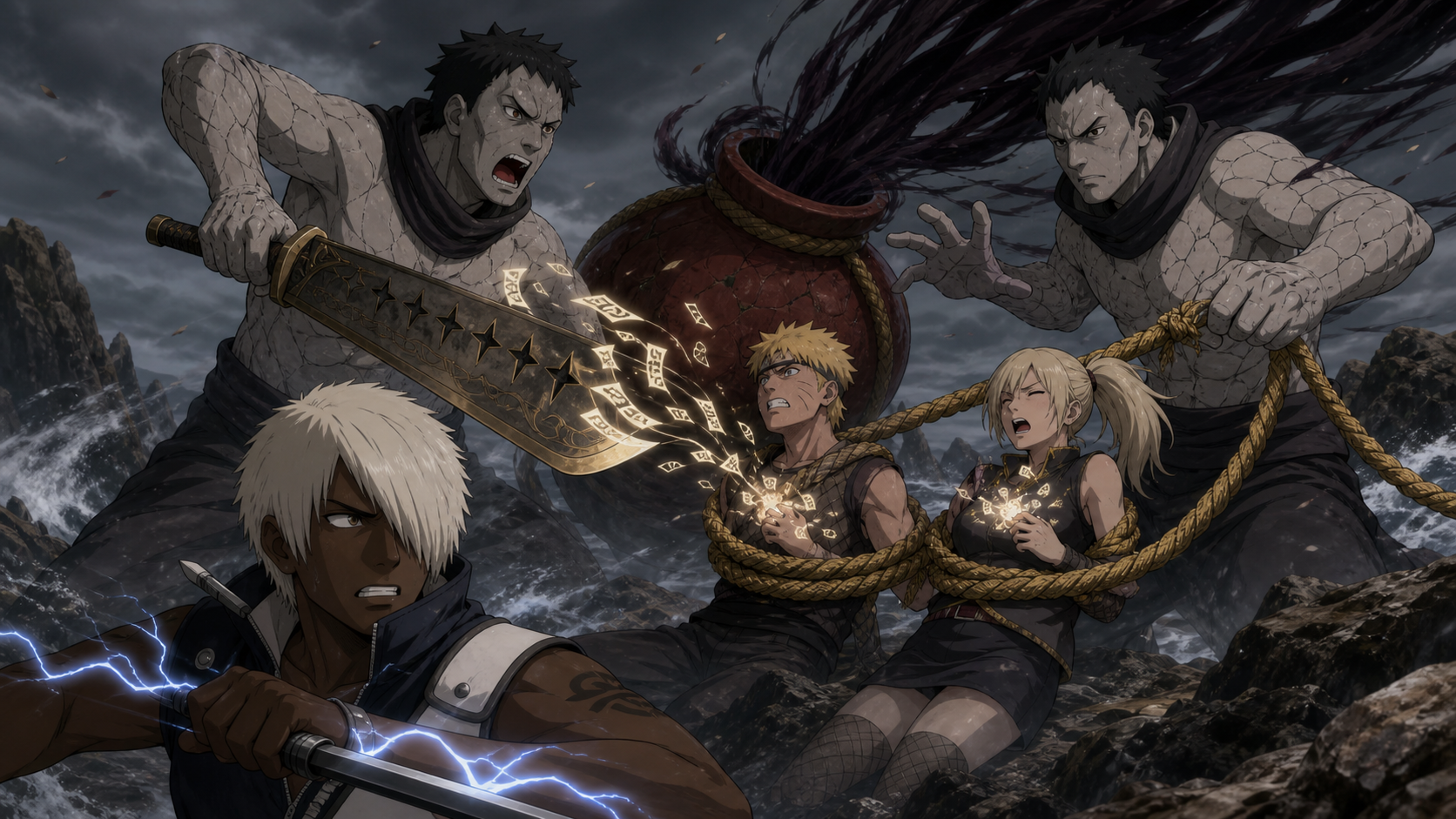
Darui learns how the Sage’s treasured tools weaponize habitual language after Atsui is trapped by speech and Samui is trapped by silence.
Bottom line
Naruto Shippuden Episode 269 turns three Cloud shinobi's ordinary speech habits into evidence against them. Atsui says “hot” because passion is built into how he moves through the world. Samui says “cool” because restraint defines her public rhythm. Darui says “dull” because understatement lets him carry pressure without performing panic. Kinkaku and Ginkaku use the Sage of Six Paths' tools to extract those habits, display them, and make one repeated word grounds for capture.
The trap gets worse when Darui learns silence also triggers the crimson gourd after enough time. Samui does the disciplined thing, refuses to speak, and disappears anyway. The brothers do not reward self-control. They change the rule so every response can become failure.
Darui survives because his most-used word changes during the battle. Regret and responsibility push “sorry” ahead of “dull,” so the word that should condemn him no longer matches the weapon's record. The escape is clever, but the emotional reason matters more than the technical loophole. Command has changed what Darui says most.
Kinkaku and Ginkaku explain only enough to enjoy the trap
The brothers reveal the treasured tools as they attack, but their explanation is part performance and part misdirection. They want the Cloud shinobi to understand the danger too late.
Knowing a forbidden word exists does not explain how the word soul is extracted, recorded, updated, or triggered by silence.
The information imbalance lets the brothers treat panic as proof of inferiority.
Kōkinjō makes contact the first boundary
The golden rope draws out a target's word soul after contact. A person cannot simply refuse the later word game if the rope has already connected.
That first step rewards reach, surprise, and confusion. Atsui and Samui enter the fight expecting weapons that cut or crush.
The rope attacks something invisible before either sibling knows what needs protection.
Shichiseiken turns a lifetime of speech into a label
The seven-star sword severs the word soul and displays the word each person has used most often. A huge history of conversation collapses into one result.
That reduction feels unfair because context disappears. “Hot,” “cool,” and “dull” can express warning, humor, temperament, or habit depending on the moment.
The weapon treats frequency as identity because simple labels are easier to punish.
Benihisago waits for the person to condemn himself
The crimson gourd records the word soul and listens for the forbidden word. Once the target speaks that word, the gourd pulls the person inside.
The mechanism makes capture look self-inflicted. Kinkaku and Ginkaku can claim the victim supplied the final condition.
That framing hides who created the trap, withheld the rules, and forced the conversation under attack.
Allied witnesses also see a comrade vanish after speaking, which can make the remaining line afraid of ordinary communication. The tool therefore damages coordination beyond the person captured. Kinkaku and Ginkaku gain silence, hesitation, and rumor across soldiers who were never touched by the rope.
Atsui's heat becomes a predictable trigger
Atsui reacts openly to danger and speaks with the same intensity. He knows “hot” is dangerous after the sword reveals the word.
Battle pressure still pushes him toward his habitual language. Avoiding one ordinary word while fighting legendary enemies demands attention he also needs for survival.
The tool punishes him for sounding like himself at the worst possible time.
Samui chooses silence because discipline usually protects her
Samui recognizes “cool” as her forbidden word and stops speaking. Her restraint appears to be the rational counter.
She does not panic, fill the air, or hand the enemy an obvious mistake. The response fits her training and personality.
The gourd seals her anyway because prolonged silence becomes another trigger.
The silence rule converts caution into failure
Ginkaku gagged Samui, which gives Darui a clue that the tools punish more than spoken repetition. A target who remains silent too long can also be drawn into the gourd.
The added rule removes the safest apparent option. Speak, and the forbidden word may slip. Stay quiet, and silence itself becomes grounds for capture.
The system offers choice only between controlled risks.
Weaponized rules can imitate fairness
The treasured tools follow consistent mechanics. Consistency can look fair from a distance.
The brothers possess the tools, know the rules, select the targets, create the pressure, and benefit from every outcome. Equal application does not create equal power.
A predictable trap remains a trap when only one side enters with informed consent.
Darui reads behavior as evidence
He notices that Ginkaku prevented Samui from speaking rather than simply waiting for her to say “cool.” That choice would make no sense if silence were safe.
Darui infers the hidden rule while avoiding his own word and defending against two attackers.
His intelligence appears through observation under pressure, not a sudden lecture supplied by the plot.
“Dull” describes Darui's style without describing his value
Darui uses the word to complain, deflect praise, and lower the emotional temperature. The habit fits a man who appears relaxed while handling serious work.
Kinkaku and Ginkaku treat the label as weakness because they value loud status and mythic reputation.
Darui's calm pace supports his command. Understatement does not mean absence of care.
“Sorry” grows through responsibility
Darui apologizes for allowing attacks through, for the danger faced by comrades, and for taking on Cloud legends. Repeated responsibility changes his most-used word.
The apologies are not all admissions of personal fault. Leaders often say sorry because they stand where consequences arrive.
That habit updates the word soul during combat and saves him from the earlier record.
The escape depends on change being possible
The treasured tools assume a person's most-used word provides a stable identity marker. Darui's result changes.
Human language responds to new roles, grief, relationships, and pressure. A lifetime pattern can move when present circumstances demand another voice.
The weapon fails because Darui is not frozen into the label extracted moments earlier.
Darui's survival does not make the mechanism harmless
He escapes through a narrow update in the record. Atsui and Samui remain sealed.
Most targets cannot deliberately replace a lifetime's most-used word during one battle. Darui does not manufacture the change as a trick.
The loophole offers hope without becoming a reasonable defense plan for everyone.
Black Lightning gives Darui another inherited burden
Darui received Black Lightning from the Third Raikage, marking trust and technical inheritance. He uses that power against infamous figures from the same village history.
The technique gives him destructive reach while the treasured tools control language. Both sides wield legacies.
Darui chooses to use inheritance for the living alliance rather than village prestige.
Storm Release answers spectacle with precision
Laser Circus bends beams toward multiple targets, allowing Darui to pressure enemies without firing blindly through allied ranks.
The control suits a crowded coast where White Zetsu and allied shinobi fight in overlapping lines.
Precision becomes more valuable than a larger blast because every missed angle belongs to someone else's body.
The brothers mistake old fame for current authority
Kinkaku and Ginkaku expect Cloud shinobi to fear their names, Nine-Tails chakra, and connection to the Sage's tools.
Their past includes betrayal of their own village's leadership. Legend does not erase treason.
Darui respects the danger without granting the men moral authority over the Cloud's future.
Headquarters tells the history the battlefield needs
The Raikage explains how the brothers survived inside Kurama and gained its chakra. Tsunade and the command staff receive context needed for counters.
That knowledge reaches the battle through communication networks rather than a convenient fighter remembering everything.
Institutional memory becomes useful when leaders share damaging history instead of protecting village pride.
Samui and Atsui deserve more than becoming examples
Their capture demonstrates the tools' rules cleanly. The siblings also enter the battle with limited development beyond cool restraint and hot emotion.
Turning their names and personalities into the mechanic is clever and thin at once.
The episode asks viewers to care about Darui's response more than the interior experience of two people disappearing into a gourd.
Darui cannot mourn while the tools remain active
He sees comrades captured and has to keep solving the fight. Stopping to process the loss could put the rest of the division inside the same trap.
Command delays grief without canceling grief. The apologies continue because he feels the cost even while moving.
Survival demands emotional compartmentalization that will need attention later.
Language becomes bodily danger
Most combat techniques target muscles, chakra pathways, senses, or terrain. These tools make speech part of the body under attack.
Words leave the target as a visible soul, then return as a condition controlled by somebody else.
The mechanism fits a war where Kabuto already steals bodies and memories. Kinkaku and Ginkaku steal the person's voice as evidence.
The fight exposes how translation carries risk
The forbidden words depend on repetition and sound. Different subtitles must choose English equivalents for Japanese habits tied to names and puns.
Viewers may receive “hot,” “cool,” “dull,” or slightly different phrasing depending on the release. The underlying mechanic remains frequency.
The episode's cleverness is therefore partly dependent on translation making the pattern legible without rewriting character voice.
Darui keeps allies informed after learning the rule
Once he understands silence and speech both matter, Darui communicates the danger rather than guarding the insight for a personal duel.
Shared rules give reinforcements a chance to avoid repeating the same capture sequence.
Leadership turns private deduction into collective protection.
The treasured tools reveal coercion hidden inside choice
Targets appear to choose whether to speak. The battlefield conditions make free choice impossible.
They are restrained, attacked, confused, and denied complete information. Every available response carries a punishment designed by the enemy.
Calling the final word a mistake places responsibility on the wrong person.
The tools pretend frequency can explain a person
A lifetime of speech becomes one displayed word, stripped from tone, audience, joke, duty, and circumstance. The reduction looks objective because the sword counts repetition. Counting accurately does not make the conclusion complete.
Atsui is more than “hot.” Samui is more than “cool.” Darui is more than “dull.” Those habits reveal something real without becoming the whole self. The brothers gain power by treating a partial truth as a total identity, then arranging punishment around the label they extracted.
The victim’s mouth is made to resemble the guilty hand
The crimson gourd waits until a target says the forbidden word, creating the appearance that capture was self-inflicted. Atsui speaks. The object responds. Kinkaku and Ginkaku can stand beside the mechanism as though they merely enforced a neutral rule.
Every meaningful choice happened earlier. They selected the target, initiated contact, removed the word soul, controlled the information, and produced battlefield pressure. The final syllable belongs to the victim. Responsibility for turning that syllable into a cage does not.
Samui proves correct behavior cannot beat a rigged system
Once she learns “cool” is dangerous, Samui does exactly what discipline recommends. She stops speaking. Ginkaku has already accounted for restraint by adding a silence condition the victims do not know.
Her capture is not a lesson that she should have been more expressive. It reveals a system designed to reinterpret every response as failure. Speak and risk the word. Remain silent and trigger the timer. A choice between punishments is still coercion even when both rules operate consistently.
Atsui’s expressiveness is not the moral opposite of discipline
Atsui’s heat makes his forbidden word easier to predict, but it also makes his urgency visible to allies. Open emotion can warn, rally, and clarify. The tool selects the same trait under conditions where visibility becomes exposure.
That is why the capture should not become a lecture about controlling personality. Kinkaku and Ginkaku weaponize an ordinary pattern. Atsui’s responsibility is to learn the battlefield when possible. Their responsibility is greater because they built the situation in which sounding like himself becomes grounds for disappearance.
Darui solves the rule by watching what the enemy fears
Ginkaku’s decision to gag Samui is more useful than the explanation he offers. If silence were safe, preventing speech would protect her. Darui notices the contradiction and understands that the enemy is managing another condition.
The deduction respects intelligence as attention rather than magic. He does not suddenly inherit a complete manual. He studies behavior under pressure and asks why an opponent took an unnecessary action. The hidden rule becomes visible through the effort used to conceal it.
“Sorry” records responsibility without proving fault
Darui apologizes when comrades suffer inside a battle he did not design. Leadership places him where consequences arrive, so regret enters his speech even when personal blame does not fit cleanly.
The distinction matters. Constant apology can become another way institutions make responsible people absorb failures created above them. Here it also shows care. Darui is not detached from Samui and Atsui because he keeps fighting. His language changes because their loss has already entered how he carries command.
The updated word soul rejects a frozen identity
The sword records “dull” as though a statistical past should control Darui’s future. During the fight, “sorry” overtakes it. The escape is convenient in timing and powerful in implication: a person can change faster than a mechanism designed to classify him expects.
Darui does not manufacture a new catchphrase to cheat the counter. Responsibility changes his actual pattern. The weapon fails because it assumes identity is stable enough for extraction to become destiny. Human response keeps moving after the label is printed.
Cloud history becomes useful only when Cloud stops protecting its pride
Kinkaku and Ginkaku carry legendary chakra, sacred tools, and the fame of surviving Kurama. They also attacked their own leadership. Treating strength as automatic honor would force Darui to admire the people currently sealing Cloud shinobi for spectacle.
Headquarters shares the ugly history because living soldiers need it. That is institutional memory doing honest work. A village protects its future by naming what powerful predecessors did, not by polishing betrayal until the legend becomes safe for monuments.
The tools are sacred only to people spared their consequences
Connection to the Sage of Six Paths gives the weapons prestige before anyone asks what each object does to a person. Myth can make possession look like authority and survival look like worthiness.
On the coast, sacred inheritance becomes forced extraction, labeling, and confinement. Origin does not morally supervise use. Darui’s task is not to show reverence toward a famous artifact. It is to understand the mechanism quickly enough that fewer living voices disappear inside it.
Darui’s calm keeps communication possible after speech becomes dangerous
A language trap could destroy the division without capturing everyone. Soldiers who fear a common word may stop warnings, delay orders, or misread silence as safety. Coordination begins to collapse before the rope touches another target.
Darui’s controlled pace gives the unit a model for thinking while afraid. Calm does not mean he cares less. It keeps information moving after communication itself has become threatening. His leadership protects the space between panic and silence where an allied formation still functions.
The episode’s cleverness cannot repay Samui and Atsui’s thin interior lives
The siblings demonstrate the mechanics beautifully: heat speaks, coolness withholds, and both responses lose. The structure makes the rules memorable while using two people primarily as examples in Darui’s puzzle.
That imbalance deserves notice. Their capture matters because they are comrades, not because they efficiently teach the audience. More history, friction, or private exchange before the fight would make the gourd swallow lives rather than representative personality traits. The editorial reading cannot supply development the episode withheld.
The cruelest trick is not that words become dangerous. It is that the brothers make victims monitor every ordinary instinct while fighting for their lives, then call the predictable slip a personal failure. Darui wins by refusing their definition of what his voice means today.
What landed
Darui deducing the silence condition from Ginkaku's behavior gives the complicated mechanic a satisfying tactical turn.
The update from “dull” to “sorry” connects his escape to leadership and responsibility rather than random luck alone.
The episode makes habitual language feel intimate. The tools do not only measure what a shinobi can do. They attack how a person moves through ordinary conversation.
What did not fully land
The rule sequence requires substantial explanation during an active fight. Momentum pauses while characters and viewers learn what each tool does.
Samui and Atsui function as demonstrations more than full participants. Their capture would carry more weight with stronger relationships established before the war.
Darui's updated word soul solves an otherwise lethal condition at exactly the needed moment. The emotional logic helps, but the timing still feels extremely convenient.
Final reaction
Naruto Shippuden Episode 269 builds a combat system that looks impartial because a word count determines the outcome. Kinkaku and Ginkaku control every meaningful condition. They select the targets, extract the word souls, reveal incomplete rules, create panic, and hold the gourd.
Atsui loses because pressure pushes him toward the language that always expressed his heat. Samui loses because she correctly avoids her forbidden word and the enemy secretly punishes silence too. Neither capture proves a character flaw.
Darui survives because command has changed his voice. “Sorry” replaces “dull” as he takes responsibility for people he cannot fully protect. The treasured tools try to freeze identity into one repeated label. Darui escapes because a person is still capable of becoming someone who says something else.
RaeRae’s call
The treasured tools are not fair because their rules are consistent. The brothers control every condition. Darui survives when responsibility changes his language, proving a person remains larger and more changeable than the label extracted from him.
Episode details and viewing routes
- Official episode reference: Naruto Official episode guide
- Licensed episode route: Crunchyroll licensed episode page