
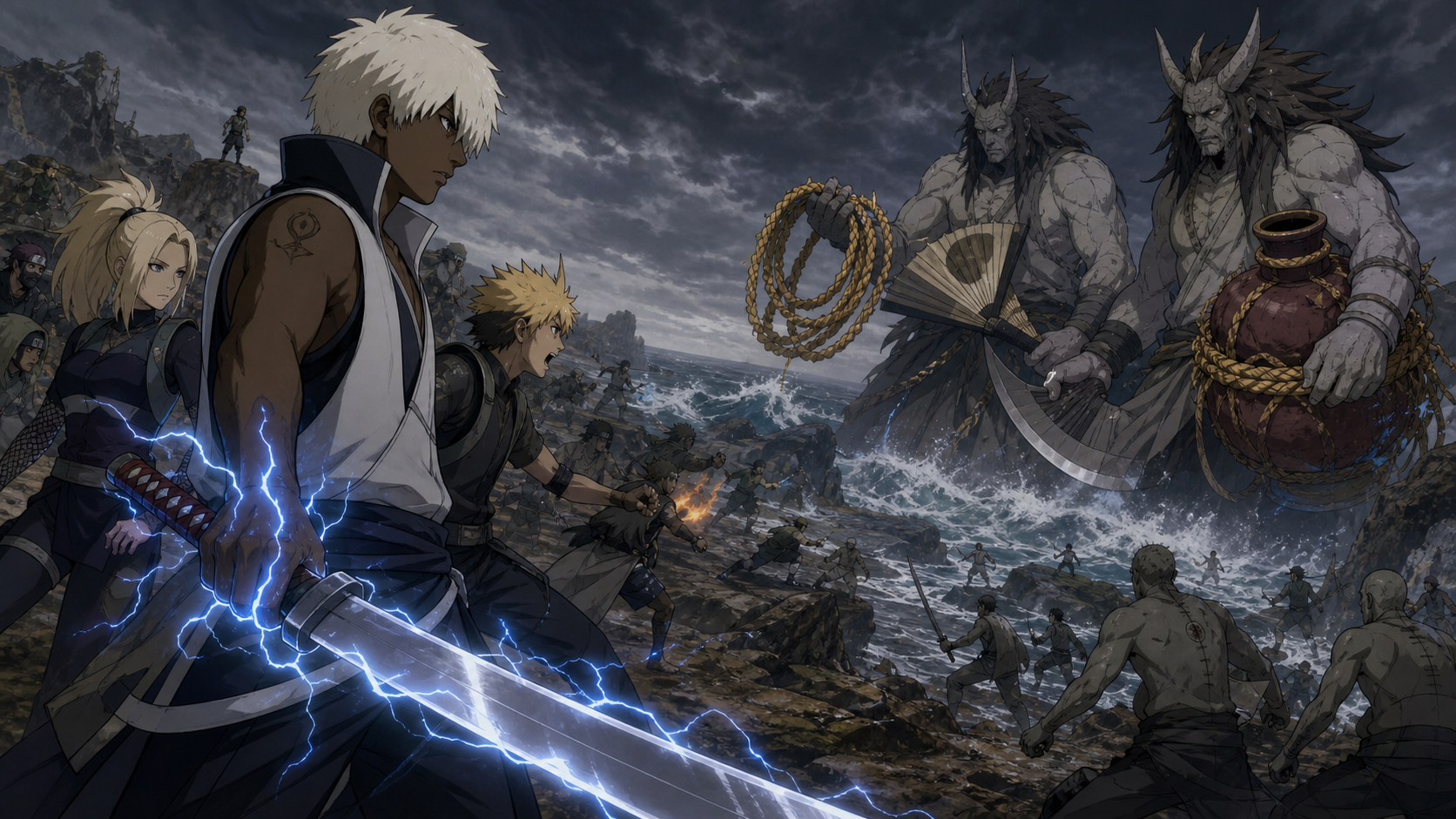
Battleground!
Darui inherits Cloud history at the coast while Gaara divides his troops and the Sage’s treasured tools turn speech itself into a battlefield vulnerability.
Bottom line
Naruto Shippuden Episode 268 shows the cost of Shikaku's new formation on the ground. Gaara sends half his division toward Darui while keeping enough shinobi to face four reanimated Kage. Elemental units combine attacks against White Zetsu. Hiashi and Hizashi stand on opposite sides of the same war. At the coast, Darui inherits the Gold and Silver Brothers and their Sage of Six Paths tools without receiving time to learn the rules.
Kinkaku and Ginkaku do not simply bring greater chakra. Their weapons attack language, memory, and habit. The golden rope draws out a person's word soul, the seven-star sword records and severs that soul, and the crimson gourd can seal anyone who speaks the word used most often in life. Samui's restraint and Atsui's impulsiveness become tactical vulnerabilities before either sibling understands the game.
Darui stays in front because leadership now means translating Cloud history for allies from other villages while fighting the men who disgraced that history. His apology about dimming their gold and silver glow sounds corny. The commitment underneath is serious. He refuses to let legendary status excuse betrayal.
Shikaku's arrows become people leaving Gaara's line
Headquarters orders Gaara to send part of the Fourth Division toward Darui's overloaded coast. On a map, the shift looks like balanced reinforcement.
On the desert, soldiers separate from familiar units and move toward an enemy they have not seen. Those remaining must face former Kage with fewer bodies.
Strategy becomes real through marching time, fatigue, and the fear of leaving one crisis for another.
Temari questions the risk because the risk is real
Temari knows Mū can erase his presence and use Dust Release. Dividing the force before that confrontation makes the Fourth Division more vulnerable.
Her concern does not undermine Shikaku or Gaara. Good command needs people willing to name what a plan exposes.
Gaara proceeds because Darui's front may collapse without help. Accepting one danger prevents a larger failure elsewhere.
Ōnoki brings the specific knowledge Gaara needs
Ōnoki reaches the desert to confront Mū, his former teacher. His arrival replaces some of the expertise lost when troops leave.
He understands Dust Release, concealment, flight, and the habits of a man who trained him. No general briefing could give Gaara the same depth.
Older leadership becomes useful when an elder takes responsibility for history rather than ordering younger people to absorb every consequence.
The former Kage make power look like institutional memory
Rasa, Mū, Gengetsu, and the Third Raikage embody techniques and decisions tied to their villages. Kabuto resurrects more than strong fighters.
Each leader carries rivalries, policies, family wounds, and knowledge the living inherited unevenly.
The alliance must fight past authority while deciding which lessons deserve to survive.
Gaara keeps command while facing his father
Rasa's presence could narrow Gaara's attention to a private confrontation. Thousands of soldiers still depend on him.
He surveys the battlefield, maintains sand defenses, and coordinates with Ōnoki before addressing the personal history.
That discipline shows the leader Rasa never believed Gaara could become.
Darui's coast receives the pressure Shikaku predicted
White Zetsu numbers strain the First Division while reanimated specialists create separate threats. Darui has to hold a line broad enough for reinforcements to reach.
The coast offers broken rock, surf, limited movement, and crowded allied formations. Large attacks can hit friends as easily as enemies.
Darui's calm helps the unit keep tasks separated instead of becoming one panicked mass.
Elemental units turn difference into a sequence
Shinobi organize by chakra nature and combine wind, fire, earth, water, and lightning in coordinated waves. One technique creates the condition another technique needs.
The sequence is a practical result of the alliance. Villages once guarded techniques and fought for advantage; soldiers now combine knowledge across uniforms.
The formation works because timing matters more than who receives individual credit.
White Zetsu makes scale the first enemy
The clone army lacks the prestige of reanimated Kage, but numbers can exhaust any division. Every body demands identification, force, and attention.
Zetsu's ability to move through earth and later imitate chakra makes ordinary battlefield certainty unreliable.
The alliance cannot spend elite techniques on every clone. Resource management becomes survival.
Hiashi and Hizashi embody the Hyūga system's unpaid debt
The brothers meet across the battlefield because Hizashi has been reanimated. Hiashi leads living clan members while facing the twin whose life was sacrificed to protect the main family.
Hizashi chose to die for his brother and son, but the clan structure created the demand. The branch seal and political bargain shaped what choices remained.
Kabuto turns that unresolved institutional harm into another forced family battle.
Neji lives inside the consequence even when absent
Hizashi's death defined Neji's belief that destiny could not be escaped. Naruto challenged that conclusion during the Chūnin Exams.
The war returns Hizashi to a system that has changed less than the people inside that system. Hiashi can love his brother and still represent the main family that benefited from the sacrifice.
Their confrontation cannot be reduced to sibling affection without addressing the structure between them.
Dan's return threatens Tsunade through distance
Dan appears among the reanimated fighters on Darui's front while Tsunade remains at headquarters. Kabuto does not need to place them face to face for the knowledge to matter.
Dan's Spirit Transformation Technique creates a severe tactical threat beyond personal history. His body must be contained before the technique can bypass ordinary defenses.
The alliance needs people capable of separating Tsunade's grief from the immediate counter required.
Kakuzu treats the chaos as a chance to collect
Kakuzu recognizes powerful figures and looks for useful hearts while the larger battle spreads. Death remains a resource in his personal economy.
Reanimation removes his need to protect his own body in the usual way, making his appetite more dangerous.
His behavior mirrors Kabuto's method on a smaller scale. Both men classify bodies by what can be extracted.
Kinkaku and Ginkaku arrive with reputation as armor
Cloud shinobi know the brothers as criminals who attacked their own village's leadership and survived impossible contact with Kurama.
Legend creates hesitation. Soldiers may assume no ordinary strategy can work before testing the actual limits.
Darui rejects that surrender by naming their glow as something he intends to remove.
Darui's language sounds lazy while his judgment stays sharp
He describes himself with dull or sluggish words, maintaining a relaxed tone during crisis. The style can look like indifference.
Darui reads threats quickly, protects his unit, and accepts responsibility for Cloud history. His pace is controlled rather than careless.
The contrast will matter when speech itself becomes dangerous.
Samui brings discipline into a language trap
Samui is known for staying cool and measuring her response. That habit helps her avoid giving enemies unnecessary information.
The Sage's tools punish repeated language, however, not merely loud emotion. Silence becomes important only after the rules are understood.
Her discipline provides an advantage without creating immunity.
Atsui broadcasts exactly where pressure can reach him
Atsui reacts loudly and passionately, announcing anger through speech and movement. His name and personality make heat part of his identity.
Against ordinary opponents, energy can rally allies. Against a tool that records habitual words, repetition becomes a target.
The enemy weapon turns personality into a technical weakness without making the personality morally wrong.
The treasured tools demand a rulebook during combat
The Kōkinjō draws out the word soul. The Shichiseiken severs and records that soul. The Benihisago seals a person who then says the word used most frequently.
The Bashōsen can produce any of the five basic chakra natures. These tools reshape combat around language and massive chakra cost.
An opponent who does not know the sequence may lose before understanding that a conversation was part of the attack.
The Sage of Six Paths legacy is not automatically sacred
The tools are connected to the Sage, which gives them mythic prestige. Kinkaku and Ginkaku use them for coercion and killing.
An object's origin does not determine the ethics of every use. Reverence can become cover for whoever currently holds the handle.
Darui's division needs mechanics, not worship.
Chakra cost explains why ordinary users cannot copy the tactic
The treasured tools consume enormous chakra. A normal shinobi risks death from extended use.
Kinkaku and Ginkaku can wield them because Nine-Tails chakra transformed their reserves. Their survival inside Kurama gave them access without partnership.
The same weapons would punish most people attempting to claim their advantage.
Kurama's chakra appears without Naruto's relationship
The brothers gained fox chakra by consuming flesh while trapped inside Kurama. Their shrouds resemble Naruto's transformations.
The visual separates power from moral identity. Fox chakra does not make someone Naruto, a jinchūriki, or a protector.
How power was obtained and what the user chooses still matter.
Darui leads across villages while carrying a Cloud-specific burden
The brothers belong to his village's shame, but the soldiers threatened by them come from the whole alliance. Darui cannot treat the confrontation as private cleanup.
He explains enough for others to act and places himself at the front of the counter.
Responsibility becomes useful when the person with history shares knowledge instead of claiming exclusive ownership.
Several battles remain visible at the same time
The episode moves among coast, desert, forest, and headquarters. No single fight pauses the others.
That structure can feel crowded, but war should not wait politely for one emotional resolution.
Shikaku's plan gains credibility because viewers see the simultaneous pressure behind every redirected unit.
Reinforcement does not erase local command
Shikamaru and other transferred shinobi move toward Darui's line under the larger plan. Darui remains responsible for the immediate battlefield.
Support should increase options rather than replace the leader already reading local conditions.
The alliance works when central strategy and local judgment inform one another.
The battlefield turns Shikaku’s tradeoff into marching bodies
Half of Gaara’s division leaving for the coast looks tidy as an arrow at headquarters. On the ground, people abandon known positions, separate from familiar partners, and spend stamina traveling toward rules they have not learned. The remaining soldiers watch their margin shrink before facing four Kage.
That is the honesty strategy requires. A reinforcement does not appear from nowhere because the plan is brilliant. Help for Darui is exposure for Gaara. Shikaku’s decision can still be correct while placing real people in greater danger. Command becomes accountable when the cost stays visible after the marker moves.
Temari’s objection strengthens the order she eventually follows
Temari knows exactly what Mū can do and refuses to treat division size as a decorative concern. Her challenge is not disobedience. It gives Gaara one more chance to test whether the transfer remains defensible under the threat in front of them.
He sends the troops because Darui’s line needs them more urgently, not because her fear is foolish. The exchange shows coalition discipline working without emotional silence. A subordinate can name the dangerous consequence, receive an answer, and carry out the decision without pretending the consequence disappeared.
Gaara must command while his childhood stands across the sand
Rasa is a military threat, a former Kazekage, and the father who made Gaara a container before judging the child for breaking under isolation. Any one of those identities could consume the encounter. Gaara keeps reading the entire field.
Gaara’s command proves survival after abuse without crediting abuse for his strength; he refuses to make the army orbit family fear as Rasa did.
Hiashi and Hizashi expose the difference between sacrifice and consent
Hizashi chose to die in Hiashi’s place, but the Hyūga system created the branch seal, unequal status, and political bargain surrounding that choice. Calling his death voluntary without naming the structure would turn love into absolution for the institution that benefited.
Reanimation violates him again by forcing his body against the brother he protected. Hiashi cannot repair the clan’s history during combat. He can refuse the convenient story that affection made the system fair. Grief becomes honest only when the family and the hierarchy remain visible together.
The elemental units make cooperation depend on sequence
Wind, fire, earth, water, and lightning are not displayed as five isolated specialties competing for applause. One unit prepares the condition another unit needs. Timing gives difference its value.
That structure is the alliance at its best. Villages do not become identical, and guarded knowledge does not vanish. Soldiers make techniques answer one another across old borders. No element wins the montage alone because the point is not individual supremacy. The point is building an attack none of the separated forces could sustain as efficiently.
The Sage’s tools treat a person’s habits as evidence against them
A frequently spoken word sounds trivial until the crimson gourd makes repetition a sealing condition. Language carries personality, relationships, work, and the phrases used to survive ordinary days. The weapon strips that history into a trigger.
Kinkaku and Ginkaku do not need to overpower every opponent immediately. They make people afraid of their own speech while learning rules under attack. The tool’s cruelty lies in conversion: something intimate and automatic becomes testimony delivered by the victim’s mouth.
Samui’s silence is discipline, not absence of feeling
Samui appears safer because she controls her outward response. The story risks confusing coolness with superior character and Atsui’s heat with foolishness. The weapons are not moral judges. They exploit frequency, timing, and ignorance.
Restraint buys Samui time because it reduces accidental information. It cannot guarantee safety once the brothers control the sequence. Her discipline matters as a practiced skill, not proof that quieter people deserve survival more than expressive ones.
Atsui’s openness becomes a weakness without becoming a flaw
Atsui speaks his reactions and brings heat into the group’s energy. In another fight, that visibility could rally frightened soldiers or make danger easier to communicate. Here, an enemy system reads repetition as an access point.
The distinction protects the character from a cheap lesson about shutting up. Atsui does not deserve capture because he is expressive. Kinkaku and Ginkaku possess a weapon designed to punish recognizable human patterns. Responsibility belongs to the person exploiting the pattern, not the person who had one.
Darui inherits Cloud shame without accepting Cloud worship
The Gold and Silver Brothers come wrapped in legend, Nine-Tails chakra, and treasured objects tied to the Sage. Darui knows they also attacked their own leadership and turned power against the village now expected to admire them.
He refuses the idea that history must become reverence simply because the criminals were strong. His wordplay sounds relaxed because that is how Darui carries pressure. The judgment beneath it is firm: gold and silver do not become honorable when their shine is purchased through betrayal.
Kurama’s chakra proves power does not carry one moral identity
Kinkaku and Ginkaku gained fox chakra through survival and consumption, not a jinchūriki bond. Their shrouds resemble Naruto’s power while serving choices that have nothing to do with his loyalties.
The resemblance breaks the lazy equation between energy and character. Chakra can be stolen, inherited, shared, extracted, or forced. What matters is the relationship built around access and the purpose chosen afterward. Naruto is not heroic because Kurama’s color surrounds him. He is accountable for what he does while carrying it.
Multiple fronts prevent one family wound from owning the war
Gaara sees Rasa. Hiashi faces Hizashi. Tsunade receives news of Dan. Darui confronts Cloud’s criminals. Each history deserves attention, yet no battlefield pauses for another person’s resolution.
The crowded structure can frustrate because scenes leave before emotion settles. It also preserves scale. War turns private grief into simultaneous operational pressure. Shikaku’s plan matters because the audience can see that every request for help is arriving beside another reunion capable of breaking a formation.
What landed
The elemental unit sequence gives mixed-village cooperation a concrete form. Different chakra natures become an ordered system rather than a montage of colorful attacks.
Darui, Samui, and Atsui establish three distinct responses before the treasured tools reveal why personality and speech matter.
The simultaneous family and village confrontations show Kabuto's army attacking history as deliberately as territory.
What did not fully land
The rapid front changes keep several emotional reunions at outline depth. Hiashi and Hizashi deserve more room than the episode can give them.
The treasured tools arrive with complicated mechanics that the next episode must explain during combat. The setup risks feeling arbitrary before the rule sequence becomes clear.
Darui's wordplay about gold, silver, and dullness may not land for every subtitle or viewer. His resolve matters more than the translated pun.
Final reaction
Naruto Shippuden Episode 268 turns the map from Episode 267 into bodies moving under pressure. Gaara sends away soldiers he could use against four Kage. Ōnoki arrives because experience with Mū matters more than raw numbers. Hiashi faces the brother his clan sacrificed. Darui receives two Cloud criminals carrying weapons almost nobody can survive using.
The alliance's strength comes from combining difference without pretending every fighter is interchangeable. Elemental units build sequences. Sensors identify threats. Reinforcements move while local commanders keep reading terrain.
Kinkaku and Ginkaku challenge that cooperation with tools designed to isolate a person's habits and turn speech into capture. Samui's restraint, Atsui's heat, and Darui's repeated language now belong to the battlefield. The coast is no longer a contest of who hits harder. Survival depends on learning the rules before the enemy makes your own voice testify against you.
RaeRae’s call
The Sage’s tools do not reveal moral weakness. They weaponize recognizable habits. Darui’s real test is learning the rules quickly enough to protect expressive and restrained people without letting legend decide who deserves to survive.
Episode details and viewing routes
- Official episode reference: Naruto Official episode guide
- Licensed episode route: Crunchyroll licensed episode page