
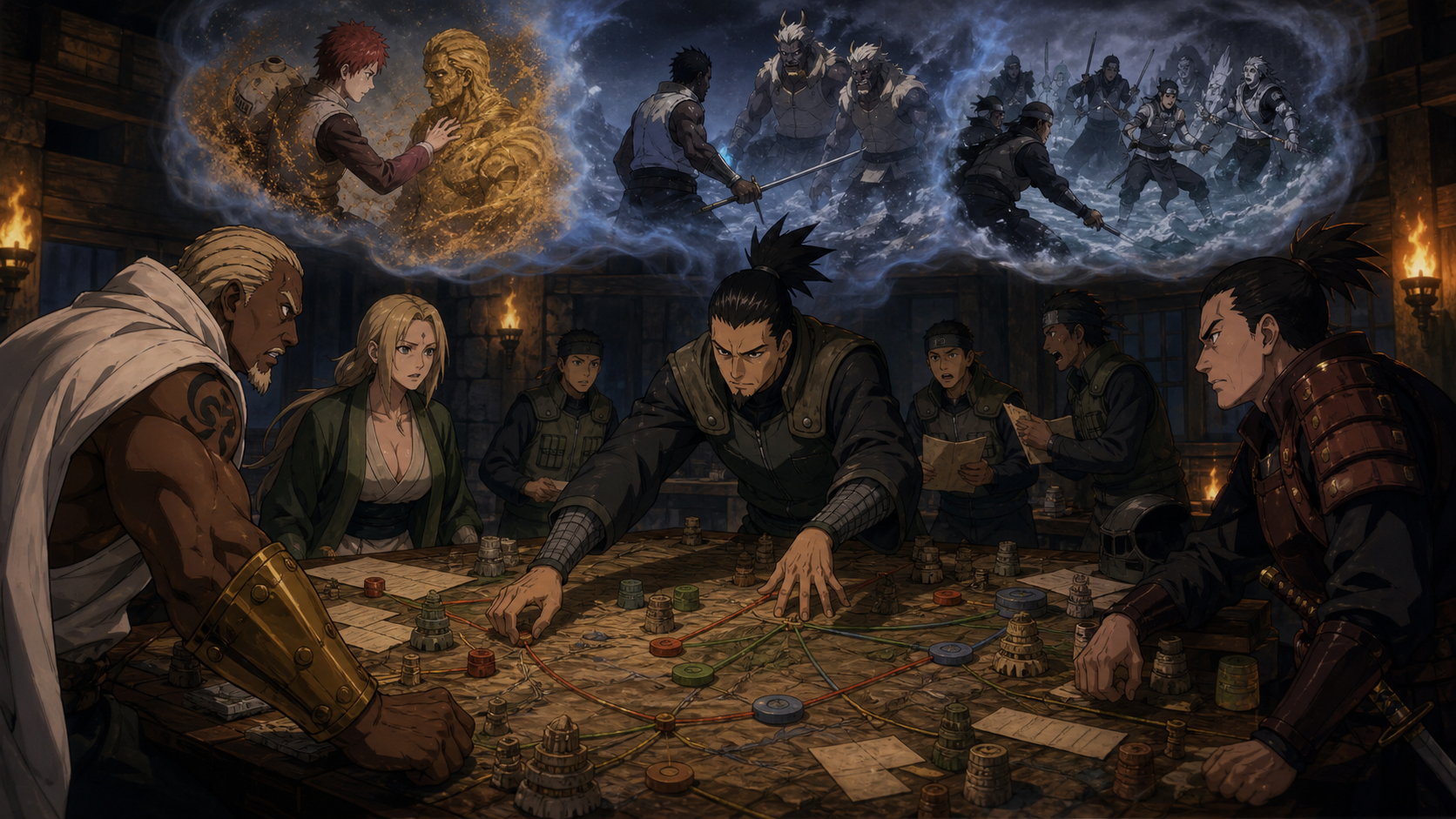
The Brilliant Military Advisor of the Hidden Leaf
Shikaku turns incomplete reports and scarce reinforcements into a plan strong enough to stop the Raikage from abandoning headquarters for a personal war.
Bottom line
Naruto Shippuden Episode 267 makes Shikaku fight the war with reports, travel time, exhausted divisions, and leaders who want to run toward personal enemies. Darui faces White Zetsu, Kakuzu, Dan, Hizashi, and the Gold and Silver Brothers. Gaara discovers four reanimated Kage, including his father Rasa. Kakashi remains locked against the Seven Swordsmen. Every front asks for more support than the alliance can give.
The Raikage wants to enter battle when he learns Kinkaku and Ginkaku have returned. Shikaku stops him and redraws the formation around the whole war rather than one commander's history. The choice is not disrespect. Headquarters cannot lose the leader responsible for decisions across all divisions because two notorious brothers know how to provoke him.
Shikaku's brilliance is not mystical prediction. He listens, identifies which threats require specific counters, calculates which units can move without collapsing another line, and convinces powerful people to trust a plan they cannot personally supervise. Strategy becomes the work of deciding whose danger receives help first.
Headquarters receives several disasters at once
Sensory operators and messengers report reanimated shinobi, underground White Zetsu movement, bloodline users, and failing positions across a wide battlefield.
No report arrives with complete certainty. Distance, combat pressure, and enemy interference distort timing and detail.
Shikaku must act before perfect information becomes available. Waiting for certainty would let every front worsen together.
Darui's division faces a collection designed to overload history
The First Division encounters fighters tied to several villages and personal relationships. Kakuzu brings Akatsuki experience and multiple hearts. Dan carries Konoha history. Hizashi confronts the Hyūga family. Kinkaku and Ginkaku carry Cloud infamy and Nine-Tails chakra.
Each enemy demands a different tactical and emotional response. Combining them increases the chance that one recognizable face will break formation.
Kabuto builds pressure by arranging the dead where memory can compete with command.
The Gold and Silver Brothers trigger the Raikage personally
Kinkaku and Ginkaku are legendary criminals from Kumogakure who survived inside the Nine-Tails and gained access to its chakra. Their history includes an attempted coup and an attack that left the Second Hokage near death.
The current Raikage knows their danger as village history and family responsibility. Hearing their names makes direct intervention feel necessary.
His reaction is understandable. Command still requires a decision larger than justified anger.
Shikaku stops power from abandoning position
The Raikage is one of the alliance's strongest fighters. Sending him toward Kinkaku and Ginkaku could solve a battlefield problem quickly.
Headquarters also depends on his authority, knowledge, and coordination with Tsunade and Mifune. A trap, delay, or injury would damage every division.
Shikaku tells a more powerful man to stay because physical strength is not the only resource at risk.
Disagreement becomes part of competent command
Shikaku does not flatter the Raikage or wait for his anger to pass. He explains the strategic cost and offers another formation.
The Raikage listens even though he dislikes remaining behind. That willingness matters as much as Shikaku's plan.
A command room fails when rank makes correction impossible. Trust allows expertise to challenge authority without becoming mutiny.
The new formation redistributes risk rather than removing risk
Shikaku redirects support toward Darui while accounting for Kakashi's battle and Gaara's front. Every movement leaves another location with fewer options.
No arrangement protects everyone equally. Strategy chooses where concentration can prevent the largest collapse.
The episode avoids pretending a clever map creates safety. Shikaku moves danger into a shape the alliance may survive.
Logistics make the plan real
Divisions need travel routes, communication, medical capacity, sealing teams, and enough stamina to arrive useful. A reinforcement sent too late or exhausted can become another casualty group.
Shikaku calculates more than combat strength. Terrain and distance determine whether an order can exist outside the command table.
The best plan respects bodies moving through physical space.
Inoichi turns thought into transmission
Inoichi and the communications team distribute Shikaku's changes across the alliance. A brilliant order that reaches only headquarters has no battlefield value.
Mental communication reduces delay, but carrying thousands of messages creates its own strain. Accuracy matters because one mistaken route can expose an entire unit.
The alliance's nervous system depends on workers whose names receive less attention than front-line commanders.
Ao and the sensory unit determine what headquarters can know
Ao and other sensors track massive chakra movements, enemy concentrations, and underground routes. Their interpretations shape Shikaku's options.
Sensory information is not omniscience. Different techniques have range, interference, and identification limits.
Strategy begins with people making careful judgments about signals they cannot always confirm visually.
Gaara discovers an enemy who is also his father
The Fourth Division locates Mū, Gengetsu, the Third Raikage, and Rasa. Gaara recognizes the father who made him a jinchūriki, authorized attempts on his life, and judged him as a failed weapon.
That reunion arrives immediately after Gaara united the army through the truth about his own violent childhood.
Rasa becomes a battlefield threat and the source of wounds Gaara has spent years learning to name.
Rasa sees a son he never expected to lead
Rasa died believing Gaara's instability endangered Sunagakure. Reanimation places him before Gaara as Kazekage and commander of an allied division.
The evidence contradicts his old judgment before either man speaks. Gaara survived policies designed around fear and became the leader capable of asking former enemies to cooperate.
That outcome does not excuse what Rasa did. Success after abuse does not make abuse necessary.
Gold dust and sand turn family history into terrain
Rasa's Magnet Release controls gold dust, a technique he used to restrain Shukaku and protect the village's economy. Gaara controls sand shaped by his own defense and growth.
Their powers carry institutional roles as well as family meaning. Both men became Kazekage under different expectations.
The coming fight will compare leadership through the materials each man commands and the people standing behind him.
Mū makes concealment a Kage-level threat
The Second Tsuchikage can erase his presence, fly, divide his body, and use Dust Release. Ordinary sensory assumptions fail against him.
Gaara's division needs a counter rooted in experience with Mū's exact abilities. Raw numbers may give him more targets rather than creating an advantage.
Shikaku recognizes that some enemies require personal historical knowledge.
Ōnoki refuses to leave Mū to younger shinobi
Ōnoki decides to go to Gaara's battlefield because Mū was his teacher and possesses techniques the current Tsuchikage understands.
The choice contains duty and unfinished history. He does not ask Gaara's generation to absorb a threat produced by his own.
Unlike the Raikage's impulse, Ōnoki's movement fills a specialized gap in Shikaku's plan. Personal motive aligns with strategic need.
Former Kage warn the living about themselves
The reanimated leaders retain enough personality to explain abilities and urge the alliance to stop them. Kabuto forces them to fight while their knowledge helps the opposition.
Their warnings expose the contradiction inside reanimation. A famous technique can return without returning loyalty to the summoner.
Kabuto may suppress them later, but each warning gives the living a chance to prepare.
The Second Mizukage treats the reunion like an argument resumed
Gengetsu and Mū bicker over their mutual deaths and old rivalry. Their humor does not make the history harmless.
Both men died fighting one another, leaving villages to carry the consequences. Reanimation lets the feud continue while another commander points them at a new generation.
The exchange shows how pride can survive death more easily than accountability.
The Third Raikage's presence changes the Cloud calculation
The Third Raikage is remembered for extraordinary endurance and strength. His reanimation places Cloud shinobi against one of their most revered leaders.
The current Raikage now faces danger connected to his father and the Gold and Silver Brothers at different fronts.
Shikaku's plan must account for the emotional pressure on a commander expected to remain rational for everyone else.
Kinkaku and Ginkaku carry stolen Nine-Tails power
The brothers survived being swallowed by Kurama by eating chakra-rich flesh from inside the tailed beast. Their bodies retained enough power to produce a foxlike shroud.
Their transformation mirrors Naruto without sharing his relationship to Kurama. Power can be acquired through survival, theft, inheritance, coercion, or partnership.
The resemblance will confuse soldiers who know Naruto mainly as the alliance's protected jinchūriki.
Darui receives a problem his village helped create
Darui must lead against two Cloud legends while maintaining a line filled with shinobi from other villages. He inherits the consequences without choosing the original history.
His calm style helps the division avoid matching Kinkaku and Ginkaku's aggression. Understatement becomes a command tool.
The battle will test whether he can translate village-specific knowledge into protection for the entire alliance.
Shikaku treats commanders as people with biases
His plan accounts for more than abilities. He knows the Raikage may react to Cloud history, Ōnoki understands Mū, Gaara faces Rasa, and Darui can handle pressure differently.
Strategy fails when people become identical pieces. Personal history affects timing, judgment, and willingness.
Shikaku uses that knowledge without reducing anyone to a weakness.
Tsunade supports expertise instead of competing with specialists
Tsunade holds enormous authority and combat ability. In headquarters, she lets Shikaku perform the job assigned to him.
Her support helps his correction of the Raikage carry institutional weight. Leaders do not need to produce every answer personally.
Competence includes recognizing when another person's specialized judgment is better.
Mifune keeps the coalition broader than the five villages
The samurai commander participates in decisions that affect shinobi divisions while representing a different military tradition.
His presence reminds headquarters that the alliance is not simply a temporary council of Kage. Samurai lives and territory also carry the war's cost.
Coalition strategy must remain legible to people outside village rivalries.
The episode makes command work dramatic without pretending maps are magic
Markers move, routes change, and messages leave headquarters. None of those actions guarantee that soldiers will survive contact.
Shikaku's plan matters because he makes decisions under constraint and accepts responsibility for the consequences.
The drama comes from limited resources and human trust, not from a genius label floating above unexplained certainty.
Shikaku’s genius begins with admitting the map is incomplete
Shikaku’s brilliance is choosing responsibly under incomplete information, without confusing uncertainty with paralysis or confidence with control in the command room.
The Raikage’s body is not headquarters’ spare weapon
A can break enemy lines in ways few soldiers can match. Sending him toward Kinkaku and Ginkaku therefore feels efficient until the rest of his job enters the calculation. His authority holds together decisions affecting thousands of people who cannot see one another.
Shikaku protects that function from the Raikage’s understandable anger. The order to remain is not an insult to strength. It is recognition that leadership has made his presence infrastructure. If he treats himself as the nearest available fist, every division loses access to the commander positioned to see the whole war.
Stopping a powerful man requires a command room where correction survives rank
Shikaku cannot physically force the Raikage into his chair, and a timid suggestion would disappear beneath urgency. He names the wider cost, supplies another route, and trusts the commander to value the alliance more than the satisfaction of answering Cloud history himself.
The Raikage’s restraint deserves credit too. Expertise only protects an institution when authority permits itself to be challenged. The scene works because disagreement is not framed as disloyalty. Shikaku performs his assigned duty by saying no, and the Raikage performs his by listening.
Every reinforcement order creates an absence somewhere else
A map makes units look movable without friction. Real shinobi carry fatigue, injuries, limited chakra, frightened teammates, and obligations to the position they leave. Redirecting support toward Darui does not create soldiers. It transfers risk from one set of bodies to another.
Shikaku’s plan earns respect because the episode lets scarcity remain visible. Nobody receives everything requested. The goal is not fairness distributed evenly across a battlefield that refuses fairness. The goal is preventing one collapse from becoming the route through which every other front is surrounded.
Communications workers turn thought into collective action
Inoichi and his team carry the strategy farther than Shikaku’s voice could travel. Their work is easy to mistake for delivery after the important decision. Transmission is part of the decision because timing, clarity, and mental strain determine whether an order exists anywhere beyond headquarters.
One corrupted route or delayed warning can strand a reinforcement column. The alliance’s intelligence depends on people maintaining accuracy while thousands of minds demand attention. The dramatic commanders remain possible because quieter specialists keep the shared nervous system from tearing under scale.
Shikaku reads personal history as battlefield terrain
Mū is not merely a collection of abilities. He is Ōnoki’s teacher. Rasa is not merely a Magnet Release user. He is Gaara’s father and former abuser. Kinkaku and Ginkaku are not merely jinchūriki-like threats. They belong to the Cloud’s political shame and the Raikage’s inherited responsibility.
Ignoring those relationships would not make the plan objective. It would make the plan inaccurate. Emotion changes speed, hesitation, judgment, and which warning a fighter will believe. Shikaku respects people enough to treat history as operational reality without reducing anyone to the worst thing history might make them feel.
Ōnoki’s personal motive fills a strategic need
The Tsuchikage wants to face Mū because the dead man taught him and because his generation helped produce the conflict now reaching younger soldiers. Unlike the Raikage’s impulse, the movement answers a specific gap no generic reinforcement can fill.
That does not make the choice free from pride. Ōnoki carries plenty. It means pride, duty, knowledge, and strategy can point in the same direction. Good command does not require leaders to become emotionless. It requires enough honesty to decide whether emotion improves the assignment or merely makes the assignment feel personally satisfying.
Gaara’s battlefield cannot be solved from headquarters
Shikaku can send support and Ōnoki can explain Mū. Nobody in the command room can answer Rasa for Gaara. The son must face a father who authorized his isolation and attempted murder, then decided the resulting instability proved the child was a failed weapon.
Strategy has an ethical boundary here. It can create time, formation, and survival conditions. It cannot convert a family reckoning into an efficient objective without repeating Rasa’s mistake of treating Gaara’s interior life as a village resource. Support means giving him room, not claiming ownership of the answer.
Kabuto assembles bodies while Shikaku assembles consent
Both commanders move specialized fighters toward pressure points. The resemblance ends at authority. Kabuto can suppress objection and send a restored father against his son. Shikaku must persuade leaders, explain tradeoffs, transmit orders, and trust living soldiers to interpret those orders under changing conditions.
Consent makes his coalition slower and less predictable. It also makes correction possible. A sensor can revise a report. A commander can challenge a route. A specialist can name a limitation. Kabuto’s obedience removes friction by removing the person who might tell him the plan is wrong.
The title belongs to a system, not one miraculous brain
Shikaku deserves the spotlight. He also depends on Ao’s sensing, Inoichi’s communication, Tsunade’s backing, Mifune’s coalition perspective, field commanders’ honesty, and soldiers who can execute adjustments without seeing the full map.
Calling him brilliant should identify how well he uses that network, not erase the network. His intelligence becomes military power because he listens before deciding and explains after deciding. Genius here is relational. It organizes other people’s knowledge without pretending their contribution originated inside one man.
What landed
Shikaku's confrontation with the Raikage shows strategic authority working correctly. He challenges rank with evidence and offers a viable alternative.
The simultaneous fronts make the alliance feel genuinely large. Darui, Kakashi, and Gaara each face threats that could carry an episode alone.
Gaara recognizing Rasa gives the next battlefield a personal stake rooted in leadership, abuse, and the question of what kind of Kazekage Gaara chose to become.
What did not fully land
The rapid movement between reports can make powerful reanimated characters feel like names on a checklist. Dan, Hizashi, Kakuzu, and the former Kage receive introduction more than presence.
Shikaku's plan arrives quickly enough that the hard calculation remains partly off screen. More detail about distances, depleted units, and tradeoffs would make the brilliance easier to evaluate.
The title centers a Leaf strategist even though the command system depends on sensory, communications, samurai, and Kage cooperation. Shikaku deserves credit, but the work remains collective.
Final reaction
Naruto Shippuden Episode 267 shows why a war cannot be won by sending the strongest person toward the loudest emergency. The Raikage sees Kinkaku and Ginkaku as a Cloud responsibility. Shikaku sees Kakashi's mist battle, Gaara's four Kage, Darui's overloaded line, every travel route, and the command structure that must survive tomorrow.
His answer is not painless. Reinforcing one division leaves another with fewer options. Keeping the Raikage at headquarters asks a son and village leader to trust someone else with dangerous family history. Sending Ōnoki toward Mū puts an aging Kage directly into the field.
Shikaku earns the word brilliant because he makes those tradeoffs visible enough for powerful people to accept them. Across the desert, Gaara faces the father who treated him as a failed weapon. Headquarters cannot solve that grief. Good strategy can give Gaara the support and space to answer on his own terms.
RaeRae’s call
Shikaku does not win the room by knowing everything. He shows powerful people what their personal urgency would cost everyone else, then builds a plan from specialists willing to correct, carry, and trust one another.
Episode details and viewing routes
- Official episode reference: Naruto Official episode guide
- Licensed episode route: Crunchyroll licensed episode page