
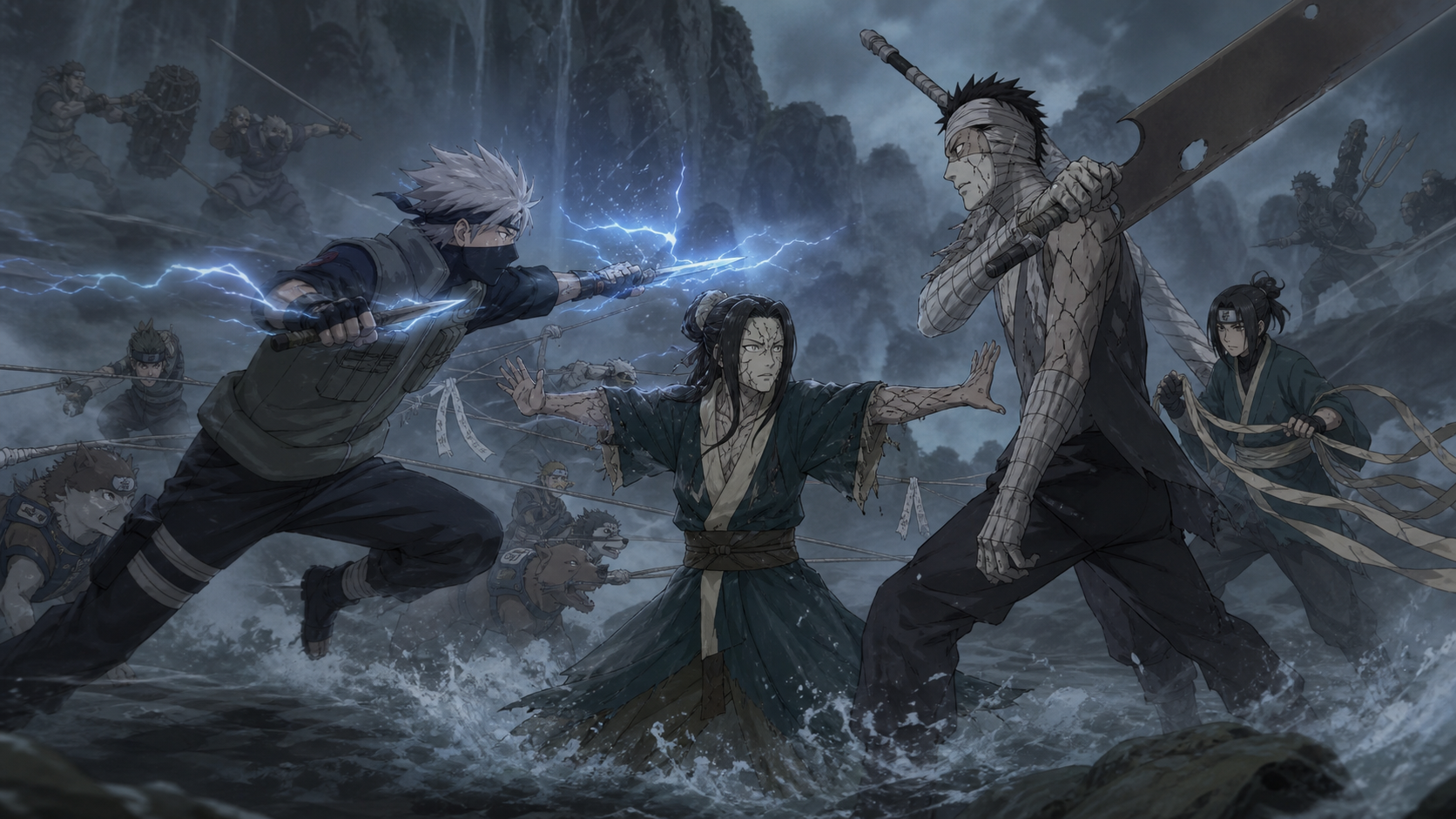
The First and Last Opponent
Kakashi turns the Land of Waves rematch into a division-wide plan and releases Zabuza and Haku before taking up the Executioner’s Blade.
Bottom line
Naruto Shippuden Episode 266 forces Kakashi to defeat Zabuza and Haku by repeating the wound that ended their first battle. Haku intercepts Kakashi's Lightning Blade again, Zabuza attacks through Haku's body again, and the difference is devastating: Kabuto has removed the choice that once made Haku's sacrifice his own.
Kakashi's division wins through tracking, coordinated restraint, and sealing. The hidden mist blocks sight, so the team marks scent, relies on hounds and sensors, pins Zabuza's movement, and gives Maki time to seal both reanimated enemies. Kakashi does not win because his attack becomes larger. He wins because an entire division turns memory into a plan.
The episode closes Zabuza and Haku's second ending with tears still visible beneath Kabuto's control. Kakashi takes the restored Executioner's Blade and promises to unleash the Copy Ninja's full force against the remaining swordsmen. The anger lands because the blade represents people Kabuto refused to leave at peace.
The Seven Swordsmen change the battlefield before they swing
The reanimated Seven Ninja Swordsmen of the Mist arrive with weapons designed around radically different killing styles. Their presence forces Kakashi's division to divide attention inside Zabuza's mist.
Each sword carries a reputation that can make less experienced shinobi hesitate before contact. Kabuto benefits from that fear before any blade reaches its target.
The division needs enough information to avoid treating seven specialists as one generic group.
Hidden Mist takes sight away from a large formation
Zabuza's technique covers the battlefield in dense mist. A large allied division loses the visibility required for formations, medical response, and coordinated defense.
Silent killing works by making every sound and movement feel like a possible attack. Soldiers can injure allies if fear outruns identification.
Kakashi has faced this problem before. Personal experience becomes the first piece of a division-wide solution.
Kakashi refuses to fight the previous battle exactly as before
On the bridge, Kakashi used tracking hounds to restrain Zabuza after reading blood from a wound. The current enemy body regenerates, and multiple swordsmen fill the mist.
He adapts the earlier method instead of copying the final attack alone. The team spreads scent-marked cloth and creates location cues that do not depend on vision.
Memory becomes useful when Kakashi extracts the principle rather than worshipping the old move.
Scent tracking turns invisible movement into shared information
Ninken and sensory shinobi help locate enemies through smell, chakra, sound, and disrupted air. Guide lines and marked cloth give allied fighters reference points.
The method is not glamorous, but the whole plan depends on reliable position data. Lightning Blade cannot hit a target Kakashi cannot find.
Support work transforms one commander's old knowledge into something hundreds of shinobi can use.
The division has to restrain before the sealing team can work
Reanimated bodies regenerate from ordinary damage. Cutting or crushing an attacker only buys time.
Allied fighters must immobilize each enemy long enough for specialists to apply sealing cloth and complete the formula. Combat and containment become separate jobs.
That structure prevents the strongest attacker from receiving all the credit for a victory that sealing personnel actually finish.
Maki carries the final responsibility
Maki of the Sand leads the sealing effort around Zabuza and Haku. Her work determines whether Kakashi's successful strike produces release or another regeneration cycle.
She enters range after others create an opening, but proximity still places her at risk from the mist and swordsmen.
The episode treats sealing as battlefield labor with timing, courage, and technical precision.
Haku's body repeats the bridge sacrifice
Kakashi reaches Zabuza with Lightning Blade. Haku moves between them, recreating the moment that killed him during the Land of Waves mission.
The visual repetition hurts because Kabuto suppressed Haku's personality. His body performs the protective pattern without a freely expressed decision.
The original sacrifice came from Haku's devotion and damaged sense of worth. The second becomes an enemy command exploiting both.
Love and conditioning remain tangled in Haku's action
Haku loved Zabuza and believed his own value depended on serving as Zabuza's tool. Those truths existed together.
Kabuto uses a fighting instinct rooted in that relationship. The technique does not reveal whether love or conditioning would guide Haku if he had control.
Kakashi cannot solve that history during the strike. He can stop another person from using Haku's body to continue the pattern.
Zabuza attacks through Haku without the old hesitation
On the bridge, Haku's death broke through Zabuza's emotional defenses. Under Kabuto's control, Zabuza continues the attack while Haku stands in the line.
The absence of hesitation shows what personality suppression removed. Kabuto keeps the assassin's technique and discards the grief that made him human.
The result is not a truer Zabuza. The result is a reduced weapon wearing his abilities.
Kakashi has to survive the emotional repetition
Lightning Blade enters the same relationship that haunted the first mission. Kakashi remembers Haku's death and understands what Zabuza later admitted.
Stopping now would let Kabuto use both men to kill more people. Continuing means participating in an image he never wanted to repeat.
Command requires him to act without pretending the choice is emotionally clean.
The tears prove control is not total
Zabuza and Haku show tears even after Kabuto suppresses their conscious resistance. Some part of their emotional history remains visible.
The tears do not restore agency or stop the attack. They give the living evidence that the people inside those bodies have not disappeared completely.
Sealing becomes release for selves who cannot control their own hands.
Naruto's lesson returns through Kakashi's decision
Naruto once asked whether liking an enemy was allowed after Haku showed him kindness outside combat. The question challenged the village habit of reducing every opponent to a target.
Kakashi now fights Zabuza and Haku while keeping their personhood in view. Recognition does not require surrender.
Naruto's ethics become practical: stop the threat, protect the living, and refuse Kabuto's claim that a controlled body is only a weapon.
The title completes a circle without making history identical
Zabuza and Haku were Team 7's first serious opponents. They become the first major reanimated enemies Kakashi's division seals in this war.
Calling them the last opponent describes an intended farewell, not a return to the same relationship. Kakashi, Sakura, Naruto, and the wider world changed after the bridge.
The second ending matters because the living bring different knowledge to the fight.
Kubikiribōchō restores itself through blood
The Executioner's Blade repairs damage by absorbing iron from blood. The mechanism makes violence part of the weapon's maintenance.
Restoration on a crowded battlefield turns every injury into material. The blade's mythology is inseparable from the bodies that paid for its durability.
Kakashi takes control of the weapon after Zabuza is sealed, carrying both tactical value and that history.
Kakashi does not inherit Zabuza's philosophy
Wielding the Executioner's Blade does not make Kakashi a successor to silent killing or Bloody Mist ideology.
He uses an enemy weapon to protect the division and defeat the forces preventing the dead from resting. Purpose changes through the person holding the handle.
The same principle appeared when Kankurō used Sasori's puppet body against Sasori. Inheritance does not require obedience to the creator.
The Copy Ninja returns as a promise of range
Kakashi declares that he copied a thousand techniques and will use that range against the enemy. The line restores an identity the story has sometimes narrowed to one or two signature attacks.
His copying ability represents accumulated encounters, observation, and adaptation. The war has gathered enemies from many eras, so breadth matters.
The promise is exciting because anger now serves a plan rather than replacing one.
The remaining swordsmen demand different answers
Kiba channels lightning through paired blades. Kabutowari combines an axe and hammer to break defenses. Nuibari stitches targets together. Shibuki joins a blade with explosive tags.
Samehada's former wielder Fuguki brings another history, while Mangetsu can handle the full set even though not every sword is present.
Kakashi's division cannot use one counter for all of them. Survival depends on learning each weapon fast.
Suigetsu tells Jūgo the family history behind the legend
Away from the immediate fight, Suigetsu explains the Seven Swordsmen and his brother Mangetsu. His goal of collecting the blades gives the war personal relevance for him.
Mangetsu's reanimation turns family history into an enemy asset. Suigetsu sees the swords as ambition and connection, not merely village equipment.
The information widens the meaning of the battlefield beyond Kakashi's division.
Kirigakure has to face what the Bloody Mist produced
The Seven Swordsmen symbolize elite strength and a village culture that normalized brutal selection, assassination, and fear.
Current Mist shinobi fight within the alliance against legendary figures their village once celebrated. Cooperation does not absolve the institution that created them.
The war forces Kirigakure's history into public view beside soldiers from former enemy villages.
Sealing the dead protects their memory from further use
Kakashi's division is not destroying Zabuza and Haku's souls. The sealing process prevents Kabuto from continuing to command their bodies.
That distinction matters because the dead already expressed a wish to be stopped. The living honor the request through containment.
Release becomes a form of care performed under combat conditions.
The victory remains collective
Kakashi reaches the target, but trackers locate Zabuza, fighters maintain the lines, medics keep the unit moving, and Maki seals the bodies.
Any missing role could turn the successful strike into temporary damage followed by regeneration.
The episode gives its hero moment to Kakashi while leaving evidence of the system supporting him in every frame.
The division's anger needs command
Watching Kabuto force Haku and Zabuza through their deaths again creates rage across the people who understand the violation.
Anger can sharpen commitment or scatter a formation into reckless pursuit. Kakashi turns his response into a clear order against the remaining enemies.
Leadership gives emotion a direction without asking anyone to feel less.
A repeated image does not carry the same consent
Kabuto repeats Haku’s sacrifice after erasing the choice defining it.
Zabuza’s tears survive where speech cannot
Kabuto removes conscious resistance because objection interferes with function. Tears still cross the faces he has reduced. They cannot halt a blade, explain a memory, or change the command, yet they expose the self his technique has failed to make irrelevant.
Tears persist. Emotion remains true without becoming a secret counterspell. The alliance must do the physical work of release while believing what the tears say about the people trapped inside.
Kakashi’s knowledge creates responsibility, not hesitation alone
Understanding Zabuza and Haku does not require Kakashi to lower Lightning Blade. It changes why he uses it. An enemy can remain a person and still require immediate restraint when another will directs lethal movement through that person’s hands.
This is the ethical lesson Team 7 began learning in the Land of Waves. Recognition is not softness or surrender. It prevents force from becoming contempt. Kakashi fights to protect his division and to end Kabuto’s ownership, holding both obligations without flattening either one.
The rematch belongs to an entire division
On the bridge, Team 7 survived through a small collection of improvisations, personal risks, and Naruto’s disruptive refusal to accept the story adults offered. In the war, Kakashi has trackers, sensors, combat teams, medics, guide lines, and sealers distributed through a formation.
Growth appears as coordination rather than a larger solitary attack. Kakashi’s memory identifies the problem, but other people make the answer scalable. The scene lets experience mature into leadership: the veteran does not prove he can repeat an old victory alone. He makes old knowledge useful to everyone.
Maki’s seal is the real end of Kakashi’s strike
Lightning Blade creates an opening. Reanimated tissue would close it. Maki’s cloth and formula convert temporary damage into release, placing a Sand specialist at the final step of a battle rooted in Leaf and Mist history.
That arrangement is the alliance in miniature. The famous fighter receives the dramatic approach, while a teammate from another village makes success durable. Sealing is not cleanup after the meaningful action. It is the action that prevents Kabuto from sending the same stolen body back through the same grief again.
The hidden mist asks soldiers to trust information they cannot see
Zabuza removes the battlefield’s most reassuring sense. Orders arrive through sound. Position comes from scent, chakra, lines, and the people assigned to read what ordinary vision cannot. Panic would make every nearby movement feel hostile.
The division survives by accepting partial knowledge from specialists. That trust is fragile and practical. Nobody needs to become intimate friends in the fog. They need to believe a tracker’s warning, maintain a line, and resist striking before identification. Coalition unity becomes a series of disciplined seconds.
The Executioner’s Blade makes every casualty part of its repair
Kubikiribōchō restores itself with iron taken from blood, turning wounded bodies into maintenance supplies. The mechanism is a brutally honest summary of the legend surrounding it. Durability has always been financed by somebody else’s injury.
When Kakashi lifts the blade, he inherits capability and burden. Using it against Kabuto’s army does not cleanse its history. The new purpose matters because Kakashi directs the weapon toward release rather than reputation, but every swing still carries the question of what kind of tool a shinobi agrees to become while wielding it.
The Seven Swordsmen are more dangerous than their group name
A legendary label encourages the alliance to imagine one kind of threat. The weapons punish that assumption. Lightning, explosive tags, paired impact, stitching wire, chakra consumption, and specialized bodies demand different spacing and counters.
Kabuto assembles the men as a collection because the title produces fear efficiently. Kakashi’s division must restore specificity. Survival depends on learning who holds which blade, what range each technique controls, and where support can interrupt it. Accurate names become tactical resistance to myth.
Kirigakure cannot celebrate the legend and disown the blood
The swordsmen embody skill the Mist once treated as proof of national strength. They also belong to a culture of brutal graduation, assassination, internal betrayal, and children trained to make killing look ordinary. The village’s current allies now face that history in physical form.
Kabuto bears responsibility for the reanimation. He did not invent the system that made these men legendary. Fighting beside the Mist requires other villages to distinguish present comrades from old institutions without pretending the institutions never existed. Alliance cannot mean historical amnesia.
Sakura’s competence is quieter than the blade and just as necessary
Sakura cannot remove the mist, seal every body, or personally answer seven weapons. She can keep injured soldiers alive long enough for the formation to remain a formation. Every survivor returned to position preserves options Kakashi’s plan would otherwise lose.
The work has no clean finishing pose because medicine continues after the enemy falls. That does not make it secondary. A war story obsessed with named attacks can forget that endurance is constructed by people stabilizing bodies between those attacks. Sakura’s presence refuses that forgetting even when the camera moves elsewhere.
“First and last” is a promise Kabuto has no right to interrupt again
Zabuza and Haku were Team 7’s first serious enemies and the first people who made Naruto question what the word enemy concealed. Calling them the last opponents now means protecting an ending they already earned once.
The title cannot guarantee another forbidden technique will never disturb their graves. It names Kakashi’s intention. He will treat this sealing as release, carry their lesson without carrying Kabuto’s version of them, and refuse to let repeated combat become the only way the living remember who they were.
What landed
The scent-based plan makes the rematch tactical rather than a simple power upgrade. Kakashi uses knowledge from the first battle and scales the answer through his division.
Haku's repeated interception exposes the cruelty of personality suppression. The image looks familiar while the missing consent changes the meaning.
Maki's sealing work completes the victory, which keeps the episode honest about how reanimated enemies are actually removed from battle.
What did not fully land
The episode repeats the Haku sacrifice so closely that emotional recognition risks becoming reenactment. The changed issue of coercion deserves more explicit attention than the action gives.
Several Seven Swordsmen receive a weapon introduction more than a character presence. The spectacle promises variety, but the individuals remain silhouettes behind famous blades.
Kakashi's declaration about a thousand techniques raises expectations the following battles do not always satisfy on screen. The line works as intent, though production constraints narrow the visible payoff.
Final reaction
Naruto Shippuden Episode 266 gives Zabuza and Haku a second ending nobody should have needed to perform. Kabuto takes the relationship Naruto exposed on the bridge and converts that relationship into an attack pattern. Haku protects Zabuza. Zabuza strikes through Haku. Their tears remain while their choices disappear.
Kakashi refuses to answer control with emotional denial. He uses trackers, scent, restraint, division support, and Maki's sealing craft to stop two people he now understands better than he did when they first met.
Taking Zabuza's blade does not celebrate the violence that maintained the weapon. Kakashi carries the history forward to end Kabuto's use of other stolen bodies. Zabuza and Haku were Naruto's first opponents, and their final release proves the lesson they gave him still matters: an enemy remains a person, even when protecting people requires putting that enemy down.
RaeRae’s call
Kakashi honors Zabuza and Haku by stopping them. Their tears prove the people remain inside Kabuto’s weapons; Maki’s seal ensures those people do not have to perform the same tragedy a third time.
Episode details and viewing routes
- Official episode reference: Naruto Official episode guide
- Licensed episode route: Crunchyroll licensed episode page