
An Old Nemesis Returns
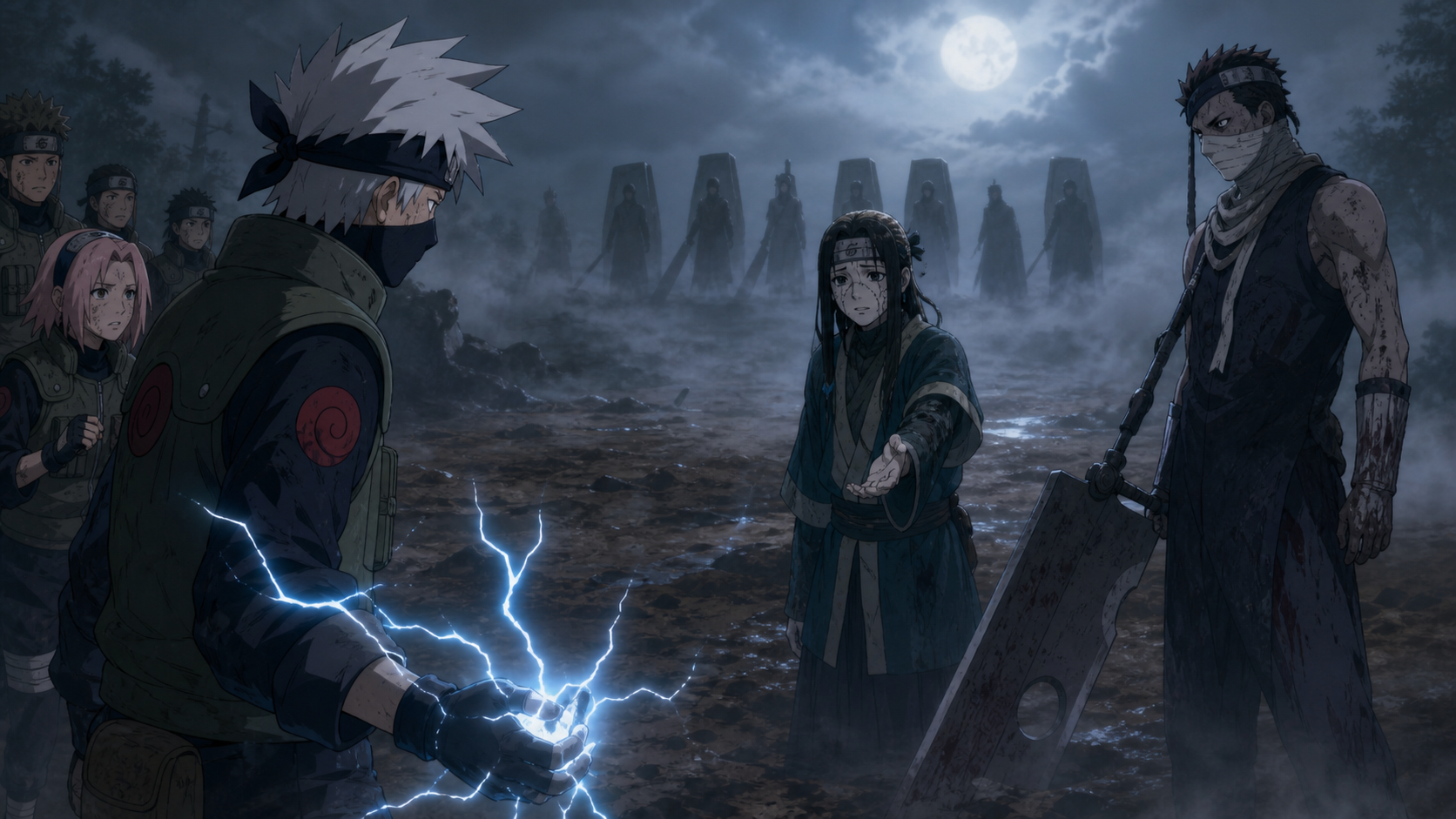
Kakashi gives Haku the truth about Zabuza’s final tears before Kabuto erases their resistance and sends the Seven Swordsmen into the mist.
Bottom line
Naruto Shippuden Episode 265 brings Zabuza and Haku back without Naruto, then proves that Naruto's words remained with them anyway. Kakashi tells Haku that Zabuza died beside him, cried for him, and stopped pretending their bond was only between a weapon and its user. Haku receives the truth he wanted in life seconds before Kabuto removes both men's personalities and forces them to attack.
The reunion is cruel because recognition changes nothing about their physical orders. Zabuza and Haku ask Kakashi to stop them while they can still speak for themselves. Kabuto hears resistance and responds by deleting the part of each person capable of objecting.
Kakashi's division arrives to save Kankurō's exhausted unit, but the battlefield expands through Scorch Release, Explosion Release, hidden mist, and six more legendary swordsmen. The old enemies are not returning for a respectful rematch. Kabuto has stripped dead shinobi from different generations into a collection built to kill people who remember them.
Kakashi arrives before the surprise unit is overwhelmed
Kankurō's Surprise Attack Division survived Deidara, Sasori, controlled captives, and Shin's explosive body. That success did not make the unit ready for another group of powerful reanimated shinobi.
Kakashi's Third Division reaches the battlefield as Zabuza, Haku, Pakura, and Gari press the attack. Reinforcement turns a collapsing position into a fight with structure.
The arrival shows why divisions exist. One team can complete its assignment and still need relief before exhaustion becomes a death sentence.
Sakura recognizes the beginning of Team 7's real education
Sakura sees Zabuza and Haku again years after the Land of Waves mission. Their first encounter forced Team 7 beyond practice drills and low-risk village work.
She watched Sasuke appear to die protecting Naruto, saw Kakashi fight an elite missing-nin, and learned how a mercenary contract could place an entire poor community under violence.
The reunion brings early fear into a war where Sakura now serves as a trained medic and experienced shinobi. Growth does not make the memory smaller.
Zabuza remembers Naruto's refusal to accept his lie
Zabuza spent much of the bridge battle calling Haku a tool. Naruto challenged that performance after Haku died protecting him.
The boy's anger forced Zabuza to confront grief he wanted to classify as weakness. His tears and final attack against Gatō showed that the bond existed beneath the language of use.
Reanimation returns Zabuza with that recognition intact. Kabuto can revive the assassin, but he cannot honestly restore the man who believed Haku meant nothing.
Haku still believes he failed Zabuza
Haku asks about Zabuza and carries guilt over failing to protect him. His sense of worth remains tied to usefulness even after death.
That belief grew from abandonment, persecution, and Zabuza's offer of purpose. Haku accepted being a weapon because the role felt safer than having no place at all.
Kakashi's answer gives him a different measure. Zabuza's final actions proved that Haku mattered as a person, not merely as successful protection.
Kakashi gives Haku the ending he never witnessed
Haku died before Zabuza admitted the truth of their relationship. Kakashi tells him what happened after his sacrifice.
Zabuza cried. He attacked Gatō despite mortal wounds. He asked to be placed beside Haku. Naruto carried their story forward.
The account cannot return the life Haku lost. The truth releases him from one false conclusion: Zabuza's grief means Haku was loved, even if that love was expressed too late and badly.
Naruto changes the battlefield while absent
Naruto remains hidden on the island, unaware that the first enemies who shaped his shinobi ethics have returned. His influence reaches the confrontation through Kakashi's testimony.
The Land of Waves taught Naruto that being treated as a tool does not erase personhood. He used that lesson later with Gaara, Sai, and others.
Episode 265 returns the lesson to its source. Haku learns that Naruto's furious insistence reached Zabuza when gentler evidence had failed.
Zabuza and Haku ask to be stopped
Both reanimated shinobi understand that Kabuto will force their bodies to fight. They tell Kakashi not to hesitate.
The request gives the living moral permission without making the task emotionally easy. Kakashi must attack people who now acknowledge the truth Naruto uncovered.
Stopping them becomes a form of respect because continued reanimation serves only Kabuto's war.
Kabuto treats selfhood as an adjustable setting
Kabuto senses resistance and suppresses the reanimated fighters' personalities. Their memories and techniques remain useful. Their objections do not.
The control reveals how little his claim of restoring the dead actually means. He wants recognizable abilities without the personhood that might refuse him.
When identity interferes with function, Kabuto deletes identity.
Anko's chakra helps him tighten control
Kabuto keeps Anko captive near his operation and uses the curse-mark connection to Orochimaru's chakra to strengthen his technique.
Her body becomes another resource without consent. Anko's history with Orochimaru, including the mark imposed on her, now supports a new man's control over other bodies.
Violence moves through systems because later abusers inherit access created by earlier abuse.
Haku protects Zabuza again after choice disappears
Once Kabuto suppresses their personalities, Haku's body resumes the familiar pattern of moving between Zabuza and danger. The action echoes the bridge.
The repetition looks like devotion, but the current body cannot freely choose the sacrifice. Kabuto exploits a technique, memory, and relationship pattern at once.
Kakashi must distinguish the love Haku felt from the control now directing how that love appears.
Zabuza's mist turns recognition into vulnerability
Hidden Mist removes visibility across the battlefield and lets Zabuza use silent killing. The allied shinobi cannot depend on clear lines or familiar formations.
Kakashi understands the method from their first fight. Experience gives him a response, not immunity.
The same mist that once isolated Team 7 now spreads across an entire division. Personal history becomes military intelligence.
Kakashi knows the enemy and still faces a different fight
Zabuza and Haku have familiar techniques, but reanimated bodies regenerate and do not tire normally. Defeating them requires restraint and sealing rather than an ordinary lethal strike.
Kabuto's control also removes hesitation that shaped their earlier battle. Zabuza can use Haku without the emotional break that Naruto once forced him to acknowledge.
Knowing a person's past does not make a coerced version predictable.
Pakura brings a village betrayal into the alliance's war
Pakura of the Sand uses Scorch Release to remove moisture from opponents with terrifying speed. Her presence adds another powerful bloodline to Kabuto's unit.
She also carries a history of being sacrificed through political deception. Sunagakure celebrated her while concealing the bargain that sent her to death.
Reanimation forces her to serve another strategy built by leaders who treat individual lives as expendable.
Scorch Release gives the battlefield no gentle warning
Pakura's heated spheres can kill through contact before a medic has any meaningful response. The technique turns positioning into survival.
Allied shinobi who focus on the mist or Zabuza's blade can die from a threat moving through another angle.
The mixed enemy unit is dangerous because each fighter changes the rules around the others.
Gari makes close combat unstable
Gari's Explosion Release detonates impact through his strikes. A normal block or exchange can become fatal at the point of contact.
His technique pressures the division to abandon familiar close-range instincts. Fighters need information before muscle memory carries them into the blast.
Kabuto selected bloodline abilities that punish different defensive habits, making coordination harder under the mist.
The dead come from villages now fighting together
Zabuza and Haku belong to Kirigakure's violent history. Pakura carries Sunagakure's betrayal. Gari represents Iwagakure strength.
The living alliance tries to overcome village grudges while Kabuto assembles the dead without caring about their former loyalties.
His army looks diverse because coercion can place anyone in the same formation. The allied army must create cooperation without that shortcut.
Kakashi's division pays for every second of uncertainty
Recognizing a former enemy creates a pause filled with memory and questions. Reanimated attackers can use that pause.
Kakashi has to share essential history quickly while commanding a large unit under multiple bloodline threats. Personal explanation competes with battlefield timing.
The war makes emotional knowledge necessary and costly at once.
Guy and Lee bring another kind of continuity
Guy and Lee arrive as part of the same allied effort. Their presence links the current war to Konoha teams that grew beside Team 7.
They do not share Kakashi's personal history with Zabuza and Haku, but they can protect the division while he reads the old enemy.
Support allows the person with specific knowledge to use that knowledge instead of handling every threat alone.
Sakura's medical role changes what survival means
Sakura once stood on the bridge feeling unable to alter the central fight. In the war, her medical skill makes her responsible for keeping a division functional through injuries caused by unfamiliar techniques.
She still cannot save everyone from instant Scorch or Explosion Release damage. Expertise has boundaries.
Her growth appears through work rather than a speech about how much stronger she has become.
The Seven Ninja Swordsmen arrive as a second wave
Six additional coffins rise, bringing legendary members of the Seven Ninja Swordsmen of the Mist into the battle. Zabuza regains the Executioner's Blade as the group forms.
The reveal changes the scale without resolving the existing threats. Kakashi's division now faces a coordinated tradition of weapons and killing styles.
The episode ends at the point where recognition must become a plan.
The swords are histories, not just upgrades
Each blade carries owners, techniques, village mythology, and deaths. Kabuto has assembled former wielders to restore a feared military institution.
The weapons make Kirigakure's Bloody Mist history physically present. Current allied shinobi must fight the legacy while working beside the village that produced that legacy.
That contradiction belongs to the alliance's larger challenge. Shared enemies do not erase what each village built.
Reanimation makes closure temporary
Zabuza and Haku already received an ending on the bridge. Their bodies were placed together, and Naruto carried their lesson away.
Kabuto reopens that ending for tactical value. The living must perform another goodbye under worse conditions.
Grief becomes renewable ammunition when a technique can retrieve the dead without their permission.
Kakashi carries Naruto's witness responsibly
Kakashi does not claim that Zabuza became innocent or that Haku's devotion was healthy. He reports the specific evidence Naruto forced into view.
Zabuza cared. Haku mattered. Their final actions proved more than Zabuza's earlier language admitted.
That accurate witness gives Haku dignity without rewriting the violence they committed.
Haku receives the truth too late and still needs it
Zabuza’s tears give Haku dignity, not reimbursement for his life.
Zabuza’s love does not sanitize the life they lived
Naruto was right that Zabuza cared. Care did not prevent Zabuza from training Haku as a killing tool, accepting his self-erasure, or taking contracts that placed civilians under violence. The tears reveal a person beneath the performance. They do not make the performance harmless.
That complication is why the relationship endures beyond a simple villain redemption. Zabuza could love Haku and fail him. Haku could choose devotion inside choices narrowed by fear and survival. Naming affection matters because affection was denied. Naming the damage matters because love alone did not protect either of them.
Kakashi becomes the witness Naruto cannot be today
Naruto is hidden far from the battle, but Kakashi carries the words he shouted on the bridge. A witness has responsibilities beyond remembering accurately. Kakashi must deliver the ending without turning himself into its hero or reducing Haku’s need to a convenient battlefield weakness.
He tells the specific truth: Zabuza cried, fought Gatō, and asked to lie beside Haku. The account belongs to the dead men and to the boy who forced honesty into the open. Kakashi’s role is to make sure Kabuto does not become the only person narrating their return.
Asking to be stopped is the last choice Kabuto allows
Zabuza and Haku understand what their bodies are about to do. Their warning does not free them, but it tells Kakashi how to read the coming violence. Every attack after suppression belongs to Kabuto’s command, even when it travels through techniques the two men once used willingly.
The request changes restraint into respect. Kakashi is not ignoring their humanity when he prepares to seal them. He is honoring the final instruction they gave while instruction was still possible. Reanimation makes death reversible and consent brutally brief.
Kabuto keeps memory only until memory develops an opinion
Kabuto preserves memory when it unsettles the living and deletes it when the dead resist, proving restoration was never his purpose; control remained the point.
Haku’s repeated sacrifice is not automatically the same act
On the bridge, Haku chose to intercept Kakashi’s strike for Zabuza. That choice grew from a relationship shaped by dependency and genuine devotion. In the mist, his reanimated body repeats protection after Kabuto suppresses the self capable of deciding.
The visual rhyme invites emotion while demanding precision. Love explains why the first act meant something. It cannot be used to authorize the second. Kabuto steals a familiar movement because witnesses may confuse recognizable devotion with continuing consent.
The alliance fights history without pretending history is innocent
Kakashi’s division includes people from villages that once feared, employed, betrayed, or celebrated the dead now attacking them. Zabuza carries the Bloody Mist. Pakura carries Suna’s political betrayal. Gari carries Iwa’s military legacy. The Seven Swordsmen turn institutional memory into formation.
Defeating them cannot mean declaring the living villages morally clean. The alliance must stop weaponized history while remaining accountable for the systems that produced it. Kabuto’s coercion is the immediate enemy. It does not erase the choices leaders made before he opened the coffins.
Sakura’s growth appears in what she can hold, not what she can defeat
The child on the bridge once watched two teammates fall and understood how little control she had over the encounter. The medic in this war can triage a division, identify survival priorities, and keep soldiers available while legendary techniques tear through the mist.
That is power even when it does not receive the clean image of a decisive strike. Sakura cannot heal instant death or remove Kabuto’s command. She can preserve people between attacks, which determines whether Kakashi’s strategy has anyone left to carry it out.
The swordsmen reveal how legends flatten the people carrying them
Each famous blade arrives with techniques, former owners, and a reputation larger than the person currently forced to wield it. The reveal is designed to thrill because viewers recognize a feared institution before understanding every man inside the line.
Kabuto depends on that flattening. A collection is easier to command than seven complicated histories. The alliance will need specific knowledge, not awe. Naming the swords, weaknesses, loyalties, and deaths becomes a way to return individuality to figures the battlefield presents as one legendary threat.
Another goodbye cannot replace the first one Kabuto violated
Zabuza and Haku already had an ending. Snow fell, the bridge received a new name, and their bodies were placed together. Naruto carried the lesson forward into relationships neither man lived to see.
Reanimation forces Kakashi and Sakura to reopen grief for tactical survival. Sealing them again may restore rest, but it cannot make the intrusion neutral. The living should not have to prove love repeatedly because a stranger found a technique capable of repossessing the dead.
What landed
The reunion works because Episode 265 lets Zabuza and Haku remember before Kabuto suppresses them. Their request to be stopped makes the coming fight an act of release rather than simple revenge.
Kakashi telling Haku about Zabuza's tears gives the Land of Waves ending a new recipient. The truth reaches the person who most needed to hear those words.
Pakura and Gari prevent the battlefield from becoming a nostalgia-only rematch. Their bloodline techniques show how Kabuto combines histories into new tactical danger.
What did not fully land
The Land of Waves flashback occupies substantial time in an episode that also introduces two bloodline users and the Seven Swordsmen. Longtime viewers may feel the recap slowing a battle already crowded with setup.
Some reconstructed flashback staging does not match the original sequence cleanly. The emotional point survives, but continuity mistakes are distracting in a scene built around memory.
Pakura and Gari arrive primarily as powers before the episode gives their personal histories room. Their inclusion broadens the war while leaving their own coercion less developed than Zabuza and Haku's.
Final reaction
Naruto Shippuden Episode 265 proves that an old enemy can return without restoring the old relationship. Kakashi no longer sees Zabuza and Haku only as targets from Team 7's first serious mission. Naruto forced everyone on that bridge to recognize the care hidden beneath Zabuza's language of tools.
Haku finally learns that Zabuza cried, fought for him, and wanted to lie beside him in death. Then Kabuto removes the personalities capable of holding that truth. The sequence makes Reanimation Jutsu more obscene than a simple zombie army. Kabuto preserves every useful technique and discards the self who can object.
Kakashi's duty is therefore harder and clearer. He must stop Zabuza and Haku because he now understands them better, not because understanding disappeared. As the Seven Swordsmen rise through the mist, the war asks the living to defeat history without letting Kabuto decide what that history meant.
RaeRae’s call
Haku finally hears that Zabuza loved him, then Kabuto erases the self capable of answering. Kakashi must fight harder because he understands them now. Recognition makes release a responsibility, not an excuse to soften what either man did in life.
Episode details and viewing routes
- Official episode reference: Naruto Official episode guide
- Licensed episode route: Crunchyroll licensed episode page