
For My Friend
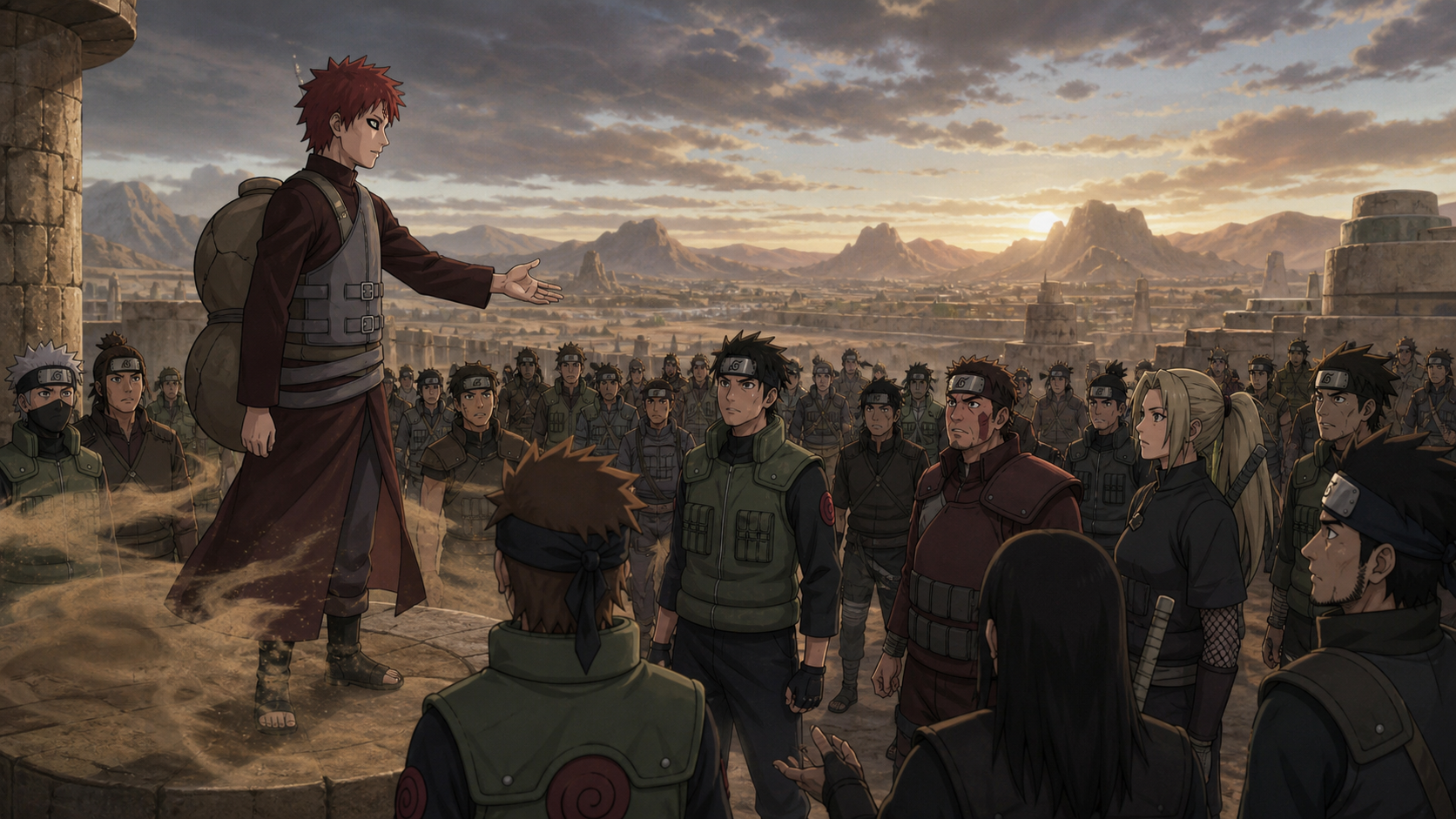
Gaara confronts the hatred inside the allied ranks and asks former enemies to help protect the friend who proved another future was possible.
Bottom line
Naruto Shippuden Episode 261 returns to the present with an army that has uniforms, commanders, and one serious problem: the shinobi still remember what the other villages did to them. Gaara stops a fight, tells the truth about the hatred that once ruled him, and asks thousands of soldiers to help protect the friend who pulled him out of that life. His speech works because Gaara offers his own history as evidence. He does not pretend decades of bloodshed disappeared when the leaders signed an alliance.
Naruto never enters the gathering, yet his choices shape the entire scene. He befriended Gaara when both boys had every reason to treat connection as a trap. Gaara now converts that private rescue into public leadership. The alliance does not unite around a slogan. Soldiers unite around proof that an enemy can become a friend and that a weaponized child can choose another future.
That emotional victory has limits. One speech cannot repay dead families or settle every border grievance. Gaara creates enough shared purpose for the army to move together today. With Kabuto's dead shinobi and Tobi's White Zetsu army already advancing, today is the deadline that matters.
The war returns after four weeks of memory
Four anniversary episodes pulled the story back through Team 7's formation, the Chūnin Exams, Sasuke's isolation, and his departure. “For My Friend” finally returns to the Fourth Shinobi World War.
The placement gives Gaara's speech extra weight. Viewers have just watched Naruto fail to bring Sasuke home at the Valley of the End. Naruto still changed another lonely boy enough for Gaara to stand before the allied army years later.
The retrospective was badly timed for momentum, but the transition reveals a result Naruto could never see during those early failures. Saving one person did not solve every problem. Saving Gaara gave the coming war a commander capable of speaking from the wound everyone else wants to hide.
An alliance on paper is not trust in the field
The Five Great Shinobi Countries agreed to cooperate against Akatsuki. Their soldiers did not receive a magical memory wipe with the orders.
Old enemies stand together while remembering killed relatives, invaded territory, stolen techniques, and missions that rewarded one village for hurting another. Some shinobi use the gathering to restart those arguments. The hostility makes practical sense even when the timing is reckless.
Military cooperation requires soldiers to trust the person beside them with warning, support, and retreat. A shared vest cannot manufacture that trust. The alliance needs a reason stronger than the resentment each village taught its children.
Gaara stops the fight without dismissing the grievance
Gaara uses sand to separate shinobi before their argument becomes a larger brawl. He exercises command first, then explains why command should mean more than forced silence.
He does not call the soldiers childish or order them to forget their dead. Gaara acknowledges that the villages hurt one another and that hatred has a history. That choice keeps the speech from becoming cheap harmony.
The soldiers need discipline, but they also need recognition. Gaara treats their anger as dangerous and real. A leader can interrupt violence without pretending the people involved imagined the cause.
Gaara's authority comes from surviving the same system
Gaara is young enough that some soldiers could reasonably question why he commands the Main Battle Regiment. His title as Kazekage supplies formal authority. His life supplies the harder answer.
Sunagakure turned Gaara into a jinchūriki weapon, isolated him, tried to kill him, and then expected him to embody village strength. Other villages used different methods, but every uniformed person in the crowd understands a system that converts children into military assets.
Gaara does not speak as a protected politician giving troops a lesson about sacrifice. He speaks as someone whose village planted the war inside his body before he could consent.
He names the person he used to be
Gaara tells the alliance that hatred once controlled him. He lived for himself and believed killing proved his existence because human connection had become another source of danger.
That confession risks his image. Commanders usually project certainty and strength before battle. Gaara admits that he was violent, lonely, and wrong.
The honesty matters because his argument depends on change being possible. If Gaara hides the former assassin and shows only the respectable Kazekage, the army receives a polished success story. By naming both lives, he gives them a transformation with visible cost.
Naruto reached Gaara because he recognized the loneliness
Naruto defeated Gaara during the Konoha invasion, but force alone did not create their friendship. Naruto understood the loneliness beneath Gaara's violence because both villages had made children carry tailed beasts and then punished those children for frightening everyone.
Their lives did not become identical. Naruto found Iruka, Team 7, and people willing to acknowledge him. Gaara received fear, assassination attempts, and a lie about the one person he believed loved him.
Naruto recognized the common wound without claiming every detail matched. That distinction helped Gaara hear him.
Friendship becomes political evidence
Gaara tells thousands of shinobi that Naruto saved him and became his friend. A private relationship becomes evidence for a public argument.
Naruto represents more than a valuable jinchūriki target. His history with Gaara proves that inherited hostility does not control every future choice. Two children positioned as weapons by different villages found enough understanding to reject the role.
Gaara asks the alliance to protect that possibility. The request makes friendship part of military strategy without reducing Naruto to a mascot.
Protecting Naruto corrects the alliance's original language
The alliance formed partly because Akatsuki hunts Naruto and Killer B. Leaders often describe jinchūriki through security language: assets, targets, weapons, containers, risks.
Gaara says friend. The word returns personhood to a boy whose body carries power every faction wants to control.
Protecting Naruto still serves the war effort. The difference lies in why the protection matters. Gaara refuses to let strategy erase the human relationship that gives him a reason to fight.
The speech does not erase what the villages owe
Soldiers begin apologizing and lowering their hostility after Gaara speaks. The change is moving, but nobody should confuse immediate cooperation with full repair.
A soldier who lost family to another village may choose not to attack an ally today. That decision does not settle responsibility, compensation, truth, or grief. Those questions remain after the battlefield.
Gaara's speech succeeds because the goal stays narrow enough to be honest. He asks the army to fight together for a shared future. He does not declare every old wound healed.
Mifune's alliance still needs shinobi to choose participation
The samurai general Mifune serves as commander-in-chief, while Gaara commands the main force. Titles create a chain of command across countries that normally protect their own interests.
No command chart can make a Stone shinobi value a Leaf shinobi's survival. Soldiers must choose cooperation in hundreds of small battlefield decisions.
Gaara gives those choices a human reason. The army follows because enough people accept the argument, not because a seal on an order compels genuine loyalty.
The five divisions turn ideals into jobs
The Allied Shinobi Forces divide their strength by combat function. Darui leads the First Division's mid-range fighters. Kitsuchi commands the Second Division's close-range specialists. Kakashi leads the Third Division's short-to-mid-range unit. Gaara commands the Fourth Division's long-range fighters, and Mifune leads the Fifth Division's special battle unit.
Those assignments matter because unity needs structure. A moving speech without logistics would leave thousands of inspired people colliding on the road.
The alliance pairs emotional purpose with roles, routes, communication, medical support, intelligence, and command. Cooperation becomes work.
Shikamaru watches leadership become larger than one team
Shikamaru has led missions where every decision placed a friend's life against the objective. The allied army expands that burden beyond anything a squad leader can fully track.
His generation grew up inside village rivalries and now inherits responsibility for preventing those rivalries from destroying the coalition. Young commanders must work with adults who helped maintain the old system.
Gaara's speech gives Shikamaru and the others a common direction. Their decisions will determine whether the direction survives contact with the enemy.
The army's enemy has been denied ordinary choice
Kabuto fields reincarnated shinobi whose bodies and techniques have been forced back into war. Tobi fields White Zetsu copies grown for infiltration and mass combat.
The allied army has conflict because living people carry memory, loyalty, fear, and judgment. Those complications create danger, but they also make moral choice possible.
Gaara asks flawed people to cooperate voluntarily. Kabuto treats the dead as inventory. The contrast gives the opening of the war a clear human fault line.
Kabuto makes history fight the present literally
The Reanimation Jutsu turns famous shinobi, former leaders, bloodline users, and private grief into weapons. Old wars no longer survive only in the soldiers' memories. Kabuto can place the dead directly in front of the people who mourned or feared them.
That method exploits the same unresolved history Gaara addresses. The alliance must face former enemies, former family, and legends their villages taught them to revere.
Unity will require more than standing in formation. Each division must keep choosing the living future while history speaks through stolen bodies.
Anko's capture gives Kabuto another advantage
Kabuto has captured Anko after her attempt to trace the enemy's hideout. Her connection to Orochimaru and the curse mark gives Kabuto access to power he understands how to exploit.
The capture also reminds viewers that intelligence work carries personal cost before the main armies meet. Anko does not become a simple piece of background information because the battlefield has grown larger.
Kabuto uses bodies, memories, and former bonds as resources. His treatment of Anko fits the larger pattern that makes his army so disturbing.
Naruto remains protected from the truth
Naruto trains away from the battlefield while the alliance limits what he knows about the war built partly around him. Leaders fear that he will rush toward danger and give Akatsuki the target they need.
The strategy has practical logic and repeats a familiar failure. Adults protect Naruto by controlling information and deciding how much agency he can safely hold.
Gaara asks an army to fight for his friend while that friend cannot decide how to participate. The contradiction will not stay contained for long.
Gaara gives Naruto credit without turning him into a saint
Naruto changed Gaara's life, but the episode does not need Naruto to appear flawless for the story to work. Naruto can be reckless, intrusive, loud, and painfully convinced that persistence will solve a refusal.
He also saw a person where villages saw a monster. That act had consequences beyond either boy's knowledge at the time.
Gaara's testimony honors a specific choice. The speech does not require every audience member to worship Naruto or forget his mistakes.
The apology in the ranks is a beginning
Shinobi who were arguing begin apologizing. The moment could have felt false if the episode claimed permanent reconciliation.
Instead, the apologies function as a battlefield decision. The soldiers acknowledge that carrying the feud into formation will help the enemy kill all of them.
An apology before war cannot rebuild a family or rewrite a mission report. The apology can stop one fist, create one reliable partner, and keep a division moving. Those outcomes count.
Gaara asks for strength instead of obedience
Gaara could end with an order. He asks the army to lend him strength so he can protect the friend who saved him.
The request exposes need, which conventional military performance often hides. Gaara cannot protect Naruto or defeat Akatsuki alone. A Kazekage still depends on people from villages that once treated Suna as an enemy.
That admission makes his leadership collective. He provides direction and accepts dependence at the same time.
The war begins with a choice about belonging
The Allied Shinobi Forces move out under one banner. The image is thrilling because every soldier still carries a village history beneath the shared symbol.
Belonging to the alliance does not require erasing those identities. The immediate test asks whether shinobi can treat difference as something other than permission to kill.
Gaara frames Naruto as his friend, then invites the army to make that protection their work. Personal belonging expands without becoming ownership.
Gaara does not ask the army to forgive on command
Gaara asks wounded soldiers to suspend vengeance without erasing its history.
His confession turns political authority into personal risk
Gaara could hide behind the Kazekage title and issue an order. Instead, he tells thousands of armed strangers that hatred once governed him and that another boy’s compassion changed his life. The admission gives opponents material they could use to question his stability, youth, or right to command.
That vulnerability is the evidence. Gaara is not selling optimism from outside the problem. He has been the isolated weapon, the violent child, the enemy at Konoha’s wall, and the leader saved by people his village once attacked. Every version of him stands behind the promise that change is difficult and still possible.
Naruto’s absence keeps the speech from becoming self-congratulation
Naruto never hears the praise; the consequence of his earlier compassion unfolds entirely beyond his knowledge.
That matters on a site full of heroes who are often praised in the same scene that proves them heroic. Naruto reached one person because he recognized pain he knew intimately. Years later, that person uses the rescue to prevent thousands of soldiers from attacking one another. Care becomes legacy without requiring its source to supervise the result.
The alliance needs one purpose without pretending to be one culture
Shared uniforms and division assignments organize bodies. They do not erase accents, village techniques, clan obligations, or political memory. Unity becomes dangerous when it demands that difference disappear before people qualify as trustworthy.
Gaara offers another model. Stone, Cloud, Mist, Sand, Leaf, and samurai can remain distinct while choosing a common protection. They do not need identical histories to recognize Akatsuki’s plan to reduce living people to tools. Belonging expands because the mission makes room for difference, not because every soldier becomes interchangeable.
Kabuto answers voluntary alliance with stolen obedience
The living army is noisy, resentful, frightened, and capable of saying no. Kabuto’s reanimated forces appear more efficient because consent has been removed. Their skills, faces, and histories remain while their bodies are turned toward objectives selected by someone else.
That contrast gives Gaara’s messy coalition moral weight. Voluntary cooperation requires speeches, apologies, logistics, doubt, and repeated decisions in the field. Forced unity requires a controller. The alliance’s friction is not merely a weakness for the enemy to exploit. It is evidence that the people inside it are still people.
“For my friend” is intimate enough to hold a world war
Gaara does not finish with an abstract promise to history. He asks for strength to protect Naruto. One named relationship gives the enormous military formation an emotional scale a map cannot provide.
The phrase risks making the war sound as though one famous boy matters more than every soldier present. Gaara avoids that trap by making Naruto proof, not royalty. Protecting him means protecting the possibility that enemies can interrupt what their villages taught them and become responsible for one another’s future.
What landed
Gaara's speech earns the episode because the argument grows from his complete history. The frightened child, violent weapon, defeated enemy, rescued Kazekage, and military commander all stand in the same place.
The soldiers' resentment gives the alliance believable friction before the first major clash. Cooperation has meaning because hostility was never absent.
The contrast between living shinobi choosing unity and Kabuto forcing the dead into service sets the war's moral stakes without a lecture about good and evil.
What did not fully land
The turnaround in the ranks happens very quickly. Immediate battlefield discipline makes sense, while deeper reconciliation would require scenes the episode does not have time to show.
Several division commanders receive titles and deployment shots more than developed perspective. The scale is exciting, but individual soldiers risk becoming proof that Gaara's speech worked.
Returning from four recap episodes also forces “For My Friend” to restart momentum that the war preparation had already built. Gaara deserves this spotlight. The broadcast placement still makes the story feel as though somebody released the brake after a month.
Final reaction
Naruto Shippuden Episode 261 gives Gaara one of the best leadership moments in the series because he refuses the easy version of unity. The villages harmed one another. Their soldiers remember. Gaara does not ask them to call that history imaginary or harmless.
He gives them a present-tense reason to choose differently. Naruto once met Gaara inside loneliness and refused to leave him there. Gaara now stands before former enemies and admits that friendship changed what kind of man he could become. His request turns gratitude into responsibility without hiding how much support he needs.
The allied army moves because thousands of shinobi accept one limited, urgent truth: they can settle old accounts later only if they survive the enemy coming now. The Fourth Shinobi World War begins with weapons, divisions, and resurrected legends, but the first victory belongs to a young commander who stops his own side from fighting long enough to remember whom they chose to protect.
RaeRae’s call
Gaara earns the army’s attention because he does not sell forgiveness as amnesia. He asks wounded people to choose one another for a day, and his own life proves that one day of choosing differently can become an entirely different future.
Episode details and viewing routes
- Official episode reference: Naruto Official episode guide
- Licensed episode route: Crunchyroll licensed episode page