
Parting
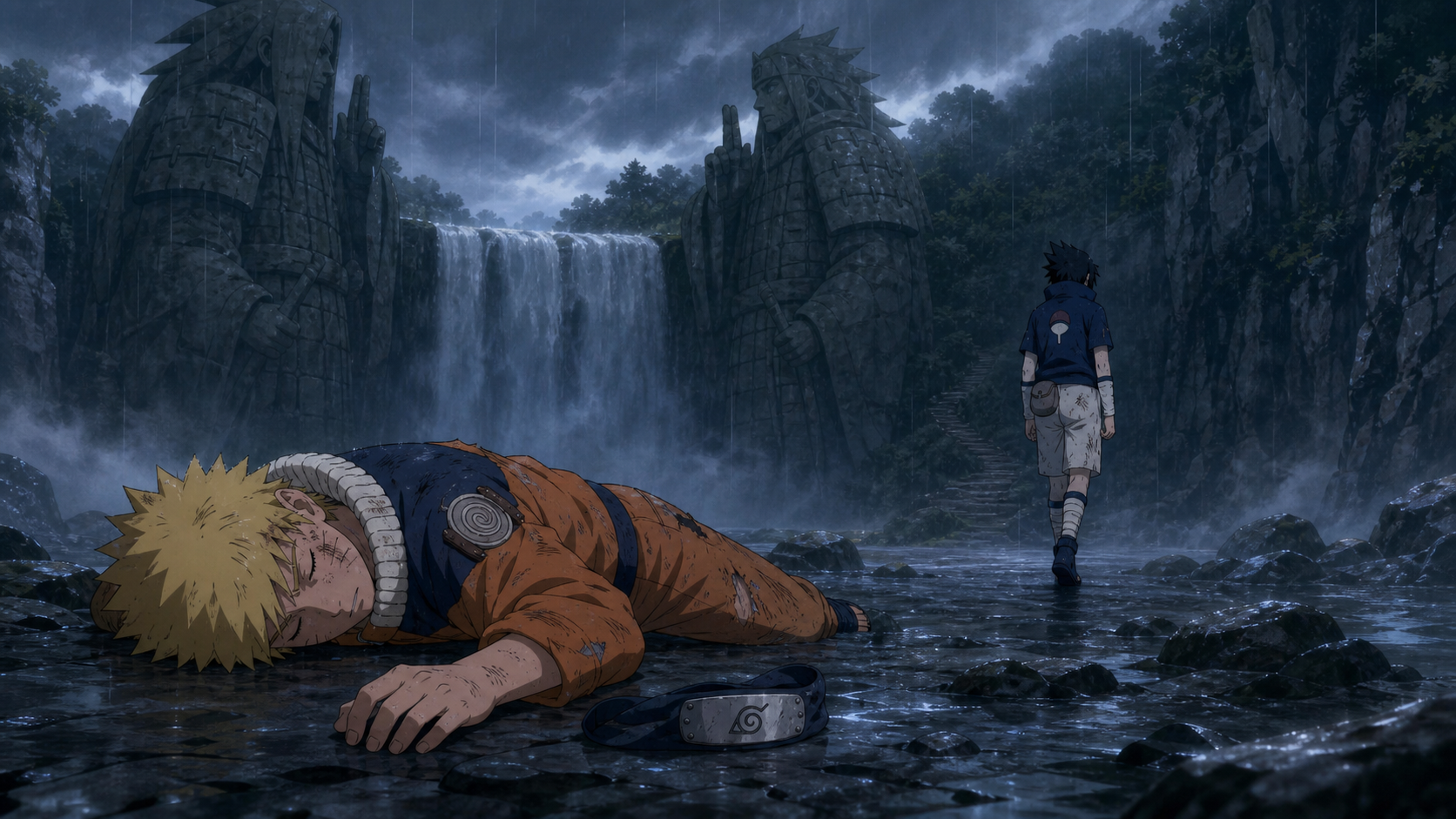
Naruto calls Sasuke his brother at the Valley of the End, but Sasuke chooses Orochimaru and leaves the scratched forehead protector behind.
Bottom line
Naruto Shippuden Episode 260 closes the anniversary retrospective with Sasuke choosing Orochimaru, Naruto choosing the bond Sasuke denies, and several other children nearly dying inside the distance between those choices. The Valley of the End fight gets the iconic finish, but “Parting” begins with a village failure. Konoha knows Orochimaru marked Sasuke, knows revenge controls his decisions, and still leaves enough space for the Sound Four to walk him out at night.
Naruto says Sasuke is the closest thing to a brother he has ever had. Sasuke says Naruto cannot understand losing family because Naruto never had family to lose. Both claims contain pain and unfairness. Naruto knows loneliness without memory. Sasuke knows love transformed into traumatic memory. Their similarities create recognition, while the differences give each boy a weapon to use against the other.
Sasuke wins and leaves Naruto alive. That mercy matters because he refuses to gain power through the exact method Itachi prescribed. The choice does not make the departure kind. Sasuke walks toward a man who wants his body, leaves his teammates to collect the wounded, and turns Naruto's survival into another burden Naruto will carry back to Sakura.
Sasuke accepts leadership of the people who just humiliated him
The Sound Four greet Sasuke as their leader once he leaves Konoha. The title flatters his status while hiding the real command structure. Orochimaru owns the mission, controls the promised power, and expects Sasuke to become a future vessel.
Sasuke dismisses the ceremony because reaching Orochimaru matters more than rank inside the escort. His impatience sounds like control. The route has already been chosen by people who understand his desperation.
Calling him leader helps the recruitment feel voluntary even while every part of the journey narrows his ability to turn back.
Leaving at night avoids the relationships most likely to stop him
Sasuke does not announce a principled departure to Team 7 or request a formal release from service. He leaves while the village sleeps.
The secrecy protects him from Naruto's challenge, Kakashi's warning, and Sakura's plea. Those relationships matter enough that facing them would make the choice harder.
Avoidance does not prove that Sasuke feels nothing. Leaving quietly proves that attachment remains an obstacle he must manage.
Sakura's plea identifies the emotional truth Sasuke refuses to use
Sakura intercepts him and asks him to stay. She speaks from love, fear, and the knowledge that Orochimaru's interest cannot end safely.
Her offer to help, even to go with him, shows how desperate she has become to preserve connection. Sasuke thanks her before knocking her unconscious and placing her out of immediate danger.
The gratitude is real. The act still removes her choice. Sasuke responds to care by deciding what the caring person is allowed to do.
Konoha turns a defection crisis into another mission for children
Shikamaru receives command of the retrieval team shortly after becoming a chūnin. Naruto, Chōji, Neji, and Kiba join him, with Akamaru as Kiba's partner.
The team has talent and almost no experience with a mission this politically and personally dangerous. Adult manpower is limited after the invasion, so institutional shortage becomes adolescent responsibility.
Konoha wants Sasuke recovered because he is a comrade, an Uchiha, a security risk, and a target carrying forbidden power. The young team carries all those stakes without receiving adult-level support at departure.
Shikamaru defines comradeship before he knows the cost
Shikamaru admits that he does not particularly like Sasuke. He still promises to risk his life because Sasuke is a Leaf shinobi and therefore a comrade.
The speech gives the mission an ethic beyond Naruto's personal attachment. A village cannot abandon a child because rescuing him is inconvenient.
The principle is admirable and dangerous. A system that sends children to die for comrades must also ask why adults allowed the comrade to reach this point.
The retrieval formation is built around sacrifice from the beginning
Shikamaru organizes the group by tracking ability, combat strength, perception, and response speed. The formation reflects thoughtful command.
The Sound Four repeatedly force one Leaf shinobi to remain behind so the others can continue. Each decision preserves the objective by concentrating risk on one child.
The mission advances through subtraction. Progress toward Sasuke is measured by how many friends Naruto must leave fighting alone.
The Mind Awakening Pill makes power look like medical procedure
Sakon and Ukon tell Sasuke that reaching the curse mark's second state requires a pill and suspended animation. The Sound Four seal him inside a barrel while managing the transformation.
The process uses the language and posture of treatment, but Orochimaru's goal is control. Sasuke entrusts his unconscious body to people who serve the man planning to take that body permanently.
He accepts because power now feels urgent enough to justify dependence on the least trustworthy people available.
The barrel turns Sasuke into cargo before Orochimaru ever receives him
Once sealed, Sasuke cannot direct the journey or respond to the battles fought around him. The person named leader becomes an object transported by the escort.
That image exposes the contradiction in his plan. He leaves Konoha seeking autonomy from its limits and immediately gives physical control to Orochimaru's system.
The Sound Four protect the barrel because Sasuke's value lies in what their master wants to do with him, not because they respect his freedom.
Chōji spends his body to keep the route open
Chōji remains behind against Jirōbō and uses clan pills that can cause devastating physical consequences. His commitment contradicts every shallow judgment that treated him as comic relief or a weak link.
He risks death for a teammate who has already chosen to leave. The sacrifice comes from loyalty to the retrieval group and faith that bringing Sasuke back matters.
Naruto later invokes that cost at the Valley because Sasuke's indifference would make Chōji's suffering feel disposable.
Neji names Sasuke's darkness while accepting his own dangerous assignment
Neji stays behind to fight Kidōmaru and tells Naruto to continue. The boy who once described destiny as fixed now chooses a role that may kill him so another teammate can reach Sasuke.
His warning that Sasuke is lost in darkness does not mean Sasuke is beyond recovery. Neji recognizes that pursuit requires more than winning a race.
Naruto carries that warning forward while refusing to accept the conclusion Sasuke offers at the valley.
Every fight makes Naruto's promise more expensive
Kiba and Akamaru face Sakon and Ukon. Shikamaru confronts Tayuya. Lee and Gaara become part of the effort against Kimimaro. The retrieval extends across people who have complicated histories with one another.
Naruto cannot see every outcome while chasing Sasuke. He knows friends are staying behind and may not survive.
That uncertainty fuels his anger when Sasuke dismisses the team's effort. Naruto is not speaking only for himself. He is carrying the risk everyone else accepted.
The Valley of the End turns political history into a stage for personal rupture
Naruto catches Sasuke beneath statues of Hashirama and Madara, two founders whose relationship shaped Konoha and ended in conflict at the same site.
The setting does not force Naruto and Sasuke to repeat history, but the parallel warns how personal wounds can become institutional consequences. Their future strength will affect far more than Team 7.
Two children argue under monuments to adults who also failed to find a durable way to share power and trust.
Naruto asks for return while Sasuke hears imprisonment
Naruto tells Sasuke to come back because Konoha, Team 7, and the retrieval group still claim him as a comrade. Sasuke hears the request as a demand to accept limits that leave him unable to defeat Itachi.
Neither boy can supply the condition the other needs. Naruto cannot promise that Konoha's training will satisfy Sasuke's revenge. Sasuke cannot admit that leaving may destroy the relationships he still values.
The conversation becomes physical because each boy treats the other's refusal as proof that words have failed.
Sasuke weaponizes the difference between never having family and losing family
Sasuke tells Naruto that an orphan who never knew his parents cannot understand losing an entire clan. The distinction is factually real and emotionally cruel.
Naruto lacks memories to grieve, which means he also lacks the history Sasuke can hold. His pain comes from absence without explanation. Sasuke's pain comes from love remembered through murder.
One form of loss does not disqualify the other. Sasuke uses the difference to deny connection because connection threatens his decision.
Naruto calls Sasuke a brother because rivalry became his first chosen family
Naruto says Sasuke is the closest person to a brother he has known. The claim explains why retrieval becomes personal beyond village orders or Sakura's request.
Their bond formed through competition, meals, missions, rescue, jealousy, and recognition. Neither boy needed a formal declaration for attachment to become real.
Naruto's language also carries pressure. Calling someone family does not grant ownership over his choices. The bond creates obligation to care and reason to intervene, not a simple right to force return.
The forehead protector turns acknowledgment into a challenge
Sasuke initially dismisses Naruto's claim that he might scratch the Leaf symbol. He eventually wears the protector and accepts Naruto as an opponent worth facing seriously.
The scratch proves Naruto can reach him. The band also represents the village Sasuke is leaving and the teammate identity he denies while still responding to its symbols.
Leaving the protector behind after the fight makes the departure material. Sasuke abandons an affiliation while carrying the relationship that caused the mark.
Curse-mark power offers freedom through visible loss of self
Sasuke enters the second state and his body changes under Orochimaru's seal. The transformation gives him power sufficient to answer Naruto's tailed-beast chakra.
The visual cost is part of the warning. Sasuke seeks autonomy and gains strength through a mark another man placed on him for possession.
He interprets control of the transformation as control of the bargain. The future will show how much work that assumption requires.
Naruto's one-tailed cloak makes protection look frightening too
Naruto draws on Kurama's chakra until a one-tailed cloak surrounds him. The power lets him keep pace with Sasuke's curse state.
His goal is rescue, but the force used to rescue can injure the person he wants to save. The visual refuses a clean division between loving motive and dangerous method.
Both boys use power connected to adults and entities that shaped their bodies without childhood consent. The fight becomes a contest between inherited violations as much as personal skill.
The final collision cannot solve the argument underneath
Rasengan and Chidori meet with more power than the rooftop clash. The attacks settle who remains standing, not whether Sasuke's departure is justified or whether Naruto understands his grief.
Sasuke wins. Naruto cannot fulfill the mission or the promise to Sakura.
The result proves that force alone cannot restore a relationship when one person has decided departure is necessary. Naruto will need more than greater strength if he wants a different ending later.
Sasuke spares Naruto and rejects one part of Itachi's script
Itachi told Sasuke that killing his closest friend could awaken greater ocular power. Sasuke stands over Naruto with the opportunity to follow that instruction.
He leaves Naruto alive and decides he will gain power by his own method rather than copying his brother's path. The choice preserves a line of autonomy inside his defection.
Mercy does not undo the violence or the abandonment. The decision proves that Naruto matters enough for Sasuke to refuse a power route built on killing him.
Kakashi arrives after the choice has already become distance
Kakashi and Pakkun find Naruto after Sasuke has gone. The adult capable of challenging the Sound Four and confronting Sasuke reaches the valley too late.
That timing summarizes the arc's institutional failure. Adults recognize the danger, but children absorb the immediate cost while support races behind them.
Kakashi carries Naruto home. Sasuke continues toward Orochimaru. Rescue and prevention separate into two different tasks.
Naruto's apology to Sakura makes failure his private debt
Naruto returns without Sasuke and feels that he has broken his promise to Sakura. The apology treats the outcome as a personal failure even though an under-supported child team faced Orochimaru's elite guards.
Sakura shares the grief, and the mission's failure will shape both of them. Neither child created the conditions that drove Sasuke away.
Naruto still converts the loss into a future vow. Persistence helps him survive disappointment, but the habit also lets the village place impossible responsibility on him.
Sasuke’s thank-you is a goodbye, not absolution
Sakura reaches Sasuke with every argument available to a frightened twelve-year-old. She names loneliness, offers help, confesses love, and finally threatens to call for help. His quiet thank-you confirms that her care reached him. It does not mean he accepted what that care asked.
Knocking her unconscious keeps the Sound Four from harming her and prevents her from following. It also lets Sasuke control the farewell completely. He receives her vulnerability, withholds his own, and removes her ability to choose what risk she will take. Tenderness and violation occupy the same scene.
The retrieval team pays for an adult system’s delayed response
Every child left behind makes the mission feel noble and makes Konoha’s preparation look worse. Orochimaru marked Sasuke during a sanctioned exam, invaded the village, killed its Hokage, and continued recruiting its most vulnerable survivor. None of this threat was hidden.
Yet Shikamaru receives a handful of peers and the instruction to improvise. Their courage is not proof the deployment was reasonable. It is proof children will build loyalty inside bad conditions and then spend their bodies protecting one another from dangers adults already understood.
Naruto’s promise to Sakura becomes larger than either of them intended
The promise carries every friend’s sacrifice into Naruto’s final demand for return.
The Valley of the End makes inheritance look inevitable
Hashirama and Madara loom above the boys like a conclusion carved before either child arrived. The image invites us to read Naruto and Sasuke as repetition: the land remembers the wound.
Hashirama and Madara’s inheritance narrows the boys’ choices, but history never makes those choices innocent, automatic, or entirely inevitable for them. They still make choices. The tragedy is that their available choices have been narrowed so thoroughly that reenactment feels natural.
Sparing Naruto is the choice that proves the bond survived the victory
Sasuke can follow Itachi’s instruction, gain power through murder, and turn his closest relationship into fuel. He refuses. For once, rebellion against his brother matters more than the efficiency of revenge.
That refusal is not a secret rescue that cancels everything else. Naruto is injured, friends are scattered across battlefields, and Sakura wakes alone on a bench. Mercy tells us Sasuke has not become indifferent. It makes departure sadder because love remains present while he chooses separation anyway.
Naruto survives with evidence that love cannot command an outcome
Naruto often treats effort as the bridge between impossible desire and eventual success. The valley gives him an unbearable exception. He tries harder, risks more, understands something real about Sasuke, and still fails to bring him home.
The lesson is not that the bond was false. The scratched forehead protector and Sasuke’s mercy prove otherwise. The lesson is that another person’s love can create responsibility without creating ownership. Naruto’s future task is not simply becoming strong enough to win. It is learning how salvation can leave room for Sasuke to choose life himself.
What landed
The episode keeps the emotional center on the cost paid by the retrieval team. Chōji, Neji, Kiba, Shikamaru, Lee, Gaara, and others make Sasuke's departure a communal event rather than a private duel.
Sasuke sparing Naruto remains the most important complication. He chooses Orochimaru without fully surrendering his decisions to Itachi's model of power.
The scratched forehead protector works as a clean visual record of recognition, conflict, village identity, and separation.
What did not fully land
Compressing the retrieval mission into one episode reduces several near-fatal fights to evidence supporting Naruto's argument. Those characters deserve more than being stakes for Sasuke's choice.
Sakura's goodbye and Naruto's later apology remain framed around Sasuke while her own sense of powerlessness receives limited development.
The anniversary recap also ends exactly where many viewers already remember the original series ending. The placement before the war adds meaning, but four consecutive retrospective episodes remain a severe pacing interruption.
Final reaction
Naruto Shippuden Episode 260 shows that parting can contain love, cruelty, mercy, manipulation, and choice at once. Sasuke cares enough to thank Sakura and spare Naruto. He still removes Sakura's agency, leaves his retrieval team bleeding across the route, and walks toward a predator who wants his body.
Naruto understands Sasuke through shared loneliness and misunderstands him by assuming that shared pain should produce the same decision. Sasuke understands Naruto's attachment and rejects the claim because accepting Naruto as family would make departure feel like betrayal instead of necessity.
The Valley of the End does not decide which boy cares more. Sasuke wins the fight, refuses Itachi's command to kill his closest friend, and leaves the scratched forehead protector behind. Naruto survives with proof that the bond was mutual and proof that mutual love was not enough to keep Sasuke home. The war can resume after this retrospective, but Naruto is still fighting the same question: how do you save someone without pretending love gives you ownership over his answer?
RaeRae’s call
“Parting” hurts because the bond is mutual and the departure is still chosen. Sasuke’s mercy proves Naruto matters. It cannot reimburse Sakura, the retrieval team, or the boy left unconscious beneath two monuments to inherited failure.
Episode details and viewing routes
- Official episode reference: Naruto Official episode guide
- Licensed episode route: Crunchyroll licensed episode page