
Rift
The rooftop Rasengan and Chidori clash exposes Sasuke’s fear before the Sound Four offer him Orochimaru’s forbidden power.
Bottom line
Naruto Shippuden Episode 259 shows Sasuke reaching the point where Naruto's growth feels less like healthy competition and more like evidence that his entire life plan is failing. Gaara survives Chidori and the curse mark leaves Sasuke unable to continue. Itachi returns to Konoha and defeats him with humiliating ease. Naruto learns Rasengan, helps bring Tsunade home, and keeps moving forward. Sasuke sees every result through one question: if Naruto can pass me, how am I ever supposed to kill my brother?
The hospital-rooftop fight is not a random argument between competitive teammates. Sasuke is trying to force the hierarchy back into a shape he understands. Naruto accepts because the contest he has wanted since childhood finally appears available. Both boys charge lethal techniques before either admits that winning should not require killing the person whose opinion matters most.
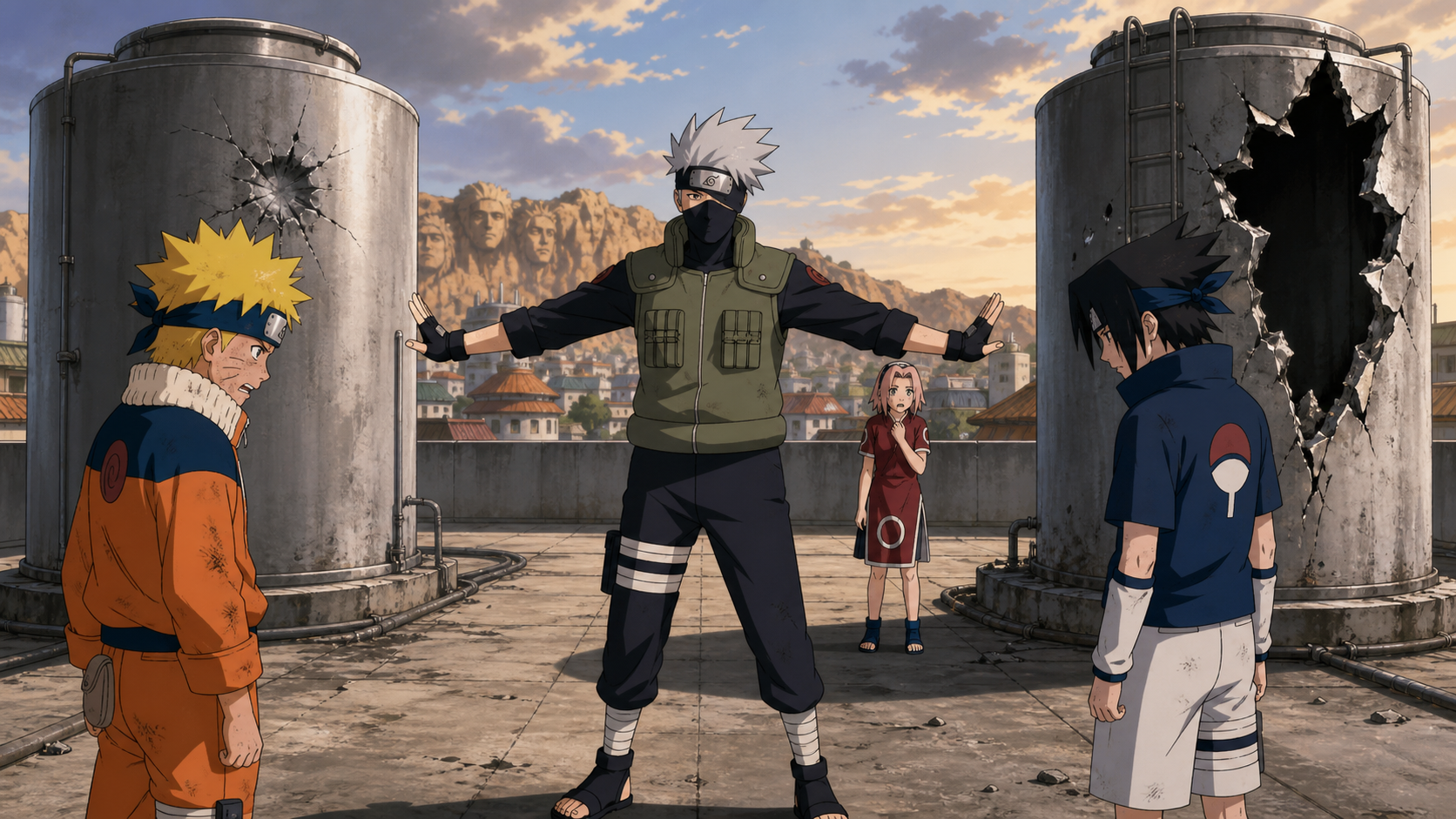
Kakashi saves them and the water tanks reveal what the clash would not. Chidori punches a clean hole through metal. Rasengan tears the back of Naruto's tank apart. Sasuke studies the damage and hears Orochimaru's promise getting louder. The Sound Four arrive when humiliation has made forbidden power look like the only honest option.
Sasuke trains alone because every recent comparison has gone wrong
Sasuke attacks a boulder with Chidori while replaying his failures. Training usually gives him control. Here, repetition cannot change what already happened.
Gaara regenerated after Sasuke broke through the sand defense. The curse mark left Sasuke unable to sustain the fight. Naruto later defeated the threat Sasuke could not finish.
The boulder receives the anger, but the target inside Sasuke's mind keeps shifting between Gaara, Naruto, Itachi, and himself.
Gaara exposes the limit of a technique Sasuke believed would settle the gap
Kakashi's Chidori training gives Sasuke a real breakthrough. He can penetrate Gaara's defense and force blood from an opponent who had treated every previous attack as irrelevant.
The success lasts long enough to prove the technique works. Gaara's transformation and regeneration then show that one breakthrough is not enough.
Sasuke has built identity around being the talented one. Reaching a limit in public would hurt under any circumstances. Watching Naruto continue after that limit makes the result feel personal.
Naruto defeating Gaara changes admiration into threat
Naruto reaches Gaara through endurance, summons, Kurama's chakra, and recognition between two jinchūriki. He protects Sakura and Sasuke while addressing the loneliness underneath Gaara's violence.
Sasuke can respect that achievement and still feel diminished by the comparison. Naruto accomplishes what he could not and does so for the teammates Sasuke wanted to protect.
The result rearranges their rivalry. Sasuke is no longer waiting for Naruto to catch up. He is watching Naruto move past the point where Sasuke stopped.
Itachi destroys the illusion that village training is closing the real distance
Itachi returns to Konoha and overwhelms Sasuke. The encounter confirms that Sasuke remains nowhere near the brother he has organized his life around killing.
The defeat is physical, psychological, and intimate. Itachi controls the exchange and forces Sasuke back through the massacre that created his revenge.
Sasuke wakes in the hospital carrying proof that the gap has not meaningfully closed. Naruto's progress becomes unbearable because Naruto is nearby, visible, and moving while Itachi remains unreachable.
Tsunade heals Sasuke's body without touching the structure driving him
Tsunade brings Sasuke out of the mental damage Itachi inflicted. Medical intervention restores his ability to function.
Healing cannot answer what he should do with revenge, grief, humiliation, or Orochimaru's mark. The village has specialists for damaged bodies and far fewer practices for a child whose family was murdered by the person he still loves and hates most.
Sasuke leaves the hospital medically recovered and emotionally primed for escalation.
Naruto becomes the safest person Sasuke can challenge
Sasuke cannot reach Itachi. He cannot redo the Gaara fight. Naruto is close, willing, and directly connected to every fear about falling behind.
Challenging Naruto offers measurable evidence. If Sasuke wins, the old hierarchy returns. If he loses, the crisis becomes impossible to deny.
Naruto accepts because he has wanted recognition from Sasuke for years. He does not understand that the proposed fight is carrying far more than ordinary rivalry.
The rooftop argument uses insults to hide attachment
Both boys provoke each other, but the anger depends on how much each opinion matters. A stranger's progress would not threaten Sasuke this deeply. A stranger's challenge would not excite Naruto this quickly.
The fight lets them speak through movement while avoiding direct admissions. Sasuke cannot say that Naruto's growth scares him. Naruto cannot say that being treated as inferior by Sasuke still hurts.
Violence becomes the language available when emotional honesty feels more dangerous than a punch.
Sakura understands the fight is no longer safe
Sakura watches the exchange escalate and tries to intervene. Her fear is justified before the final techniques appear. Naruto and Sasuke are not sparring under a teacher's supervision or rules.
When Chidori and Rasengan form, she moves between them because somebody has to interrupt the trajectory. The choice places her body where the boys' pride has created lethal risk.
The scene repeatedly makes Sakura responsible for recognizing emotional danger while giving her too little authority to change the people causing the danger.
Chidori and Rasengan carry different relationships to mentorship
Kakashi teaches Sasuke Chidori after identifying his Lightning Release and seeing a younger shinobi with similar tools. Jiraiya teaches Naruto Rasengan through demanding stages that reward persistence and improvisation.
Neither technique is inherently a moral statement. Both become dangerous because the boys aim them at a teammate during an argument.
The mentors have transmitted power without ensuring that their students can manage what the power means inside this relationship.
Kakashi catches the result adults helped create
Kakashi arrives in time to redirect both attacks into water tanks. He saves Naruto, Sasuke, and Sakura from a consequence none of the children can reverse.
He berates Sasuke for using Chidori against a comrade. The criticism is necessary. Kakashi also trained a revenge-driven child in an assassination technique and knew the curse mark was complicating Sasuke's choices.
Stopping the clash addresses the emergency. The deeper failure began earlier, when adults treated Sasuke's revenge as a motivation to train around rather than a crisis requiring sustained intervention.
Jiraiya's challenge exposes the hypocrisy around approved power
Kakashi questions why Jiraiya taught Naruto Rasengan. Jiraiya returns the criticism: Kakashi gave Chidori to someone openly committed to revenge.
Both men are partly right and partly defensive. Naruto and Sasuke need strong techniques because the shinobi world places children in lethal missions. Those same techniques magnify unresolved conflict between them.
The argument shows that mentorship cannot end at successful instruction. Teachers remain responsible for how power fits the student's needs, fears, and likely choices.
The water tanks reveal the comparison Sasuke was trying to force
Chidori leaves visible damage on Sasuke's tank. Rasengan appears to leave a smaller mark on Naruto's tank from the front.
Sasuke sees the torn-open back and understands that Naruto's technique caused much greater internal destruction. The evidence answers the question he brought to the roof, but not in the direction he needed.
Nobody announces a winner. The tanks still give Sasuke a ranking, and he walks away feeling defeated.
Sasuke's fear after the clash is the detail pride refuses to show
The retrospective allows both boys to register how close the attack came to disaster. The bravado cannot fully conceal the shock.
Sasuke wanted proof that he remained stronger. He nearly received proof by killing Naruto or being killed by him. Neither outcome would bring him closer to a healthy relationship with his family or team.
Fear could have opened a conversation. Shame closes that chance before anybody knows how to use the moment.
Kakashi's lecture names revenge but cannot offer Sasuke a replacement
Kakashi restrains Sasuke and warns that revenge will leave him empty. He speaks from personal loss and understands the temptation to let grief define every future choice.
Sasuke hears a command to abandon the only obligation that has given his survival direction. Kakashi asks what Sasuke would do if everyone he loved had been killed. Sasuke responds that Kakashi's important people are already dead.
The exchange reveals the limit of warning someone away from revenge without helping him build another way to honor the dead.
Team 7 has care but no shared language for Sasuke's crisis
Naruto wants Sasuke close and competitive. Sakura wants him safe and emotionally reachable. Kakashi wants him to reject the path that could destroy him.
Each person cares. None can give Sasuke a convincing account of what justice, memory, and identity could look like without killing Itachi.
That absence leaves Orochimaru's proposal with an advantage. Forbidden power offers a concrete action while friendship asks Sasuke to stay inside uncertainty.
The Sound Four attack when comparison has already weakened the boundary
Orochimaru's guards do not create Sasuke's insecurity. They arrive after Gaara, Itachi, and Naruto have made the insecurity acute.
They defeat him together and call him weak. The humiliation confirms the story Sasuke is already telling himself.
Recruitment works because the Sound Four match their offer to the wound: Konoha has limits, Orochimaru can supply power, and leaving becomes proof that Sasuke is serious about his goal.
Their group victory is propaganda disguised as evidence
Four specialized fighters overwhelm one exhausted and emotionally unstable genin, then use that outcome to prove he needs their master.
The demonstration is manipulated. Their numerical advantage and curse-mark power are part of the sales pitch, not neutral evidence about Sasuke's potential.
Sasuke still accepts the underlying conclusion because the conclusion promises relief from uncertainty. He would rather risk becoming Orochimaru's vessel than remain inside a village where Naruto's growth keeps exposing his fear.
Orochimaru offers power while planning to erase the person seeking power
The Sound Four describe Orochimaru as the route to strength. Sasuke knows the Sannin wants his body and believes he can use the arrangement before the arrangement uses him.
That confidence repeats a familiar Uchiha problem: talent makes exploitation feel negotiable. Sasuke assumes exceptional will and hatred can keep him in control.
Orochimaru's actual plan turns the seeker into a container. The offer solves Sasuke's fear of weakness by threatening his ownership of himself.
Naruto's growth is not responsible for Sasuke's choice
The narrative links Sasuke's decision to comparison, but Naruto does not cause the defection by improving. He trains, protects people, and seeks recognition.
Sasuke interprets that growth through trauma, revenge, and a competitive identity adults have praised for years. Orochimaru deliberately exploits the interpretation.
Blaming Naruto would repeat Sasuke's mistake by treating another person's success as an injury. The village's failures and Orochimaru's manipulation matter far more.
The rift grows because every intervention arrives after escalation
Tsunade heals Sasuke after Itachi. Kakashi stops the rooftop attack after lethal techniques form. His lecture comes after Sasuke has already received the curse mark and begun questioning Konoha's path.
Adults repeatedly respond to the emergency without building continuous care around the cause. Sasuke is talented enough to appear functional between crises, which lets the system wait until damage becomes visible.
The Sound Four do not wait. They approach at the exact moment Sasuke's confidence collapses.
Sasuke is not jealous of happiness, he is terrified of uselessness
Sasuke fears uselessness because revenge became his only measure of survival.
The rooftop fight asks for reassurance in the language both boys trust
Sasuke cannot say, “Tell me I have not wasted my life.” Naruto cannot say, “Tell me you finally see me as someone worth keeping.” A match appears to answer both requests without requiring either boy to expose the need underneath it.
That is why the challenge accelerates so quickly. A normal spar could have ended with bruises and boasting. Instead, each boy pours identity into one attack. Backing down would feel like accepting the fear he came to disprove, even after Sakura’s body makes the human cost impossible to ignore.
Sakura should never have needed to become the emergency brake
Sakura recognizes before the impact that Naruto and Sasuke are no longer testing skill. She moves because the adults are absent and because care has taught her to monitor emotional weather the boys insist on calling competition.
The scene values her terror as proof that the clash is serious, then returns narrative ownership to the rivals and their male mentors. Sakura nearly dies interrupting a crisis she did not create. Her judgment is correct, yet the story gives her responsibility without enough authority, training, or sustained support to change what happens next.
The water tanks measure damage but cannot measure the relationship
Chidori’s neat puncture and Rasengan’s torn metal give Sasuke the visible ranking he demanded. The reveal is unforgettable because the back of Naruto’s tank holds the answer pride could not see from the front.
Damage cannot measure love, wisdom, protection, or worth. Sasuke treats the tanks as a verdict because numbers and damage feel cleaner than grief. The comparison proves Naruto’s technique is formidable and proves nothing about Sasuke’s worth.
Kakashi names the danger after helping arm it
Kakashi is right to stop the attacks and right that revenge will not rebuild Sasuke’s family. He is also confronting a predictable use of the assassination technique he placed in the hands of a traumatized child whose stated life goal has always been killing his brother.
This is not an argument against teaching Sasuke. The village already sends him into lethal danger. It is an argument that instruction without continuing emotional care is incomplete mentorship. Kakashi sees himself in Sasuke, but recognition produces one urgent lecture where the boy needs a relationship sturdy enough to survive repeated refusal.
The Sound Four stage a demonstration, not a fair test
Four curse-mark users ambush one distressed genin, overwhelm him collectively, and present the result as objective proof that Konoha has made him weak. It is recruitment theater built around a conclusion selected in advance.
Their cruelty feels persuasive because it mirrors Sasuke’s internal voice. They do not need to invent a new fear. They give his existing fear uniforms, choreography, and an exit route. Orochimaru’s promise wins the moment power starts sounding more concrete than the uncertain work of remaining with people who cannot explain how he should live with the dead.
Leaving looks active while healing looks like surrender
Konoha asks Sasuke to stay, wait, trust teachers, and loosen the purpose that has structured his survival. Orochimaru asks him to travel somewhere, endure a ritual, master a mark, and claim a measurable increase in power. One path feels passive even when it could preserve him. The other feels decisive while arranging his exploitation.
That emotional imbalance explains the choice without excusing it. Sasuke harms everyone who loves him, but the harmful road offers tasks he can perform. Nobody has made healing feel equally active, honorable, or connected to the Uchiha memory he refuses to betray.
The rift is created by silence long before Sasuke crosses a border
Team 7 already has loyalty. What it lacks is a shared way to speak about why Sasuke’s success never feels sufficient, why Naruto’s approval matters, and why Sakura’s care cannot become surveillance strong enough to hold a teammate in place.
The separation begins every time affection is translated into insult, fear into training, and grief into a mission objective. The Sound Four exploit the final opening. They do not create it. “Rift” works when it shows departure as the accumulated consequence of needs everyone could see but nobody knew how to hold.
What landed
The water-tank comparison still lands because the visual delivers Sasuke's fear without a speech. He sees the internal damage and understands that Naruto's power is no longer hypothetical.
The added awareness that both boys were frightened improves the rooftop material. Neither attack was emotionally clean, even though pride made retreat feel impossible.
The Sound Four's recruitment also works as manipulation rather than random temptation. They supply humiliation, demonstration, and solution in one controlled encounter.
What did not fully land
The recap compresses Sasuke's recovery from Itachi and the rooftop challenge so quickly that medical healing can look like emotional reset. His trauma deserves more space.
Kakashi's lecture contains truth but leaves the conversation at prohibition. The episode does not show a practical support plan for the child he has just identified as a defection risk.
Sakura again bears immediate emotional danger without receiving enough narrative authority. She nearly enters the path of two lethal techniques, then the boys' rivalry remains the main subject.
Final reaction
Naruto Shippuden Episode 259 works because the rift is not one argument. Gaara exposes Sasuke's limits. Itachi makes those limits humiliating. Naruto's growth turns them into a daily comparison. Kakashi and Jiraiya give the boys lethal tools while the adults around Team 7 keep responding after the emotional crisis becomes physical.
The rooftop clash offers Sasuke the proof he demands. Rasengan's damage shows that Naruto has developed power Sasuke cannot dismiss. The correct conclusion could be that both boys have grown and both nearly made a terrible mistake. Sasuke reads the tanks as another verdict on his failure to avenge the Uchiha.
The Sound Four arrive with an answer designed for that reading. Orochimaru promises strength without healing, purpose without freedom, and control while planning to take Sasuke's body. “Rift” revisits the moment Sasuke chooses that danger because staying beside Naruto has become more frightening than admitting why Naruto matters.
RaeRae’s call
The rooftop does not prove Sasuke is weaker. It proves Team 7 has confused damage with truth for too long. Orochimaru wins because his lie gives Sasuke something to do while Konoha’s concern never becomes a believable life beyond revenge.
Episode details and viewing routes
- Official episode reference: Naruto Official episode guide
- Licensed episode route: Crunchyroll licensed episode page