
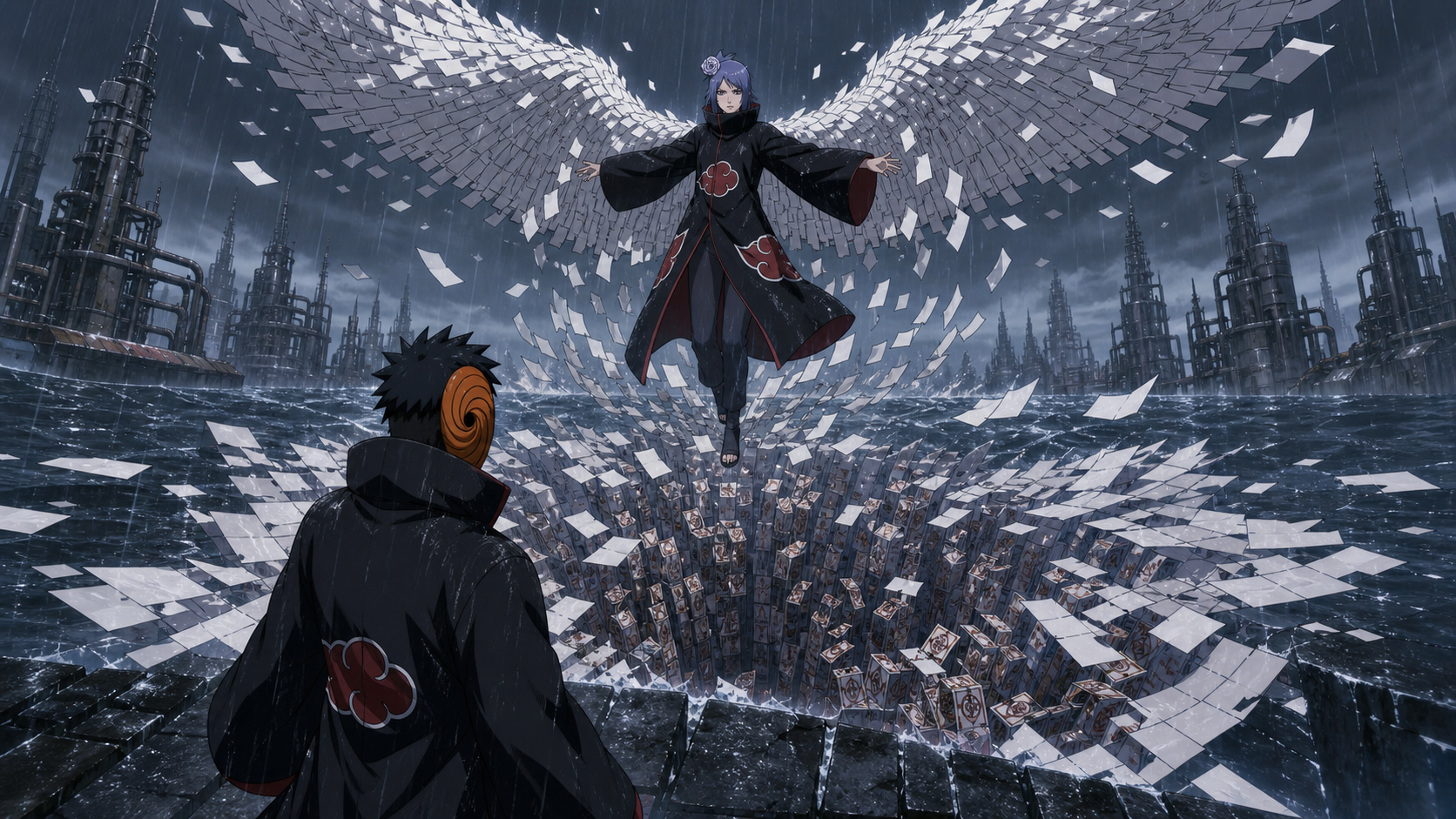
The Angelic Herald of Death
Konan rejects the masked man’s claim over Nagato, trusts Naruto with their first dream, and turns years of observation into a paper ocean built to outlast intangibility.
Bottom line
Naruto Shippuden Episode 252 gives Konan the confrontation her story has been building toward since Pain's defeat. The masked man comes to Amegakure to take Nagato's Rinnegan, speaking as if the body, eyes, and power already belong to him. Konan refuses. Nagato was her friend, not abandoned Akatsuki property, and Naruto's answer restored the hope the original trio formed under Jiraiya.
Konan does not enter the fight on faith alone. She has studied the masked man's space-time technique, identified limits in his intangibility and absorption, prepared ordinary paper alongside explosive tags, and hidden an ocean of six hundred billion paper bombs beneath the rain. The angel imagery that once supported Pain's manufactured divinity becomes her own declaration of judgment.
The episode still leaves a painful tension. Konan is defending Nagato's dignity, but the conflict centers on possession of his eyes after death. Both fighters understand the Rinnegan as strategic power. Konan's moral distinction comes from relationship and consent: she protects the remains of someone she loved from the person who manipulated his grief and now treats his body as equipment.
The masked man returns to Amegakure as a collector
The visitor enters the Hidden Rain with a single objective. Nagato is dead, Akatsuki's public Pain system has collapsed, and the Rinnegan can no longer be left outside his control. The masked man speaks about taking the eyes with the confidence of someone retrieving an asset.
That posture reveals how he understood Nagato all along. Nagato's suffering, ideals, and leadership mattered while they moved Akatsuki toward the Eye of the Moon Plan. Once Nagato chose resurrection and entrusted hope to Naruto, the body became salvage.
Konan's refusal interrupts that logic. She will not provide directions, surrender the corpse, or accept the visitor's story about ownership. Amegakure may be isolated and wounded, but the masked man cannot enter without meeting the person who remained beside Nagato before Akatsuki gave him a title.
Konan controls access to her friend's grave
Konan knows where Nagato and Yahiko rest. That knowledge is not merely intelligence. She is the surviving friend responsible for protecting a private place from the organization that consumed their public lives.
The masked man frames concealment as defiance against Akatsuki. Konan frames protection through loyalty to the people behind the names Pain and Deva Path. The disagreement is about who has the right to decide what happens to Nagato after death.
Konan's answer is clear because Nagato made his final decision. He rejected the masked man's direction, trusted Naruto, and used his power to restore the people killed in Konoha. Taking the Rinnegan for the old plan would violate the meaning of that choice.
Naruto becomes the bridge the original Akatsuki wanted
Yahiko, Nagato, and Konan created their organization to build peace in a country repeatedly used as a battlefield by larger villages. Manipulation, loss, and despair turned that movement into the Akatsuki Naruto encountered. Nagato's conversation with Naruto reopened the possibility that their first hope had not been childish.
Konan now treats Naruto as the bridge toward peace. The phrase matters because a bridge does not erase the distance between histories. Naruto cannot undo Yahiko's death, Hanzo's betrayal, or the destruction Nagato caused. He can carry their unresolved hope toward people who never heard the original promise.
Trusting Naruto is not blind optimism. Konan watched him defeat Pain, refuse revenge, listen to Nagato, and answer suffering without accepting mass coercion. Her faith rests on choices he made while holding enough power to choose differently.
The paper flower returns to Jiraiya's first lesson
Konan's paper flower connects the adult combatant to the child Jiraiya taught. Paper was once play, shelter decoration, communication, and a way of creating beauty inside war. Akatsuki turned the same material into wings, weapons, surveillance, and explosive disguise.
The flower therefore contains both versions of her life. Konan never stopped being the child who folded hope out of scraps, even when survival required turning paper into lethal technique.
The masked man sees a combat system. Konan carries memory. Her power cannot be reduced to the number of tags prepared because every sheet also belongs to a personal language formed before he recruited the trio's pain into his plan.
Calling herself an angel changes meaning
Under Pain's rule, Amegakure viewed Konan as an angel serving a god. The imagery supported a political religion built around Nagato's remote bodies and total surveillance. Konan's wings helped make authority appear supernatural.
Episode 252 reclaims the image. Nagato is gone. Konan is not performing divinity for citizens. She spreads paper wings to oppose the person claiming rights over her friend's remains.
The “angelic herald of death” is not announcing Pain's judgment. She is bringing a death sentence she designed herself. Whether the sentence succeeds remains uncertain, but the decision belongs to Konan rather than a title assigned by someone else's regime.
Konan names the masked man's role in their corruption
The masked man likes to present himself as the force who recognized Nagato's potential. Konan sees the cost. He supplied direction after Yahiko's death, encouraged the transformation of grief into Akatsuki's weaponized doctrine, and benefited from every body Pain collected.
Nagato made his own choices and remains accountable for them. Recognizing manipulation does not erase agency. The masked man found people at their most isolated and gave despair a structure that served his hidden goals.
Konan's confrontation rejects his attempt to narrate their lives as pieces of his design. The original Akatsuki existed before him. Their hope did not originate with him. Nagato's final change proves his influence was never ownership.
Paper turns rain into controlled territory
Amegakure's endless rain would appear hostile to paper techniques. Konan has mastered the environment so thoroughly that the city becomes an extension of her preparation. Sheets move through water, mist, towers, and open air without losing formation.
Home-ground advantage here means accumulated knowledge. Konan understands sight lines, surfaces, channels, and the masked man's likely approach. She does not wait for an unpredictable invasion and improvise from nothing.
The rain also creates visual honesty. Paper clings, separates, dissolves into swarms, and reforms. Konan's body can become part of that system, making the boundary between person, decoy, and attack difficult to read.
The first assault tests absorption rather than chasing damage
Konan sends paper around the masked man knowing ordinary attacks will pass through his intangible body. The initial exchange gathers timing. She needs to know when he chooses to absorb material and when he phases through danger.
His technique offers two defensive answers, but the answers cannot operate without limits. Intangibility avoids contact. Absorption requires engagement with the target. Minato exploited the instant of solidity needed for offense. Konan investigates the time needed to pull a large attack into the alternate space.
The fight becomes an experiment conducted under lethal conditions. Every sheet carries pressure and information.
Ordinary paper hides explosive paper
Konan mixes explosive tags among harmless-looking sheets and wraps both around herself and the masked man. The disguise targets his confidence in absorption. If he pulls the mass away, he also pulls the explosives close.
The tactic requires Konan to enter the blast zone. She is willing to sacrifice herself rather than let the Rinnegan be taken. Her resolve mirrors Kisame's refusal to surrender intelligence, but the causes differ. Kisame protected Akatsuki's war plan. Konan protects Nagato's final choice from Akatsuki's architect.
That difference matters without making self-destruction an uncomplicated virtue. Konan's willingness reveals how little future she imagines beyond guarding the dead and entrusting peace to Naruto.
The explosion tears through certainty
The paper-bomb attack damages the masked man and breaks part of his mask. Konan also survives, though injured. For the first time in the encounter, the person who speaks as if every outcome is already understood has visible proof that Konan can reach him.
Damage to the mask has symbolic weight because his authority depends on controlled revelation. He changes names, claims identities, and offers only the information needed to move other people. A broken edge does not expose the full face, but the image of invulnerability has been punctured.
Konan's success comes from analysis, not a sudden emotional power increase. She observed, prepared, and accepted risk the masked man assumed she would avoid.
Space-time ninjutsu still has measurable limits
Konan has calculated that the masked man cannot remain intangible forever and that absorption takes time. Those limits turn a seemingly absolute technique into a resource governed by duration and sequence.
Her preparation follows the same tactical principle Minato used: do not attack the effect that looks invincible. Attack the transition or limit the user cannot escape. Minato targeted the instant of solidity. Konan designs an attack that lasts longer than continuous intangibility can.
Knowledge moves across enemies even when they never coordinate. Konan has studied the masked man's behavior closely enough to build a counter from the traces other battles revealed.
Six hundred billion paper bombs make patience visible
Konan separates the surrounding water into a vast trench lined with explosive tags. The number is deliberately overwhelming. More important than scale is what the scale represents: time spent preparing for this specific confrontation.
She did not assume loyalty, home territory, or anger would be enough. She built a continuous detonation intended to outlast the masked man's phasing limit. The trap answers a space-time technique with duration measured in uninterrupted destruction.
The paper ocean also reverses the visitor's expectations. He entered Amegakure believing Konan stood between him and a hidden grave. He discovers that the city itself has been arranged as the weapon guarding that grave.
Preparation becomes Konan's form of authorship
Much of Konan's life was shaped by decisions made by men around her: Jiraiya left, Yahiko sacrificed himself, Nagato transformed into Pain, and the masked man redirected Akatsuki. Episode 252 gives her a plan nobody else wrote.
The trap uses her technique, city, observations, and chosen meaning. Even Naruto's role does not replace her agency. She trusts him with the future while personally defending the past.
That separation is important. Konan is not waiting for Naruto to save her or validate her grief. She acts because Nagato's body and the original Akatsuki's hope deserve protection now.
Nagato's eyes remain a contested inheritance
The Rinnegan originated beyond Nagato in ways Konan does not fully know, but Nagato lived, suffered, and made choices through those eyes. The masked man treats origin and plan as proof of ownership. Konan treats relationship and final intent as the stronger claim.
Neither position turns a dead person's body into something Nagato can actively consent to now. The ethical boundary has to rely on his last expressed values. Nagato entrusted hope to Naruto and rejected the plan that required manipulating him.
Protecting the eyes from renewed use in that plan aligns with the person Nagato became at death, even if the shinobi world lacks a clean language for bodily autonomy after death.
Konan protects a person from being reduced to useful remains
The masked man speaks about Nagato’s eyes as equipment returning to an owner. Konan remembers the child, friend, revolutionary, killer, grieving survivor, and dying man who made a final choice. Relationship gives the body a history acquisition language deliberately strips away.
Nagato cannot consent now, so his last expressed values matter. He rejected the Eye of the Moon Plan, restored the people he killed, and entrusted hope to Naruto. Taking his eyes to continue the rejected project would turn death into one final theft.
Naruto carries the future without taking over Konan’s fight
Calling him the bridge could have reduced Konan to somebody waiting for a male hero to complete the work. The episode avoids that trap. Naruto receives the promise. Konan still prepares the battlefield, controls access to the grave, studies the enemy, and makes the decision at her door.
Trust is not surrender. She delegates one future while owning this present. That separation gives her faith weight because it comes from a person still willing to act, not someone using hope as an excuse to disappear.
The paper flower refuses Akatsuki’s version of her history
Paper existed before Pain’s angel, before black cloaks, and before the masked man redirected grief. It belonged to three war orphans learning under Jiraiya and creating fragile beauty inside a country other villages treated as disposable terrain.
Konan’s weapons therefore carry memory the intruder cannot claim. Every sheet can become flower, wing, body, decoy, or bomb. Her technique holds the difference between what she and her friends wanted and what Akatsuki later made them do.
Preparation is the argument, not merely the giant number
Six hundred billion bombs invite fandom to debate logistics until the emotional architecture gets lost. Konan observed a technique presented as untouchable, identified its duration limit, and built an attack whose defining feature was lasting longer.
That is what makes the trap hers. She does not receive a convenient counter from another character. Years of proximity to the masked man become information, and information becomes a battlefield written specifically around the instant his certainty must fail.
Her willingness to die deserves scrutiny alongside admiration
Konan protects Nagato and refuses renewed manipulation. She also governs a wounded Amegakure that has already lost Yahiko, Nagato, and countless civilians. Treating her death as an easy acceptable price risks asking the village to survive one more leader’s self-erasure.
The sacrifice impulse comes from love and from a life where Konan repeatedly remained after somebody else disappeared. Her future has narrowed around guarding memory. Courage is present. So is grief that may no longer imagine a life beyond duty to the dead.
The masked man’s confidence is another form of theft
He claims authorship over Nagato’s power, Akatsuki’s direction, and the meaning of the original trio’s suffering. Konan’s refusal attacks that narrative before any explosive tag ignites. Their movement existed before his recruitment, and Nagato’s last choice escaped his design.
The damaged mask matters because controlled revelation is part of his authority. Konan forces visible consequence onto someone accustomed to treating every other person as readable while remaining unread. Even partial exposure proves his story is not the only one with power.
Amegakure itself should remain in the frame. Larger nations repeatedly used the Rain as a battlefield, then left its children to build political answers from rubble. Konan’s ocean of paper sits beneath a city whose civilians have already survived foreign wars, Hanzo, civil conflict, Pain’s surveillance, and the collapse of a manufactured god. Her trap protects Nagato, but detonating that much force inside the village also reveals how completely personal grief and national defense have merged. Konan is not fighting in an empty arena. She is using the wounded homeland she still leads as the final wall around another wounded body.
That is why I cannot call the confrontation simple vengeance. Konan wants the manipulator dead, absolutely, and she has earned anger sharp enough to cut rain. She also knows the Rinnegan would revive a plan Nagato rejected and endanger the future he placed with Naruto. Her attack protects memory, bodily dignity, a political choice, and people who may never know why the sky filled with paper. The tragedy is that all four responsibilities now rest on the last surviving member of the original trio alone.
What landed for me
Konan's preparation lands because the series allows a quieter character to be dangerous through observation and time. Six hundred billion tags sound impossible, but the emotional logic is precise. She had years inside Amegakure and every reason to expect the masked man would eventually come for Nagato.
The reclamation of angel imagery also lands. Konan no longer functions as Pain's herald. Her wings belong to a personal judgment against the person who exploited their movement.
Most of all, her faith in Naruto avoids making her passive. Naruto carries hope forward. Konan still fights the battle at her door.
What did not fully land
The scale of the paper-bomb preparation strains practical belief even within a world of extreme ninjutsu. The episode emphasizes the number more than the material and logistical process that could produce, conceal, and maintain such a trap beneath a populated city.
Konan's willingness to die also receives heroic framing without much attention to the people of Amegakure who still depend on her. Protecting Nagato matters, but she is also the surviving leader of a traumatized village. Her life has obligations beyond the grave.
Those concerns complicate rather than cancel the confrontation. Konan's plan is powerful because grief, duty, and self-erasure have become difficult for her to separate.
Final reaction
Naruto Shippuden Episode 252 turns Konan from Pain's quiet partner into the author of a battle designed around everything she has learned. She refuses to surrender Nagato's Rinnegan, names Naruto as the bridge carrying their first dream, disguises explosives among ordinary paper, and opens an entire paper ocean beneath the masked man.
Her strength is not a surprise upgrade. Preparation is the strength. Konan studied the time limits of intangibility, anticipated the visitor's objective, and transformed Amegakure into a defense of Nagato's final decision.
The angel now serves no god. She protects a friend, judges a manipulator, and entrusts peace to someone who chose listening over revenge. The trap has not yet proved fatal, but Episode 252 makes one truth undeniable: the masked man did not come to collect an undefended body.
RaeRae’s call
Konan does not guard a pair of eyes. She guards Nagato’s final choice from the man who keeps confusing manipulation with ownership, and she turns years of observation into a battlefield only she could author.
Episode details and viewing routes
- Official episode reference: Naruto Official episode guide
- Licensed episode route: Crunchyroll licensed episode page