
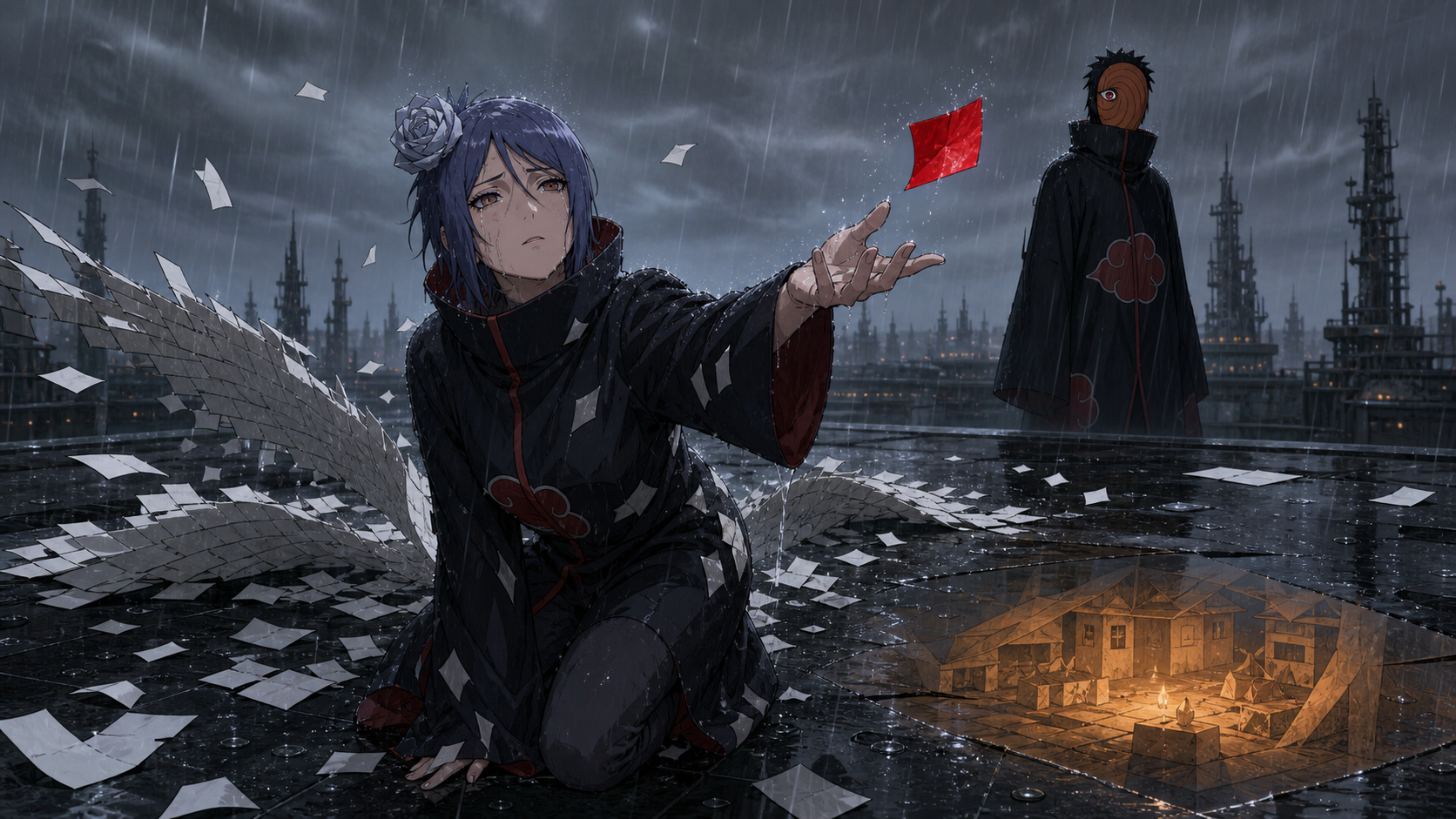
The Bridge to Peace
Konan defeats the limits she studied, loses to the hidden reality rewrite called Izanagi, and still sends one final paper home carrying her trust in Naruto.
Bottom line
Naruto Shippuden Episode 253 lets Konan's preparation work and then reveals the hidden rule she could not have studied. Six hundred billion paper bombs detonate long enough to exceed the masked man's known intangibility limit. Her analysis is correct. He survives by using Izanagi, sacrificing a Sharingan to rewrite his death as an illusion.
That distinction matters because Konan does not lose through carelessness, lack of resolve, or inferior planning. She builds the right counter for the technique the masked man allowed the world to see. He wins through another stolen or concealed system made possible by Uchiha and Senju power in the same body. His advantage is not merely strength. His advantage is controlling which rules other people know exist.
Konan dies still naming Naruto as the bridge to peace. One blood-red sheet of paper returns to the childhood hideout where she, Yahiko, and Nagato once used cards to signal that they had come home. The masked man takes Nagato's Rinnegan, but he cannot make their first hope belong to him.
Konan's paper ocean lasts longer than intangibility
The trap beneath Amegakure is designed around a measured limit. The masked man can remain intangible for roughly five minutes. Konan creates a continuous chain of explosions lasting twice that time, denying him a safe instant to become solid.
The scale looks excessive until the logic becomes clear. One large blast would fail because he could phase through the peak. Scattered explosions would create gaps. Konan needs uninterrupted duration, so the number of tags becomes a timing mechanism rather than decorative spectacle.
Her plan demonstrates the difference between knowing that a technique is powerful and knowing how the technique operates. Konan has watched long enough to convert observation into an engineering problem.
Preparation gives Konan a real victory before the reversal
The detonation consumes the masked man within the conditions she predicted. His known defense expires. His body is caught. For the tactical system Konan can observe, the fight is over.
That success should not be erased by what follows. Stories often treat a surviving villain as proof that the attack failed. Konan's method defeats intangibility exactly as designed. The masked man must spend a separate forbidden technique and sacrifice an eye to continue.
Forcing that cost is meaningful. She removes one Sharingan and exposes another secret. The outcome is tragic, but the trap changes his body, options, and future equipment.
Izanagi converts consequence into illusion
Izanagi allows the user to treat harmful reality as illusion for a limited period while turning desired actions into reality. Death can be denied after the event appears to occur. The technique consumes the eye used to activate the rewrite.
The power is thematically perfect for the masked man. He advocates a world where reality will be replaced by a controlled dream. In battle, he survives by deciding that an unwanted consequence did not count.
Konan's paper bombs operate through evidence, duration, and cause. Izanagi interrupts that chain with inherited authority over reality itself. Her planning cannot include a rule deliberately concealed beyond the technique she has studied.
The cost of Izanagi still reveals vulnerability
The forbidden technique is not free. The Sharingan closes permanently. The masked man cannot repeat the same reversal indefinitely without access to more eyes. Konan makes him spend a resource he clearly values.
That cost separates Izanagi from simple invincibility. Reality can be rewritten only within a system of sacrifice and compatible power. The masked man survives because his body has been modified and because he has accumulated access to abilities originating in other people.
His strength therefore depends on extraction. Eyes, cells, identities, and historical claims become tools attached to a body that treats inheritance as possession.
Uchiha and Senju power meet inside one concealed body
The masked man explains that Izanagi reaches full use through the union of Uchiha ocular power and Senju vitality. The revelation connects his body to the same historical conflict he claims to transcend.
Rather than resolving that conflict through relationship, he combines its biological materials through control. Unity becomes an engineered weapon inside one person. The method foreshadows the Eye of the Moon Plan's broader promise: end conflict by removing everyone else's ability to choose reality.
Konan represents another kind of bridge. Her trust in Naruto links separate lives and inherited hopes without absorbing them into one controlling body.
Konan's knowledge was accurate but incomplete by design
Konan studied his teleportation and phasing. She understood the absorption delay and continuous-intangibility limit. The masked man let Akatsuki members see enough to use his power while keeping Izanagi outside their models.
That secrecy is a form of command. Allies plan around the rules he reveals, which ensures their contingencies remain vulnerable to rules he withholds. Nagato and Konan were never partners with equal information.
The episode validates Konan's intelligence by showing exactly why intelligence was insufficient. Missing evidence was not available through poor observation. The other side actively managed access to the truth.
The masked man attacks after letting hope rise
Konan sees light break through the rain and interprets the moment as proof that her preparation has ended the threat. Amegakure's weather carries emotional meaning because Nagato once used the rain as a surveillance system and a reflection of grief.
The masked man's return from behind turns hope into vulnerability. He does not only survive. He waits for Konan to believe the danger has passed, then attacks from the position her analysis declared impossible.
The cruelty is psychological. He wants her to understand that the plan worked and still was not enough.
Genjutsu turns Konan's memory into another stolen route
The masked man needs Nagato's location. Konan refuses to provide that knowledge. After defeating her physically, he uses genjutsu to extract the answer from her mind.
The act mirrors Aoba's attempted interrogation of Kisame in the previous episode. Both sides use invasive techniques to reach strategically valuable memories. The moral contexts differ, but the shinobi world's treatment of minds as locked archives remains consistent.
Konan's refusal still matters. She does not volunteer the grave. The location is taken after resistance, which preserves the boundary between surrender and violation.
Calling the Rinnegan “mine” erases Nagato's life
The masked man insists that he originally gave Nagato the Rinnegan and therefore has the right to reclaim the eyes. Origin becomes a property claim extending through another person's entire life and death.
Nagato used the Rinnegan to survive, lead, destroy, resurrect, and finally choose a path the masked man opposed. Those experiences do not disappear because the eyes entered his body through manipulation.
The claim exposes how the masked man understands people. A person may carry his investment, develop power, and make choices, but the underlying asset supposedly remains his. Konan rejects that ownership even when she can no longer stop the theft.
Nagato and Yahiko rest together beyond Akatsuki titles
The hidden resting place preserves Nagato beside Yahiko. Their bodies are arranged as friends from Amegakure rather than Pain's controller and Deva Path. Konan protected the identities that existed before the organization transformed them into symbols.
The room is not a weapons vault. The masked man's arrival turns the grave into one because his objective is the Rinnegan. His presence repeats the exploitation Konan tried to prevent.
Yahiko's body also reminds us that Akatsuki's public power was built by extending use beyond death. Nagato animated his friend's corpse as Pain. The masked man now continues that pattern by extracting value from Nagato's corpse.
Konan dies without giving the masked man the final meaning
Physical defeat is complete. Konan cannot protect the grave, survive the attack, or see Naruto's promised future. The masked man wins the material objective.
He does not secure her agreement. Konan never retracts her trust in Naruto or accepts the Eye of the Moon Plan as the rightful end of their story. Her belief remains outside his control even when her memories do not.
That boundary is small and essential. Power can take information and bodies. Power cannot retroactively make coercion a shared conviction.
The red paper carries Konan home
As Konan dies, one sheet stained red drifts through Amegakure and reaches the childhood hideout. The paper covers or joins the card associated with her place among the trio, signaling a return home.
The image transforms blood without showing the body as spectacle. Red becomes absence, memory, and arrival. Konan spent adulthood moving through paper. The final sheet completes the path her physical body cannot travel.
The hideout remains because the children's system of belonging outlasts the adult organization. Before rings, cloaks, Paths, and plans, three orphans needed a way to tell one another they were safely home.
Jiraiya's simple cards survive grand ideologies
Jiraiya taught the trio to use small panels or cards at the hideout so everyone would know who had returned. The system addressed an ordinary need: do not leave friends wondering whether someone is safe.
Akatsuki later pursued peace through weapons, tailed beasts, and forced illusion. The humble card contains a more human model of security. Presence is communicated. Absence is noticed. Home depends on mutual accountability.
Konan's final paper returning to that system suggests their original hope was never located in overwhelming power. The bridge to peace begins with people knowing whether others made the journey home.
Naruto inherits hope without inheriting ownership
Konan calls Naruto the bridge because he carries Jiraiya's teachings and Nagato's renewed faith. She does not claim Naruto belongs to the trio or must reproduce their exact path.
That difference separates inheritance from possession. Naruto receives a responsibility through trust, but the responsibility leaves room for his choices. The masked man claims Nagato's eyes through origin and control. Konan entrusts hope through relationship.
The bridge image works because a bridge connects distinct sides. A bridge does not dissolve every person into one will.
The rain continues over a village losing another leader
Konan's death affects more than the symbolic trio. Amegakure has lost Yahiko, Nagato, and now Konan. The village that suffered as a battlefield between larger powers is again left without the person who knew its recent history from the inside.
The episode prioritizes Konan's personal meaning and the Rinnegan theft, giving limited attention to what leadership vacuum follows. That omission mirrors how often the wider story treats the Hidden Rain as a source of tragedy rather than a community still living after the protagonists leave.
Konan's trust in Naruto carries an implicit obligation toward those people, not only toward a philosophical idea of peace.
Konan wins the fight she was allowed to study
Her trap exceeds the documented intangibility limit, prevents absorption through uninterrupted detonation, and kills the body inside those known rules. The later reversal should not rewrite that accomplishment as failure. The masked man survives by spending a different concealed technique.
That distinction protects Konan’s intelligence. She does not miscalculate because emotion made her sloppy. She forces an opponent who hoards secrets to reveal another secret and sacrifice an eye. Material defeat follows a tactical victory the story should name honestly.
Izanagi fits a man who treats consequence as optional
Konan builds cause and effect with almost brutal precision. Enough bombs for enough time should produce death. Izanagi answers by declaring the unwanted result unreal. The technique turns privilege over reality into another resource collected inside his modified body.
Of course this is his survival method. The Eye of the Moon Plan promises the same logic at global scale: if reality contains grief, conflict, and refusal, replace reality rather than build consent inside it.
Hidden rules are how he controls allies as well as enemies
Konan knew his phasing because he needed Akatsuki to work around it. She did not know Izanagi because equal knowledge would give partners leverage. He distributes just enough truth for other people to perform their roles while preserving a private escape from their judgment.
The arrangement proves Nagato and Konan were never collaborators on equal ground. Their pain was visible to him. His body, history, techniques, name, and real objective remained adjustable stories revealed only when usefulness demanded it.
The Rinnegan theft continues a pattern of bodily occupation
He carries Sharingan not originally his, Senju power added to his body, identities borrowed from dead men, and plans executed through other people’s grief. Nagato’s corpse becomes the next site where another life is converted into equipment.
Saying the eyes were once “mine” does not erase the years Nagato lived through them. Origin is not permanent ownership of a person’s body. The claim sounds especially rotten after Nagato used those eyes to reject the claimant’s plan.
Genjutsu violates the boundary Konan maintained to death
She never gives him the grave. He takes the route from her mind after defeating her body. That difference matters. Information extracted through coercion is not a confession, agreement, or final recognition of his supposed right.
Konan protects Nagato’s location for as long as choice remains available. The masked man can invade memory and retrieve coordinates. He cannot convert resistance into consent or make the theft part of the friendship she defended.
The red paper chooses a smaller language than spectacle
After an ocean of explosions and a reality rewrite, one stained sheet completes the emotional story. It returns to the hideout and the simple childhood system that told three frightened children whether their friends had come home.
That card carries more peace than Akatsuki’s machinery ever did. It notices absence. It values arrival. It assumes people owe one another the reassurance of presence. Konan’s final journey returns to a promise built before power swallowed the movement.
Amegakure loses a leader while the plot follows the eyes
Konan’s death leaves living residents behind in a country repeatedly used as somebody else’s battlefield. The episode gives the grave, the Rinnegan, and the trio’s symbolism more attention than the political vacuum opening beneath the endless rain.
That omission hurts because Konan’s obligations were not only backward-facing. Trusting Naruto with peace should include expecting him to remember the village still surviving after its god, angel, and revolutionary leadership disappear.
Naruto inherits a bridge, not ownership of their dream
Konan entrusts hope because Naruto listened to Nagato and chose against revenge. She does not hand him Amegakure, Nagato’s body, or authority to rewrite what the trio wanted. The bridge connects histories without swallowing either side.
That is the episode’s cleanest contrast. The masked man collects power and calls origin possession. Konan transfers responsibility through trust and leaves room for Naruto’s agency. One inheritance closes a fist. The other opens a road.
Konan’s death also completes a pattern the series should make us angry about. Yahiko dies to protect friends from Hanzo’s trap. Nagato dies after spending the last of his power repairing Konoha. Konan dies guarding Nagato from the architect who profited from both losses. The original trio keeps paying for a world larger powers broke around them, while Amegakure remains available as scenery for somebody else’s turning point. Naruto accepting their hope creates an obligation deeper than winning the war. If his bridge means anything, it must eventually reach the people still living under that rain, not only preserve three dead friends as inspiration for his own moral journey. Otherwise, the bridge becomes another road out of Amegakure carrying value away while leaving residents with wreckage and memorials.
What landed for me
The episode lands by making Konan right. Her timing calculation, attack duration, and understanding of intangibility all work. Izanagi does not reveal that she misunderstood the known technique. The forbidden jutsu reveals a second system hidden from her.
The red paper ending also lands. A giant explosion cannot provide the emotional closure that one small sheet reaching a childhood home provides. Scale gives way to belonging.
Konan's distinction between trusting Naruto and defending Nagato herself remains strong. She does not outsource the present battle to the person carrying future hope.
What did not fully land
Izanagi arrives as a powerful exception immediately after Konan executes an unusually specific counter. The explanation fits established eye-based reality manipulation, but the timing can feel designed primarily to preserve the masked man rather than deepen the fight.
Konan's death also concludes years of history without showing who will care for Amegakure afterward. Her role as guardian of Nagato's memory receives more attention than her responsibility to living residents.
Those frustrations come from wanting the story to treat Konan's life as broadly as the episode treats her sacrifice. Her final stand is memorable, but her future is closed just as her agency becomes most visible.
Final reaction
Naruto Shippuden Episode 253 is a defeat for Konan and a validation of everything she brought to the fight. Her paper-bomb sea exceeds the masked man's known limit and forces him to sacrifice a Sharingan through Izanagi. He survives because he withheld a reality-rewriting rule, not because her preparation lacked precision.
He takes Nagato's location and Rinnegan. Konan loses the body she protected and the life she might have used to rebuild Amegakure. Yet the red paper returns to the hideout, placing her beside Yahiko and Nagato in the language they created as children.
The masked man collects eyes. Konan leaves a bridge. One treats inheritance as property; the other treats inheritance as trust. The coming war will decide which model can shape the future, but Episode 253 makes Konan's final answer unmistakable.
RaeRae’s call
Konan defeats the rules she could observe and loses to a secret reality rewrite. He takes Nagato’s eyes; she leaves Naruto a bridge. Possession wins the body, but it never earns the meaning.
Episode details and viewing routes
- Official episode reference: Naruto Official episode guide
- Licensed episode route: Crunchyroll licensed episode page