
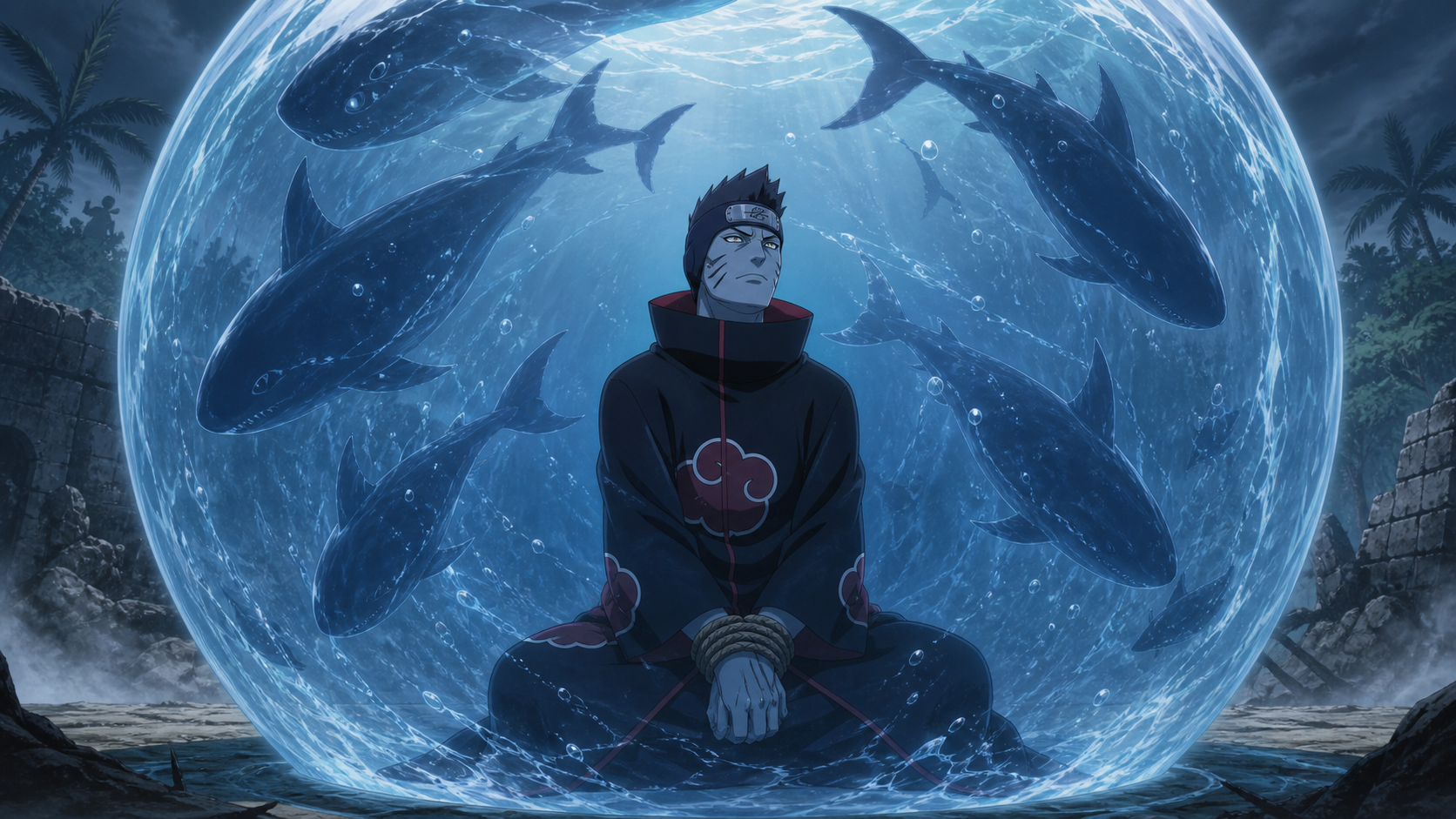
The Man Named Kisame
Kisame’s memories reveal how a village taught him to kill for secrets before capture forces him to decide whether Akatsuki will receive the same lethal loyalty.
Bottom line
Naruto Shippuden Episode 251 explains Kisame Hoshigaki without asking us to mistake explanation for innocence. His life in the Hidden Mist trained him to protect information by killing comrades before enemies could capture them. The superior who gave those orders was secretly selling intelligence, so Kisame killed him too and inherited Samehada. A masked man then offered Kisame a world without lies, converting disgust with one corrupt system into loyalty to another.
Captured on the island, Kisame faces the exact danger he spent his career preventing: an enemy entering his mind and taking organizational secrets. He escapes Aoba's interrogation long enough to summon sharks inside his own water prison. The death is deliberate, violent, and consistent with the code imposed on him. Guy finally remembers Kisame's name because the enemy he called a monster proves capable of a grim form of loyalty.
The episode's achievement is not making Kisame secretly good. He murdered colleagues, served Akatsuki, hunted jinchūriki, and helped an organization build a mass-coercion plan. “The Man Named Kisame” shows how a person taught that truth always becomes betrayal can choose loyalty to something terrible because loyalty feels like the only identity left.
Guy wins the fight and immediately returns to the mission
Daytime Tiger leaves Kisame defeated and Guy physically depleted. The Seventh Gate gave Guy the force needed to overcome Great Shark Bullet, but his body now carries the cost. Victory does not create a relaxed aftermath because the intelligence scroll remains the operational priority.
Guy secures Kisame instead of celebrating. The team restrains the prisoner and prepares interrogation. Every action recognizes that capturing an Akatsuki operative alive may be more valuable than another battlefield kill.
Kisame also understands the value of his own mind. Physical defeat is not the mission's final boundary. As long as Allied shinobi can extract Akatsuki plans, his capture threatens the organization more than his death would.
Aoba enters a mind built around sealed information
Aoba uses a mind-reading technique to search Kisame's memories. The method places the episode inside the ethics of wartime intelligence. The alliance needs information about Akatsuki, but obtaining that information means entering a restrained prisoner's mind without consent.
Kisame has inflicted harm that makes urgent interrogation understandable. Still, the scene deliberately mirrors his earliest trauma. He was taught to kill allies so enemy interrogators could never reach Mist secrets. Now he is the captured operative whose memories have become a battlefield.
The mirroring does not make both sides morally identical. The alliance seeks to stop a war Akatsuki is escalating. The parallel shows how shinobi institutions repeatedly turn people into containers for information and treat the destruction of a mind as an acceptable security measure.
The Hidden Mist taught Kisame that comrades were liabilities
Young Kisame served on a mission protecting a cipher unit. When enemy shinobi threatened capture, his orders required him to kill the very people he was escorting. Their knowledge mattered more to the village than their lives. Kisame obeyed.
That assignment destroys the usual language of teamwork. Comrades are supposed to trust the shinobi guarding them. Kisame's role contained a hidden condition: protection lasted only while their continued survival protected the village's secrets.
The killings are not excused by orders. Kisame chooses obedience. The episode reveals the structure that made obedience appear professional and betrayal appear necessary. His first lesson in loyalty was that loyalty might require eliminating everyone beside him.
Fuguki made secrecy a rule he did not follow
Kisame's superior, Fuguki Suikazan, enforced the code of information protection while selling secrets himself. The hypocrisy gives Kisame evidence that the system's moral language is performance. The man who ordered subordinates to die for secrecy treated intelligence as personal currency.
Kisame kills Fuguki and takes Samehada. The act punishes betrayal, advances Kisame within the Seven Ninja Swordsmen, and ties him more deeply to the violent system he despises. Removing a corrupt superior does not free him. Kisame becomes the next wielder of a weapon and role built by the same village.
This pattern defines his tragedy. Every time Kisame discovers a lie, he responds through the tools the liar gave him. Violence removes the individual hypocrite while preserving the worldview that made hypocrisy powerful.
Samehada fits the identity Kisame has been given
Samehada is a living sword that feeds on chakra and chooses according to appetite. The weapon suits Kisame's enormous chakra reserve and sharklike appearance, strengthening the reputation that he is less human than other shinobi.
The bond also externalizes how Kisame relates to institutions. Samehada's loyalty is conditional and sensory. The sword follows preferred chakra, just as villages and organizations retain operatives while their usefulness remains high.
Kisame accepts that instability because transactional loyalty feels honest. A blade that follows appetite may be more trustworthy to him than leaders who speak about duty while selling secrets.
The Bloody Mist made identity feel fraudulent
Kisame's memories present a world where masks are not limited to costumes. Superiors perform loyalty. Villages call murder duty. Comrades trust one another while hidden orders prepare betrayal. Kisame begins to wonder whether anyone knows who they truly are.
His despair is philosophical but not abstract. Every doubt comes from bodies he has been ordered to kill and lies he has personally uncovered. “Who am I?” becomes difficult because his identity has always been assigned through missions that contradict their own stated values.
The problem is not that Kisame lacks a self. The problem is that he builds his self around being the person who will carry out the ugly rule without pretending the rule is beautiful. Brutal honesty becomes his substitute for morality.
The masked man offers truth through another mask
The person controlling the Fourth Mizukage reveals a plan to create a world without lies. The offer reaches Kisame at exactly the point where hypocrisy has exhausted him. A reality governed through illusion is presented as the route to authenticity.
The contradiction should be obvious: a masked stranger promises truth while hiding identity, manipulating leadership, and recruiting through selective disclosure. Kisame notices the irony, but the promise still appeals because no existing village has earned his trust.
Akatsuki does not cure his alienation. The organization gives alienation a mission. Kisame can serve a plan that admits the current world is false and violent, even when the proposed solution depends on coercing everyone into a manufactured dream.
Itachi recognizes the danger of not knowing oneself
Kisame's partnership with Itachi begins through a conversation about identity and death. Both men have killed comrades under orders tied to village protection. Both carry reputations that simplify them into monsters. Both understand that betrayal may be judged differently depending on which secret survives.
Itachi warns that a person may not know their true nature until the moment of death. The line becomes the frame for Kisame's final choice. Captivity forces him to decide whether his loyalty was merely professional habit or a value he will preserve when no reward remains.
The parallel has limits. Itachi's motives and protected relationships differ from Kisame's commitment to Akatsuki. Their shared recognition creates understanding, not equivalence.
Capture makes Kisame face his original assignment from the other side
As Aoba reaches deeper into the memories, Kisame becomes the operative carrying intelligence that enemies intend to extract. The young cipher guards he killed return as an ethical mirror. He now occupies the vulnerable position he once treated as a security problem.
The expected response under Mist doctrine is clear: prevent capture at any cost. Nobody needs to issue the order. Kisame has internalized the system so completely that he can act as both commander and target.
That internalization is more disturbing than simple obedience. External authority can disappear while the command continues operating inside the person shaped by the rule.
Kisame uses the smallest opening to regain agency
Kisame interrupts the interrogation and draws on chakra hidden or recovered during capture. The escape is brief and cannot become a route off the island. Guy and the others still control the larger environment.
The opening gives Kisame control over one remaining decision: what information leaves his mind. He creates a water prison around himself and summons sharks before the team can reestablish restraint.
Calling the act agency does not make the choice healthy or admirable. The term identifies why the moment matters to Kisame. Capture has reduced his body and memories to enemy assets. Self-destruction becomes the only form of control his training has left him able to imagine.
The sharks complete the monster image while revealing a human choice
Kisame's summoned sharks circle inside the water prison and turn on him. The scene fulfills every visual expectation attached to the “Monster of the Hidden Mist.” A sharklike man disappears among sharks created through his own technique.
The emotional meaning resists the label. Kisame is not acting from animal appetite. He is making a calculated decision to prevent intelligence extraction. The choice is human in planning, loyalty, and despair.
Human does not mean morally good. The episode challenges the habit of using “monster” to avoid examining how institutions and convictions shape violence. Kisame's final action is terrible precisely because a person makes the choice.
Suicide is not redeemed by loyalty
Guy respects Kisame's commitment, and the story frames the death with solemnity. That respect should not become romantic approval. Kisame has been conditioned to believe death is preferable to captured information. Akatsuki benefits from the same code that destroyed his earlier comrades.
His refusal protects dangerous people and a plan aimed at mass domination. Loyalty has moral value only in relation to what and whom the loyalty serves. Consistency cannot transform Akatsuki into a just cause.
The tragedy is that Kisame finally proves authentic within the framework that harmed him. He dies without betraying comrades because he learned loyalty through being ordered to kill comrades. The code closes perfectly around him.
Guy remembers the name because he sees the person
Guy's repeated failure to recognize Kisame functioned as comedy and insult. After Kisame's death, Guy promises to remember his name. The shift does not erase their opposition. Guy recognizes the resolve of an enemy while remaining clear that the enemy had to be stopped.
Remembering is a form of refusing simplification. Kisame was not only a shark-featured Akatsuki fighter, chakra battery, or target. He was a man whose choices followed a history of coercive secrecy and chosen allegiance.
Guy's response is compassionate without becoming pardon. That balance suits a series interested in understanding opponents without pretending understanding dissolves accountability.
The intelligence scroll still carries a second trap
Kisame's death does not end the mission. The team opens the captured scroll and triggers a prepared water prison, while a summoned shark carries the intelligence away. The contingency proves Kisame planned for defeat before the battle began.
His body protected information from interrogation. The scroll mechanism protects delivery from capture. Personal sacrifice and operational redundancy work together, showing why Kisame was valuable to Akatsuki beyond combat power.
The outcome denies the alliance a clean victory. Guy stopped Kisame from escaping in person, but the intelligence may still reach its destination. Winning the fight and losing control of information can happen in the same clearing.
The Bloody Mist made loyalty indistinguishable from betrayal
Kisame protects comrades until capture makes their survival inconvenient to the village. Then duty requires killing them. The order teaches that a teammate’s life matters only while the information inside that life remains secure.
Calling the murders professional does not reduce Kisame’s responsibility. It shows why his moral vocabulary becomes warped. He learns that betrayal is not defined by harming people who trust you. Betrayal is defined only by letting the wrong institution receive a secret.
Fuguki’s hypocrisy confirms the worst lesson
The commander preaching secrecy sells information himself. Kisame discovers that the code demanding blood from subordinates never constrained the man issuing it. Killing Fuguki punishes one hypocrite while proving Kisame still believes violence is the proper language of institutional correction.
He inherits Samehada and the role instead of escaping either. That is the trap. Kisame sees through the lie more clearly than most people and still uses the liar’s methods to decide what truth should cost.
The masked man sells coercion as a world without lies
A hidden face promises authenticity while manipulating a Mizukage and recruiting through selective information. The contradiction is practically wearing bells. Kisame accepts it because the existing world has made honest cruelty feel more believable than moral language.
Akatsuki gives his disgust a destination. It does not heal the disgust. A plan to imprison everyone inside manufactured experience becomes attractive because Kisame has stopped believing freely chosen relationships can remain truthful.
Aoba’s interrogation completes an ugly institutional circle
The alliance has urgent reasons to enter Kisame’s mind. Akatsuki is preparing war, and his knowledge could save thousands. The necessity does not erase the mirror: Kisame becomes the captured information carrier his first mission taught him to destroy.
He no longer needs a superior to repeat the order. The village doctrine lives inside him. When memory extraction begins, Kisame applies the old command to his own body, acting as prisoner, guard, and executioner at once.
The final act is agency narrowed almost to nothing
Kisame chooses the sharks, but a lifetime of conditioning has made self-destruction the only loyal option he can imagine. Calling the choice voluntary without naming that narrowing would romanticize a system that trained people to become disposable locks around information.
His courage is real. So are despair and complicity. The secrets he protects belong to an organization pursuing mass coercion. Loyalty does not become moral merely because somebody maintains it consistently through death.
Guy remembers without pretending remembrance is absolution
At last, Guy says Kisame’s name. He recognizes a person capable of discipline, conviction, planning, and terrible choices. The respect does not require approving Akatsuki, excusing murdered comrades, or calling suicide noble.
This is Naruto at its best: understanding expands judgment rather than dissolving it. “Monster” becomes inadequate because it hides how human institutions built the man. “Good man” would be equally inadequate because Kisame repeatedly chose to carry their violence forward.
The cipher unit remains the people I do not want the episode to forget. Their deaths become the first exhibit in Kisame’s psychological file, but each person entered that mission believing the armed shinobi beside them provided protection. They never consented to becoming secrets with legs or casualties triggered by the possibility of capture. Kisame’s pain matters. So does the pain he created before the story became interested in his interior life. Centering his tragedy can quietly reproduce the same institutional logic that erased those operatives: their value lies in what their deaths reveal about somebody more important. A complete judgment keeps them present. Kisame was used by commanders, lied to by Fuguki, recruited through despair, and trained to understand murder as security. He also brought that training down on people who trusted him. The final sharks do not begin a new pattern. They turn the old pattern inward, making Kisame the last body his doctrine consumes before the island falls silent again.
What landed for me
The flashback lands because every stage of Kisame's life connects to the final decision. Killing the cipher unit, exposing Fuguki, accepting Samehada, meeting the masked man, and partnering with Itachi are not disconnected villain facts. Each moment teaches him that information defines loyalty and that death may be the only dependable seal.
Guy's response also lands. He does not celebrate. He does not declare Kisame innocent. He recognizes discipline and remembers the name. Respect remains possible across a moral boundary without requiring false equivalence.
The scroll contingency is an effective final sting. Kisame's planning continues after his death, keeping the focus on intelligence rather than turning the episode into a purely emotional obituary.
What did not fully land
The episode's solemn framing risks making self-destruction appear noble without giving enough space to the coercive doctrine behind the choice. Kisame acts willingly in the final moment, but his imagination of available options was built by leaders who treated subordinate lives as expendable security devices.
The flashback also gives limited attention to the cipher shinobi Kisame killed. Their deaths primarily explain his psychology. They had their own loyalties, fears, and possible choices, none of which the story explores.
Those omissions do not erase the episode's insight. They mark the point where understanding Kisame can accidentally recenter the person who survived long enough to tell the story over those he silenced.
Final reaction
Naruto Shippuden Episode 251 earns its title by separating “Kisame” from “monster” without pretending the man was harmless. Kisame learned loyalty in a village that ordered him to murder teammates for information. He exposed a corrupt commander, then carried the same ruthless security logic into Akatsuki. When capture threatened his memories, he applied the old rule to himself.
His final choice proves consistency, courage, indoctrination, despair, and complicity at once. No single label can contain all five. Guy honors the resolve by remembering his name, which is more meaningful than declaring the enemy redeemed.
Kisame dies protecting secrets, yet the episode leaves a harsher question behind. A shinobi world that praises people for becoming perfect containers of information will keep producing deaths like his, regardless of which village or organization receives the loyalty.
RaeRae’s call
Kisame dies proving loyalty to a system that taught him loyalty through murder. Guy remembers the man without pardoning the choices, which is far more honest than turning consistency into redemption.
Episode details and viewing routes
- Official episode reference: Naruto Official episode guide
- Licensed episode route: Crunchyroll licensed episode page