
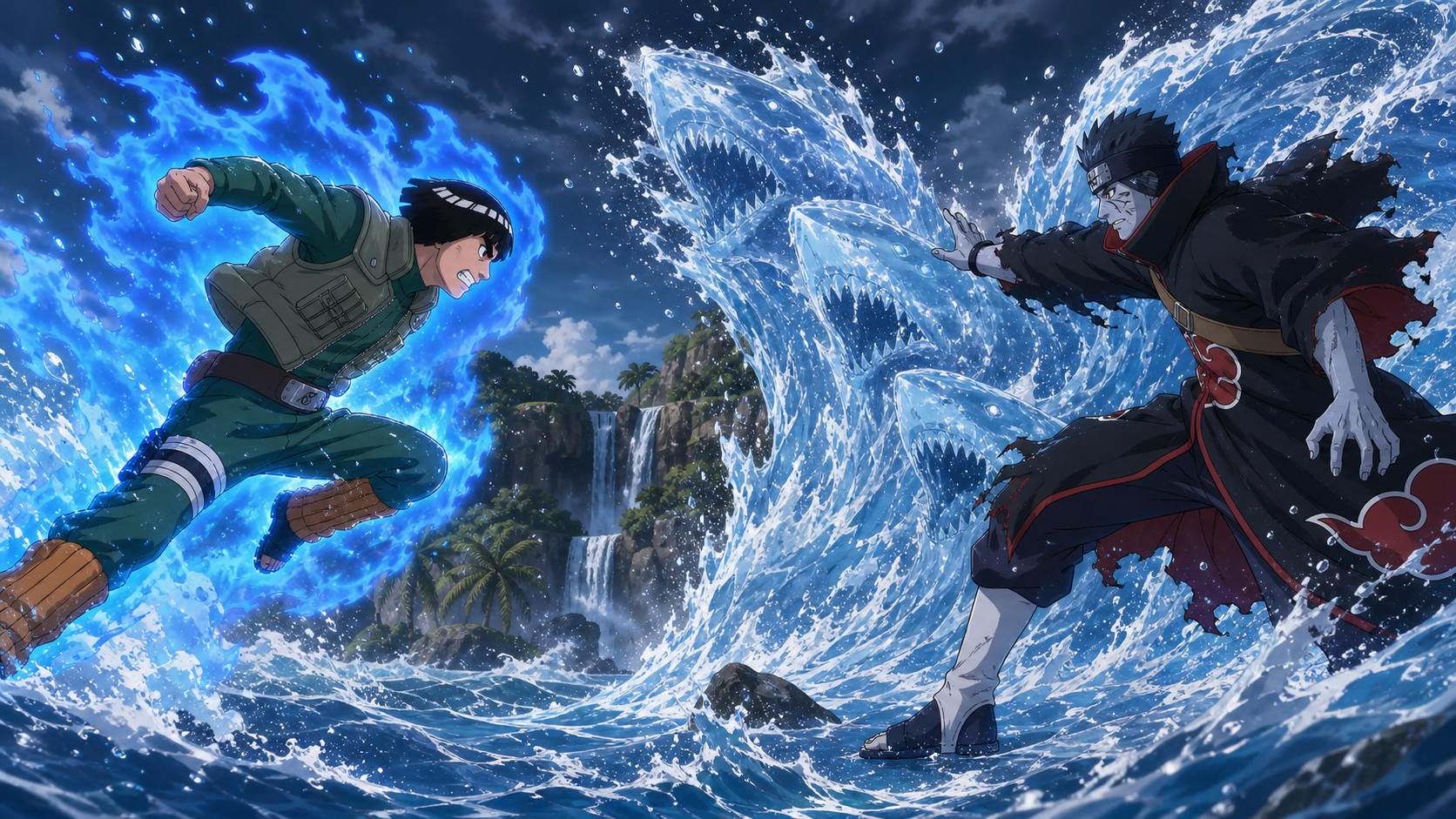
Battle in Paradise! The Odd Beast vs. The Monster!
Naruto’s new senses expose Kisame inside Samehada, and Guy counters a chakra-devouring shark with Seventh Gate force that contains no chakra to steal.
Bottom line
Naruto Shippuden Episode 250 ends the emotional stillness of Naruto's family reunion by revealing that Kisame has been hiding inside Samehada throughout the island training operation. Naruto's new chakra mode lets him sense the hostility nobody else detected. Kisame responds by fleeing with intelligence on the Allied Shinobi Forces, and Might Guy becomes the person capable of stopping an enemy who expects chakra to solve every fight.
The title's “odd beast” is Guy, a human who has pushed physical training beyond what ordinary observers think a body should do. The “monster” is Kisame, whose chakra reserves, sharklike physiology, and water techniques make him resemble a tailed beast without a tail. Their collision works because neither label tells the whole truth. Guy's eccentricity hides discipline and responsibility. Kisame's monstrous reputation hides a shinobi whose loyalty and choices will receive closer examination next.
Episode 250 is loud, fast, and occasionally ridiculous, but the tactical structure is clean. Samehada's chakra absorption helps Kisame against many ninjutsu specialists. Guy's strongest attack is compressed air pressure produced through taijutsu. Kisame prepares a technique designed to grow stronger by consuming chakra, then discovers that the Daytime Tiger gives the shark nothing to eat.
Naruto returns from the seal carrying a visible transformation
Naruto emerges from the inner battle with Kurama's chakra under control. His new form glows with a bright, organized pattern instead of the uncontrolled red cloak that once erased his judgment. The visual shift announces that Naruto can use the fox's power without immediately surrendering his body.
The victory remains limited. Naruto has taken Kurama's chakra rather than earned the fox's cooperation. Killer B and Gyūki model partnership; Naruto and Kurama are still separated by distrust and a renewed seal. The new mode proves operational control, not emotional reconciliation.
Kushina's story also changes how the power looks. Naruto now knows the chakra came through his mother before reaching him and that Minato designed the seal around a future confrontation. The glow represents achievement, inheritance, and a burden chosen for him at birth.
Negative emotions become part of Naruto's sensory world
The controlled chakra gives Naruto the ability to perceive hostile intent. Kisame survived Killer B's earlier battle by hiding inside Samehada and suppressing his presence. Conventional observation missed him because the sword was already accepted as an object with unusual chakra and behavior. Naruto notices the malice within.
This ability fits Naruto thematically. He has always been sensitive to rejection, anger, and loneliness because those feelings shaped his childhood. The new mode converts emotional awareness into battlefield detection. Hatred becomes information he can locate rather than a force that only harms him.
The gift also carries risk. Sensing negativity does not automatically reveal context or identity. A feeling can indicate danger without explaining motive. Naruto's empathy will matter when deciding what to do after perception raises the alarm.
Kisame turns Samehada into a hiding place
Kisame's concealment works because Samehada is more organism than ordinary weapon. The sword feeds on chakra, chooses wielders, changes shape, and already transferred its apparent loyalty toward Killer B. Kisame uses that ambiguity to infiltrate the island inside the blade and observe the jinchūriki protection effort from within.
The plan rewards patience. Kisame does not reveal himself when B handles Samehada or when Naruto begins training. He waits until he has gathered information valuable to Akatsuki. Survival is only part of the mission. The intelligence scroll is the real objective once discovery becomes unavoidable.
That priority distinguishes Kisame from an attacker chasing a dramatic rematch. He understands that reaching the organization with deployment information may matter more than defeating everyone on the island.
Naruto's first burst of speed is powerful and unfinished
Naruto reacts to Kisame with speed compared to the Yellow Flash. He strikes before the infiltrator can settle into an escape rhythm. The moment shows why Minato believed Kurama's chakra could become necessary against the masked man.
Then Naruto's foot catches because his body has not adapted to the acceleration. The comedy protects the transformation from instant perfection. Naruto has obtained a new capacity, but control under laboratory-like training conditions is different from movement through a real environment.
The stumble also creates space for the team. Naruto identifies and wounds the threat. Other shinobi must continue the pursuit. New power expands Naruto's contribution without making every ally irrelevant.
The island's secrecy has already failed from inside
The island was selected to hide Naruto and Killer B from Akatsuki. Kisame's presence proves concealment alone cannot secure them when the enemy has already entered through an object everyone trusts. The operation has protected its location while overlooking an infiltrator carried by one of the protected people.
This is not simple incompetence. Samehada deceives sensory expectations, Kisame can merge with the sword, and B had reason to believe the weapon had chosen him. The failure demonstrates how intelligence work exploits accepted assumptions rather than merely weak walls.
Once exposed, Kisame's scroll turns the security problem outward. Information gathered on the island can compromise the wider alliance. Stopping his departure becomes more urgent than preserving the training site's secrecy.
Killer B faces the cost of trusting Samehada
B's relationship with Samehada seemed like a comic reversal after Kisame's defeat. The sword preferred B's chakra and helped him survive. Episode 250 reveals that the apparent prize also carried the enemy inside the security perimeter.
Trusting Samehada was not foolish in a simple sense. The sword has agency and did bond with B. Kisame used that genuine preference as cover. The best deception often contains a fact the target can verify.
B's pursuit becomes personal because his own weapon connection enabled the infiltration. Still, the episode does not waste time blaming him. The priority is containing the information and preventing Kisame from reaching Akatsuki.
Guy arrives with the wrong memory and the right instincts
Might Guy has fought Kisame before, yet initially struggles to remember him. The recurring joke frustrates Kisame because recognition matters to a shinobi whose identity has been shaped by secrecy and betrayal. Guy treats the encounter as another urgent opponent rather than the return of a legendary personal enemy.
The humor does not reduce Guy's competence. Once he understands the threat, his body and attention align immediately. He protects the mission, pursues across impossible terrain, and escalates only as much as the situation requires.
Guy's lack of dramatic recognition may even help. Kisame cannot manipulate a rivalry Guy refuses to romanticize. The Leaf shinobi focuses on the scroll and escape route rather than feeding the opponent's reputation.
A living island makes pursuit stranger than open terrain
The training ground is not a passive paradise. Giant animals, moving terrain, waterfalls, and the island's own ecology complicate every route. Kisame uses water and speed to move toward the coast while the Leaf team reacts through an environment designed to keep powerful jinchūriki occupied.
The setting makes the episode's title playful. Paradise contains monsters because the island was chosen precisely for isolation and scale. Guy's physical extremity fits among creatures whose ordinary movements feel like natural disasters.
The lush scenery also contrasts with the mission. Bright water and tropical forest surround an intelligence breach that could affect the coming war. Beauty offers no guarantee of safety.
Kisame creates distance through water
Once Kisame reaches open water, the terrain begins favoring him. Water is mobility, defense, and ammunition. He can produce enormous volumes even without an existing source, and the ocean removes the spatial limits that would constrain his techniques on land.
The escape plan uses multiple shark constructs to confuse pursuit and carry the intelligence. Guy must determine which target contains Kisame and which routes are decoys. Physical speed alone cannot solve the problem without reading the movement correctly.
Kisame's strategy remains mission-first. Every water technique expands the chance that the scroll will leave the island even if his own body is intercepted.
Guy opens the Seventh Gate because ordinary pursuit is not enough
The Eight Gates release restrictions the body uses to protect itself. Opening the Seventh Gate grants Guy overwhelming speed and power while forcing his muscles and circulation into dangerous stress. The blue aura is not ordinary chakra armor. The energy appears through sweat evaporating from his body under extreme heat.
That distinction matters against Kisame. Guy's strongest advantage comes from trained physical force and controlled self-damage rather than a large external chakra reserve. Kisame is built to drain opponents who feed power into his absorption system. Guy brings an attack the system misreads.
The choice is still costly. “Hard work” in Guy's story never means effort has no limits. His body pays for each gate. Discipline lets him choose the cost knowingly; discipline does not remove the cost.
Great Shark Bullet expects power the technique can consume
Kisame's Great Shark Bullet is designed to absorb chakra from an opposing technique and grow larger. Against a conventional high-level ninjutsu attack, the shark turns the enemy's strength into its own. The more power someone sends, the more dangerous the counter becomes.
Kisame therefore reads Guy's enormous aura as fuel. His experience tells him that a spectacular attack must contain spectacular chakra. That assumption is reasonable and wrong.
The technique embodies Kisame's broader survival method. He endures by taking what opponents provide: chakra, information, trust, and openings. Guy wins the exchange by refusing to provide the expected resource.
Daytime Tiger is pressure, not a chakra animal
Guy's Daytime Tiger resembles an enormous white beast rushing through the air. The shape invites the same interpretation as Kisame's water shark, but the tiger is compressed atmospheric pressure produced by a devastating punch. No chakra creature waits for Great Shark Bullet to absorb.
The counter works through category error. Kisame prepares for ninjutsu and receives taijutsu operating at a scale that looks like ninjutsu. Guy's “odd beast” identity becomes tactical camouflage. His body produces an effect the opponent classifies incorrectly.
The collision also preserves a core Naruto idea: training can create answers that inherited or stolen power does not anticipate. Guy cannot use ninjutsu the way many elite shinobi do. He developed a different language of force, and Kisame's absorption vocabulary has no word for that language.
The blast settles the fight without settling Kisame
Daytime Tiger overwhelms the Great Shark Bullet and strikes Kisame. Guy reaches the intelligence scroll and prevents the escape route from succeeding. The immediate mission boundary is met: Akatsuki does not receive the island's information through this attempt.
Kisame's defeat does not yet explain the person beneath the monster label. His willingness to continue the mission after exposure, injury, and isolation points toward a loyalty more complicated than appetite for battle.
Episode 250 ends with physical containment. The next episode must confront memory, intelligence, and the choices Kisame will make when capture threatens the secrets he has protected.
Naruto’s new sense turns old pain into useful perception
He recognizes Kisame through hostility because anger is no longer merely something happening to him. Naruto spent childhood reading rooms for rejection before anyone spoke. Chakra mode gives supernatural reach to an emotional vigilance he developed for survival.
That origin keeps the ability from feeling random. The danger is assuming negative feeling always equals simple villainy. Naruto can locate malice now. His harder work will remain understanding what produced it and deciding whether the response requires force, empathy, or both.
Samehada proves trust can be genuine and exploited
The sword really does prefer Bee’s chakra. That fact makes the deception stronger, not weaker. Kisame hides inside a relationship Bee has reason to believe changed allegiance. Security fails because everyone sees evidence supporting the comfortable story.
Bee is not foolish for recognizing Samehada’s agency. Kisame is clever for using that agency as camouflage. The breach warns against treating a living weapon’s affection as a complete safety guarantee, especially when its former partner understands every appetite shaping the bond.
Guy’s forgotten rivalry denies Kisame the legend he expects
Kisame has built identity through terrifying reputation, secret missions, and loyalty nobody is supposed to understand. Guy cannot even place his name correctly. The joke lands like an insult because a man organized around becoming memorable meets somebody focused only on the present threat.
That forgetfulness also protects the mission. Guy does not waste time feeding a dramatic rematch. He sees an enemy carrying intelligence and chooses the force required to stop him. Kisame’s mythology receives no tactical privilege.
The Seventh Gate makes effort look nothing like safety
Guy’s body can answer chakra absorption because decades of training built another route to overwhelming force. The episode should not turn that achievement into the claim that anybody can accomplish anything by trying harder. His muscles, circulation, and future health pay for this answer.
Discipline means Guy understands the cost well enough to choose it. Hard work does not remove physical limits. It lets him approach a limit deliberately, use the opening for a specific purpose, and accept that victory may leave damage behind.
Kisame loses because he classifies the spectacle incorrectly
Great Shark Bullet assumes enormous visible power must be chakra it can consume. Daytime Tiger looks like the kind of attack that should feed the shark. It is pressure driven through air by a body operating beyond ordinary restraint.
The counter satisfies because no secret exemption appears after impact. Guy’s entire fighting language has been visible for years. Kisame’s technique is excellent at answering the resource most shinobi provide. Guy wins by speaking in the one language absorption cannot eat.
The episode restores teamwork after Naruto’s transformation
A weaker version would let the glowing hero detect, pursue, defeat, and interrogate Kisame alone. Instead, Naruto senses the threat and lands the first hit, then discovers that new speed exceeds his practiced control. Others carry the response forward.
That stumble is not humiliation. It protects the alliance from becoming background scenery around one power-up. Naruto contributes something unique. Bee, Guy, Motoi, Aoba, and the island’s terrain all shape what happens next. Growth expands a team instead of replacing it.
The paradise label keeps doing useful work too. This island was chosen because distance, secrecy, and dangerous wildlife were supposed to protect two jinchūriki. Kisame has been inside the trusted sword the entire time. The failure does not mean concealment was pointless. It means a perimeter cannot solve a threat already embedded in an accepted relationship. Samehada crossed every boundary because Bee brought it, and Bee brought it because the sword’s preference was real. That mixture of truth and deception is far more dangerous than a simple disguise. By the time Naruto senses Kisame, the enemy already possesses information about troop organization and the hidden training site. The fight therefore is not just about capturing a familiar Akatsuki member. Guy is racing to keep one patient observer from converting the alliance’s own confidence into battlefield deaths. Daytime Tiger stops the messenger. It cannot undo everything the messenger saw, which is why Kisame remains dangerous even on the ground before the larger war properly begins.
What landed for me
The technique matchup lands because the solution follows established differences rather than appearing as a last-minute immunity. Samehada and Kisame absorb chakra. Guy's Gates and Daytime Tiger rely on physical force and air pressure. The visual resemblance between tiger and shark disguises a mechanical mismatch.
Naruto detecting Kisame also lands as a meaningful first use of the new mode. His breakthrough contributes something nobody else could provide, then his inexperience prevents the scene from becoming a solo victory. Detection, pursuit, and capture remain shared work.
Guy's combination of comedy and terrifying discipline continues to work. Forgetting Kisame's name is absurd. Opening the Seventh Gate over an intelligence scroll is deadly serious. Both qualities belong to the same person.
What did not fully land
The transition from Kushina's farewell to broad physical comedy is abrupt. Naruto has just completed the most emotionally important conversation of his life. The episode gives him little quiet time before Kisame erupts from Samehada and the chase begins.
The infiltration reveal also depends on viewers accepting that extensive security and sensory precautions never inspected Samehada closely enough to find Kisame. His fusion explains the concealment, but the operation's confidence around a former Akatsuki weapon remains difficult to defend.
Neither issue ruins the episode. The tonal snap restores the external war plot, and the security failure produces a consequence large enough to justify the risk.
Final reaction
Naruto Shippuden Episode 250 brings the series back from family history to the approaching war through an enemy who has been present all along. Naruto's new sensitivity exposes Kisame. Kisame turns discovery into an intelligence escape. Guy answers an opponent built around chakra absorption with a body trained to make air itself strike like a beast.
The title jokes about appearances while the fight rewards precise categories. Kisame looks monstrous and commands water sharks. Guy behaves strangely and launches a tiger-shaped shock wave. The decisive fact is not which fighter looks more human. The decisive fact is that Great Shark Bullet can consume chakra and Daytime Tiger contains none for the shark to take.
Paradise was never secure. Still, the breach reveals why the alliance needs different kinds of strength. Naruto senses the hidden threat. B and the island team force the pursuit. Guy stops the escape. The victory belongs to a chain of contributions rather than one glowing transformation.
RaeRae’s call
Guy wins because Kisame sees spectacle and assumes chakra. Daytime Tiger is disciplined physical cost turned into pressure, giving a chakra-devouring monster nothing his shark can steal.
Episode details and viewing routes
- Official episode reference: Naruto Official episode guide
- Licensed episode route: Crunchyroll licensed episode page