
Thank You
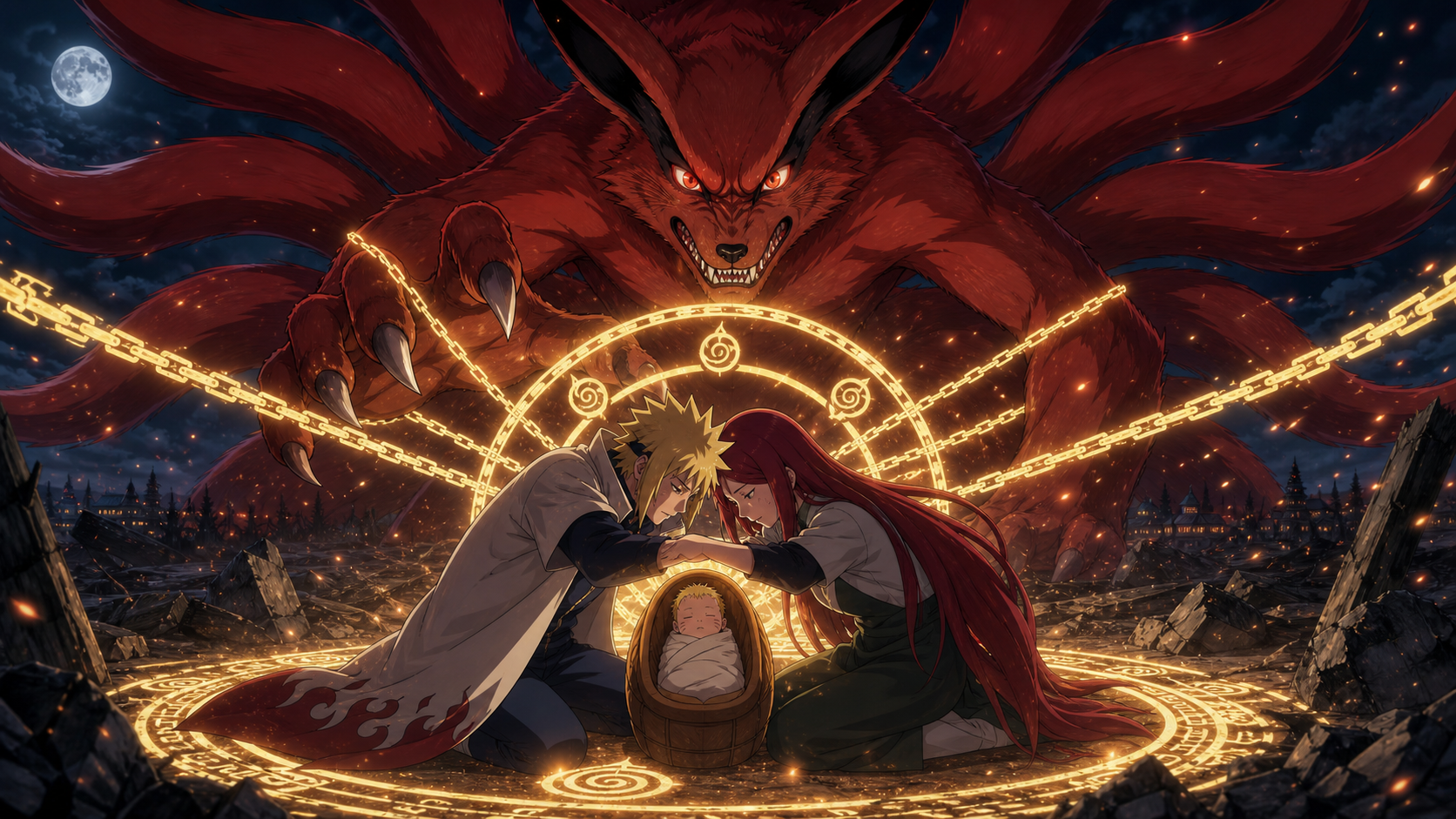
Minato and Kushina spend their final minutes protecting Naruto, building parental safeguards into his seal, and giving their newborn the love he will remember years later.
Bottom line
Naruto Shippuden Episode 249 reveals that Naruto's seal was created inside a disagreement between two dying parents who both wanted their child to live. Kushina proposes taking Kurama back into her body and dying with the fox so Minato can survive to raise Naruto. Minato chooses a different sacrifice: divide Kurama's chakra, seal half through the Reaper Death Seal, place the remaining half inside their newborn, and leave chakra imprints from both parents as future safeguards.
That choice saves Konoha and gives Naruto the power he will eventually need against the masked man. The decision also makes him a jinchūriki before he can consent, leaves him orphaned, and transfers the village's fear onto a baby. Episode 249 does not make those costs disappear. The emotional force comes from watching Kushina and Minato act under catastrophic limits, protect Naruto with their bodies, and spend their final breaths trying to give him enough love and guidance for a lifetime.
The title belongs to more than Kushina's final words. Minato thanks her. Kushina thanks Naruto for being born and making them parents. In the present, Naruto thanks his mother for loving him before he had achievements, friends, or public approval. Gratitude does not excuse the suffering ahead. Gratitude gives the family a language that the masked man's violence cannot own.
Minato moves Kurama away from the village
After breaking the masked man's control, Minato still has to stop Kurama. The fox is no longer following a Sharingan command, but rage and destruction remain. Minato summons Gamabunta to pin Kurama long enough to place a Flying Raijin mark and transport the enormous threat away from central Konoha.
The move protects civilians while transferring the crisis near Kushina and Naruto. No location is truly safe because Kurama's scale overwhelms ordinary distance. Minato can choose where the final confrontation occurs, but every choice places someone he loves within the danger.
His space-time ninjutsu again functions as public service rather than spectacle. Teleporting Kurama is a staggering feat. The scene matters because the village gains another chance to survive. Minato's best techniques repeatedly buy time rather than create clean victories.
Kushina's chains hold the fox after her body has almost failed
Kushina rises despite childbirth and extraction, then uses Adamantine Sealing Chains to restrain Kurama. Her body is failing, but her chakra still changes the entire battlefield. She does not wait for Minato to decide everything. She creates the boundary that makes any sealing plan possible.
The chains are an expression of expertise, not a final burst of unexplained maternal power. Kushina was chosen to contain Kurama because her Uzumaki chakra was unusually strong. The same quality that made her a target now lets her protect Naruto and Konoha after the fox has been removed from her.
Her strength should not romanticize what she has endured. Kushina is extraordinary, yet the episode asks an injured new mother to restrain a tailed beast because the village's containment system has collapsed. Heroism appears alongside institutional failure.
Kushina offers to take Kurama and die with him
Kushina's proposed solution is devastatingly practical. If Kurama is sealed back inside her, she can use her remaining life to carry the fox into death. The tailed beast will eventually reform, but the village and Naruto will gain time. Minato can remain alive to raise their son.
Her plan centers Naruto's ordinary needs. A living father could hold him, answer his questions, protect him from the village's suspicion, and tell him who his mother was. Kushina sees her own death as nearly unavoidable, so she tries to keep Naruto from losing both parents.
The offer is loving, but the ease with which Kushina turns her body into the final container is painful. Her life has been organized around holding Kurama for Konoha. Even at the end, the available solution asks her to become a vessel one more time.
Minato believes the masked man will return
Minato refuses Kushina's plan because the night's attack revealed a threat larger than Kurama's immediate rampage. The masked man penetrated Konoha's secrecy, controlled the Nine-Tails, countered elite defenses, and escaped after fighting the Fourth Hokage. Minato believes the attacker will return and that future shinobi will need Kurama's power to stop him.
This prediction shapes Naruto's life before Naruto can shape the decision. Minato places the burden of a future conflict onto his newborn because he trusts that his son can eventually master the chakra. The choice combines faith, strategy, and parental projection.
Trust does not equal consent. Minato's belief in Naruto will prove meaningful, but Naruto will spend years absorbing consequences his father cannot explain in person. Episode 249 asks us to hold both truths: Minato sees capacity in his son, and Minato assigns his son a terrible role.
The Reaper Death Seal divides power and family
Minato uses the Reaper Death Seal because Kurama's full chakra cannot be placed inside a newborn. He seals the yin half within himself and prepares the yang half for Naruto. The technique guarantees Minato's death, converting his own soul into the price of containment.
The division creates the power structure that will define Naruto's childhood. Kurama is separated. Minato and Kushina are about to die. Naruto becomes the living location where the remaining danger, hope, and future plan meet.
Sealing is often presented as technical mastery in Naruto. Here, every formula is also a family decision. Chakra ratios, compatible vessels, and containment methods determine who survives, who dies, and who carries the story forward.
Hiruzen arrives at a barrier he cannot cross
The Third Hokage and other Leaf shinobi reach the confrontation but are held outside Minato's barrier. They can witness the crisis without intervening in the family's final decision. The boundary protects the sealing process, yet the image of Konoha's leadership watching from outside is difficult to ignore.
Minato has concentrated the answer around himself because time is gone. That concentration makes tactical sense. The cost is that nobody inside the village can share the final burden or challenge his assumptions about Naruto's future.
Hiruzen will inherit responsibility for the child after the seal closes. The episode's later history makes that fact painful. Naruto survives the night, but survival does not guarantee the protection, truth, or affection his parents imagine the village will provide.
Minato stores future meetings inside Naruto's seal
Minato places chakra from himself and Kushina within the seal so both can help Naruto later. His imprint will appear when Naruto is close to removing the seal. Kushina's will appear when Naruto attempts to control Kurama. The design anticipates two different emergencies and assigns each parent a final intervention.
That foresight is beautiful because Naruto eventually receives answers no living adult gives him. The architecture lets his parents speak directly, explain their choices, and protect him when the seal reaches its most dangerous thresholds.
The design is also heartbreaking. Parental presence becomes an emergency feature. Naruto cannot call on those imprints when loneliness hurts or the village rejects him. He can meet his parents only when his relationship with Kurama becomes dangerous enough to activate their stored chakra.
Kurama recognizes the threat of another prison
Kurama sees the sealing ritual and understands what Minato intends. The fox has just escaped Kushina's body after years of confinement. Freedom lasts minutes before another human begins dividing and sealing its chakra. Kurama's rage is not mysterious.
The fox attacks Naruto because killing the newborn would remove the intended vessel. That action is horrifying. The target is an infant who has done nothing. At the same time, the episode has shown Kurama repeatedly treated as power to be owned, extracted, controlled, transported, divided, and inherited.
Understanding the source of rage does not excuse attacking a child. The distinction matters because Naruto's future relationship with Kurama will require recognizing pain without surrendering moral judgment.
Two parents move before the claw reaches their child
When Kurama's claw drives toward Naruto, Minato and Kushina place themselves between the fox and their son. No discussion is needed. Their bodies answer at the same instant. The scene makes visible what every prior choice has tried to express: Naruto's life matters more to them than their remaining time.
The protective gesture is not the cause of their deaths by itself. Both parents were already committed to fatal sealing choices. The claw turns that sacrifice into an intimate image Naruto can understand. They did not die at a distant battlefield while he happened to survive. They died facing him, holding the line between their newborn and a force determined to reach him.
The moment also denies the masked man final ownership of the night. His strategy separated the family and released Kurama. Minato and Kushina reunite around Naruto and choose the meaning of their last act.
Kushina tries to fit a childhood into a few minutes
Kushina's final guidance begins with ordinary care. Do not be picky. Eat properly. Bathe. Sleep enough. Make friends. Study. Respect teachers and the Three Prohibitions. Be careful with money and alcohol. Find someone worthy when love enters his life.
The list breaks me because none of the advice is grand enough to match the battlefield. Kushina does not spend her last breath telling Naruto to become a weapon or save the world. She talks like a mother imagining school days, meals, bad decisions, friendship, and adulthood.
She knows her words cannot replace years of parenting. The length of the list reflects panic as much as wisdom. Kushina is trying to pour an entire childhood into the time left before the seal closes.
The advice carries personality, not polished sainthood
Kushina's guidance is funny, specific, worried, and occasionally contradictory. She warns Naruto about traits he may inherit from his parents. She wants him to have friends he can trust, even if the group is small. She acknowledges romance while struggling to imagine another woman beside her son.
Those details keep the farewell from becoming generic inspirational dialogue. Kushina sounds like the person Naruto just met: forceful, loving, embarrassed, practical, and unable to stop once emotion takes over.
Minato listens while the time available for his own words disappears. Kushina recognizes that imbalance and apologizes for taking over. Minato answers that her words are enough. The exchange feels like marriage continuing even at the edge of death.
“Thank you for making me a mother” reverses Naruto's oldest fear
Kushina thanks Naruto for being born and for making her and Minato his parents. The statement reaches the core wound of Naruto's childhood. He grew up believing his existence caused trouble. Villagers saw Kurama when they looked at him. Adults withheld the truth. Loneliness taught him to treat attention as something he had to earn.
Kushina tells him that his existence gave her something precious before he accomplished anything. Naruto did not need to become a hero, master a jutsu, or win a village's approval to matter. Being her child was already a gift.
The gratitude does not erase the decisions that placed Kurama inside him. The gratitude establishes the emotional truth behind those decisions. Naruto was never a disposable container to his parents, even when crisis forced them to make him one.
Naruto answers his mother from the life she could not see
Back in the present, Naruto can finally respond. He tells Kushina how he has lived, what he eats, how he works, the friends he found, and the person he became. His answer is not a perfect report card against every piece of advice. Naruto's life has been messy. That honesty makes the response feel like a conversation rather than a performance.
Most important, Naruto tells her he is glad to be their son. The child who once demanded to know why his parents placed Kurama inside him can now hold anger, grief, love, and gratitude together. Understanding their circumstances does not mean pretending the consequences were painless.
Kushina fades knowing Naruto survived more than the seal. He built connections, found purpose, and reached the point where he could hear her story without letting resentment decide the ending.
Kushina’s proposed sacrifice protects Naruto’s ordinary future
She offers to take Kurama back and die because Minato could then remain. Her plan is not about producing a destined hero. It is about leaving their baby one living parent who can make food, answer questions, and stand between him and a frightened village.
That desire makes Minato’s competing plan hurt more. He is thinking about the masked man’s return and power Naruto may need years later. Kushina is thinking about the childhood that begins tomorrow. Both futures matter, and catastrophe refuses to let the family keep both.
Trust in Naruto cannot substitute for Naruto’s consent
Minato believes his son will master the fox and face the attacker. The story eventually proves that faith spectacularly correct. Proof does not travel backward and make the infant part of the decision. Naruto receives a mission before receiving a name he can understand.
Love makes the choice human. It does not make the burden fair. The strongest reading lets Minato be brilliant, desperate, loving, and responsible for assigning a terrible inheritance rather than polishing him into a father whose foresight excuses every consequence.
The village inherits a promise it does not keep
Hiruzen watches from outside the barrier and will become the senior authority responsible for Naruto after both parents die. Minato and Kushina can reasonably expect the village they saved to protect their child. We already know protection will stop far short of family, truth, and daily dignity.
That failure belongs beside the sacrifice. Naruto’s later resilience cannot pay Konoha’s debt. Two parents gave everything so their son and neighbors could live. The neighbors survived, then allowed the child at the center of that rescue to grow up visibly alone.
Kushina’s ordinary advice names everything being stolen
Food, baths, sleep, school, money, friendship, romance: the list sounds small beside a death god and a tailed beast. That is exactly why it devastates. Kushina is trying to parent a lifetime in minutes because the extraordinary crisis has taken every ordinary day.
She does not ask Naruto to become legendary. She asks him to live. The advice preserves her humor and worry while refusing the shinobi world’s habit of measuring a child by future utility. Naruto matters even if he never becomes anyone’s savior.
Naruto’s answer protects the scene from becoming a one-way farewell. He cannot give Kushina the childhood she missed, but he can introduce the person who survived it. His report says her hopes were not fulfilled and were not wasted. He found teachers, friends, purpose, eating habits, stubborn joy, and honesty to thank her without pretending he never hurt.
What landed for me
Kushina's last instructions land hardest because they insist Naruto deserved an ordinary life. The episode surrounds the family with giant chakra, a death god, sealing formulas, and village catastrophe. Her concerns remain meals, sleep, friends, school, money, and love. Those details reveal exactly what the attack steals.
The protective movement against Kurama's claw also lands because Minato and Kushina act together. Their strategies differ, but their commitment to Naruto never does. The image does not require either parent to win the argument about the seal before proving their love.
Naruto's present-day answer completes the reunion. Kushina receives evidence that her son became more than a vessel or weapon. He can speak for himself, thank her, and carry her memory without being trapped inside the night she died.
What did not fully land
Minato's confidence that Naruto should carry Kurama because a future savior will need the fox's power remains ethically difficult. Prophecy and trust give the decision narrative weight, but neither gives a newborn agency. The story sometimes leans toward proving Minato correct instead of fully confronting what Naruto had to endure because of that choice.
The episode also offers limited scrutiny of Konoha's responsibility after the sealing. Minato and Kushina entrust Naruto to the village. The audience already knows how isolated he will become. Hiruzen's presence outside the barrier makes the gap between promise and outcome especially sharp, yet the flashback does not pause to address that failure.
Those concerns deepen rather than cancel the emotion. Love can be real inside a decision that causes harm. Episode 249 works because Naruto has become strong enough to recognize both.
Final reaction
Naruto Shippuden Episode 249 transforms the origin of Naruto's seal from a legend about the Fourth Hokage into a family tragedy told by the mother history nearly erased. Kushina restrains Kurama, offers her own life as the last container, protects her child, and uses her final time to imagine the ordinary years she will never share with him. Minato divides Kurama, stores parental chakra in the seal, and trusts Naruto with a future neither parent will see.
Their choices are loving, strategic, and unfair to the baby who must carry the consequences. Naruto's answer does not need to declare every choice perfect. He thanks Kushina because he finally understands that his life began as a source of joy, not a punishment.
“Thank You” closes the reunion with mutual gratitude. Kushina thanks Naruto for making her a mother. Naruto thanks Kushina and Minato for making him their son. The seal preserved more than Kurama's power. Against every failure that followed, the seal preserved enough love for Naruto to hear that he was wanted.
RaeRae’s call
“Thank You” breaks me because love is unquestionable while the decision remains unfair. Naruto was wanted before achievement, burdened before consent, and entrusted to a village that owed him far more than survival.
Episode details and viewing routes
- Official episode reference: Naruto Official episode guide
- Licensed episode route: Crunchyroll licensed episode page