
The Fourth Hokage’s Death Match
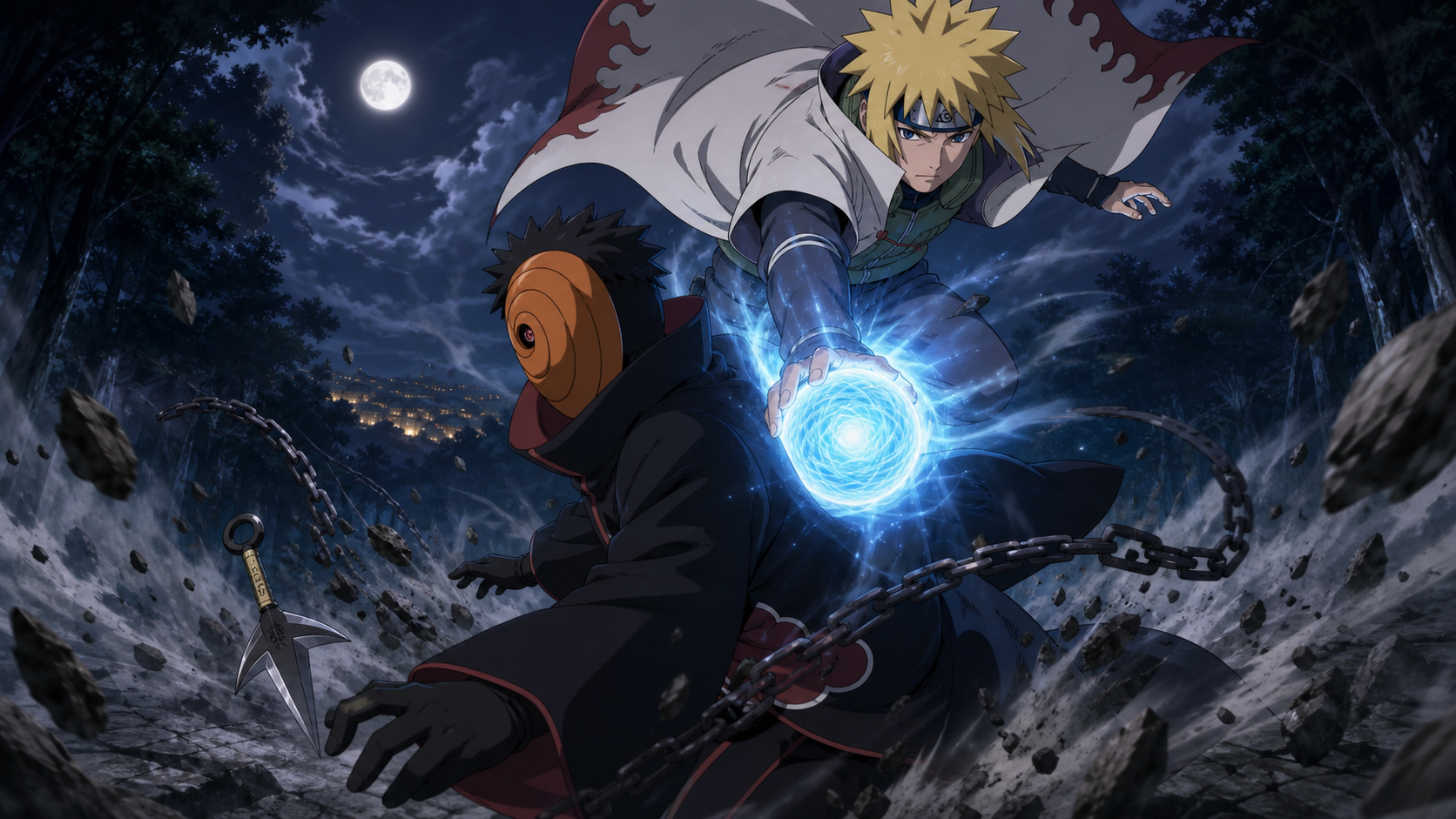
Minato protects Konoha, reads the masked shinobi’s one unavoidable moment of solidity, and converts a falling marked kunai into a decisive Rasengan counter.
Bottom line
Naruto Shippuden Episode 248 turns Minato's reputation into something more interesting than speed. The masked man has extracted Kurama from Kushina, placed the fox under Sharingan control, and attacked Konoha while Minato is still trying to protect his wife and newborn son. Minato cannot overpower every crisis at once. He survives by identifying what the enemy needs, predicting the fraction of a second when space-time intangibility must end, and turning one marked kunai into the opening for a Rasengan.
“The Fourth Hokage's Death Match” earns its title because the fight is not a tournament of impressive techniques. Every exchange happens under civilian catastrophe. Kurama is destroying the village. Kushina is dying after extraction. Naruto is a newborn hidden away from an attacker who has already used him as leverage. Minato has no room for a prolonged duel or a mistake he can study afterward.
The victory is brilliant and incomplete. Minato breaks the masked man's control over Kurama and marks him for future pursuit, but the fox remains loose in Konoha. He solves the human opponent while the larger disaster continues. The episode shows why Minato became Hokage and why even his extraordinary competence cannot protect everyone from the consequences of one coordinated attack.
Kushina survives an extraction meant to kill her
The masked man tears Kurama from Kushina immediately after childbirth, choosing the moment when her seal and body are weakest. Tailed-beast extraction normally kills a jinchūriki. Kushina's Uzumaki vitality keeps her alive, but survival should not be confused with safety. She has endured labor, abduction, and the violent removal of a being sealed inside her for years.
Her condition keeps the attack personal. The village will remember the Nine-Tails rampage as a public disaster. Kushina experiences the beginning as an invasion of her body. Kurama is the strategic target, but reaching the fox requires treating Kushina as a container that can be broken open and discarded.
The masked man then orders Kurama to kill her, removing the witness and punishing the person whose body carried his objective. Kushina has almost no strength left to resist. Minato's arrival saves her, yet the rescue does not restore what was taken. He can move Kushina away from immediate death. He cannot return Kurama to the seal or undo the physical trauma.
Minato chooses rescue before pursuit
Minato has every reason to chase the masked man immediately. An unknown shinobi has breached the village's deepest secret, taken Kurama, and threatened Naruto. Still, Minato's first responsibility is to the people in front of him. He secures his son and moves Kushina out of the attacker's reach before beginning the pursuit.
That choice distinguishes protection from revenge. Minato does not let anger decide the order of operations. Kushina needs care. Naruto needs a safe location. The village needs its Hokage. Pursuing the attacker matters only after the vulnerable people Minato can reach have been moved away from immediate harm.
The episode makes the sequence feel almost effortless because Flying Raijin collapses distance. Emotionally, nothing is easy. Minato must leave Kushina when she is barely alive because Kurama has been released. He must leave Naruto because the village is under attack. Speed lets him move between roles, but speed cannot let him remain husband, father, and Hokage in the same place.
Kurama becomes a weapon through imposed control
The masked man's Sharingan fixes Kurama inside a command structure. The fox's rage is genuine, but the direction of the attack is imposed. That distinction matters because Konoha will later place nearly all blame on the Nine-Tails while the human architect disappears into rumor.
Kurama is not innocent of violence. The fox attacks with catastrophic force. Yet Episode 248 shows a powerful being captured through genjutsu and aimed at civilians by someone seeking political destruction. The village sees a monster. The audience sees both the monster and the hand using its anger.
That pattern mirrors the jinchūriki system from another direction. Villages seal tailed beasts inside people so their power can be controlled. The masked man uses ocular power to achieve direct control. Both systems reduce sentient chakra to military capacity. Their goals differ, but neither begins by asking Kurama what the fox wants.
Konoha's ordinary night ends without warning
Kurama's appearance above the village changes the scale instantly. Families who knew nothing about Kushina's labor or the weakened seal suddenly face a disaster created by secrets they were never allowed to understand. Buildings collapse. Shinobi scramble toward a threat beyond ordinary defense. The night Naruto is born becomes the date the village will mourn.
The surprise also reveals the cost of concentrated secrecy. Limiting knowledge protected Kushina from many possible threats, but the people responsible for village defense had little warning when the plan failed. The masked man exploited information asymmetry better than Konoha did. He knew the critical vulnerability; most defenders only saw Kurama after control had already been lost.
None of that excuses the attacker. The episode simply shows why disaster response cannot depend on one perfect protector. Minato is forced to discover the crisis, redirect the largest attack, identify the enemy technique, and break the summoning contract while everyone else tries to keep civilians alive.
A Tailed Beast Bomb tests the meaning of Hokage
Kurama's Tailed Beast Bomb points directly at the village, turning Minato's first intervention into a choice between personal combat and mass protection. He uses a space-time barrier to move the blast away from Konoha. The feat is spectacular, but the framing keeps the purpose clear. Minato's technique matters because people beneath him survive.
This is the office of Hokage stripped of ceremony. No monument, cloak, or title can stop the blast. The role becomes a promise made physical: stand between the village and destruction, then find a solution before the next attack arrives.
Minato pays for that promise through isolation. Few people can follow the logic of his space-time techniques in real time. Fewer can share the decisions. His competence makes everyone depend on him at the exact moment his own family needs him most.
The masked man understands Minato's habits
The duel becomes frightening before the first clean hit because the masked man has studied Minato's movement. He knows Flying Raijin. He anticipates the Hokage's reliance on marked locations. His chains are designed to catch Minato after an apparent pass-through, converting the instant of reappearance into a restraint opportunity.
Minato recognizes the same danger from the opposite side. His attacker can become intangible when struck and can absorb targets into a separate space through physical contact. The two techniques create a lethal timing problem. Minato must attack when the masked man becomes solid. The masked man must touch Minato before the Hokage teleports away.
The battle therefore has more in common with reading than trading blows. Each man is trying to interpret the other's rule set before one mistake becomes permanent. Speed matters, but comprehension determines how speed is used.
Intangibility has a necessary ending
The masked man's space-time technique appears unbeatable because attacks pass through his body. Minato does not waste time insisting that greater force will solve the problem. He asks what the opponent must do to win. To pull Minato into the alternate space, the attacker must become tangible at the moment of contact.
That requirement creates the opening. Invulnerability is conditional because offense and intangibility cannot operate simultaneously. Minato's insight is simple once stated, but reaching that conclusion during a village-wide emergency demonstrates why his intelligence is as dangerous as Flying Raijin.
The lesson extends beyond this fight. A power's impressive surface often hides an operational cost. The correct counter does not oppose the strongest feature directly. The correct counter targets the transition the user cannot avoid.
The marked kunai is a question thrown ahead of the answer
Minato throws his special kunai through the masked man's head, apparently confirming that a physical strike cannot connect. The weapon is not a failed attack. The kunai continues past the opponent and carries a Flying Raijin marker into the precise space Minato will need a heartbeat later.
The masked man commits to grabbing Minato after the blade passes. That commitment requires solidity. Minato teleports to the falling kunai, reappears above and behind his opponent, and drives a Rasengan into his back. The entire sequence works because Minato uses the first move to position the second rather than demanding immediate success.
The attack is satisfying without becoming brute-force fantasy. Minato wins the exchange through timing, geometry, and the opponent's confidence. The Rasengan provides impact, but the marked kunai provides the argument.
Flying Raijin changes distance into memory
Minato's technique does more than make him fast. A mark allows him to return to a location or target without crossing the space between. Distance becomes a record he can revisit. Once the masked man is marked, escape no longer means the same thing.
That permanence catches the attacker off guard. He assumes retreat and intangibility will reset the duel. Minato appears beside him because the formula placed during contact remains active. The Hokage converts one successful exchange into a continuing strategic advantage.
The mark also answers the attacker's anonymity. Minato may not know the face beneath the mask, but he has created a way to find the person again. Identity can remain hidden; position cannot remain entirely private.
Contract Seal breaks control rather than destroying Kurama
After landing the Rasengan and marking his opponent, Minato uses the Contract Seal to sever the masked man's hold over Kurama. The choice is crucial. Killing the attacker is not the only objective. Stopping the mechanism directing the Nine-Tails can save more lives than extending the duel.
The seal treats control as a connection that can be broken. Kurama remains enraged and dangerous, but the fox is no longer responding to the masked man's direct commands. Minato separates the enemy from the weapon before the attacker can regain the initiative.
This solution also reflects the Fourth Hokage's full skill set. Flying Raijin creates the opening. Rasengan damages the opponent. Sealing knowledge dismantles the larger operation. None of the techniques alone would resolve the crisis.
The masked man retreats without becoming harmless
The attacker loses control of Kurama and takes a direct Rasengan, yet retreat preserves the mystery. Minato recognizes that the masked man is extraordinarily dangerous and likely connected to larger plans. He cannot pursue because Konoha is still under attack.
That unfinished boundary gives the victory weight. Minato has won the duel's immediate objective, but the enemy survives with knowledge of Konoha, Kushina, Naruto, and the village's defenses. The mark may create a future advantage. The present crisis gives Minato no time to use that advantage.
The masked man's withdrawal also proves that his goal did not require defeating Minato in a conventional sense. Kurama has already been extracted and unleashed. Buildings are falling. The family has been separated. Even a tactical loss can coexist with strategic damage.
Minato’s speed keeps exposing the impossibility of his roles
Flying Raijin lets him cross distance instantly. It cannot let him remain beside Kushina, hold Naruto, protect civilians, study the masked man, and restrain Kurama at once. The faster he moves, the more clearly the episode shows everything demanding his presence.
That pressure makes competence tragic. Minato answers each emergency correctly and still leaves somebody he loves because the next emergency is larger. Hokage mythology calls that sacrifice. A young family experiences it as repeated absence during the worst night of their lives.
The masked man turns information into the deadliest weapon
He knows the delivery schedule, the hidden chamber, the weakened seal, Minato’s technique, and the response parental love will force. None of those facts destroys Konoha alone. Combined in the correct order, they dismantle defenses built around secrecy and one exceptional protector.
The attack is terrifying because it is designed, not improvised. He does not need to be stronger than Minato at every moment. He needs to create simultaneous crises until even instant movement cannot answer all of them before damage becomes permanent.
Breaking the contract separates Kurama from the crime’s author
Konoha sees the fox towering over homes and will remember the Nine-Tails as the attacker. Minato’s Contract Seal reveals a more complicated chain. Kurama commits the violence while another person directs where that violence lands through imposed control.
Severing the link matters more than winning another exchange with the masked man. It removes the hand aiming the weapon. It also leaves the weapon enraged, conscious, and loose, which is why tactical brilliance cannot produce a clean moral ending.
The Rasengan works because the choreography respects rules
Minato does not become faster through emotion or surprise the audience with an unexplained immunity. He identifies the instant intangibility must end, throws the marker past his target, and lets the opponent’s attack commitment create solidity.
Every movement answers information already shown. The falling kunai is not decoration. The teleport is not random spectacle. The Rasengan lands because observation, positioning, and nerve converge inside one fraction of a second. That is the kind of anime fight I will happily replay until the remote files a complaint.
Kushina’s survival deserves more weight than the plot has time to give it. Extraction is supposed to kill a jinchūriki, and she endures it immediately after labor while still thinking first about Naruto and the village. Uzumaki vitality explains the mechanics. It should not turn suffering into a durability demonstration. Her body has been treated as a seal, attacked as a route to Kurama, and left behind while the men carrying the visible battle move across Konoha. She remains a decision-maker inside that devastation, not evidence that the system was survivable.
Kurama’s position is equally uncomfortable. The fox is controlled by Sharingan and aimed at civilians, yet its rage does not begin with the masked man. Humans captured, transferred, sealed, and militarized tailed beasts for generations. The genjutsu weaponizes an anger the shinobi world helped cultivate. None of that excuses the homes destroyed tonight. It does explain why breaking one contract cannot create peace. Minato removes the immediate controller, but the relationship between village and beast remains built from imprisonment and fear.
The episode also makes Konoha’s dependence on Minato look less heroic the longer the crisis continues. One person redirects the bomb, diagnoses the enemy, wins the duel, places the tracking mark, and severs the contract. Everyone needs him because the village concentrated irreplaceable knowledge and mobility inside one body. That structure produces a legend and a catastrophic single point of failure. Minato’s brilliance saves lives tonight. It cannot be the only emergency plan a community possesses.
That burden is why the death match never feels like combat. Every exchange spends seconds borrowed from Kushina, Naruto, the shinobi below, and civilians who cannot teleport away.
What landed for me
Minato's analysis lands because the episode lets intelligence appear through action. He does not pause for a long explanation while civilians wait. The kunai throw, teleport, Rasengan, and mark reveal his conclusion at combat speed. The later explanation confirms what the choreography has already communicated.
The episode also keeps Kushina present in the emotional stakes even after Minato leaves her. Every decision carries the knowledge that she is wounded and waiting beside Naruto. Minato's calm never reads as detachment. Calm is how he prevents fear from wasting the seconds his family and village need.
The Contract Seal is another strong choice. The climax is not merely a harder hit. Minato identifies the system connecting attacker and fox, then removes that control. The sequence rewards broad competence rather than a single signature technique.
What did not fully land
The village destruction moves so quickly that civilians can feel like scale markers rather than people. Houses collapse to demonstrate Kurama's power, but Episode 248 spends more emotional time on the duel than on those experiencing the attack below. Later consequences will carry that grief, though the immediate spectacle occasionally outruns the human cost.
Minato's near-perfect execution also risks making every other defense appear irrelevant. The episode needs his brilliance, yet the concentration of solutions around one person reinforces the same institutional fragility the attack exposes. A village should not require one exhausted new father to answer every impossible problem.
Neither issue breaks the episode's momentum. Both make the title feel painfully accurate. This is the Fourth Hokage's death match because the entire response has narrowed around him.
Final reaction
Naruto Shippuden Episode 248 delivers one of the series' cleanest tactical fights while refusing to make the outcome a complete victory. Minato reads the masked man's intangibility, places a marked kunai beyond him, teleports into the required instant of solidity, lands a Rasengan, and breaks the contract controlling Kurama. Every step follows a rule the episode has made visible.
The brilliance sits inside tragedy. Kushina has been attacked and extracted. Naruto has spent his first hours as a hostage and evacuation priority. Konoha is burning beneath Kurama. Minato can solve the opponent in front of him, but no technique lets him reverse time and restore the quiet family room.
The Fourth Hokage wins by understanding that the masked man's greatest defense must end whenever he chooses to attack. The episode leaves Minato with a larger version of the same problem. He has stopped the person directing Kurama. Now he must face the fox itself, and the village cannot become intangible while destruction comes down.
RaeRae’s call
Minato wins the duel by reading one unavoidable instant, but speed cannot let him be father, husband, and Hokage everywhere at once. The masked man loses the exchange after already making catastrophe permanent.
Episode details and viewing routes
- Official episode reference: Naruto Official episode guide
- Licensed episode route: Crunchyroll licensed episode page