
Kakashi, My Eternal Rival!
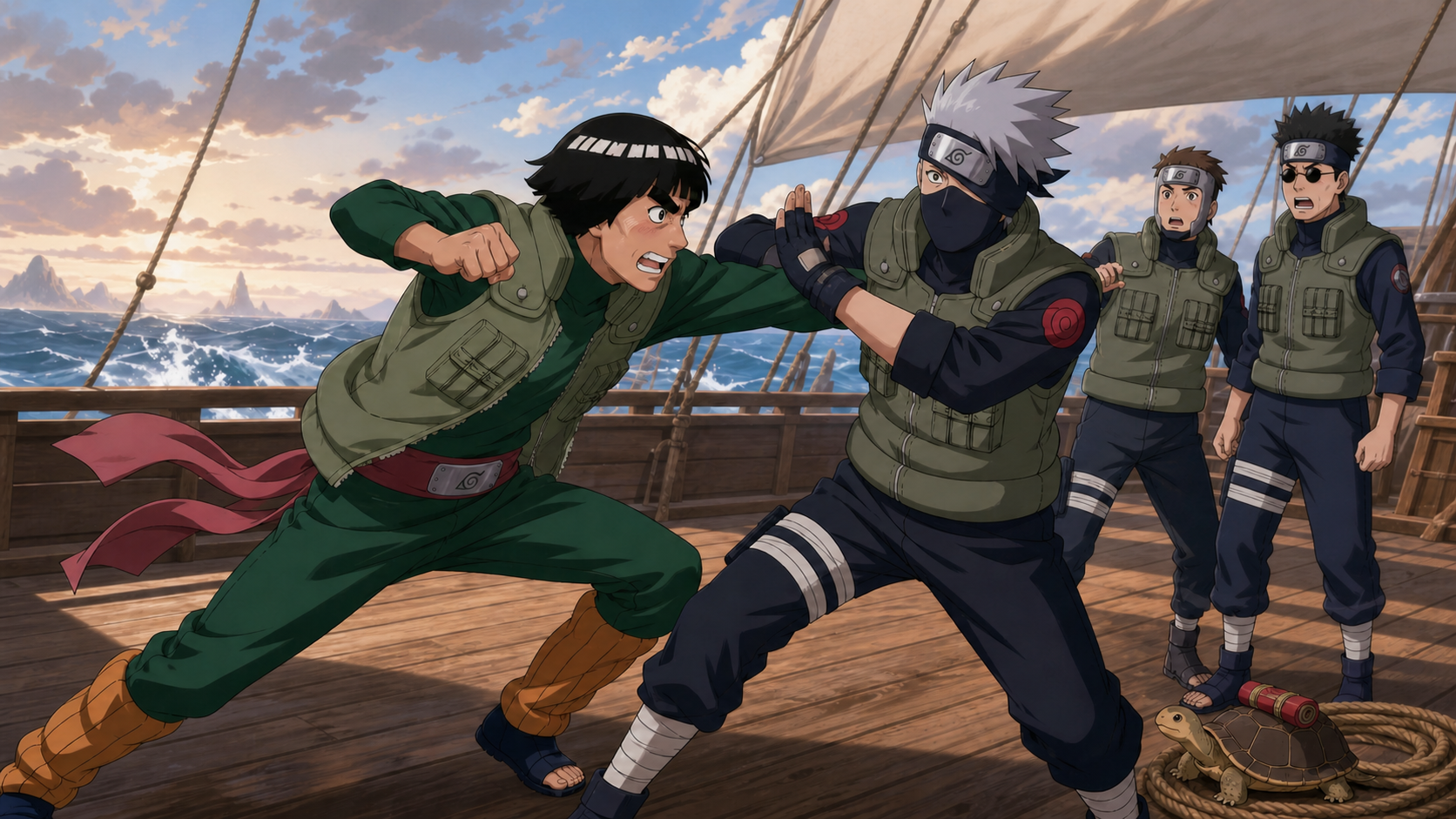
Kakashi answers Guy’s emergency call without hesitation. Guy answers the rescue by deciding his oldest rival must be fake.
Bottom line
Naruto Shippuden Episode 241 turns an accidental emergency signal into a test of how well Guy and Kakashi know each other. Kakashi leaves Konoha because Guy’s messenger tortoise delivers an SOS. Meanwhile, Yamato warns the ship that an enemy may copy both appearance and chakra. When Kakashi arrives and Guy has no memory of requesting help, the most loyal explanation becomes the most dangerous one: Guy decides his rival must be an impostor.
The fight is ridiculous, but the resolution carries real weight. Kakashi proves his identity with a private detail from their youth, something belonging to a relationship rather than a biometric test. Their hundreds of contests have produced more than a running joke. Guy trusts Kakashi because Kakashi remembers the person behind the performance, while Kakashi names Guy as the right-hand man he wants beside him in war.
Kakashi’s war appointment changes the scale
Tsunade tells Kakashi that the Allied Shinobi Forces need him as a troop commander. His experience at Kannabi Bridge gives him knowledge few living shinobi share. A comedy episode begins by reminding viewers that another generation is about to enter a war shaped by the previous one.
Kakashi does not celebrate the honor. Command means responsibility for lives, information, and choices that cannot be reversed. His response fits a veteran who knows glory is the least important part of surviving a battlefield.
Asking for a right-hand man reveals Kakashi’s trust
Kakashi accepts command with one request: he needs somebody he trusts implicitly. The person he chooses is Guy, currently escorting Naruto. That choice arrives before the rivalry flashbacks and gives every later joke a serious foundation.
Kakashi has worked with tacticians, elite jōnin, ANBU operatives, and former students. He chooses Guy because reliability under pressure matters more than presentation. Guy may be loud, theatrical, and vulnerable to seasickness, but Kakashi knows exactly what happens when danger becomes real.
The emergency tortoise makes loyalty automatic
Guy’s messenger tortoise reaches Kakashi carrying an emergency signal. Kakashi leaves without waiting for perfect information because the signal belongs to someone he trusts. The response shows the rivalry from the quiet side.
Guy spends years demanding contests and announcing eternal competition. Kakashi often acts uninterested. His immediate departure proves indifference was never the truth. When Guy appears endangered, Kakashi treats the message as sufficient reason to move.
Seasickness does not cancel Guy’s pride
On the ship, Guy continues performing toughness while the ocean repeatedly defeats his stomach. The physical joke works because his self-image remains intact even when his body refuses cooperation.
Guy’s refusal to admit weakness can be exhausting, yet the episode also treats the performance as a coping system. He survives discomfort by turning endurance into another challenge. The same habit that makes a boat ride ridiculous helps him face threats other people would call impossible.
Rivalry began with unequal expectations
Guy remembers meeting Kakashi when they were young. Kakashi carried the reputation of a prodigy and Sakumo Hatake’s son. Guy lacked talent in ninjutsu and genjutsu and had to build value through taijutsu, repetition, and his father’s rules.
Their rivalry was never simply two equal children keeping score. Guy used Kakashi as proof that effort deserved to stand beside inherited genius. Kakashi slowly learned that dismissing Guy meant misunderstanding a form of strength he could not measure through academy assumptions.
The contests created a shared language
Guy and Kakashi compete across races, combat, endurance tests, and increasingly absurd challenges. The score matters to Guy because numbers let him make persistence visible. Kakashi’s willingness to participate matters even when his expression suggests boredom.
Each contest says the relationship will continue after the result. A loss creates the next challenge rather than humiliation or separation. That repeated return turns rivalry into a stable language both men can use without delivering vulnerable speeches.
Kakashi never mocks the work beneath the spectacle
Other people may see Guy’s poses, declarations, and green uniform first. Kakashi has watched the training behind them. He knows the cost of Guy’s speed, strength, gates, and discipline.
That knowledge separates Kakashi’s teasing from contempt. He can act unimpressed because Guy does not need false praise. When stakes rise, Kakashi treats him as an equal and names him as the person needed at command level.
Yamato’s warning creates a rational fear
Yamato tells the ship’s jōnin about a rumored enemy who can duplicate appearance and chakra. A simple transformation could be challenged through sensory checks, but chakra imitation undermines the shinobi world’s stronger methods of recognition.
The warning changes the social rules before Kakashi arrives. Familiarity becomes suspicious. The better an arriving person looks and feels like Kakashi, the more convincing the rumored technique would appear. Guy’s mistake grows from bad timing rather than pure stupidity.
Guy’s missing memory becomes evidence against Kakashi
Kakashi reaches the ship and calls for Guy. Guy does not remember sending the SOS, so he interprets the contradiction through Yamato’s warning. From his perspective, a false Kakashi has followed the emergency route onto their vessel.
His decision is hasty, but the protective instinct is real. Naruto’s escort mission carries global importance. Guy would rather attack a familiar face than allow sentiment to compromise the mission. Loyalty to Kakashi and duty to Naruto collide because the enemy rumor weaponizes both.
The attack is funny because both men stay themselves
Guy launches into combat with total conviction. Kakashi blocks and evades while trying to understand why his rescue target wants to defeat him. Their physical rhythm resembles another rivalry contest, except only one participant knows the supposed rules.
The comedy does not require either man to become incompetent. Guy remains fast and decisive. Kakashi remains controlled and adaptive. The misunderstanding places their recognizable strengths inside the wrong story.
Aoba and Yamato inherit Guy’s suspicion
Aoba and Yamato support Kakashi’s explanation, but Guy reads that support as further proof of infiltration or imitation. Once fear supplies the frame, contradictory evidence can be absorbed rather than considered.
That escalation gives the joke a useful warning. Security thinking can protect a group, yet suspicion without an exit condition becomes self-sealing. Guy needs a test capable of proving identity, not more people insisting that he calm down.
Appearance and chakra are not enough for identity
The rumored mimic threatens the usual shinobi markers. A face can be transformed. Chakra can be copied. Voice, clothing, and technique might also be reproduced by a sufficiently skilled enemy.
Episode 241 answers with relational memory. Identity includes experiences shared with specific people, the meaning attached to those experiences, and the ability to recall a detail that outsiders would never know to counterfeit.
Kakashi chooses a private memory as proof
Kakashi ends the fight by telling Guy something from their youth. The exact detail matters less than the category. He does not prove himself through rank, Sharingan technique, or official credentials. He reaches into the private archive of their relationship.
That choice acknowledges Guy on his own terms. Their contests were never meaningless background noise to Kakashi. He remembers. The quiet admission carries more emotional force than any direct compliment could provide.
Memory works because the relationship has texture
A security question succeeds only when the answer belongs to more than a public biography. Guy and Kakashi have accumulated small humiliations, strange contests, childhood arguments, and reactions neither would preserve in an official file. Their bond has texture an enemy studying rank and chakra would miss.
That texture matters beyond the gag. Shinobi institutions often classify people by village, clan, specialty, rank, and known techniques. Those categories help intelligence work, but they never describe a whole person. Kakashi recognizes Guy through details produced by time together. The proof says personal knowledge can survive where administrative identity fails.
The same principle explains why imitation frightens the crew. A perfect copy threatens to turn affection into a vulnerability. Kakashi answers by showing that closeness can also become defense. Knowing someone deeply creates tests unavailable to an observer who copied only the surface.
Guy’s trust survives the embarrassment
Once the proof lands, Guy accepts Kakashi. He does not keep fighting merely to protect pride. The misunderstanding can end because the relationship includes enough security to survive looking foolish.
Guy’s embarrassment remains comic, but Kakashi does not use the mistake to humiliate him. Their bond returns to its familiar rhythm. Trust does not require flawless judgment. Trust requires a way back after judgment fails.
The tortoise caused the crisis by accident
The emergency signal was not sent by Guy. His messenger tortoise triggered the SOS accidentally. Kakashi crossed the distance for a danger that never existed, while the ship nearly created a real fight from the false alarm.
The reveal keeps the episode light, but the response still counts. Kakashi could not know the signal was accidental. He acted as though Guy’s safety mattered, and that choice remains true after the emergency disappears.
Kakashi returns carrying confirmation
Kakashi heads back to Konoha once the confusion clears. The trip does not advance the escort mission or defeat an enemy. He still leaves with confirmation that Guy remains exactly the person he trusted enough to request as his right-hand man.
Guy also receives evidence that Kakashi responds when called. The loud rivalry and quiet loyalty align. Neither man needs to formalize the conclusion for the relationship to become stronger before war.
Command makes friendship politically relevant
Kakashi’s preference for Guy is personal, but a troop commander cannot treat a deputy as a private comfort. The choice affects soldiers who may never understand their history. Trust must translate into clearer orders, honest disagreement, and dependable action when communication breaks.
Guy can challenge Kakashi without turning disagreement into disloyalty. Their rivalry established that one person can oppose the other, try to outperform him, and remain committed to the relationship afterward. That pattern is valuable in command, where a right-hand man who only agrees can help a bad decision become fatal.
Kakashi also knows Guy’s limits and recognizes the cost behind his strongest techniques. Operational trust includes knowing when a friend may sacrifice too much. Their shared history gives Kakashi context for using Guy’s strength without treating his body as an expendable weapon.
The episode places comedy beside approaching loss
The shipboard misunderstanding arrives during a pause before war. That timing lets the series preserve ordinary affection before uniforms, divisions, and casualties dominate the story. Guy and Kakashi are allowed to be ridiculous because their lives have not always been battlefield tragedy.
Humor does not erase the danger ahead. Kakashi’s appointment and request for Guy frame every flashback as preparation for possible loss. The audience knows these men may soon depend on each other against enemies far more serious than an imagined impostor.
That contrast gives the accidental SOS value. A meaningless emergency creates one more meeting, one more remembered contest, and one more confirmation of trust. Small moments become important when the future threatens to take ordinary time away.
Rivalry becomes military partnership
Childhood contests helped Guy grow beside a prodigy. Adult rivalry gave both men a stable relationship through loss, promotion, and changing teams. The approaching war asks that history to become operational trust.
Kakashi needs somebody capable of challenging him, acting without paralysis, and protecting soldiers when plans fail. Guy needs a commander who understands his power without reducing him to comic energy. Their rivalry prepared both roles.
Kakashi’s choice makes the flashbacks answer a present question
The old contests could have become a nostalgia reel with no job beyond reminding viewers that Guy yells and Kakashi sighs. Placing the command conversation first changes their purpose. Every race, challenge, and ridiculous score becomes evidence for why Kakashi chooses this man when lives will depend on the decision.
That order matters. The episode does not ask whether Guy can defeat Kakashi. It asks whether decades of testing one another produced the kind of trust an army can use. The answer arrives through behavior long before either man says it cleanly.
Guy’s suspicion is duty twisted by incomplete information
I wanted to shake him because Kakashi crossed an ocean after one accidental signal, only to get attacked for the trouble. Still, Guy is guarding Naruto while the five nations hide him from an organization hunting tailed beasts. Yamato has just described an infiltrator who can counterfeit the two signs shinobi usually trust most.
Guy makes the wrong call for a defensible reason. He refuses to let affection become a security exemption. The failure comes when caution hardens into a story that explains away every correction, which is how vigilance stops protecting people and starts manufacturing danger.
The identity test works because it cannot be standardized
A password shared across a unit can leak. A chakra signature can be copied inside this episode’s premise. A remembered humiliation between two stubborn boys is harder to steal because its value depends on context, tone, and the person hearing it.
Kakashi does more than supply a secret fact. He chooses the memory Guy needs. That judgment proves continuity of character as much as recall proves continuity of experience. A counterfeit might learn what happened without understanding why this particular moment would end the fight.
Being known is the emotional reward Guy rarely requests directly
Guy announces himself constantly, yet the performance hides a quieter need. He spent childhood being measured against talents he did not possess. He built a language of contests because asking a prodigy to recognize his effort would have exposed the wound beneath all that youth.
Kakashi’s memory answers the request without pity. He noticed. He remembers. He also wants Guy beside him now, not as charity for a hard-working underdog but because the work produced judgment, courage, and strength Kakashi trusts.
Kakashi’s calm can disguise how much he depends on people
The mask, the book, and the late arrivals make detachment look natural on him. His history says otherwise. Kakashi keeps surviving people he loves, then carrying their lessons into every role that follows. Naming Guy as his right hand is another quiet refusal to pretend he operates alone.
That choice feels healthier than the child prodigy mythology surrounding him. Command will not be one brilliant man solving war. Kakashi wants a relationship sturdy enough to challenge his instincts, absorb ugly pressure, and remain standing after disagreement.
The episode earns its comedy by protecting competence
Guy does not become slow so the audience can laugh. Kakashi does not forget how to defend himself. The tortoise creates the false premise, Yamato’s warning makes it plausible, and two capable adults commit to opposite readings of the same arrival.
That construction lets the physical comedy stay affectionate. We laugh because their familiar rhythm has been rerouted, not because the episode suddenly declares either veteran useless. Even the final embarrassment belongs to a bond that can survive one spectacularly foolish afternoon.
The boat arc keeps smuggling war preparation into side stories
Naruto remains physically removed from the summit decisions, troop assignments, and political fear gathering around him. Episode 241 uses Kakashi’s visit to let that larger movement touch the ship without breaking the travel premise. The war arrives as an appointment, a warning, and a friendship being quietly positioned for service.
That does not make every detour essential. It does make this one more than filler fog. The episode gives Kakashi and Guy ordinary time together before both men enter a conflict that will demand extraordinary damage from them.
The scorekeeping matters because it gives Guy a way to remember change without pretending the past was fair. Numbers can flatten a relationship, but these numbers keep proof that Kakashi continued showing up. He raced, fought, played games, accepted bizarre challenges, and let Guy demand another round. For a child trained to expect dismissal, participation was recognition. For the adult Kakashi, the same ritual became a place where competition did not threaten loyalty. That history is why Guy can oppose him without becoming an enemy and why Kakashi can trust him without requiring obedience disguised as friendship. Their scoreboard looks silly. Its total measures years of return, attention, and mutual permission to keep growing.
What landed and what did not
The strongest choice is revealing Kakashi’s request for Guy before the mistaken-identity fight. That scene gives the comedy emotional protection. The private memory also provides a satisfying answer to an enemy who could imitate external markers.
The episode leans heavily on recycled rivalry flashbacks, which slows the shipboard problem. The mimic rumor never becomes a real threat, so Yamato’s warning functions mainly as machinery for confusion. A shorter memory sequence and a sharper identity test could preserve the same heart with more momentum.
Final reaction
“Kakashi, My Eternal Rival!” uses a false emergency to reveal a genuine promise. Kakashi answers Guy’s SOS immediately. Guy attacks because protecting Naruto matters more than the comfort of recognizing a friend. Both choices become chaotic, but neither comes from indifference.
Kakashi proves himself with a memory only their relationship can hold. That answer turns decades of absurd contests into identity evidence. Guy is not merely the rival Kakashi tolerates. He is the person Kakashi wants beside him when war makes every decision heavier.
RaeRae’s call
The impostor panic is nonsense with a spine. Kakashi and Guy prove that rivalry can become trust, private memory can defend identity, and the person who challenges you hardest may be exactly who you need beside you in war.
Episode details and viewing routes
Naruto Shippuden Episode 241, “Kakashi, My Eternal Rival!,” first aired in Japan on December 22, 2011. The anime-original episode belongs to the Paradise Life on a Boat stretch and connects Naruto’s sea escort with Konoha’s preparations for the Fourth Shinobi World War.
- Official episode reference: Naruto Official episode guide
- Licensed episode route: Crunchyroll licensed episode page