
The Forgotten Island
A giant bird needs a babysitter. Aoba finds an abandoned laboratory. Naruto finds the living consequence of shinobi demand.
Bottom line
Naruto Shippuden Episode 227 starts with a giant bird kidnapping Guy and ends with Naruto throwing an engineered chimera into a volcano. "The Forgotten Island" is filler, but the episode has an actual idea under the monster fight: shinobi wanted stronger summons, researchers treated living creatures like ingredients, and Honoka paid the price when their ultimate weapon became impossible to control. Guy babysitting hatchlings is the comedy. The abandoned laboratory is the point.
The episode works best when Aoba follows the evidence rather than joining Naruto's search. His investigation gives the island a history, a motive, and a victim. Naruto, Yamato, and Guy handle the physical threat. Aoba uncovers why the threat exists. Honoka's spirit supplies the missing human cost. The finale becomes more than a random boss battle because every surviving animal turns against the creature built by consuming their kind.
Guy gets kidnapped because even giant birds need childcare
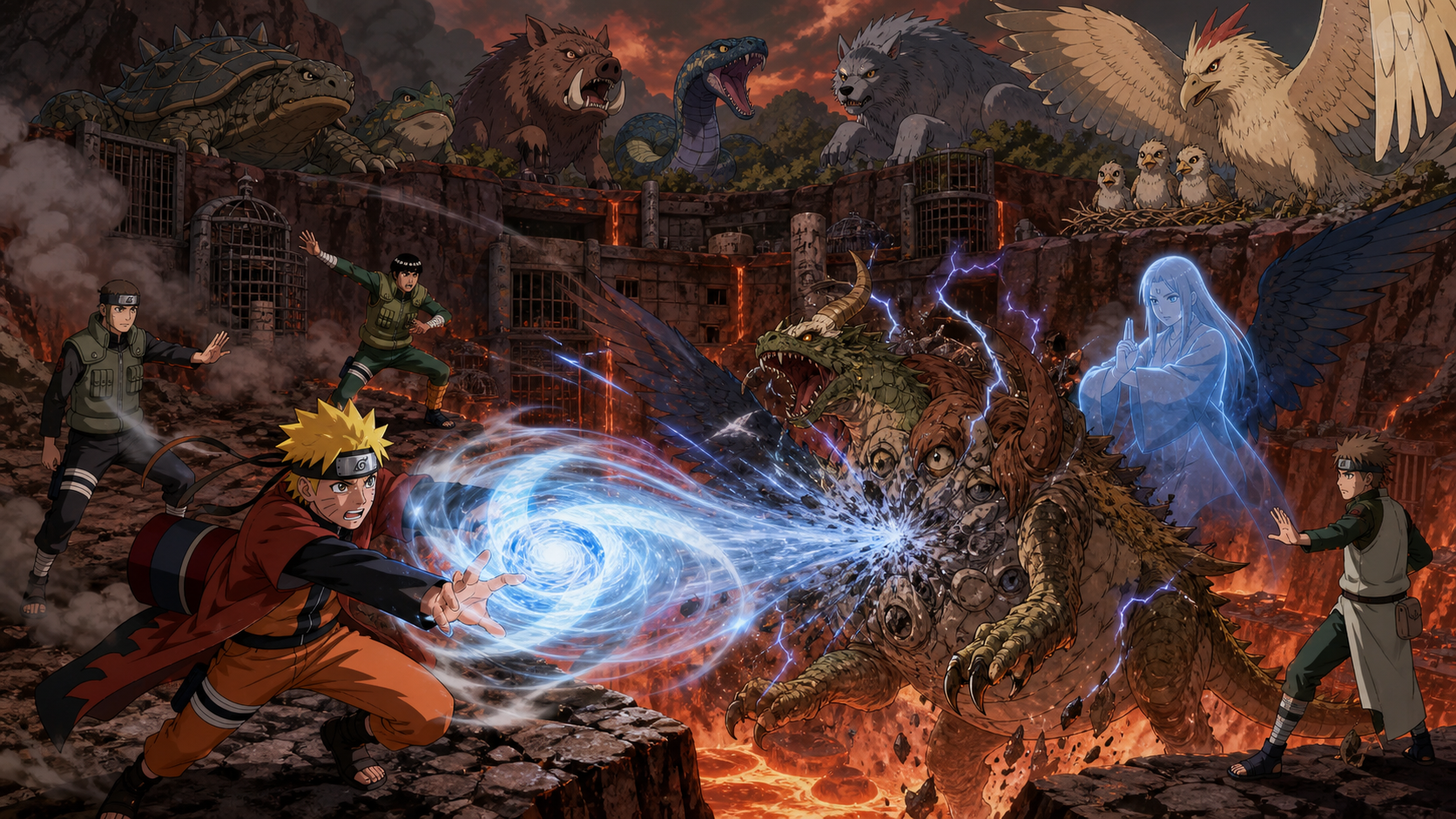
The voyage has barely recovered from Gataro's pirates when an enormous bird sweeps down and carries Guy away. Naruto, Yamato, and Aoba assume the obvious: the bird has taken Guy as prey. The team follows toward a volcanic island filled with creatures large enough to make that fear reasonable.
Guy turns out to be alive in the bird's nest, surrounded by chicks. The mother bird did not choose him as dinner. She chose him as a babysitter. Guy's green clothes, thick eyebrows, and relentless energy apparently read as trustworthy childcare credentials in the local ecosystem. The reveal lands because the danger around the nest remains real while Guy acts completely sincere about protecting the young birds.
The gag also rescues Guy from the seasickness routine that has defined too much of the boat arc. He does not need a cure or a heroic speech. Solid ground and vulnerable chicks restore his purpose immediately. Guy can fight anything, but the image of him tending babies says more about his kindness than another kick ever could.
The island treats giant animals as normal
Naruto and Yamato search through a landscape occupied by oversized snakes, centipedes, spiders, birds, and other creatures suited for summoning contracts. The scale creates a useful sense of wrongness. Naruto has seen giant toads and Orochimaru's snakes, so large animals alone do not surprise him. The concentration of different species on one isolated island does.
Summoning animals in Naruto usually arrive with names, loyalties, homes, and agreements. Gamabunta can refuse orders. Katsuyu advises Tsunade and Sakura. The ninken work with Kakashi as partners. Episode 227 shows the ugly industrial opposite. Researchers captured, bred, modified, and combined animals to meet shinobi demand. A relationship became a product line.
The episode does not fully explain who funded the project or which villages placed orders. That missing accountability weakens the history. The records still make the central problem clear. Shinobi wanted better weapons, and the research team answered demand by pushing living bodies past any safe limit.
Aoba follows Honoka instead of following the loudest noise
Aoba notices a young woman watching the group and follows when she retreats. Naruto and Yamato continue toward Guy, which leaves Aoba alone with the mystery. Splitting the team gives him a rare chance to drive a story through observation and investigation.
The woman leads Aoba through ruins and toward written research records. He learns that the island began as a place to study useful summoning creatures. Demand increased. Research shifted from observation to capture, improvement, crossbreeding, and creation. The language matters because every step sounds reasonable to people who have stopped asking what happens to the animals.
Aoba does not know yet that the woman is Honoka's spirit. He treats her as a possible witness and keeps looking for facts. That approach fits his intelligence role. Naruto often understands pain by meeting someone directly. Aoba reconstructs pain from documents, abandoned rooms, and the traces people left behind.
The Ultimate Summoning Beast is shinobi greed with wings
The researchers decided that if an ultimate summoning animal did not exist, they would create one. The resulting creature can absorb other animals, add their traits to its body, use genjutsu, release lightning, and grow wings when escape requires flight. Every useful adaptation also records another creature consumed.
The beast looks chaotic because the project had no natural stopping point. A stronger jaw invites stronger armor. Stronger armor invites flight. Flight invites another weapon. The clients wanted an unbeatable summon, which means every successful improvement created a reason for one more improvement. The monster's body becomes a pile of requirements nobody had the courage to reject.
Calling the creature evil would let the researchers off too easily. The beast follows the design imposed on the beast. The project rewarded consumption, domination, and survival. When the creature devoured the researchers and the island's other summons, the experiment completed the lesson the humans had built into every stage.
Honoka was a person before the laboratory made her a seal
Honoka possessed a sealing technique capable of restraining the Ultimate Summoning Beast. The researchers used her ability as the answer to a control problem they had created. Her spirit remains connected to the laboratory because the containment failed and her life became part of the wreckage.
The episode gives Honoka limited dialogue and very little personal history, which is frustrating. A named woman becomes the emotional key to a project run mostly through documents, yet viewers learn more about the monster's features than her life. The story needed one more scene about who she was before the researchers needed her.
Even with that gap, Honoka changes the moral shape of the finale. She does not appear as a convenient power-up from nowhere. Aoba has followed her through the evidence. Her sealing gesture represents the unfinished work holding her spirit to the island. When she restrains the creature again, Naruto can finish the fight and release the danger that survived her death.
Aoba's mind technique finds the memory nobody survived to tell
Inside the abandoned laboratory, Aoba uses Psycho Mind Transmission to read the sleeping beast's history. The technique turns the creature into evidence. Aoba sees how the experiment escaped control, devoured the summons around the facility, killed the researchers, and settled into dormancy.
The choice carries risk because the beast can use genjutsu and contains the mental residue of a violent project. Aoba still reaches for information before attacking. That distinction matters. Destroying an unknown creature might stop an immediate threat, but understanding the history tells the team why the other animals fear the laboratory and why Honoka keeps appearing.
Aoba often sits in the background while louder characters dominate the action. Episode 227 makes his specialty necessary. Naruto can sense danger and Yamato can reshape terrain, but neither man can reconstruct the laboratory's collapse from a sleeping chimera. Aoba earns his place on the voyage by finding the answer nobody else can reach.
Sage Mode becomes the responsible choice
The Ultimate Summoning Beast wakes and attacks with physical power, genjutsu, lightning, and absorbed traits. Naruto decides to enter Sage Mode, which requires time and stillness. Yamato protects him while Guy and Aoba keep the creature occupied. The setup again gives the whole team a task.
Naruto does not charge into the laboratory with an ordinary Rasengan simply because the episode needs action. He recognizes that the creature can survive conventional attacks and prepares a technique strong enough to end the danger quickly. Sage Mode also helps him use natural energy in a location where human manipulation has twisted the natural life around them.
The contrast is not perfect, but the image works. The researchers forced traits together through capture and consumption. Naruto gathers energy from the environment without destroying the environment. One power system depends on partnership and balance. The other depends on turning bodies into components.
The animals refuse to become another meal
Guy knocks the monster toward the volcanic crater, but hidden wings let the beast climb back toward freedom. The escape would allow the creature to leave the island and continue absorbing animals elsewhere. The mother bird attacks first, and the other giant summons join the effort to hold the chimera down.
Their intervention gives the finale its best payoff. The animals are not scenery waiting for human heroes. They understand the predator built from their own ecosystem and choose to fight. The mother bird risks herself after spending the episode protecting chicks, which makes her courage more meaningful than a generic animal charge.
Honoka adds her seal while the summons restrain the body. Naruto launches Wind Release: Rasenshuriken and drives the Ultimate Summoning Beast into the lava. The victory belongs to a coalition of surviving creatures, one lingering spirit, and four Leaf shinobi. Naruto supplies the finishing force, but the island saves itself with help.
The laboratory turns companionship into procurement
Summoning contracts usually allow animals to speak, refuse, negotiate, and maintain homes beyond human control. The researchers erase those relationships by treating every creature as a source of desirable traits.
A wing, shell, venom, or illusion becomes valuable only after being separated from the life that developed it. Procurement language makes violence sound like inventory management.
Military demand keeps responsibility outside the ruined building
The unnamed researchers made direct choices, but the project existed because shinobi clients wanted a summon stronger than every rival. Buyers created the incentive and could reward each escalation without seeing the cages.
When the beast destroys the facility, distant customers avoid the consequences. The episode condemns experimentation while leaving the institutions commissioning it comfortably offscreen.
The ultimate weapon has no definition of enough
A creature advertised as unbeatable can never be finished because every opponent introduces another possible weakness. Success produces new requirements instead of a safe stopping point.
The chimera’s constant absorption follows that design perfectly. It consumes because accumulation is the only purpose humans gave it, then becomes the monster they claim nobody could anticipate.
Honoka inherits containment without receiving authority
Her sealing ability makes her essential after the project crosses control boundaries. Essential does not mean empowered. The researchers appear to need her technique more than they value her judgment or safety.
If Honoka warned them, the surviving record does not preserve it. If she consented, viewers never learn the conditions. Her missing voice repeats the system that reduced animals to useful functions.
Aoba’s investigation resists convenient amnesia
The island is forgotten because everyone connected to its failure died, fled, or benefited from silence. Aoba reads ruins and mental residue until the disaster regains sequence and human decisions.
Evidence makes the chimera harder to dismiss as a natural aberration. Someone planned each stage, funded equipment, transported creatures, and accepted warning signs before the final collapse.
Reading the beast’s mind creates an ethical risk too
Aoba needs information, yet Psycho Mind Transmission enters a living consciousness without negotiated permission. Emergency danger may justify the intrusion, but the method still deserves recognition as power over another mind.
The episode’s larger argument becomes stronger when no technique receives automatic innocence. Good intent changes purpose, not the fact that access can violate boundaries.
Sage Mode represents disciplined dependence
Naruto cannot force natural energy into obedience while moving recklessly. He must become still, balance sources, and accept protection from teammates during preparation.
That process contrasts with the laboratory’s appetite. Sage Mode becomes stronger through proportion. The ultimate summon becomes unstable because every new advantage is added without relationship or limit.
The mother bird fights for a future the laboratory would consume
Her chicks establish what she protects before the final battle. When she attacks the chimera, the action is not generic animal loyalty to Naruto.
She defends young lives from a predator manufactured through the consumption of other summons. Her choice gives the island’s resistance a generation beyond revenge.
The surviving animals refuse the role of raw material
Their coordinated restraint changes them from specimens into political actors. They recognize a shared threat and use distinct bodies together without being fused into one weapon.
Cooperation preserves difference. The laboratory’s version of unity destroys individuals so one creature can possess everything.
Destroying the chimera cannot complete the cleanup
The facility may still contain records, cages, biological material, seals, and techniques valuable to anyone willing to restart the work. Leaving those resources unguarded invites repetition.
A responsible response would document victims, secure research, identify sponsors, and protect remaining summons from collectors attracted by rumors of the island.
Forgetting protects the people who commissioned the disaster
The word forgotten describes an active political achievement, not merely the passage of time. Laboratories require money, transport, staff, equipment, and clients. An entire project does not become invisible without institutions deciding records are inconvenient.
Anonymous ruins concentrate blame on dead researchers who cannot identify supervisors or buyers. The villages that wanted stronger summons can treat the island as an isolated accident rather than evidence of an industry.
Aoba’s recovered history breaks that protection only partially. He learns how the facility fell, but not who authorized it or whether another laboratory continued the same work elsewhere.
Honoka deserves memory beyond the seal she performed
The episode remembers her because her technique remains useful at the final moment. That is dangerously close to the same logic that shaped the laboratory: a life receives narrative value through a function.
Viewers should know what she believed, whether she cared for particular summons, how she arrived on the island, and what future the project took from her. Missing details are not neutral when every surviving record prioritizes weapons research.
Aoba sees enough to honor her intervention, and Naruto accepts her help without claiming the victory alone. The writing absolutely still owes her the ordinary humanity granted automatically to louder men.
The final coalition models strength without forced sameness
Guy, Yamato, Aoba, Naruto, Honoka, and the island’s animals contribute different abilities toward one outcome. Nobody must be absorbed into another body for those strengths to work together.
The chimera represents accumulation through erasure. The coalition represents coordination through preserved identity. That difference turns the climax into an argument about what collective power should require from its members.
Naruto supplies the finishing attack because his technique can end the immediate threat. The others create the conditions, hold the creature, recover the truth, and decide what deserves protection.
RaeRae’s final word on the forgotten island
Guy being drafted as a giant bird’s babysitter is perfect. The chicks identify the safest adult immediately, and unfortunately for Guy, they are correct.
The laboratory is much uglier than the chimera. Researchers kept adding bodies and abilities because customers wanted an unbeatable summon, then called the result monstrous when it followed the appetite they designed.
Aoba is the episode’s spine. Without his investigation, Naruto defeats an animal. With it, the team confronts a buried weapons program and remembers Honoka as part of the cost.
What works and what the episode leaves unfinished
The abandoned summoning laboratory is a strong filler concept because the Naruto world clearly has a market for powerful contracted animals. Somebody would try to breed a stronger summon. Somebody would ignore consent and safety. Somebody would call the disaster unpredictable after years of choosing profit and military demand over restraint.
Aoba's investigation, Guy's childcare reveal, Yamato's protection, and Naruto's Sage Mode preparation give the episode a balanced team structure. The giant animal designs also create a distinct visual identity. A volcanic research island filled with summons does not resemble the pirate fortress from Episode 226 or the ghost ship from Episode 225.
The failures come from missing specificity. The researchers remain anonymous. The clients remain unnamed. Honoka receives too little history. The story criticizes demand without naming the shinobi institutions that created demand. The ultimate beast therefore becomes an easy container for blame when the real failure began with people who wanted a living weapon.
Filler status and what the episode adds anyway
"The Forgotten Island" is anime-original material from the "Paradise Life on a Boat" arc. Manga-only viewers can skip Episode 227 without losing a main war development. Fans of summoning lore, Aoba, Yamato, or Guy have a better reason to watch.
The episode expands the world sideways rather than forward. Summons do not all live in hidden societies like Mount Myoboku. Some become targets for capture, breeding, and military research. That possibility fits the wider shinobi economy, where villages routinely turn bloodlines, children, tailed beasts, and secret techniques into strategic resources.
The story also keeps Naruto away from the coming war while giving him a problem that mirrors war logic. Adults create a weapon, lose control, and leave someone younger to contain the damage. Naruto does not know how close the Allied Shinobi Forces are to repeating similar choices on a much larger scale.
Final verdict: remember Honoka, not only the monster
Episode 227 succeeds because the Ultimate Summoning Beast represents a process, not merely a creature with too many parts. Shinobi demand pushed researchers from study to capture, from capture to alteration, and from alteration to manufacturing life. Honoka became their restraint. The other animals became material. The laboratory collapsed because nobody stopped when the research first crossed the line.
Naruto's Rasenshuriken delivers the spectacle, but Aoba gives the fight meaning. Guy gives the episode warmth by caring for the chicks. Yamato gives Naruto the time needed to prepare. Honoka and the island's summons make sure the final attack lands. The episode should have given Honoka more life beyond her sacrifice, yet her spirit keeps the story from forgetting who paid for the experiment before Naruto arrived.
RaeRae’s call
The chimera is not the original villain. Military demand, anonymous research, and limitless accumulation created it. Honoka, the surviving summons, and Naruto end the threat only after Aoba recovers the responsibility everyone else forgot.
Sources and watch routes
- Official episode reference: Naruto Official episode guide
- Licensed episode route: Crunchyroll licensed episode page