
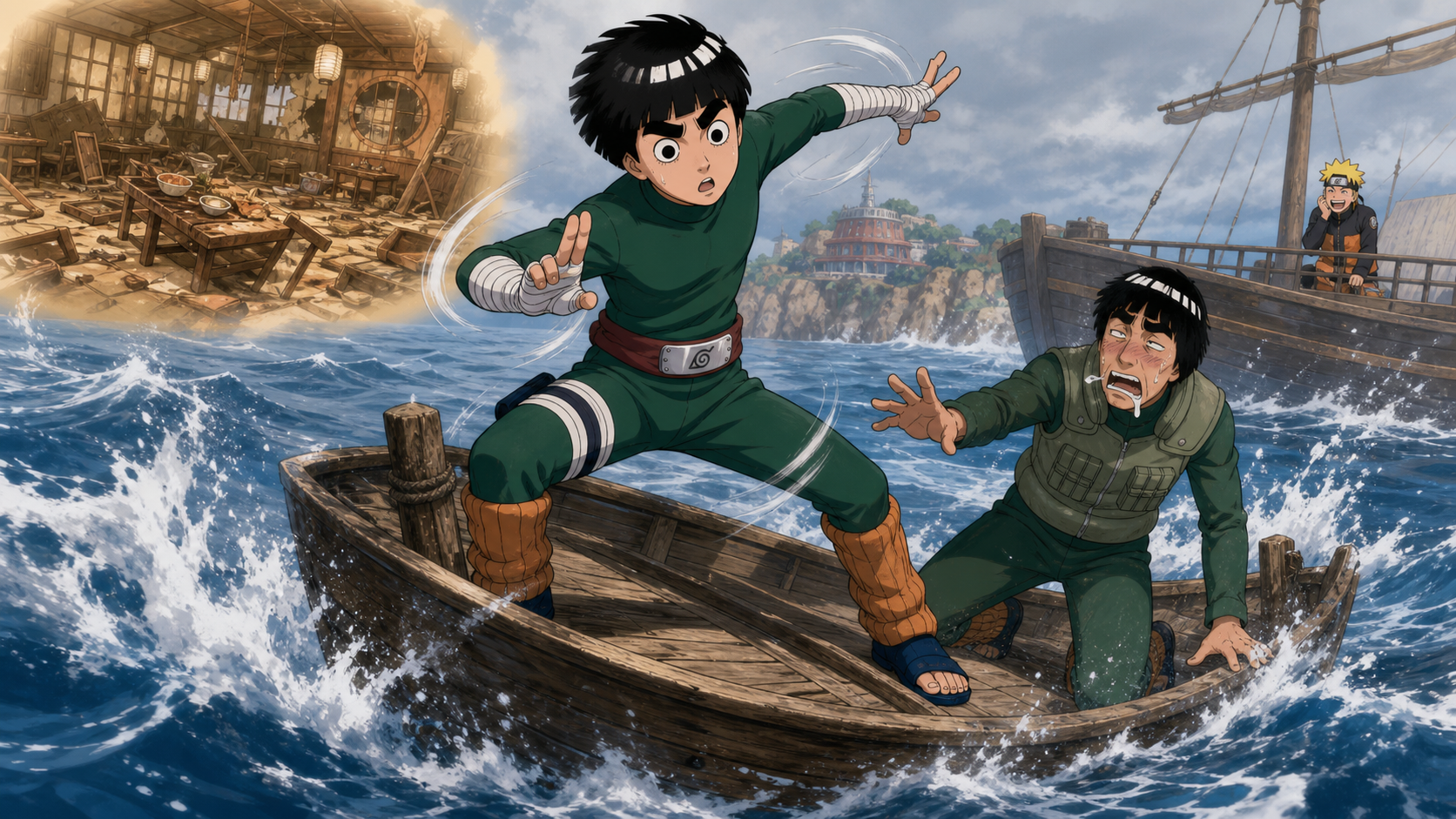
Fight! Rock Lee!
Lee turns nausea into footwork, Guy turns shame into training, and Naruto finds the flaw nobody else noticed.
Bottom line
Naruto Shippuden Episode 228 turns Rock Lee's Drunken Fist into a lesson so logically broken that Naruto notices the problem before Guy does. "Fight! Rock Lee!" is a comedy flashback, not a war episode, and the central training method makes no practical sense. The episode still understands the relationship that makes Lee and Guy lovable. Guy tries to protect Lee from embarrassment, Lee tries to protect Guy from embarrassment, and both men train with total sincerity long after common sense has left the boat.
The best material is not the restaurant wreckage or the Seasickness Fist gimmick. The best material comes from Lee recognizing what Guy did for him during the ruined dinner. Lee remembers his teacher kneeling before an angry owner and taking responsibility for damage Lee caused while intoxicated. Guy thinks the memory will shame Lee. Lee sees proof that his teacher will place himself between Lee and a consequence every single time.
Lee dreams about fighting the war by himself
The episode opens with Lee dreaming that he faces Tobi using Drunken Fist. The fantasy gives him a secret medicine, impossible confidence, and enough unpredictable movement to strike an enemy who normally slips through attacks. Lee wakes embarrassed that he slept during training for the coming war.
That opening tells us where Lee's mind is even during a comedy episode. Naruto has become strong enough to carry enormous expectations. Lee measures himself against that growth and worries that hard work alone will not close the gap. Drunken Fist offers something his disciplined training cannot manufacture on command: unpredictability.
Lee does not envy Naruto in a petty way. Naruto's progress becomes evidence that Lee needs to keep moving. The problem is that Lee starts looking for a shortcut inside a style caused by losing control, which contradicts everything he normally values about preparation and discipline.
Guy remembers the restaurant and immediately regrets having a memory
Guy's seasickness on Naruto's ship brings back the night Lee accidentally drank alcohol after perfecting the Reverse Lotus. Guy had taken his student to dinner as a reward. One wrong drink turned Lee into a Drunken Fist disaster and turned the restaurant into kindling.
The comedy works because Lee does not become mean while drunk. His balance, timing, rhythm, and reactions become impossible to predict. Every attempt to stop him creates another broken table. Guy, the adult responsible for bringing Lee, spends the next morning apologizing to the owner on his knees.
Guy fears the humiliation more than the bill. His whole identity depends on being Lee's confident model of youth, discipline, and honorable conduct. Begging before an owner does not fit the heroic picture he wants Lee to remember. Guy therefore decides the smartest response is to train Lee until Lee forgets the night. Reader, that was not the smartest response.
Image training becomes an elaborate cover story
Guy takes Lee through visualization exercises based on animals and fighting forms. Lee follows every instruction with the same focus he brings to weights, kicks, and the Eight Gates. Guy presents the work as a serious path toward better taijutsu, but his actual goal is distraction.
The lie feels affectionate and ridiculous rather than cruel. Guy does not want to erase a failure by blaming Lee. He wants to protect his student from shame. The cover story becomes more complicated each time Lee gets close to remembering the Drunken Fist. Guy keeps adding explanations because admitting the truth would also mean admitting how badly he handled the restaurant.
Lee's trust makes the plan possible. If Guy says an animal pose will improve combat, Lee will attempt the pose until sunset. That devotion is beautiful when the training has a purpose. The same devotion becomes comedy when Guy invents exercises to outrun one embarrassing memory.
Drunken Fist reveals the talent Lee cannot train normally
Lee's usual taijutsu depends on repetition, conditioning, timing, and precise control. Drunken Fist reverses the equation. Alcohol disrupts conscious balance and creates movements even Lee cannot plan. An opponent trained to read stance and rhythm loses the normal signals used to predict his attack.
The style worked against Kimimaro because Lee's instability produced real tactical value. Kimimaro could not map the rhythm. Lee slipped around counters with movements that looked accidental until a strike landed. Episode 228 remembers that the technique is not merely a joke about a lightweight teenager.
The danger remains obvious. Lee cannot safely use alcohol as routine training equipment, especially as a minor. Drunken Fist also reduces judgment and control. A style that destroys the room around the target fails any mission involving civilians, teammates, intelligence, or property the village would prefer to keep standing.
Guy renames the problem instead of solving the problem
When Lee begins remembering the restaurant, Guy calls the technique Seasickness Fist. The name gives him a respectable training explanation and removes alcohol from the lesson. Both teacher and student get seasick, so a rocking boat can reproduce some of the unstable balance that makes Drunken Fist unpredictable.
The substitution sounds clever for about ten seconds. Seasickness creates nausea, weakness, dizziness, and reduced coordination. Those symptoms can mimic an uneven rhythm, but they also make Lee miserable and less capable of sustained combat. Guy chooses the one condition that might prevent Lee from reaching the fight at all.
Still, the experiment suits their shared philosophy. If Lee has a weakness, Guy asks whether training can turn the weakness into a tool. Lee could not use ninjutsu or genjutsu, so he built elite taijutsu. Seasickness becomes another limitation they refuse to accept without testing.
Lee knew the truth and protected Guy anyway
Guy eventually learns that Lee remembers the ruined dinner. Lee did not play along because Guy successfully erased anything. Lee played along because he understood why his teacher felt ashamed. More importantly, Lee remembered Guy taking responsibility before the restaurant owner.
That memory honors Guy in Lee's eyes. A weaker teacher might blame the server, punish Lee publicly, or disappear before the bill arrived. Guy knelt down and owned the damage. The posture looked humiliating to him because he saw only a failed public image. Lee saw an adult refusing to leave a student alone with a consequence.
Their mutual protection becomes the emotional center of the episode. Guy lies to preserve Lee's dignity. Lee accepts the lie to preserve Guy's dignity. Neither man needs the deception once they speak honestly, but the awkward route to honesty fits them perfectly.
The moving boat proves the technique and the flaw
Lee trains on a small boat, letting waves disrupt his footing. His body begins adapting to the movement, and the resulting form resembles Drunken Fist without alcohol. Guy celebrates Seasickness Fist as a breakthrough.
The scene demonstrates Lee's physical intelligence. He can read the deck, water, momentum, and his own center of gravity quickly enough to fight through constant movement. That skill has value even without the fake style name. Shinobi cross rivers, ships, bridges, collapsing roofs, and unstable terrain. Training balance on a moving platform makes sense.
The problem comes from making nausea the engine. Lee performs well only after his body converts sickness into erratic movement. If he adapts to the sea and stops feeling sick, the special condition disappears. If he remains sick, he may lack the strength to fight. The useful lesson is moving-platform combat. Guy insists on packaging the lesson as a signature fist.
Naruto commits the murder with one sentence
After Guy finishes the story, Naruto points out the contradiction. A seasick Lee cannot fight effectively. A Lee who conquers seasickness cannot use Seasickness Fist. Guy has built a training system that destroys its own activation condition.
Naruto's observation is funny because Guy has spent years treating the method as a brilliant answer. Lee's faith and Guy's enthusiasm carried both men past the most basic question. Naruto, patron saint of questionable training decisions, becomes the voice of reason. That should hurt more than the seasickness.
Guy's horror gives the episode a clean final punch line without undoing the affection in the flashback. The training failed as a reusable combat system. The time together still mattered, and Lee still learned balance, adaptability, and what his teacher would do for him.
Rock Lee deserves more than nostalgia in Shippuden
Episode 228 is enjoyable partly because Shippuden rarely gives Lee enough room. His original-series fights against Gaara and Kimimaro established him as one of the most emotionally compelling young shinobi. He trained against a limitation nobody could remove and made the limitation part of his identity without pretending the struggle felt fair.
The sequel series expands power far beyond ordinary taijutsu, and Lee often becomes a familiar face in group scenes rather than a driver of events. A flashback reminds viewers why they loved him, but nostalgia cannot replace current development. The coming war should challenge the adult shinobi Lee is becoming, not only recycle the teenager who once wrecked a restaurant.
The episode gives him a present motivation through the dream and war training. The rest remains focused on an older story. A stronger version would connect the Seasickness Fist lesson to a current decision Lee makes about preparing for combat beside Naruto.
Guy’s embarrassment begins with a real adult responsibility
Lee caused the restaurant damage while accidentally intoxicated, but Guy brought the underage student, supervised the celebration, and remained responsible for what followed. Kneeling before the owner was not weakness.
The apology demonstrated that mentorship includes consequences after the inspiring speeches end. Guy paid social and material costs instead of leaving Lee to face an adult dispute alone.
Lee remembers protection where Guy remembers humiliation
The same posture holds opposite meanings for them. Guy sees his heroic image collapsing in public. Lee sees a teacher lowering himself so the student will not carry the entire disaster.
The emotional misunderstanding is gentle because neither person doubts the bond. They disagree only about which memory threatens the other’s dignity.
The cover story underestimates Lee’s emotional intelligence
Guy assumes animal visualization and relentless training can distract Lee from the truth. Lee understands the plan and participates because protecting Guy’s pride feels kinder than exposing it.
Physical comedy often treats Lee as literal-minded. This episode quietly reminds viewers that sincerity is not stupidity. He reads the person he loves with considerable care.
Training cannot safely require impairment
A reliable combat method must be available on demand without creating a new medical emergency. Alcohol, nausea, and uncontrolled dizziness compromise judgment, stamina, communication, and awareness of teammates.
Unpredictability helps only if Lee retains enough control to distinguish target from civilian and attack from retreat. A technique that removes those choices is not mastery.
The useful lesson is adaptation to unstable terrain
Lee can train balance on decks, loose stones, ice, mud, ropes, and collapsing structures without preserving seasickness. The moving surface supplies uncertainty while practice improves control.
If opponents cannot predict how he uses external motion, Lee gains tactical variety without depending on illness. Guy discovered a worthwhile drill and attached the wrong theory to it.
Drunken Fist works because failure remains possible
Against Kimimaro, intoxication disrupted Lee’s recognizable rhythm, but it also endangered Lee and everything nearby. The style’s excitement comes from the same instability that prevents responsible routine use.
Turning one desperate accident into a formal system would sand away the condition that made it surprising while preserving the harm that made it dangerous.
Lee’s war anxiety deserves a present-tense answer
His dream is not merely a callback. He wants proof that taijutsu can matter against an enemy whose space-time ability humiliates conventional attacks.
The episode retreats into memory instead of letting adult Lee test strategy, teamwork, or a new controlled application. Affection fills the runtime, but his professional fear remains unanswered.
Power escalation has pushed Lee away from the center
Shippuden increasingly rewards bloodlines, ocular techniques, tailed-beast chakra, and inherited secrets. Lee built excellence through a body that could not access two major shinobi disciplines.
That contrast once challenged the series to make effort visible. Leaving him in nostalgic comedy avoids the harder question of where disciplined taijutsu belongs in a war of supernatural scale.
Guy teaches through faith before he teaches through logic
His methods succeed because he believes Lee can transform limits through work. That faith rebuilt a child other instructors had already dismissed.
The weakness is that enthusiasm can make an experiment feel proven before evidence arrives. Naruto’s final question supplies the testing step both men skipped.
Naruto becomes useful precisely because he stands outside the bond
Lee trusts Guy, and Guy wants Lee to succeed, so both are motivated to protect the Seasickness Fist idea. Naruto has affection for them without investment in the theory.
His obvious objection is valuable peer review. Honest friendship sometimes means interrupting beautiful commitment before it becomes a completely avoidable disaster.
Their shared lie stays tender because truth eventually returns
Mutual protection becomes unhealthy only when honesty disappears permanently. Guy and Lee each allow the misunderstanding because they think disclosure will embarrass the other. The episode finally lets both recognize the care beneath the performance.
That recognition matters more than determining who successfully fooled whom. Neither relationship nor authority collapses when the truth surfaces. They can laugh, keep the affection, and discard the impossible purpose attached to the training.
Mentorship becomes stronger when a student can see a teacher’s mistake without losing respect. Lee admires Guy because the man accepts responsibility, not because Guy maintains an invulnerable image.
Lee’s body deserves training that does not treat suffering as proof
Lee built his identity around working harder than people with natural access to ninjutsu and genjutsu. That history can make pain feel like evidence that a method is serious.
Seasickness is not useful merely because enduring it is difficult. Training should create repeatable capacity, allow recovery, and reduce unnecessary harm. Discipline includes rejecting effort that consumes the body without serving the objective.
Guy’s faith taught Lee not to accept other people’s limits. Good coaching must also teach him that self-destruction is not the price of deserving recognition.
Comedy protects the bond from becoming sentimental perfection
Guy and Lee love each other deeply, but the episode refuses to make that love elegant. It arrives through wrecked furniture, a kneeling apology, animal poses, nausea, and a training theory defeated by one sentence.
The mess is why the relationship feels lived. They do not communicate through polished speeches when an elaborate exercise and mutual misunderstanding can do the job less efficiently.
RaeRae needs the show to give adult Lee more than flashbacks, but this one remembers the exact warmth that made his original story matter.
RaeRae’s final word on Fight! Rock Lee!
Guy invents an entire martial art to avoid admitting that Lee remembers a restaurant bill. That is commitment, panic, and terrible curriculum design working together.
Lee knew. He trained anyway because the memory he kept was not humiliation. It was Guy kneeling beside the damage and refusing to abandon responsibility for his student.
Naruto ends Seasickness Fist with basic logic, as he should. The technique loses. Lee and Guy’s ridiculous, protective, deeply sincere bond wins without needing the gimmick to work.
Lee keeps the lesson that mattered: accountability can look awkward and still be love. Training continues after the bad theory is gone too.
What works and what feels stretched
Lee and Guy carry the comedy through sincerity. Neither man knows how to perform a halfhearted exercise. Their commitment makes every bad idea bigger and every emotional beat warmer. The restaurant sequence, Guy's apology, Lee's quiet understanding, and Naruto's final objection form a complete comic arc.
The animal visualization section runs longer than the idea needs. Repetition slows the middle, especially for viewers who already know Drunken Fist from the Kimimaro fight. The episode also uses a war countdown as a frame without giving Lee meaningful war preparation beyond a dream and another boat exercise.
The animation benefits from unstable movement. Lee's swaying body and the tilting boat create action that looks different from a standard exchange of punches. The best physical comedy stays rooted in real balance, timing, and Guy's increasingly desperate face.
Filler status and watch value
"Fight! Rock Lee!" is anime-original material within the "Paradise Life on a Boat" arc. Viewers following manga-only plot can skip Episode 228 without losing war information. Lee and Guy fans should watch because their relationship gets a sweet, ridiculous spotlight.
The episode also provides a useful bridge between Lee's famous Drunken Fist appearance and his current desire to become stronger. The bridge does not change canon or grant him a new reliable style. The value comes from character memory and from watching two people express love through training plans no reasonable academy would approve.
Final verdict: the technique fails and the relationship wins
Episode 228 cannot prove Seasickness Fist is useful because Naruto destroys the premise with basic logic. The episode does prove why Lee follows Guy. Guy takes responsibility when Lee loses control. Lee recognizes the care behind Guy's embarrassment. Both men protect each other's dignity, then return to training because effort is the language they share best.
The filler stretches one joke, but the joke belongs to these characters. Lee turns nausea into footwork. Guy turns shame into a lesson. Naruto turns the whole lesson into nonsense with one question. Nobody defeats an enemy, yet the episode leaves Lee and Guy's bond stronger than the technique they invented.
RaeRae’s call
Seasickness Fist fails as a combat system, but the training reveals what matters: Guy accepts consequences for Lee, Lee protects Guy’s dignity, and Naruto supplies the basic logic their mutual devotion skipped.
Sources and watch routes
- Official episode reference: Naruto Official episode guide
- Licensed episode route: Crunchyroll licensed episode page