
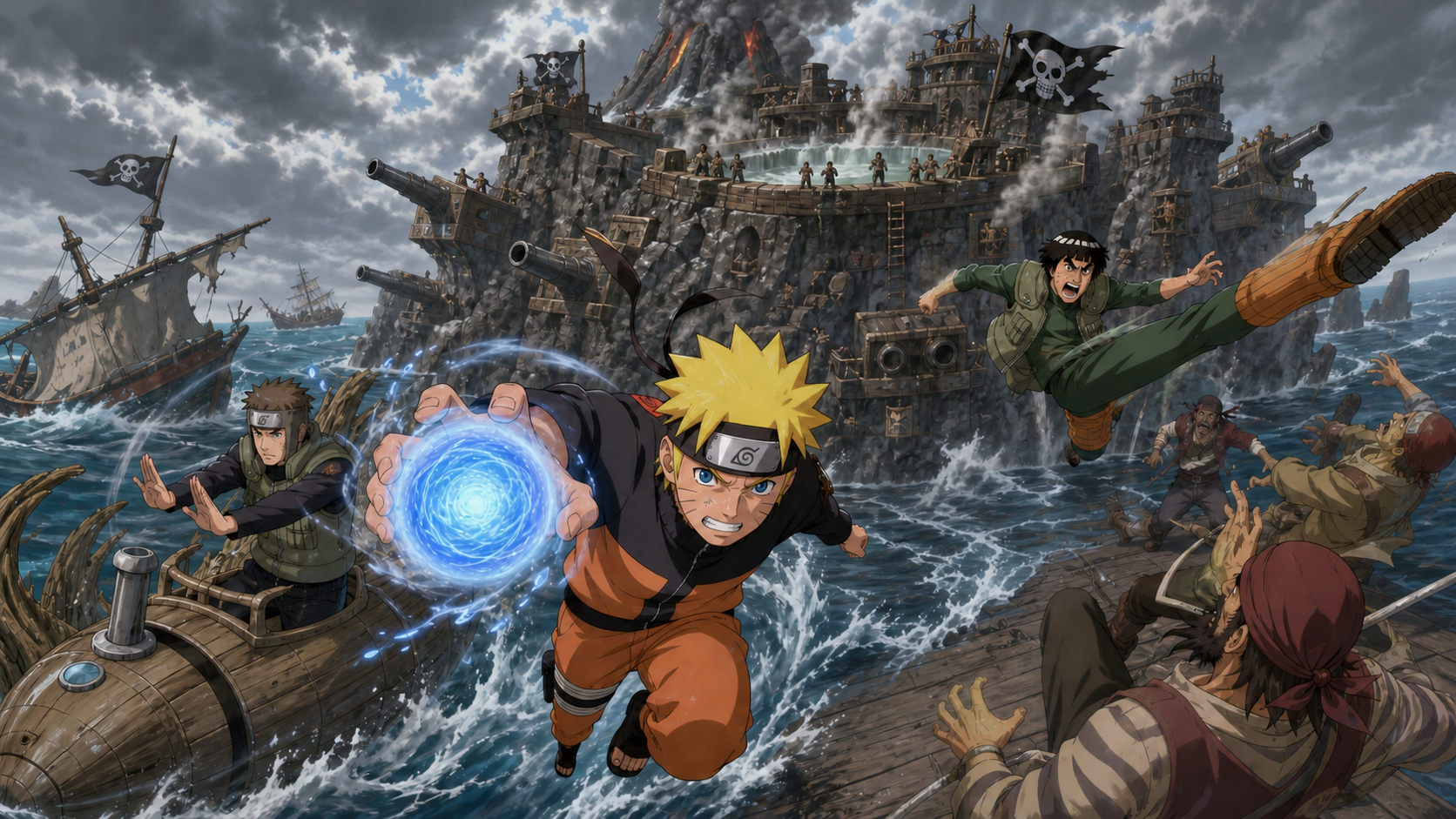
Battleship Island
Gataro steals Naruto’s forehead protector, then learns that Yamato can build a submarine and Guy can weaponize a hot spring.
Bottom line
Naruto Shippuden Episode 226 drops Naruto into a pirate attack and somehow makes Yamato's emergency woodworking the best part. "Battleship Island" does not move the Fourth Shinobi World War forward, and nobody should pretend otherwise. The episode still earns its twenty minutes by giving the travel team a problem that requires more than one loud Rasengan. Yamato turns a damaged ship into a submarine, Guy turns geothermal pressure into an escape route, Aoba keeps the group thinking, and Naruto turns a stolen forehead protector into a promise to people he never met. The pirate captain, Gataro, builds his whole operation around frightened crews who cannot fight back. He gets four Leaf shinobi instead. Bad day for piracy.
The episode also understands why this stretch of anime-original material can work when the writers stop treating the voyage like dead air. A self-contained obstacle can reveal how a team functions under pressure. Naruto brings outrage and momentum. Yamato brings control. Guy brings impossible physical force. Aoba brings awareness. The result feels like a small mission with a beginning, a tactical middle, and a ridiculous but satisfying finish. No grand canon revelation arrives, but the crew finally feels like a crew.
The sea starts the fight before the pirates do
Rough currents push the ship off course before anyone sees the island. The water matters because the pirates do not rely on sword fights alone. Gataro's people control the route, the firing angles, and the panic. Their island resembles a battleship because they have turned rock into a fixed weapons platform. Cannons built into the cliffs fire explosive-tag ammunition at vessels trapped by the current. Any ordinary merchant crew would spend the attack choosing between drowning and surrender.
Naruto reacts like Naruto. He wants to hit the threat as soon as the threat appears. That instinct works when a clear enemy stands on solid ground. Cannon fire across open water punishes the same instinct. A moving ship carries civilians and a limited supply of wood, rope, and luck. One badly timed attack can sink everyone. The opening therefore gives Yamato room to lead without making Naruto useless. Naruto can fight Gataro, but Yamato must keep a battlefield under their feet.
The pirate assault also brings an old-fashioned adventure flavor that fits the boat arc better than another random delay. The island silhouette, gun smoke, churning water, and patched pirate ships create a clean visual idea in seconds. The direction never needs a long explanation for why the route is dangerous. The cannons explain everything.
Gataro steals the one thing Naruto will always chase
Gataro gets close enough to fight Naruto and takes Naruto's forehead protector. The theft lands harder than ordinary loot because the metal plate represents Naruto's place in Konoha. Naruto spent childhood demanding recognition from a village that treated him like a threat. The headband marks the day Konoha finally recognized him as a shinobi. Gataro sees a trophy. Naruto sees proof that Iruka trusted him and that Team 7 began.
The scene also lets Gataro score a believable emotional win without pretending a pirate captain can overpower Naruto at full focus for an entire battle. Gataro catches the young shinobi during chaos, uses a blade with precision, and takes something personal. Naruto immediately stops viewing the attack as a travel inconvenience. The captain has made the fight personal, which would usually be a terrible tactical decision. Gataro does not know Naruto well enough to understand how much stubbornness one small piece of metal can unleash.
Naruto's anger needs direction, though. Charging the cannon line again would give the pirates another clean shot. Yamato forces the group to survive first. That choice keeps the episode from becoming a simple revenge chase and gives the stolen headband time to connect Naruto's personal grievance with the island's much larger history.
Yamato builds a submarine because apparently that was an option
Yamato uses Wood Release to protect the vessel and reshape part of the ship into a submarine-like craft. The solution is absurd in the exact way Naruto combat engineering should be absurd. Wood Release already lets Yamato build houses, bridges, restraints, and shelters at a speed that makes normal construction workers look personally insulted. A temporary submarine stretches the technique, but the episode shows a clear chain of need: cannon fire controls the surface, so Yamato moves the group below the surface.
The maneuver costs chakra and does not create a perfect machine. The improvised vessel gets the team away from immediate fire, then carries them into an underground cavern beneath the island. That limitation helps. A flawless wooden submarine would erase the danger and turn Yamato into a transportation service. A strained emergency build shows skill under pressure while leaving the group with another problem.
Yamato's leadership feels practical rather than flashy. He does not compete with Naruto for the final hit. He protects the ship, controls the retreat, admits the chakra cost, and waits for a better opening. Kakashi often leads by reading an opponent. Yamato leads here by changing the physical conditions of the fight. The whole crew survives because their captain can look at a sinking boat and see raw material.
The hot spring gives the episode a pause with a purpose
The underground cavern contains a hot spring, which lets the team recover after Yamato's heavy chakra use. Yes, the episode finds time for a bath in the middle of a pirate siege. The pause could have become empty fan service. Instead, the hot spring creates the breathing room needed for the group to study the cavern and learn who lived below the fortress.
Ruins and records reveal that native islanders fled underground after the pirates attacked their home decades earlier. The people escaped the first slaughter, but hiding beneath an occupied island trapped them in a slow death. Gataro's operation therefore rests on more than robbery. The pirates stole land, erased a community from the surface, and kept using the same fortress to prey on other travelers.
That history changes Naruto's reason for returning. He still wants his headband, but personal property no longer carries the whole fight. Naruto wants justice for people who died without anyone answering what happened to them. The writers do not give those islanders individual names or enough detail, which limits the emotional weight. Their record still turns the cavern from a lucky shelter into evidence.
Naruto's promise works because the evidence comes first
Naruto vows to avenge the islanders after seeing their remains and reading the account of the occupation. The sequence works better than a generic hero speech because the episode gives him a concrete wrong. He does not claim to understand every life lost. He understands that armed men drove families underground, waited above them, and profited from the same violence for years.
Naruto has always reacted strongly to people treated as disposable. Haku, Gaara, Nagato, and many others taught him that isolation can become a weapon long before a battle begins. The islanders suffered a different kind of isolation, but the pattern feels familiar. Powerful people controlled the story because nobody remained above ground to contradict them. Naruto cannot restore the dead. He can stop the pirates from repeating the crime.
The episode wisely keeps the promise local. Naruto does not deliver a speech about ending all injustice. He has an island, a captain, a stolen headband, and several loaded cannons to handle. Smaller stakes help the conviction sound honest.
Guy turns geology into transportation
The escape plan uses the island's underground hot water and dormant volcanic structure. Guy strikes the ground hard enough to open the route and increase the pressure. The group positions the ship so the resulting geyser can launch the vessel through the crater and back toward the surface. Subtle? Absolutely not. Effective? Somehow, yes.
Guy's role matters because seasickness has reduced him to a running joke through much of the voyage. Episode 226 finally lets his physical power solve a problem that ninjutsu alone cannot handle. Yamato builds and steers. Aoba helps assess the route. Naruto creates the distraction. Guy supplies the force. The plan needs everybody, including the man who spends half the boat arc looking one wave away from death.
The geyser launch also pays off the hot spring setup. A location introduced for recovery becomes the engine of the counterattack. That kind of reuse gives a disposable adventure more structure than the episode strictly needs. The writers establish underground heat, show the cavern system, then turn both into the only route the pirates do not control.
Shadow clones make Gataro celebrate too early
Naruto appears before Gataro and gives the pirate captain the confrontation he expects. Gataro cuts down Naruto, only to discover that he attacked a shadow clone. The feint keeps Gataro's attention above while the real plan builds underneath. Naruto has used shadow clones for years, but this application shows growth because deception matters more than numbers.
The young Naruto often created a crowd and hoped determination would carry the crowd through. The older Naruto can make one clone perform the exact emotional role an enemy expects. Gataro believes Naruto will rush back for the forehead protector, so Naruto weaponizes that belief. The pirate captain reads Naruto's anger correctly and Naruto still tricks him.
When the ship blasts out through the crater, Naruto's clones attack the cannon positions and the returning vessel crashes into the sea with enough force to swamp Gataro's fleet. The finale mixes ninja tactics, cartoon physics, and maritime revenge. Gataro loses the island's advantage, the ships, the loot, and the headband. The pirates built a system around controlling every normal exit. Naruto's team creates an abnormal exit.
The episode gives Yamato the respect the main story often forgets
"Battleship Island" belongs to Yamato almost as much as Naruto. Yamato saves the crew from the opening barrage, creates the underwater retreat, manages his chakra, reads the underground conditions, and helps execute the launch. Naruto supplies the moral center and final pressure, but Yamato makes survival possible.
That balance matters because the main Shippuden story often uses Yamato as a restraint for the Nine-Tails or a substitute captain until Kakashi returns. Episode 226 remembers that Wood Release has creative uses beyond holding Naruto down. Yamato can reshape terrain and structures during a crisis. His calm also prevents Naruto's anger from becoming another opening for Gataro.
The bath scene adds comedy, but the strongest Yamato material comes from competence. He looks tired because the technique costs him. He keeps planning anyway. The episode does not need a tragic flashback or new power to make him valuable. Give the man a sinking ship and five minutes.
The pirates weaponize geography before they weaponize cannons
Gataro’s greatest advantage is not personal strength. Currents restrict movement, cliffs conceal artillery, and the island gives his crews protected firing positions against vessels with nowhere safe to turn.
The setup matters because violence becomes a system rather than one captain’s temper. Removing Gataro without dismantling the route would leave the same machinery available to his successor.
Merchant crews are trapped by economics as well as water
A captain under fire may surrender cargo to preserve lives, but repeated piracy raises insurance, prices, wages, and the risk attached to every future voyage. Communities beyond the island eventually pay for Gataro’s control.
The episode shows frightened sailors without lingering on that network. Their fear is not weakness. It is the rational response of workers whose ships were never built to fight a fortress.
Naruto’s forehead protector links private memory to public duty
The headband matters because Iruka gave it after recognizing Naruto’s persistence and belonging. Recovering it could remain a personal grievance.
The underground evidence expands what the symbol requires. Being a Leaf shinobi means using recognized power to answer harm against people who never had a hidden village strong enough to defend them.
The islanders deserve more than anonymous motivation
The story uses their remains and record to redirect Naruto’s anger, then gives viewers almost no individual names, relationships, or choices to remember. Collective tragedy becomes efficient fuel for a living hero.
Naruto’s promise is sincere, but the writing would carry more weight if one person’s testimony survived beyond a convenient explanation of Gataro’s cruelty.
Yamato converts retreat into a tactical resource
Moving underwater looks like escape, and escape is exactly what the team needs while the pirates control the surface. Refusing a bad battlefield is not cowardice.
The retreat discovers evidence, restores chakra, and reveals terrain Gataro never expected opponents to use. Yamato changes the terms before Naruto returns to the fight.
Engineering becomes leadership when everyone survives the transition
Building an improvised submarine is only useful if the structure holds pressure, preserves air, carries the crew, and reaches a location from which another plan is possible.
Yamato does not merely produce wood. He translates a technique into shelter, transport, and time, which are the resources every other teammate needs to contribute.
Guy’s impossible force works because the episode prepared the mechanism
The geyser launch is outrageous, but it grows from established heat, water, cavern pressure, and Guy’s ability to deliver force far beyond ordinary limits.
Cartoon physics feel earned when the story shows its pieces before combining them. The punch pays off exploration rather than arriving as an unrelated miracle.
Ending piracy requires restoring confidence in the route
Piracy survives when every attacked crew experiences the loss alone. Merchants change course, survivors absorb the damage, and Gataro keeps the island because nobody combines testimony with enough force to challenge him.
Destroying cannons and scattering ships ends the immediate attack. A durable response would chart the hazard, recover stolen cargo, warn neighboring ports, and keep patrols present long enough for ordinary crews to trust the passage again.
Naruto’s team is traveling under secrecy, so remaining to build that system may be impossible. The episode nevertheless still leaves the work visible. Institutions must keep that route open.
The island’s dead need recovery as well as revenge
Defeating Gataro answers the people who were driven underground, but their remains, records, and homes still require care. Justice includes identifying the dead and returning their history to public memory.
Otherwise, the pirates disappear and the islanders remain anonymous evidence inside Naruto’s adventure. Their story deserves preservation by people who can name the occupation, protect the site, and decide what the island becomes next.
What works and what still feels thin
The episode's strongest choice is the team problem-solving. Every major action changes the next option. Cannon fire forces the submarine. The submarine leads to the cavern. The cavern reveals the islanders. The hot spring supplies recovery and the escape mechanism. Naruto's clone distracts Gataro while Guy and Yamato prepare the launch. The sequence feels connected rather than assembled from random fights.
The pirate design also gives the episode an immediate identity. A rocky fortress covered in cannons looks memorable, especially after the fog and muted wreckage of Episode 225. The sound of explosions and rushing water gives the voyage some needed physical weight. The animation does not chase theatrical spectacle, but the island remains readable during the action.
The thin part is Gataro. He enjoys cruelty, steals from wrecks, and treats frightened crews as entertainment. Those traits make him easy to hate, but the episode gives him little personality beyond pirate captain nonsense. The native islanders suffer the same lack of detail. Their fate motivates Naruto, yet no named survivor or family story carries their memory. A few specific lives would have made the promise hit harder.
Filler status and the larger voyage
Episode 226 is anime-original material in the "Paradise Life on a Boat" stretch. Viewers following manga-only plot can skip the episode without losing a war development. Viewers who enjoy the travel team should keep the episode because the story gives Yamato, Guy, and Aoba active jobs rather than placing every answer in Naruto's hands.
The voyage also serves a larger dramatic trick. Naruto believes he is traveling for an S-rank mission while the Allied Shinobi Forces prepare for war and deliberately keep him away. Episodes like this fill the time created by that deception. The best voyage stories make the delay reveal character. "Battleship Island" clears that bar through teamwork, even if Gataro never becomes more than a temporary villain.
The placement after "The Cursed Ghost Ship" creates a funny accidental pattern. Naruto keeps finding dead communities and dangerous sea creatures while the adults insist this trip counts as a controlled mission. Somebody in Konoha owes him a better travel brochure.
Final verdict: a ridiculous plan saves a straightforward episode
"Battleship Island" takes a basic pirate attack and improves the material with tactical cause and effect. Yamato's wooden submarine is the standout. Guy's geyser punch turns a joke into a payoff. Naruto's clone feint shows that his anger does not stop him from thinking. Aoba helps the team read the danger instead of becoming background furniture. The crew wins because four skill sets solve four parts of the same trap.
The episode cannot make Gataro deep, and the islanders deserve more individual humanity than a record and a grave site. Still, Naruto's promise leads to action with a clear consequence. The pirates lose the fortress system that let them terrorize travelers for years. Naruto gets his forehead protector back. Yamato gets to build a submarine out of a boat. That final detail alone gives Episode 226 more personality than a routine filler brawl had any right to claim.
RaeRae’s call
Gataro controls a route by making ordinary crews helpless. Naruto’s outrage matters, but Yamato’s engineering, Guy’s force, Aoba’s awareness, and coordinated retreat are what dismantle the system.
Sources and watch routes
- Official episode reference: Naruto Official episode guide
- Licensed episode route: Crunchyroll licensed episode page