
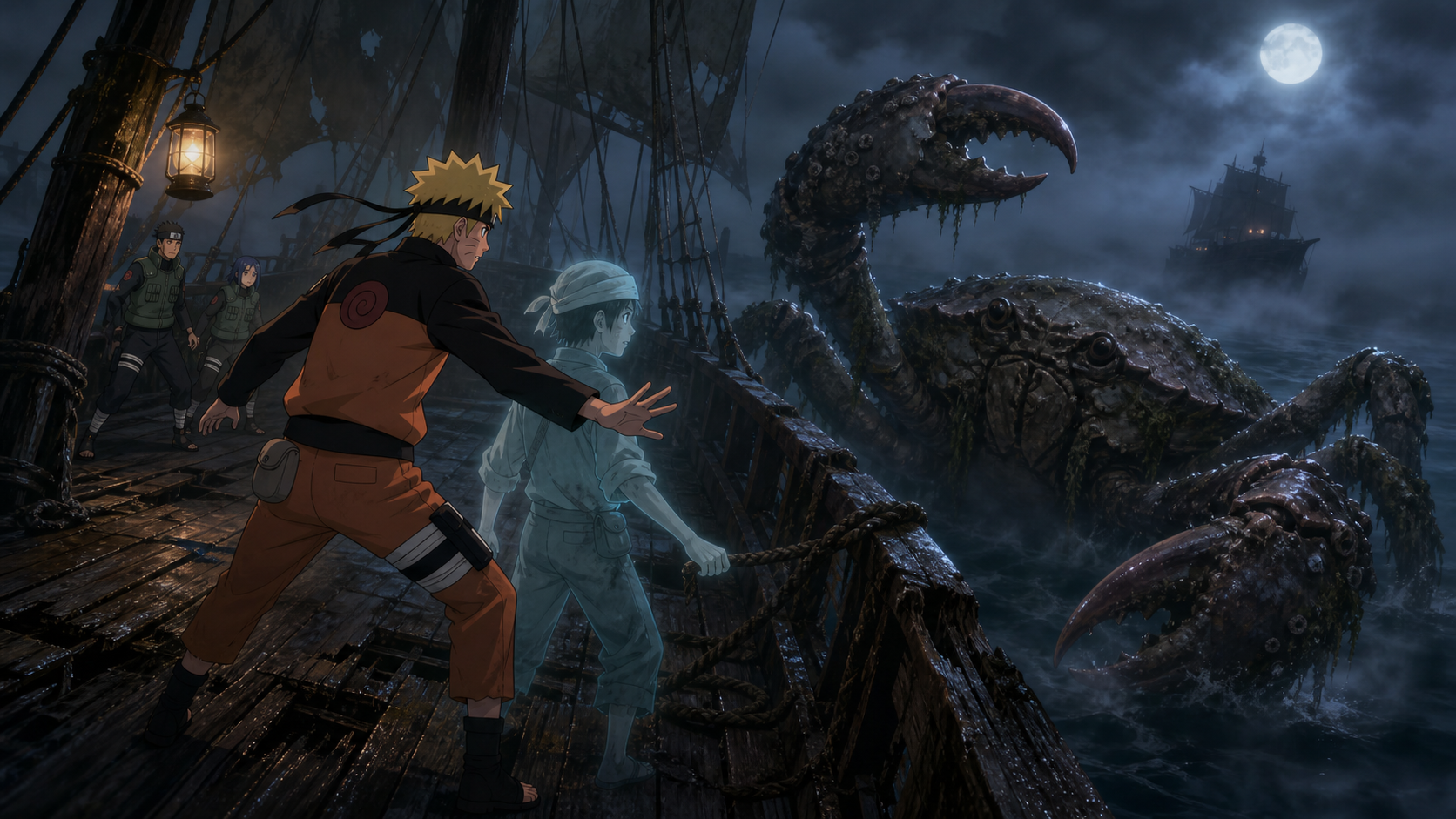
The Cursed Ghost Ship
Hishaku survived by obeying his captain, then spent death mistaking the captain’s protection for his own betrayal.
Bottom line
Naruto Shippuden Episode 225, "The Cursed Ghost Ship," gives Naruto a boy who survived by obeying his captain and then spent death punishing himself for that obedience. Hishaku escaped the Giant Corpse Crab when his captain ordered him to save himself. His body still died with the crew, but his spirit remained aboard because guilt turned survival into betrayal inside his memory.
Naruto helps defeat the creature, and Hishaku finally understands that leaving was not cowardice. A captain used his last authority to protect the youngest sailor. The boy did not abandon the crew. He carried the captain's choice.
The episode wraps that idea inside fog, ghost-story comedy, a ruined ship, and a crab designed by somebody who clearly looked at ordinary crab anatomy and said, "Needs more nightmare." The horror works best when the monster stops being the main problem. Hishaku's real prison is the belief that love required him to die beside everyone else.
Yamato tells the worst possible story for a fog bank
Dense fog leaves the escort ship moving slowly with poor visibility. Yamato responds by telling Naruto about cursed vessels appearing at sea.
That choice is not leadership training. That choice is a grown man entertaining himself because Naruto is wonderfully easy to scare.
The teasing also prepares the episode's atmosphere. Naruto can face Akatsuki, Pain, and the Nine-Tails, but an uncertain shape in fog activates a different fear because strength cannot punch a rumor before the rumor becomes visible.
Naruto's fear is funny because fear remains selective
Naruto has survived threats that would flatten most people. Ghost stories still get under his skin.
Courage never means equal comfort around every danger. Known enemies have bodies, techniques, and intentions Naruto can confront. A ghost may ignore the rules he understands.
His fear keeps him human and gives the later connection with Hishaku more value. Naruto boards the ship while afraid rather than waiting to feel invulnerable.
A drifting ship requires investigation
The vessel appears without a visible crew in conditions where collision, distress, disease, piracy, or wreckage could endanger both ships.
Yamato, Aoba, and Naruto investigate because professional sailors and shinobi cannot assume every silent vessel is supernatural or harmless.
Boarding remains risky. Rotting deck boards, unstable rigging, hidden attackers, contaminated cargo, and sudden current changes create practical danger before any ghost enters the conversation.
Hishaku looks like a living boy doing impossible work
Naruto finds Hishaku maintaining the ship alone. The tasks give the appearance of routine: rope, deck, repairs, and the daily labor needed to keep a vessel from collapsing.
One child cannot truly maintain a large sailing ship indefinitely. The impossibility becomes a clue before the episode confirms his death.
Hishaku repeats work because duty is the identity he remembers. Ghost labor keeps him attached to the crew through chores that no longer preserve living people.
A child sailor reveals the world beneath shinobi stories
Hishaku dreamed of becoming a captain and worked under adults at sea. The episode treats his role warmly, but the labor conditions deserve attention.
Ships need young hands because maritime economies often turn children into apprentices early. Training can provide skill, belonging, and a future. Training can also expose a child to storms, injury, exploitation, and violence without meaningful power to refuse.
The captain's final order acknowledges that Hishaku was the person aboard who still had a life ahead worth protecting.
The captain uses authority to save the youngest
When the Giant Corpse Crab attacks, the captain tells Hishaku to flee. The order creates separation while the rest of the crew faces death.
Hishaku interprets the result through shame. He survived the decisive moment while people he admired remained behind.
The captain likely understood the opposite. Leadership sometimes means choosing who must leave because asking everyone to die together protects nobody.
Survivor guilt rewrites obedience as betrayal
Hishaku believes fear made him abandon his captain. Memory reduces the attack to the moment he moved away.
Trauma often ignores the information available during crisis. He was a child, the creature was overwhelming, and the captain issued a direct order. Guilt still asks why his legs carried him when others could not escape.
That question cannot be answered through punishment. Remaining on the ship does not restore the crew or prove love. The haunting only extends the casualty list.
Naruto understands living under dead people's expectations
Naruto carries Minato's seal, Jiraiya's key, prophecy, village hope, and his own promises to people who died. He knows how love can become an obligation that fills every quiet moment.
His situation differs from Hishaku's, but the emotional pressure is familiar. Naruto often measures himself against what a dead mentor believed he could become.
Helping Hishaku requires more than killing the crab. Naruto must show that a bond can survive without the younger person joining the dead.
The Giant Corpse Crab turns remains into weapons
The creature's shell, pincers, barnacles, and grasping limbs create body horror around the idea of a scavenger. The name connects the crab to death before the attack begins.
Barnacle-like organisms and appendages threaten living people, making the shell feel like a moving graveyard rather than ordinary armor.
The design is excessive, but excess fits a ghost story told at sea. Fog hides scale until the nightmare is already against the hull.
A hard shell changes the combat problem
Naruto cannot solve every threat by hitting the visible center harder. The crab's armor resists straightforward attacks while pincers and limbs control space around the ship.
Fighting on a damaged deck adds constraints. A missed strike can break the vessel. A powerful technique can throw allies into the water. The team must protect Hishaku and maintain enough structure to escape.
Yamato's construction abilities become as important as offensive force because the battlefield is sinking beneath them.
Hishaku participates instead of waiting for rescue
Hishaku knows the ship, the creature, and the history of the attack. His contribution keeps him from becoming a ghost-shaped mission objective.
Facing the crab also lets him revise the final memory. He is no longer the terrified child moving away while adults die. He can act beside people strong enough to help.
The distinction matters because healing through action can become dangerous when stories imply trauma disappears after one successful fight. Hishaku's action works here because his spirit needs completion, not a lifetime treatment plan.
Revenge gives Hishaku a goal, not the whole answer
He asks Naruto to defeat the creature that killed his crew. The request makes sense. The crab remains dangerous to other ships and directly caused the deaths.
Destroying the creature removes the external threat. Hishaku's guilt only changes when he can see the captain's order as protection rather than condemnation.
Revenge opens the final confrontation, but understanding releases the ghost.
The crew's absence is present in every task
Hishaku tends ropes, deck, and ship because those jobs once connected him to other workers. Every empty station marks someone missing.
The episode does not need a line of spectral sailors explaining their relationships. The vessel's scale tells viewers that one boy was never supposed to operate alone.
That emptiness gives the ship emotional weight beyond visual decay. The haunting belongs to routine interrupted by death.
Ghost stories turn unresolved duty into place
Hishaku remains where the loss occurred. The ship carries his guilt through the same water and fog.
Many ghost traditions attach spirits to unfinished obligations, violent death, burial problems, or powerful emotion. Episode 225 uses the familiar pattern without claiming one specific religious system.
The ship becomes a physical version of repetition. Hishaku cannot reach another shore because his memory never moves beyond the attack.
Naruto protects Hishaku without mocking belief
Naruto begins frightened by the possibility of ghosts. Once he meets Hishaku, fear gives way to attention.
He does not spend the episode arguing whether spirits can exist. The boy needs help, the crab threatens ships, and the situation demands action.
That practical compassion fits Naruto. A person's pain matters before Naruto understands every rule governing the person.
Yamato's ghost joke acquires consequences
Yamato tells a scary story for entertainment, then boards a vessel containing an actual spirit and a lethal sea creature.
The reversal is satisfying because adults often enjoy controlling fear through stories. Reality removes that control.
Yamato responds as a captain should once the threat becomes real. He investigates, protects the team, and uses Wood Release to manage a ship that can no longer support itself.
Aoba provides skepticism without abandoning caution
Aoba approaches the vessel as a shinobi problem rather than a campfire tale. Observation and investigation keep the team from letting Naruto's panic dictate decisions.
Skepticism does not require walking blindly into danger. A silent ship in fog is suspicious whether ghosts exist or not.
His steadier presence gives Naruto room to react emotionally while the team maintains professional procedure.
The living escort ship anchors the return route
Naruto's group has a functioning vessel and crew nearby. That practical anchor matters because the ghost ship cannot become reliable transport after the fight.
The episode keeps two maritime worlds beside each other: living workers continuing a mission and a dead crew trapped in repetition.
Hishaku's release allows the ruined ship to leave the living route rather than remain a permanent hazard.
The captain's protection should not become Hishaku's sentence
The captain chose a chance for Hishaku to survive. Hishaku turned that gift into years of spiritual punishment because accepting survival felt disloyal.
That pattern appears beyond ghost stories. People can reject joy, rest, or future relationships because suffering seems like the only honest memorial.
The episode's answer is blunt and necessary: love from the dead does not demand that the living person stop living.
Anime-original status gives the voyage a contained moral tale
Episode 225 does not adapt manga chapters. The ghost ship functions as a self-contained story during the longer trip toward B.
The detour does not advance Akatsuki strategy or Naruto's Nine-Tails training. The episode expands Naruto's experience with another young person carrying inherited guilt.
That thematic connection gives the filler more purpose than a random monster fight, even when the giant crab design belongs to a different level of chaos.
The Japanese performances carry fear, duty, and release
Naruto's Japanese performance commits to the ghost panic without making him useless. His voice shifts naturally once Hishaku becomes a boy rather than an unknown supernatural threat.
Hishaku sounds earnest and over-responsible, fitting a child who has performed adult ship duties for so long that guilt became part of his job.
Yamato's controlled delivery makes the opening ghost story funnier and his later command decisions steadier. Aoba keeps the investigation grounded.
Hishaku mistakes the captain’s sacrifice for an unpaid debt
The captain ordered the youngest sailor away because authority created one final chance to protect him. Hishaku hears that choice as an obligation he failed to repay with death.
His haunting turns love into accounting. If the crew died, he believes remaining in pain is the only balance honest enough to prove he belonged with them.
Obedience can still leave trauma when the outcome is unbearable
Hishaku followed a legitimate command and made the action most likely to preserve life. Correct conduct does not guarantee emotional peace after everyone else is gone.
The episode separates responsibility from feeling. He can be blameless while still experiencing shame, fear, and the recurring conviction that another choice might have changed everything.
The empty ship keeps demanding labor from a dead child
Hishaku continues maintaining ropes and decks because work makes the lost crew feel temporarily present. Routine offers structure where grief otherwise has no boundary.
Yet every completed task leads back to the same absence. The ship cannot become seaworthy through devotion, and the crew cannot return because the youngest sailor refuses to abandon his station.
Naruto recognizes a bond that has become self-punishment
Naruto honors dead mentors through promises, training, and service. He also risks believing that rest or failure would betray everyone who trusted him.
Hishaku shows the endpoint of that logic. Memory stops guiding a future and becomes a command to remain inside the worst moment forever.
The crab gives guilt a body Naruto can confront
Internal shame cannot be defeated by a Rasengan. The creature can. Fighting it creates enough safety for Hishaku to revisit the attack without being overwhelmed by the same helplessness.
The physical victory is therapeutic only because conversation changes the meaning afterward. Otherwise, revenge would leave the boy aboard with a dead enemy and the same accusation against himself.
Sea horror works because rescue options disappear
On land, characters can imagine roads, villages, and solid ground beyond the frame. Fog and open water erase those comforts. A damaged deck may be the only surface between the team and drowning.
The episode uses confinement well. Every broken board and hidden movement makes the ship feel like a memory nobody can exit by walking away.
The crew’s final act was choosing continuation
The captain did not order Hishaku to flee because the boy mattered less. He did it because somebody’s life could continue beyond the attack.
Accepting release honors that intention more faithfully than endless labor does. The crew’s bond survives through the future they tried to preserve, not through another casualty added after the fact.
Adults should not romanticize the child who stayed useful
Hishaku’s competence is touching, but it also reveals how completely work defined him. Even in death, he imagines belonging through service rather than through being cared for.
Naruto’s attention gives him something different. The boy matters before he helps defeat the crab, explains the ship, or proves courage.
Production choices make fog serve memory
Fog limits distance, hides the living ship, and lets the ghost vessel arrive without a clear boundary between present and past.
Lantern light isolates faces and deck details while torn rigging breaks the frame into uncertain lines. The crab's size becomes legible only when a pincer rises beside the hull.
The final quiet after combat matters as much as impact. Hishaku needs enough visual stillness for release to register.
Fear changes when the unknown becomes a person
The episode also understands that fear changes after recognition. Naruto is terrified when the fog offers only a cursed ship and noises without explanation. Once Hishaku appears, the supernatural problem acquires a face, a history, and a request.
Naruto does not need to stop believing the situation is frightening. He needs enough relationship to choose action inside the fear. That shift is one of his most reliable strengths: strangers become people faster than danger can keep them abstract.
Yamato’s responsibility includes a battlefield that may collapse
Combat aboard a ruined vessel demands restraint that an open field does not. Wood Release can stabilize sections, create barriers, and replace missing structure, but every intervention changes weight and balance on damaged timbers.
Yamato must protect Naruto without destroying the platform beneath Hishaku’s final confrontation. His technique works as emergency engineering, giving the episode another reminder that shinobi power matters beyond direct attack.
Aoba’s calm keeps uncertainty from becoming panic
Aoba cannot explain the ghost ship immediately, yet he continues observing what can be tested: the vessel’s condition, the crew’s absence, the monster’s movement, and Naruto’s location.
That discipline matters whenever a team encounters something outside its normal rules. Skepticism should narrow claims, not excuse inaction. Aoba leaves room for supernatural evidence while still behaving like a professional responsible for living teammates.
The captain’s authority remains ethical because it ends at protection
The captain’s last order does not demand lifelong obedience, revenge, or memorial suffering. It asks Hishaku to leave immediate danger. Everything afterward comes from the boy’s grief, not from an adult claiming ownership over his future.
That distinction separates protective authority from control. A leader can make an emergency decision for a child without turning the rescued life into permanent property or debt.
The ship is a memorial that cannot become a home
Every rope and broken plank holds evidence of the people Hishaku loved. Preserving that space allows memory to survive, but living inside the memorial prevents any new identity from forming.
His release does not destroy the crew’s importance. It restores proportion. The ship can belong to the past without requiring the youngest sailor to remain its final unpaid caretaker.
Hishaku does not need another test of courage. He needs permission to believe the captain meant what he said: leave, live, and let the crew’s love become a beginning instead of an anchor. That is the episode’s quiet, earned victory.
Release requires permission to stop proving love
Hishaku has already demonstrated loyalty through years of guarding a dead vessel. More punishment cannot deepen what the crew meant to him.
Naruto helps him understand that leaving is not forgetting. A person can carry the dead forward without continuing the circumstances that killed them.
RaeRae’s final word on The Cursed Ghost Ship
Yamato tells a ghost story in heavy fog and then acts surprised when the universe hands him an actual haunted ship. That is consequence with excellent timing.
The Giant Corpse Crab is gloriously unreasonable. It has the energy of every ocean nightmare being attached to one shell because ordinary pincers apparently lacked ambition.
Hishaku is why the episode stays with me. He obeyed the adult responsible for him, survived the moment, and still decided survival proved cowardice.
Naruto wins the fight, but compassion ends the haunting. The captain’s final order was love, not judgment, and Hishaku can finally leave because he stops treating his future as a betrayal.
RaeRae’s call
Hishaku never abandoned his crew. His captain protected the youngest life still able to continue. Defeating the crab removes the danger, but accepting that love releases the ghost.