
The Ninja of Benisu
Wartime medicine becomes a resource contest until Naruto saves the competitors who tried to control the supply.
Bottom line
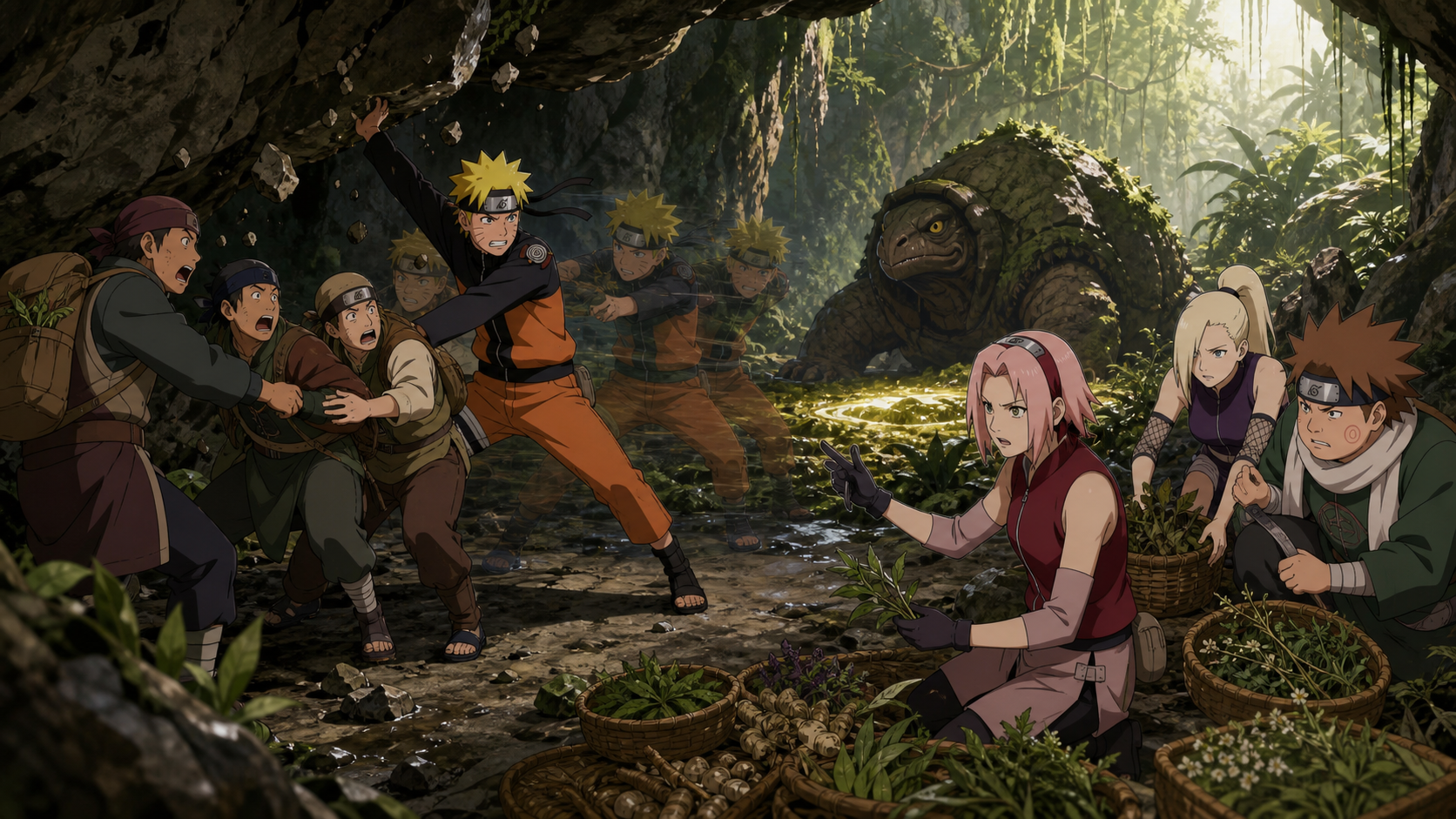
Naruto Shippuden Episode 224, "The Ninja of Benisu," turns medicinal plants into a wartime supply fight and almost says something sharp about small villages surviving beside powerful nations. Sakura, Ino, and Chōji need herbs for Konoha's coming medical burden. Bandō, Kiji, and Sada have harvested the same island because selling scarce medicine could fund Benisu.
The merchants play dirty, but their motive is not random greed. A small community without Konoha's land, hospital system, clan networks, or mission market has to convert specialized knowledge into money somehow. The problem begins when the Benisu team strips shared resources, wastes competitors' time, and treats wartime scarcity as a chance to control supply.
Naruto saves them from a guardian creature without demanding payment. They respond by sharing half the harvest. Then the closing joke reveals that their generosity still creates a debt Benisu plans to collect after the war. Gratitude, commerce, and opportunism are all sitting in the same herb basket.
Seasickness creates the island stop
Guy's body can open the Eight Gates, row against a giant marlin, and kick through stone. A moving ship still defeats him through the inner ear.
The joke works because physical strength does not make every biological system obedient. Seasickness comes from conflicting sensory information, not weak character.
The group stops so Guy can recover, demonstrating one small piece of responsible travel planning. Pressing forward with a severely ill escort would endanger the patient and everyone depending on him during an emergency.
Nanakusa Island becomes a war pharmacy
Sakura, Ino, and Chōji search the island under Tsunade's orders for herbs and medicinal material needed before the Fourth Shinobi World War.
The mission makes war preparation concrete. Medical units cannot heal thousands of people through chakra alone. They need plants, compounds, bandages, antidote ingredients, storage containers, clean water, transport, and people who know how to identify and prepare each material.
An island rich in useful species becomes strategically important even without a fortress or tailed beast.
Sakura leads through actual medical knowledge
Sakura understands which plants matter, which parts can be harvested, and which lookalikes can harm the team. Her expertise gives the mission structure beyond filling baskets.
Correct identification is only the beginning. Harvest timing, contamination, dosage, drying, storage, and combination determine whether a plant becomes medicine or poison.
The episode lets Sakura occupy the expert role while Naruto arrives with enthusiasm and almost no botanical judgment. That division fits their training rather than forcing Naruto to become competent at every problem.
Ino belongs on a medical supply mission
Ino trained in medical ninjutsu under Tsunade's system while maintaining the sensory and mind techniques of the Yamanaka clan. Herb collection supports both her medical work and the family's flower knowledge.
Her presence also spreads responsibility beyond Sakura. A war medical corps cannot depend on one gifted apprentice beside the Hokage.
Ino recognizes plant features and helps organize the search, showing how a shinobi can carry clan specialization into broader public service.
Chōji contributes observation, strength, and carrying capacity
Chōji spots useful plants and manages physical collection work without needing a sudden medical credential. Large herb loads still require somebody to move baskets safely across rough terrain.
His food knowledge also gives him a practical relationship with plants, preparation, and bodily effects. Eating and medicine are not the same discipline, but both begin with attention to what enters a body.
The episode occasionally uses his appetite for easy jokes, yet Chōji remains a working member of the mission rather than baggage for Sakura and Ino.
Naruto tries to help before learning the assignment
Naruto joins the search because friends have a job and he has time while Guy recovers. The impulse is generous.
He also eats or handles plants without enough knowledge and suffers predictable consequences. Medicinal does not mean safe in every dose, form, or preparation.
The comedy carries a useful correction. Good intentions do not replace expertise. Naruto can create a hundred clones, but a hundred uninformed harvesters can destroy a habitat or fill a warehouse with poison faster than one.
The Benisu trio recognizes scarcity before Konoha does
Bandō, Kiji, and Sada reach valuable herb patches first and gather aggressively. They understand that war will raise demand and prices.
That calculation is economically sound. Medicine becomes more valuable when armies expect mass casualties and trade routes face disruption.
Their advantage comes from specialized knowledge and speed. The ethical problem lies in turning a shared natural supply into a near monopoly without regard for the people who will need treatment.
Merchant shinobi expose another kind of village economy
Major hidden villages sell military labor through missions backed by state relationships. Benisu's shinobi operate closer to traders, scouts, harvesters, and brokers.
Their work asks what ninja skills become outside a great power. Tracking finds rare plants. stealth secures access. combat protects cargo. intelligence anticipates markets.
The episode could have pushed this idea further. Merchant shinobi are a valuable reminder that the ninja world contains livelihoods beyond assassination, guarding nobles, and village armies.
Competition becomes sabotage when one team wastes the other's time
The Benisu trio uses tricks and misdirection so Konoha's team loses access while the merchants collect. That behavior moves beyond healthy competition.
Wartime medicine is not a luxury product. Hoarding or delaying supply can increase deaths. The merchants' plan may support Benisu, but the method transfers risk to injured people who never joined the negotiation.
Small-village hardship explains the choice without excusing every consequence.
The island's resources need stewardship, not a race
Both groups treat the herb field as available inventory. Neither initially asks how much can be removed without damaging future growth.
War creates pressure to harvest everything now. Ecological damage then makes the next emergency worse, especially for local residents who depend on the island after outside teams leave.
Responsible collection would divide mature plants, preserve roots or seeds where appropriate, document locations, and plan renewal. Shinobi speed should not become environmental illiteracy.
The Elixir Mud sounds valuable because the route is dangerous
The remaining medical material lies in a hazardous cave area guarded by a large creature. Scarcity comes partly from the risk required to gather the resource.
Sakura's team needs the material, and the Benisu merchants want the same prize. Their competition pushes everyone toward a location Tsunade preferred they avoid if possible.
That escalation shows how resource rivalry changes risk tolerance. A person may reject a dangerous route until another buyer threatens to take the entire supply.
The guardian creature is protecting a habitat, not running a shop
The cave creature attacks intruders near the medicinal mud. From the human perspective, the animal blocks a needed resource.
From the creature's perspective, armed strangers enter its territory, disturb the cave, and remove material connected to the local environment.
The episode uses the guardian as an action obstacle without exploring that conflict deeply. Episode 223 had just taught Naruto to look beyond the label of monster, so the quick return to creature-as-barrier deserves scrutiny.
Naruto rescues competitors without setting a price
When the Benisu trio faces real danger, Naruto helps. He does not pause to calculate herb shares or demand repayment before saving lives.
That response separates him from the market logic dominating the episode. A person in immediate danger is not leverage.
Naruto's choice also gives the merchants new information. Konoha's team could have benefited from their failure and chose rescue instead.
Gratitude changes the herb division
Bandō, Kiji, and Sada give Konoha half the collected herbs after Naruto saves them. Sharing allows Sakura's mission to succeed while preserving material Benisu can sell.
The division is better than total hoarding and more practical than surrendering everything. Both communities face needs connected to the coming war.
Their choice shows that direct human obligation can interrupt an abstract market calculation. Naruto becomes the person attached to what Konoha previously represented as a wealthy competitor.
The debt joke keeps the merchants morally complicated
The Benisu trio does not regard the herbs as a pure gift. They expect to collect a debt after the war.
That final reveal prevents a tidy redemption. They can feel grateful, share resources, and still track commercial advantage.
The joke also raises a serious question about who will pay. Naruto offered rescue freely. Konoha did not sign a purchase agreement. Turning gratitude into institutional debt without consent is another form of opportunism.
Small communities need revenue before and after war
Benisu's plan to fund the village through herb sales should not be dismissed as villainous commerce. Wars driven by major powers disrupt small economies whether those communities fight or not.
Prices rise, routes close, clients disappear, and local shinobi may lose ordinary mission work. Selling medicine can finance food, repairs, and protection.
The fair criticism belongs to extraction and manipulation, not the desire to keep Benisu solvent.
Konoha's scale distorts what generosity means
Half a harvest may look like a friendly favor to Naruto. For a small merchant team, half may represent months of village income.
Konoha can call on clans, tax support, established hospitals, and allied supply channels. Benisu may depend on a handful of skilled workers and one seasonal resource.
The episode gestures toward unequal bargaining power without naming the structure. Naruto's personal kindness helps, but kindness does not eliminate the economic gap between their homes.
Medical preparation reveals who expects casualties
Tsunade sends teams for herbs because leaders know the alliance will suffer injuries. The mission exists before armies assemble, meaning casualty planning begins alongside strategy.
That realism deserves attention. Leaders who declare war must prepare for blood, infection, burns, poison, amputation, trauma, and long recovery.
Medicinal baskets are less dramatic than weapons, but a force without supply planning turns wounded shinobi into preventable deaths.
Anime-original status gives the episode room and responsibility
Episode 224 does not adapt manga chapters. The voyage arc expands the interval between the Kage decision and Naruto's training.
That freedom allows the anime to show war logistics and alternative shinobi economies. The episode uses both ideas, though broad comedy and a quick cave monster keep the analysis shallow.
Anime-original does not mean consequence-free. New locations, resources, and labor systems should still make sense inside the world.
The Japanese performances sell irritation and negotiation
Sakura's Japanese performance gives medical instruction an impatient precision shaped by years of managing Naruto. Ino answers as a capable peer rather than a sidekick.
Chōji's warmth keeps the herb mission from becoming sterile inventory work. Naruto's confidence collapses naturally when plant knowledge exposes him.
The Benisu trio sound theatrical and calculating without becoming faceless villains. Their final gratitude retains enough business instinct to make the debt joke believable.
Medicine becomes a battlefield before the first casualty arrives
The two teams are not fighting over decorative plants. Every bundle represents treatment for somebody whose body will absorb the war that leaders have already declared.
Competition over supply therefore reaches future patients before anyone is wounded. Hoarding, waste, and sabotage determine which medic later has enough material to keep a stranger alive.
Expertise deserves authority when enthusiasm becomes dangerous
Naruto’s clones can multiply labor, but Sakura’s knowledge must decide what that labor does. Speed without identification could gather toxic lookalikes, damage useful roots, or exhaust the patch before another harvest.
The episode lets expertise limit raw capacity. Naruto helps best after accepting that wanting to contribute does not make him the person qualified to direct the collection.
Sakura’s preparation is leadership without applause
Battlefield stories celebrate the person who lands a decisive attack. Sakura works earlier, when success looks like labeled supplies, clean storage, dosage knowledge, and a team that can move material without contamination.
Her labor may prevent deaths nobody will trace back to this island. Preventive competence often disappears from heroic memory precisely because the crisis it avoids never becomes visible.
Benisu sells knowledge as much as harvested material
The merchants locate valuable plants, understand demand, navigate dangerous terrain, and anticipate a market before larger institutions finish mobilizing. Those skills are genuine economic assets.
Konoha’s resources do not entitle it to free access to every specialist’s labor. A fair exchange could compensate Benisu while protecting medical availability. The trio choose manipulation because unequal markets taught them leverage matters more than goodwill.
Scarcity can be real even when somebody exploits it
The Benisu shinobi behave opportunistically, but their conduct does not prove the coming shortage is invented. War will consume medicine faster, disrupt transport, and make every remaining source harder to reach.
Condemning price manipulation without building reliable supply merely leaves the same shortage for another merchant to control. Ethical criticism must include a better distribution plan.
The guardian exposes extraction disguised as necessity
Both teams arrive convinced that urgent human need settles their right to enter the cave. The creature living there receives no place in the calculation until it becomes physically impossible to ignore.
Medical purpose does not automatically make extraction harmless. If gathering destroys habitat or kills the local guardian, today’s remedy may create tomorrow’s ecological loss.
Naruto’s rescue changes negotiation because it refuses leverage
He could let competitors suffer and collect everything afterward. Instead, he treats their lives as separate from the dispute over herbs.
That refusal creates the first relationship not governed by scarcity. The merchants share because Naruto demonstrated that another person’s need can interrupt advantage without erasing anyone’s right to survive economically.
Half the harvest is compromise, not moral purification
Bandō, Kiji, and Sada do not become selfless after rescue. They preserve enough inventory to benefit Benisu and surrender enough for Konoha’s medical mission to matter.
The split works because it recognizes competing needs. A perfect redemption would flatten the economic pressure that made them merchants in the first place.
The debt joke reveals consent missing from the transaction
The trio privately plans to collect later, but Naruto never bought the herbs and Konoha never negotiated a price. Gratitude quietly becomes an invoice only one party knows exists.
That is funny because the merchants remain shameless. It is also the same ethical habit the episode keeps circling: deciding what another person owes before allowing them into the decision.
Production choices make supplies visually important
Baskets, plant shapes, cave terrain, mud, and overloaded packs keep the episode's objects visible. The medical mission would feel empty if characters only announced that herbs had been gathered.
The chase structure turns identification and access into action. Konoha's team can see the needed plants while competitors repeatedly reach the resource first.
The cave rescue then changes the value of the supplies. Herbs stop being points in a contest and become goods transferred through a new relationship.
Collection is only the first stage of medical readiness
Collection alone is insufficient. Plants need sorting, cleaning, preservation, transport, secure storage, and records that tell medics what remains usable.
Sakura’s expertise matters again when the baskets reach Konoha. A rare herb ruined by moisture or mislabeled during processing cannot save anyone. Logistics protects the value created on the island.
The coming war will also scatter patients across field hospitals. Central stockpiles need distribution routes, and those routes need guards who understand that medicine can be a more valuable target than weapons.
Small villages pay for wars they did not design
Benisu did not declare the Fourth Shinobi World War, capture the tailed beasts, or control the alliance. Its economy will still face disrupted trade, inflated prices, displaced travelers, and demand for scarce goods.
The great villages can describe their struggle as protection of the entire world while expecting smaller communities to absorb costs without meaningful representation. Purchasing supplies fairly would be one way to make alliance rhetoric material.
The trio’s schemes are not an ideal response, but they grow inside a system where waiting for powerful neighbors to notice Benisu may mean waiting until nothing profitable remains.
Stewardship would turn rivalry into future capacity
Both teams could document the medicinal habitat, agree on harvest limits, preserve reproductive growth, and share information about safe access. It would create another supply next season instead of one dramatic haul now.
War urgency encourages extraction because future benefits feel abstract beside immediate casualties. Leadership means refusing to solve today’s shortage by guaranteeing a worse one for whoever arrives later.
The island is not an infinite storeroom. Treating it as one repeats the same short thinking that lets nations consume people, animals, and land whenever military necessity speaks loudly enough.
War supply chains expose unequal worlds
Konoha can dispatch trained teams under a Hokage’s authority. Benisu sends three merchant shinobi hoping one dangerous harvest will finance their community. Both groups enter the same field carrying radically different institutional safety nets.
The episode is most interesting when it allows need on both sides. Konoha’s wounded will require medicine, and Benisu’s residents will still require food and income after the larger nations finish their war.
RaeRae’s final word on The Ninja of Benisu
Guy gets seasick, Naruto gets humbled by botany, and three merchant ninja attempt to turn wartime medicine into a business plan with hidden late fees. This voyage refuses normal travel.
Sakura, Ino, and Chōji make the supply mission credible because each contributes actual knowledge or labor. Naruto’s best contribution is accepting rescue as more urgent than winning the harvest.
The Benisu trio are irritating without becoming empty villains. Their village needs money, their expertise has value, and their sabotage still deserves criticism.
Sharing half the medicine is the right practical ending. Both communities keep something they need, and gratitude interrupts monopoly without pretending commerce vanished from the basket.
RaeRae’s call
Wartime medicine belongs to patients before it belongs to a rivalry. Naruto’s free rescue makes cooperation possible, but fair distribution still requires consent, stewardship, and respect for the smaller village’s real economic need.