
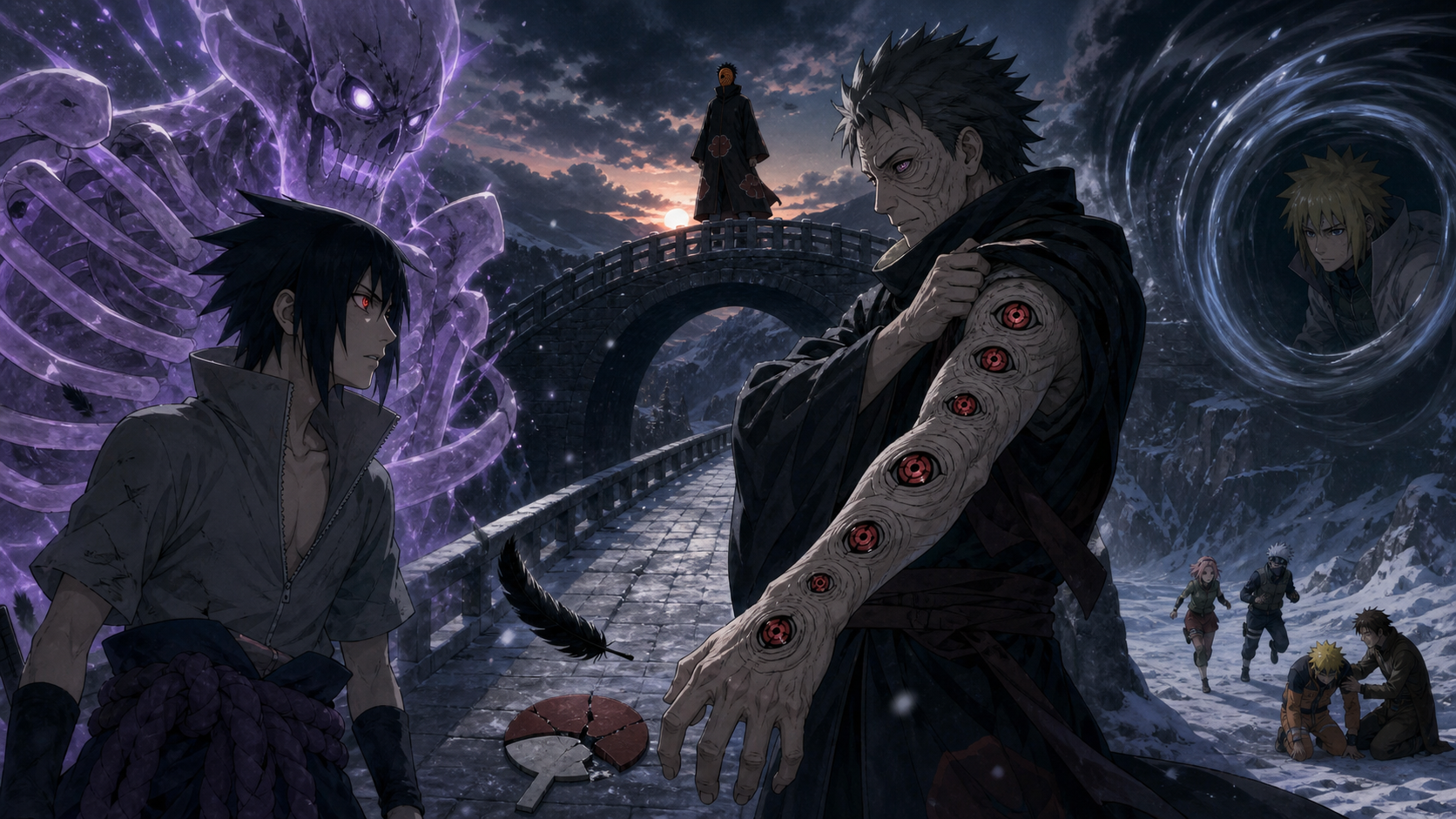
Danzō’s Right Arm
Danzō unwraps the Uchiha massacre as an arsenal, and Sasuke finally faces a man directly responsible for the wound driving his revenge.
Bottom line
Naruto Shippuden Episode 209, “Danzō’s Right Arm,” begins the confrontation Sasuke has pursued since learning the truth about Itachi.
Kakashi decides to follow Sakura and stop her from facing Sasuke alone. Yamato is ordered to return Naruto to Konoha, but Naruto collapses under the weight of the summit news, Sakura’s plan, and Tobi’s account of Sasuke.
On the Samurai Bridge, Tobi transports Sasuke and Karin into Danzō’s path. Danzō removes the seals and braces around his right arm, revealing multiple Sharingan implanted in flesh altered with the First Hokage’s cells. Sasuke summons Susanoo and demands the truth about Itachi and the Uchiha massacre. The fight begins with Danzō apparently dying, then inexplicably reappearing unharmed.
Danzō turned a murdered clan into equipment
The Sharingan along Danzō’s arm are not symbols he earned through Uchiha bonds. They are harvested weapons.
Sasuke has spent years carrying the massacre as the destruction of his family and identity. Danzō displays pieces of that family as a private arsenal hidden beneath bandages and official authority.
The reveal makes Danzō’s role in the massacre physical. He did not only support a policy that killed the Uchiha. He preserved their eyes for his own strategic advantage.
The arm reveals Danzō’s definition of sacrifice
Danzō repeatedly argues that individuals must be sacrificed for Konoha. His arm shows who benefits from those sacrifices.
He speaks as though he accepts burdens other leaders are too sentimental to carry, yet the bodies and abilities taken by Root increase his personal power. Other people lose names, freedom, family, or life; Danzō gains another tool.
That does not mean every decision he made was motivated by simple greed. His idea of necessity conveniently places him in control of what the dead leave behind.
Sasuke’s rage has finally reached a responsible target
At the summit, Sasuke cut through samurai and fought Kage who had no role in the Uchiha massacre. Danzō is different.
He helped create the conditions that forced Itachi’s choice, kept the truth hidden, stole Shisui’s eye, and now carries multiple Sharingan. Sasuke’s demand for answers is grounded in a direct grievance.
The legitimacy of the target does not automatically purify Sasuke’s methods. A direct grievance does explain why this battle carries a moral weight his attacks on unrelated guards did not.
Susanoo gives Sasuke’s anger a body
Sasuke’s incomplete Susanoo rises as a skeletal guardian around him. The construct protects, crushes, and makes his fury visible at a scale ordinary speech cannot contain.
The technique is also costly. Every use strains Sasuke’s eyes and chakra, making revenge physically consume the body carrying his anger.
Danzō’s arm and Sasuke’s Susanoo create an ugly visual contrast. One man assembles power from the bodies of others. The other burns through his own body to answer what was taken.
Danzō refuses the truth even when the evidence is exposed
Sasuke asks whether Itachi was ordered to destroy the clan. Danzō’s response is shaped by secrecy and contempt rather than accountability.
He judges Itachi for revealing information after death, as though the preservation of Konoha’s official story matters more than what the village demanded of a child.
That reaction confirms why Sasuke could never receive justice through ordinary channels. The person before him still treats truth as dangerous property belonging to the state.
Karin becomes the analyst inside Sasuke’s revenge
Karin watches chakra flow, tracks Danzō’s condition, and tries to understand how he survives attacks that should kill him.
Her sensory ability is essential because the battle’s mystery cannot be solved by force alone. Sasuke can crush or pierce Danzō, but each apparent victory resets.
Karin gives the fight a second intelligence. While Sasuke pushes forward emotionally, she measures the pattern that may keep him alive.
Danzō’s return turns death into unreliable evidence
Sasuke’s attack appears decisive. Danzō dies, and then Danzō stands elsewhere as though the death did not happen.
The effect destabilizes both Sasuke and the viewer. If a successful strike cannot be trusted, the fight becomes a problem of rules rather than power.
The Sharingan closing along Danzō’s arm suggest a cost, but the mechanism remains unclear. Sasuke must discover what Danzō is spending and how many times the impossible can repeat.
Tobi watches the battle like an experiment
Tobi arranged the confrontation, protects Karin’s position, and observes from above. He has an interest in Danzō’s techniques and Sasuke’s development.
He does not enter the fight to share Sasuke’s grief. He wants to see what Sasuke’s Mangekyō can become under pressure and what secrets Danzō will expose.
The bridge is personal for Sasuke and informational for Tobi. That difference explains why Tobi can remain so calm while both men spend stolen Uchiha power below him.
Kakashi follows Sakura because leadership means preventing a solitary mistake
Kakashi understands why Sakura believes she must stop Sasuke. He also knows she is acting from grief, guilt, and incomplete information.
Following her is not a refusal to let her make difficult choices. Kakashi refuses to let one student carry a lethal decision alone while another student waits at the center of the crisis.
Kakashi has already lost teammates because people acted inside impossible missions without enough support. He is not willing to repeat that pattern quietly.
Naruto’s collapse is not weakness
Naruto has absorbed several shocks without time to process them: Itachi’s sacrifice, the Uchiha’s history, Sakura’s lie, the rookies’ decision, Sasuke’s summit attack, and the beginning of war.
His body finally stops. The collapse reflects overload, not a lack of resolve.
Naruto usually converts pain into movement before understanding the feeling. Here the contradictions are too large for immediate action. He cannot chase everyone at once, and every available direction seems to betray someone.
Yamato is left guarding a person no order can simplify
Yamato receives a straightforward command: return Naruto to Konoha. Carrying out that order is more complicated.
Naruto is a protected jinchūriki, a target of the new war, and a young man whose closest relationships are falling apart in real time. Treating him only as a strategic asset repeats the logic the alliance claims to oppose.
Yamato must keep Naruto physically safe while recognizing that confinement cannot answer the decision Naruto still has to make.
The bandages are part of Danzō’s government
Danzō’s covered eye and sealed arm have always helped him perform restraint. He presents himself as an elder carrying wounds from service, a man whose hidden severity supposedly protects softer leaders from decisions they cannot face. Removing the braces reveals that concealment was never modesty. The wrappings protected a private arsenal from scrutiny.
That distinction matters because Danzō gained the acting Hokage title while hiding abilities built from stolen bodies and forbidden experimentation. Konoha’s public chain of authority had no meaningful view into the power beneath his sleeve. He demanded obedience to the village while exempting himself from the transparency that could make leadership accountable.
The reveal therefore belongs to the political story as much as the battle. An official body and a weaponized body occupy the same frame. Danzō never separated state necessity from personal control because secrecy allowed him to call both by the same name.
Sasuke asks for truth after truth has lost legal protection
Sasuke’s demand is simple: confirm whether Konoha ordered Itachi to destroy the Uchiha. Danzō could answer as a surviving policymaker facing the child harmed by that decision. Instead, he treats Itachi’s posthumous disclosure as a violation of secrecy.
That response shows why ordinary justice was unavailable. The massacre was protected by classification, the surviving witnesses benefited from silence, and the person carrying the evidence had been branded a criminal. Sasuke’s violence cannot create a trustworthy court, but no trustworthy court was waiting for him either.
Danzō’s contempt also misunderstands Itachi. The truth reached Sasuke through Tobi rather than through a voluntary confession, yet Danzō remains more offended by exposure than by the machinery that made exposure devastating. Institutional reputation still ranks above the child standing before him.
The Hashirama cells connect this bridge to a longer abuse
The First Hokage’s cells have appeared across the series as a shortcut powerful men keep taking through another person’s body. Orochimaru’s experiments killed children. Yamato survived and became valuable partly because survival was rare. Danzō receives similar biological power through a collaboration that served both his ambition and Orochimaru’s research.
Wood Release on the bridge is therefore not a neat surprise added to the Sharingan collection. The technique carries the history of subjects who did not survive experimentation and of institutions willing to ignore methods when the results looked useful.
Danzō condemns Orochimaru publicly while wearing the outcome of his work. Hypocrisy alone is not the deepest problem. Konoha’s shadow authority and a rogue scientist were able to exchange access, bodies, and protection because both believed necessity placed them beyond consent.
Karin gives Sasuke a relationship he is already failing
Karin stands outside Sasuke’s family grievance, but she is not outside the episode’s moral argument. She follows him into a battle against the man connected to his clan’s destruction, monitors the chakra field, and provides information Sasuke cannot obtain through force.
Her presence offers Sasuke a living bond during a confrontation dominated by stolen Uchiha remains. He could recognize that revenge is being supported by someone who chose to stand beside him. Instead, his attention narrows toward Danzō and the answer he wants.
The coming betrayal of Karin does not appear from nowhere. Episode 209 shows the imbalance before the strike. She studies his enemy, worries about his condition, and risks exposure. Sasuke receives each contribution as a resource rather than as an obligation between teammates.
Naruto and Sasuke are both trapped by other people’s plans
Tobi controls the bridge encounter’s timing and information. Kakashi and Sakura make separate decisions about Sasuke. Yamato receives orders concerning Naruto. The allied villages define Sasuke as a target and Naruto as a protected strategic asset. Both boys occupy the center of plans they did not design.
Their responses differ. Sasuke embraces the narrow path Tobi prepared because Danzō stands at the end. Naruto’s body shuts down when every available path demands the loss of someone he loves. Neither reaction produces freedom.
The parallel matters because the story is moving toward another Naruto-Sasuke confrontation. Reaching one another will require more than choosing opposite sides. They must recognize how grief, secrecy, and institutional need keep converting their choices into tools for older agendas.
The Japanese cast makes the reveal feel contaminated
Noriaki Sugiyama gives Sasuke’s questions a controlled edge before Susanoo expands the anger visually. He does not sound curious. He sounds like someone demanding confirmation of a truth already written across Danzō’s arm.
Hiroshi Ito keeps Danzō’s voice measured even after the evidence is exposed. That steadiness communicates a man who does not experience possession of the eyes as shameful. He believes the result justifies the collection, which makes every calm answer more disturbing.
Kanako Tōjō gives Karin’s observations alert precision, while Nobuo Tobita keeps Tobi comfortably removed from the emotional stakes. Junko Takeuchi breaks Naruto’s familiar vocal drive through breath and silence. Across both locations, performance distinguishes the people paying for the truth from the man studying how payment changes them.
Danzō wears the difference between service and entitlement
He describes himself as the leader willing to absorb ugly necessities, yet his body displays benefits extracted from the people required to pay. Sacrifice travels upward as power instead of inward as accountability.
The arm is not evidence that Danzō shared Konoha’s burden. It is evidence that he believed deciding who became expendable entitled him to inherit whatever usefulness remained.
Every eye carries a person the policy tried to erase
The Sharingan are valuable techniques to Danzō, but they were perception, memory, and identity inside murdered members of Sasuke’s clan. Arranging them as interchangeable sockets continues the massacre after death.
Sasuke does not see abstract military assets. He sees a state official wearing the family Konoha ordered Itachi to destroy, making institutional violence impossible to hide behind classified language.
Legitimate anger still needs a moral boundary
Danzō is directly responsible in ways the samurai and summit attendants were not. Sasuke finally stands before someone whose choices helped create the wound driving him.
That connection explains the confrontation and strengthens the demand for truth. It cannot retroactively justify every unrelated body Sasuke crossed to arrive, nor guarantee that whatever he does next becomes justice.
Izanagi makes consequence another resource Danzō consumes
Each apparent death disappears, and another Sharingan closes. The pattern suggests that even reality can be rewritten by spending an eye harvested from the Uchiha.
Danzō does not merely survive because others died years ago. He converts those stolen remains into repeated exemption from the consequence happening now, extending the original extraction through every reset.
Karin must solve the rule before Sasuke spends himself
Susanoo and rage can kill the body in front of them repeatedly without ending the fight. Karin watches which eyes close, how chakra changes, and whether the impossible return follows a measurable sequence.
Her analysis is the bridge between force and survival. Sasuke needs a teammate’s attention precisely when revenge is teaching him to notice only the target.
Hashirama’s cells reveal a market built from exceptional bodies
The Sharingan collection required Uchiha death. The altered arm also required research connected to experiments that killed children before Yamato survived. Danzō combines two histories of bodily theft inside one concealed weapon.
Calling the result national security does not change the supply chain. His power exists because vulnerable bodies became raw material for men who placed ambition beyond consent.
Tobi watches two versions of Uchiha exploitation collide
Danzō stores stolen eyes in flesh. Tobi stores Uchiha grief inside a revenge campaign he can redirect. Neither man honors the clan by claiming access to what survived.
Sasuke occupies the middle as both avenger and resource. The bridge feels personal because his anger is real, yet the observer above gains information regardless of which fighter bleeds.
Naruto’s collapse is the body refusing emotional conscription
Every visitor brings another demand disguised as information: understand Sasuke, release him, condemn him, protect the alliance, return to Konoha. Naruto is expected to convert shock into useful action immediately.
His body stops before his voice can produce another promise. The collapse interrupts a world that treats his endurance as infinitely renewable because he has survived every previous burden.
RaeRae’s reaction to Danzō’s Right Arm
Danzō unwrapped that arm and somehow made himself even more upsetting. Those eyes belonged to people. He turned an entire clan’s murder into storage space and still speaks like he is the only adult willing to make hard choices.
Sasuke’s rage makes sense here in a way his violence against the samurai did not. Danzō is not standing near the problem. He is part of the problem, wearing the evidence.
But Tobi perched above the bridge bothers me almost as much. Sasuke finally reaches the man he wants, and the setting still belongs to somebody else. Tobi chose the timing, delivered the fighters, and gets to study every technique without paying the emotional price.
Naruto collapsing in the snow is the other side of that price. Everybody keeps handing him one more truth and asking for an answer before he has breathed through the last one. Kakashi running after Sakura feels like the first genuinely responsible move in several episodes: stop making these children carry the whole disaster alone.
Kakashi interrupts the fantasy of solitary responsibility
Sakura believes facing Sasuke alone will protect Naruto and the rookies. Kakashi follows because a lethal decision involving his students belongs inside shared responsibility, however painful the disagreement becomes.
He cannot guarantee safety or innocence. He can refuse the familiar pattern where one young person disappears into a mission while adults explain afterward why isolation was necessary.
Danzō’s secrecy denied Konoha the chance to consent
His title carries village authority, but citizens and most leaders never knew what powered the arm beneath his bandages. They could not judge alliances with Orochimaru, stolen eyes, or experimental tissue they were never allowed to see.
Government conducted through permanent concealment asks for loyalty without accountability. Sasuke’s violent arrival exposes evidence that lawful channels were designed never to receive.
Sasuke and Naruto are exhausting different bodies for the same history
Sasuke spends eyesight and chakra attacking the official wearing his clan. Naruto collapses beneath truths about that clan, the village, and the friend who inherited their consequences.
Neither boy created the massacre, yet both bodies are expected to resolve what powerful adults hid. Their suffering becomes another deferred bill from Konoha’s secret peace.
The closed eyes count stolen lives twice: once through the clan’s murder, and when Danzō spends them to escape death.
RaeRae’s final word on Danzō’s Right Arm
Danzō removed those bandages and revealed the entire argument against his version of sacrifice. Other people died, and he gained inventory. Other children were experimented on, and he gained a stronger container.
Sasuke has finally reached someone directly responsible, which makes his fury honest without making revenge a courtroom. Danzō deserves exposure and accountability. Sasuke is arriving with neither process nor boundary.
Karin is doing the essential work while the men perform power. She notices that death is repeating and understands force cannot solve a rule nobody has identified.
Above them, Tobi studies the results. In the snow, Naruto’s body finally refuses another instant answer. The adults built this disaster slowly and still expect children to settle everything at battle speed.
RaeRae’s call
Danzō’s arm makes hidden policy physical: murdered Uchiha and experimental bodies became private power. Sasuke’s direct grievance is real, but Tobi still owns the stage where revenge attempts to become justice.