
As One’s Friend
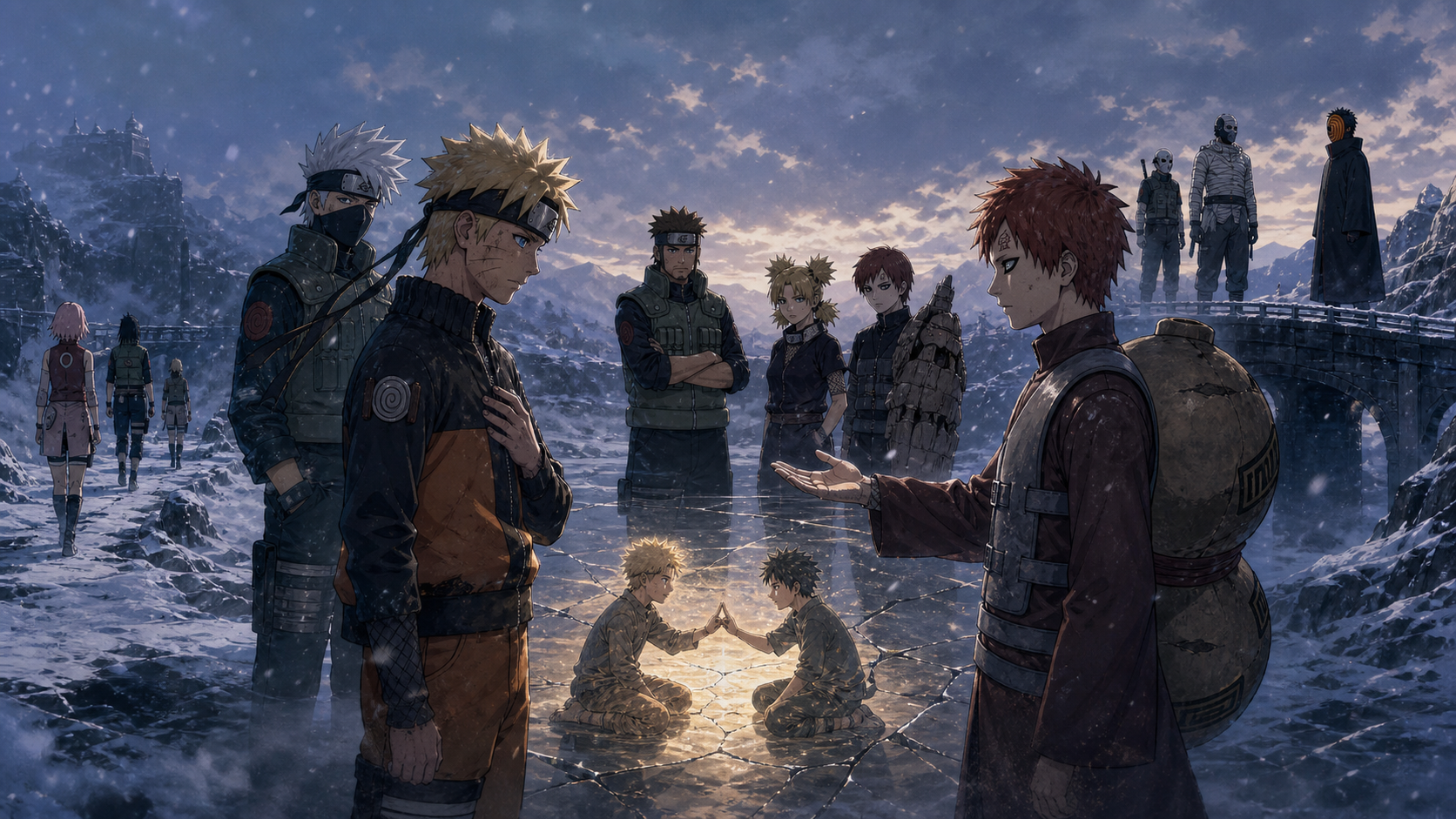
Gaara gives Naruto the truth without choosing his answer and asks what friendship requires now that Sasuke has endangered every village.
Bottom line
Naruto Shippuden Episode 208, “As One’s Friend,” forces Naruto to confront what Sasuke’s choices now mean to everyone beyond Team 7.
Sai’s ink clone tells Naruto that Sakura intends to kill Sasuke herself and that the Konoha rookies have agreed Sasuke must be stopped. Gaara, Temari, and Kankurō arrive with the summit report: Sasuke attacked the Kage, Tobi declared the Fourth Great Ninja War, and the villages are forming an alliance.
Gaara asks Naruto to decide what he will do for Sasuke as his friend. Elsewhere, Sakura remembers the history that led to her decision while moving toward Sasuke. On the Samurai Bridge, Tobi confronts Danzō, Fū, and Torune and isolates Danzō for the fight Sasuke has been pursuing.
Gaara gives Naruto information without choosing for him
Several people have tried to protect Naruto by controlling what he knows. Sakura concealed her mission. The rookies reached a decision in his absence. Tobi delivered history inside a frame designed to manipulate him.
Gaara does something different. He tells Naruto what happened at the summit and asks what Naruto will choose next.
The distinction is a form of respect. Gaara understands that Naruto’s answer may be painful or politically inconvenient, but friendship cannot survive if everyone else decides what Naruto is allowed to face.
“As one’s friend” is a responsibility, not a defense
Naruto has often used friendship as the reason he will not abandon Sasuke. Gaara asks him to define what that loyalty requires now that Sasuke has attacked the summit and joined an organization threatening every village.
Being Sasuke’s friend cannot mean denying the harm. Friendship also cannot mean allowing other people to reduce Sasuke to a target without understanding how he arrived there.
The title creates a harder middle ground. A friend may have to stop someone, oppose him, or refuse the story he tells about himself. Loyalty is not the same as permission.
Gaara can ask because Naruto once answered for him
Gaara once believed isolation and violence were the only truths available to him. Naruto fought him, recognized his loneliness, and refused to treat him as permanently lost.
That encounter changed Gaara’s life. He eventually became Kazekage and learned to protect the people who once feared him.
Now Gaara returns the same challenge. He does not promise Naruto that Sasuke will change. He reminds Naruto that care must become a choice with consequences, not only a feeling preserved from childhood.
The summit report makes Sasuke an international enemy
Sasuke’s actions are no longer a private Konoha crisis. He attacked Killer B, infiltrated neutral territory, fought multiple Kage, and became part of the event that preceded Tobi’s war declaration.
Every village now has a reason to track him. Even if Naruto persuaded Konoha to wait, he could not command the Cloud, Sand, Mist, Stone, or samurai to ignore what happened.
The scale changes Naruto’s problem. Bringing Sasuke home is no longer only about reaching one friend. Any answer must address people whose danger and grief are legitimate.
Naruto’s silence is the beginning of a new answer
Naruto does not immediately produce a speech that resolves everything. The information is too large and too contradictory.
He has learned the truth about Itachi, heard Tobi’s claim about inherited hatred, discovered Sakura’s plan, and received Gaara’s account of the summit. Each fact changes the meaning of the next.
His silence is not surrender. This is the moment when the old answer, repeat the promise and keep chasing, stops being sufficient. Naruto must decide what he believes beyond the words that carried him this far.
Sakura remembers why the decision cannot feel clean
As Sakura moves toward Sasuke, memories of Team 7 make clear that she is not approaching a stranger. She remembers affection, rivalry, ordinary missions, and the night he left.
Those memories do not prove Sasuke should be spared. They prove why Sakura cannot treat killing him like an uncomplicated assignment.
She wants to protect Naruto and the village while taking responsibility for someone she still loves. The mission demands certainty from a person whose heart contains none.
Sakura repeats Naruto’s habit of carrying everything alone
Sakura criticized the way Naruto suffered under his promise, yet her own plan depends on absorbing the burden without honest collaboration.
She intends to remove Naruto from the decision, shield the rookies from the act, and face Sasuke herself. The plan gives her control over who gets hurt, but only by assuming she can contain every consequence.
This is the same emotional mathematics Naruto often uses: if one person suffers enough, everyone else can be protected. The series keeps showing why that equation fails.
Kakashi sees the student he may have to stop
Kakashi receives the summit news as both a Leaf leader and Sasuke’s former teacher. Those roles now point toward the same duty.
Sasuke’s choices endanger the village and the alliance. Kakashi also knows that adults, including Konoha’s leadership, helped build the conditions behind Sasuke’s revenge.
Accountability and responsibility meet in him. He cannot excuse Sasuke because the village failed him, and he cannot pretend the village’s failure is irrelevant because Sasuke became dangerous.
Tobi clears the bridge for Sasuke’s revenge
Tobi intercepts Danzō and his Root guards on the Samurai Bridge. Fū and Torune attack with specialized techniques, but Tobi’s space-time ability makes ordinary contact unreliable.
The confrontation serves a specific purpose. Tobi is not there to settle the Uchiha massacre for Sasuke. He is arranging the conditions in which Sasuke can fight Danzō himself.
Once again, Sasuke’s revenge feels personal while Tobi controls access, timing, and survival around the encounter.
Danzō finally faces a consequence he cannot assign elsewhere
Danzō spent the summit using other people as layers between himself and accountability: Mifune’s judgment, Root guards, Konoha’s authority, and the language of necessity.
On the bridge, those layers are being removed. Sasuke is approaching because of actions Danzō took and secrets he helped preserve.
That does not make Sasuke’s broader violence righteous. A direct connection does make this confrontation different from the samurai he cut down. Danzō is not an unrelated obstacle. He is one of the architects of the wound.
Friendship becomes the opposite of Tobi’s control
Tobi treats bonds as levers. He uses Itachi to move Sasuke, Sasuke to destabilize the summit, and Naruto’s compassion to study his response.
Gaara treats friendship as an invitation to choose honestly. He gives Naruto facts, names the stakes, and refuses to manufacture the conclusion.
That contrast may be the episode’s most important definition. Control demands the answer that serves the controller. Friendship respects another person enough to ask the difficult question and remain present for the answer.
Gaara speaks as a friend and a head of state
Gaara’s question carries unusual weight because he is not visiting only as Naruto’s former opponent. He has just represented the Sand at a summit attacked by Sasuke, agreed to an unprecedented alliance, and heard a declaration of war. Political responsibility gives him every reason to demand a clean break.
He still addresses Naruto personally. Gaara does not erase the Kazekage role, but he refuses to let office make friendship dishonest. He names Sasuke’s actions, explains the international consequences, and leaves Naruto responsible for his own answer.
That balance shows the leader Naruto wants to become. Gaara can protect his village without treating another person’s heart as an obstacle to policy. His respect is severe because the facts are severe. Compassion does not require softening the report.
The rookies’ decision repeats Konoha’s secrecy problem
The Konoha rookies have legitimate reasons to stop Sasuke. His actions endanger the village, threaten the alliance, and place Naruto under growing pressure. Their conclusion is not cruel simply because Naruto would resist.
The failure lies in deciding around him. Friends who watched Naruto carry the retrieval promise for years form a committee, reach a lethal judgment, and send Sakura to deliver emotional closure through a lie. The method recreates the village habit of hiding unbearable decisions from the person most affected.
Naruto does not deserve veto power over everyone’s safety, but he does deserve the truth before the execution begins. Gaara’s arrival exposes that difference. Shared facts can lead to conflict without becoming betrayal. Concealment guarantees that conflict arrives after trust has already been damaged.
Sakura’s mission asks love to impersonate certainty
Sakura remembers ordinary Team 7 moments because the coming act cannot be separated from the life built around them. Her plan requires a medic, teammate, and girl who loved Sasuke to become a clean executioner at exactly the same time.
Resolve cannot make those identities agree. Sakura hopes action will end Naruto’s burden and her own guilt, yet Sasuke’s death would not return the years Naruto spent choosing him. Killing one person cannot erase a relationship from everybody who remains.
The flashbacks are therefore evidence rather than sentimental delay. They show the emotional material Sakura is trying to compress into a single strike. Her memories do not prove Sasuke should face no consequence. They prove she cannot perform that consequence as though history were absent.
Tobi’s bridge staging reveals the difference between access and agency
Tobi gives Sasuke access to Danzō, but access is not freedom. He chooses the location, removes the guards, controls the transportation, watches from safety, and knows more about Danzō’s body than Sasuke does. The revenge belongs emotionally to Sasuke while the conditions belong strategically to Tobi.
Gaara offers Naruto the opposite relationship. He brings information without manufacturing the decision. That contrast sharpens the episode’s title. Friendship creates room for agency even when the answer may hurt; manipulation creates the appearance of agency while narrowing every available path.
Sasuke wants to believe reaching Danzō proves independence. The bridge instead shows how thoroughly Tobi can arrange a private desire inside a larger war plan.
The Japanese performances make honesty sound different from pressure
Akira Ishida gives Gaara a steadiness that never becomes cold. His question to Naruto contains care, disappointment, and political urgency without forcing one emotion to erase the others. Junko Takeuchi answers through silence and disrupted breath rather than another immediate vow.
Chie Nakamura carries Sakura’s memories with determined restraint. The performance refuses a clean heroic register because Sakura does not possess clean certainty. Nobuo Tobita keeps Tobi almost casually efficient on the bridge, turning two Root specialists and Sasuke’s revenge into pieces of one operation.
The vocal contrast makes the relationship test audible. Gaara speaks hard truth and waits. Tobi supplies a target and directs motion. One voice leaves Naruto room to become responsible; the other keeps Sasuke moving before reflection can threaten the plan.
Gaara returns Naruto’s own method to him
Naruto once stopped Gaara physically, named the loneliness beneath his violence, and still required him to choose another way. Recognition did not mean permission, and force did not require declaring the person permanently unreachable.
Gaara now offers the same structure. He names Sasuke’s harm, refuses to decide Naruto’s response, and trusts that friendship can survive an honest account of danger.
The question removes Naruto’s safest identity
Naruto knows how to be the friend who never abandons someone. Gaara asks whether loyalty also means opposing Sasuke, accepting consequences, and refusing the story revenge has built around him.
The old vow supplied motion whenever doubt appeared. This question demands judgment, which is harder because no inherited phrase can choose whom friendship must protect first.
Sasuke’s victims now stand inside the meaning of friendship
Team 7 memories explain Naruto’s bond, but B, the samurai, summit attendants, and every village threatened by Akatsuki possess moral claims that cannot remain outside the frame.
Calling Sasuke a friend must never turn those people into background damage. A responsible bond sees the person causing harm and the people required to survive that person at the same time.
Naruto’s silence refuses a performance of certainty
Everyone expects some recognizable version of him: Sakura expects release, the rookies expect agreement, Tobi expects inherited conflict, and Gaara needs an answer suitable for wartime reality.
Naruto pauses because repeating confidence would be easier than rebuilding belief. Silence becomes the first honest space he has made since several incompatible truths arrived.
Sakura prepares an ending nobody authorized her to own
She interprets responsibility as personally delivering the final consequence, as though killing Sasuke could settle Naruto’s promise, the rookies’ fear, Konoha’s danger, and her own love in one act.
The plan is brave enough to look selfless. It is also controlling because everyone else must live inside an ending she designed without their informed participation.
Memory does not excuse Sasuke or equip Sakura to erase him
Team 7 flashbacks keep the approaching target connected to ordinary meals, training, jealousy, care, and departure. They explain why the mission cannot become emotionally clean through repetition.
Sakura needs those memories to understand the cost, not to prove that consequences should disappear. Love remains evidence about the person she faces, never automatic authority over whether he may continue living.
Kakashi inherits leadership and unfinished responsibility together
The Kage trust him because his conduct can be verified across borders, yet Sasuke is also the student he trained and failed to keep from leaving. Public credibility does not cancel private failure.
Becoming the likely Hokage means holding Konoha’s safety beside the village history Tobi exposed. Kakashi must stop present harm without allowing institutions to hide behind Sasuke’s criminal status.
Danzō reaches the consequence he spent years outsourcing
Root children, clan members, guards, and political offices carried the cost of decisions he named necessary. On the bridge, the surviving Uchiha arrives with direct knowledge of what that necessity demanded from Itachi.
Sasuke’s other violence remains indefensible. Danzō’s responsibility remains real. The confrontation is dangerous because revenge and accountability have entered the same space without any trusted process separating them.
Tobi grants access because access keeps Sasuke dependent
He transports Sasuke, removes obstacles, times the encounter, and preserves his own position as the source of routes nobody else can open. Each favor makes revenge feel possible while proving who controls its infrastructure.
Sasuke chooses to fight Danzō, but Tobi keeps deciding when and where that choice can exist. Assistance becomes a leash made from desired outcomes.
RaeRae’s reaction to As One’s Friend
Gaara walks into this emotional disaster and does the one thing almost nobody else has managed: he tells Naruto the truth without wrapping the report in a trap. No fake confession, no destiny lecture, no secret committee decision presented after the fact. Just: this is what Sasuke did, this is what the world is becoming, and what will you do as his friend?
That question hurts because Naruto cannot answer with the old promise anymore. Sasuke is not only the boy who left. He is a wanted Akatsuki attacker standing in the path of a new war.
Sakura’s memories make her choice hurt too. She is walking toward someone she loves with a plan built around killing him, while pretending she can spare everyone else the cost. Ma’am, that is Naruto’s worst coping mechanism in a different coat.
And Tobi arranging the bridge battle proves the larger problem. Sasuke thinks revenge is the purest expression of his own will, but the masked man keeps setting the stage. Gaara gives Naruto a question. Tobi gives Sasuke a target. Only one of those relationships leaves room for freedom.
Friendship leaves room where manipulation closes it
Gaara supplies facts and waits. Tobi supplies facts and arranges the next collision before Sasuke can question their frame. Both men understand pain well enough to influence another person.
The ethical difference is whether influence preserves an answer the speaker may dislike. Gaara risks Naruto choosing badly because agency matters. Tobi makes undesired choices increasingly inaccessible.
The rookies are right about danger and wrong about process
Sasuke cannot be protected from accountability indefinitely. His former classmates recognize a threat other villages already have every right to answer, and delay exposes more people.
Their secret consensus still repeats Konoha’s worst habit: adults and peers deciding unbearable truths around someone, then calling exclusion protection. A necessary decision can be damaged by a method that denies relationship.
Gaara models the leader Naruto has not yet become
He speaks as Kazekage without hiding the friend who owes Naruto his life. Neither identity weakens the other. Political responsibility sharpens the truth, while affection prevents policy from flattening Naruto into an asset.
Naruto’s future leadership will require the same capacity: seeing institutions, victims, offenders, and beloved people without making one category erase the rest.
Naruto cannot answer Gaara by choosing between blind loyalty and political obedience. Friendship has to become the discipline of seeing Sasuke completely: the wounded child, the dangerous adult, the manipulated survivor, and the person responsible for every choice he makes.
RaeRae’s final word on As One’s Friend
Gaara enters a room full of half-truths and finally gives Naruto the dignity of a complete question. Sasuke attacked the summit. War is coming. Their bond still exists. Now what does friendship require?
There is no childhood vow big enough to answer all of that automatically. Naruto’s silence is painful because he has stopped using certainty to outrun the problem.
Sakura is preparing to carry everybody’s grief alone, which sounds noble until we remember she had to lie to make the plan possible. Solitary sacrifice keeps becoming this world’s favorite counterfeit solution.
Across the bridge, Tobi gives Sasuke exactly what he wants and calls the arrangement freedom. Gaara gives Naruto truth and leaves room for an answer. Only one man is behaving like a friend.
RaeRae’s call
Friendship does not excuse harm or manufacture obedience. Gaara respects Naruto by naming every consequence and preserving his agency, even when the answer may affect an entire alliance.