
RaeRae Reacts · One Piece Episode 95
Ace and Luffy
One Piece Episode 95 explores Ace and Luffy's bond as Luffy refuses the Whitebeard invitation and chooses his own path toward Pirate King.
Quick reaction
One Piece Episode 95 gives Luffy and Ace the kind of reunion that explains both brothers without trapping either one inside a family speech. Ace holds Smoker back, finds Luffy again, and offers him a place beneath Whitebeard. Luffy refuses with complete affection and absolutely no hesitation. Their bond survives because neither brother treats love as ownership.
The episode also catches the Straw Hats performing their most reliable travel ritual: preparing carefully, counting supplies, and somehow failing to count their captain. That joke works because everybody knows Luffy will follow his own impulse before any itinerary. The same habit becomes dangerous in Nanohana, where Marines, Baroque Works agents, fire, smoke, and civilians already occupy the same narrow streets.
RaeRae’s bottom line: Ace arrives with power, charm, and a famous captain behind him, yet Luffy never becomes smaller beside his brother. Their different loyalties reveal the same stubborn freedom. Whitebeard may deserve Ace’s devotion, but Luffy will choose his own crew, his own route, and his own impossible crown.
Fire and smoke turn Nanohana into somebody else’s battlefield
Ace continues blocking Smoker long enough for Luffy and the crew to escape. The elemental matchup looks spectacular because flame and smoke can flood the frame without giving either Logia user an ordinary body to strike. The spectacle also belongs inside a populated port. Every awning, roof, stall, animal, worker, and family nearby carries the physical risk that the two powerful men can shrug off.
Smoker wants an arrest. Ace wants his brother free. Neither goal excuses turning Nanohana into collateral scenery. Dry timber, cloth, cooking fuel, and desert wind can carry fire past the original clash, while dense smoke can injure people who never appear in the center of the fight. The clean victory is separation, not a prolonged contest over whose element controls the street.
That distinction matters for how One Piece handles power. A Devil Fruit can remove ordinary vulnerability from the user without removing responsibility toward everyone else. Ace’s protective choice remains generous, but protection should create an exit. Smoker’s duty remains lawful inside his own institution, but enforcement should not punish the neighborhood more than the pirate he wants.
The Going Merry prepares for a desert that will not forgive sloppy planning
While the brothers cross paths, the crew loads water, food, medicine, shade material, and equipment for the journey toward Erumalu. The work looks less glamorous than the elemental clash, yet the supplies will decide whether anyone reaches the ruined city healthy enough to help Vivi. Alabasta makes logistics part of the adventure because heat turns every forgotten container into a future emergency.
Nami and Vivi need an inventory built around people, distance, delay, and changing conditions. Chopper needs protected medicine and enough clean water for treatment rather than drinking alone. Containers need seals, distributed storage, and protection from heat. A single damaged barrel should not threaten the entire group. The crew also needs to know which supplies leave the ship and which remain aboard.
The scene grounds Vivi’s mission in physical labor. Saving a country still requires lifting crates, checking routes, protecting medicine, and deciding how much water each body can carry. Heroic determination cannot replace those tasks. The desert will not care that Luffy defeated Arlong or survived Loguetown if the crew leaves Nanohana with the wrong load.
Luffy goes missing because the crew keeps treating a pattern like a surprise
The Going Merry becomes nearly ready to depart before somebody realizes Luffy is absent. Again. The joke lands because the Straw Hats know their captain perfectly and still organize departure as though he will suddenly behave like a punctual passenger. Their frustration is justified, but surprise stopped being a reasonable response several islands ago.
A named roll call would solve the immediate problem. One person confirms every traveler, including the captain, before the ship leaves a berth or exposed shoreline. Luffy also needs the route, meeting point, deadline, and a fallback signal. Leadership does not exempt him from sharing enough information for the crew to distinguish a short detour from an arrest or injury.
The crew should not send everybody back into Marine attention. A small search pair can check Luffy’s last known route while Vivi and the supplies move toward a safer holding point. That choice respects both the missing person and the mission. Friendship should motivate a search without allowing one impulsive captain to expose the entire group repeatedly.
Ace and Luffy reconnect through competition instead of explanation
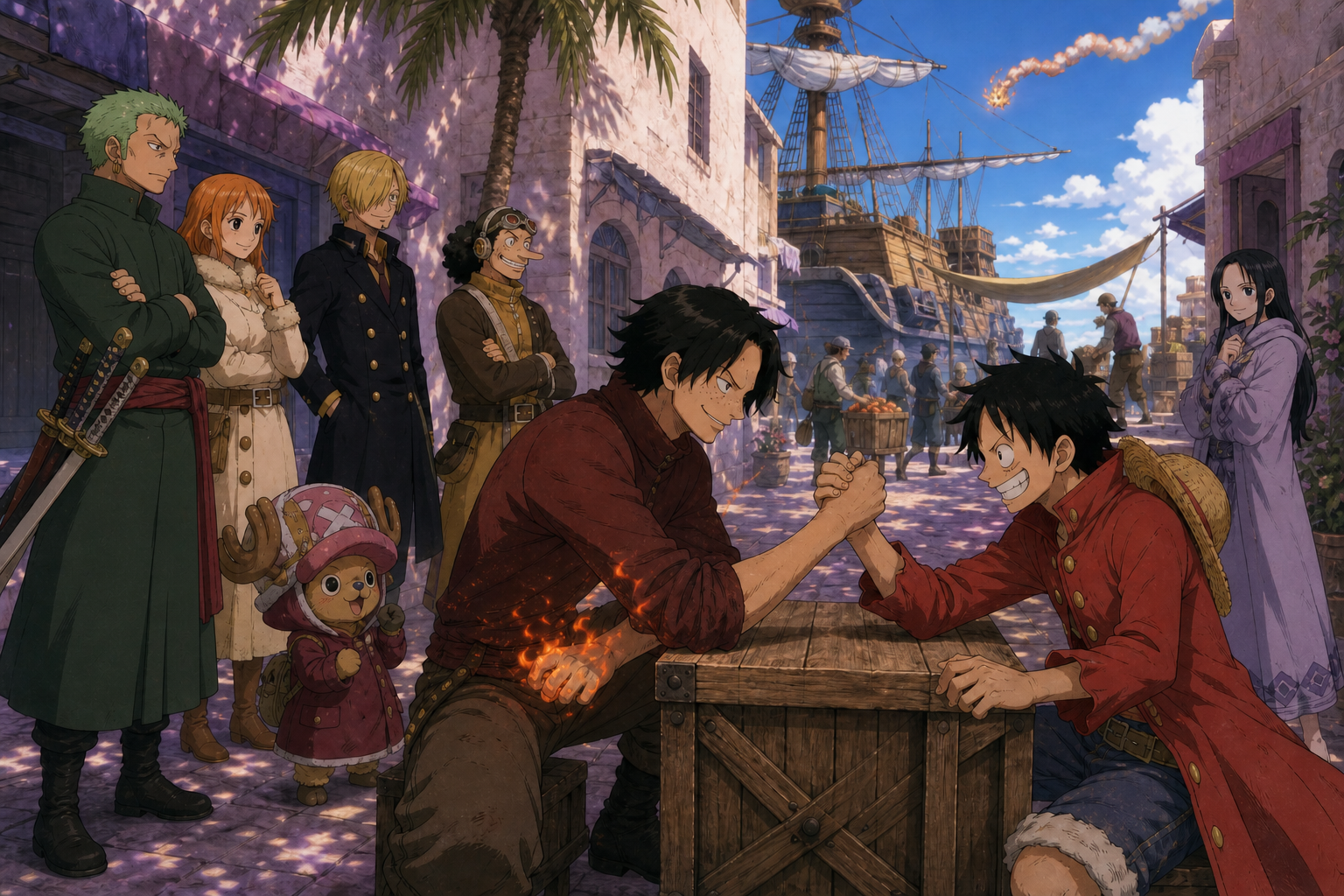
When the brothers finally find space together, they do not begin with a polished account of childhood, separation, or longing. They arm wrestle. The contest carries years of shared language in one familiar action: challenge, annoyance, pride, affection, and the certainty that neither brother needs careful handling from the other.
The reunion feels human because neither man performs the emotion for an audience. Ace can look at the pirate Luffy became while still recognizing the boy who chased him. Luffy can admire Ace without turning admiration into obedience. Their physical contest says that time changed their strength and circumstances, but did not erase the relationship underneath either identity.
One Piece often understands that intimacy does not require characters to translate every feeling into a speech. The brothers remember through rhythm, teasing, appetite, and argument. Their affection lives in how quickly they resume an old dynamic and how easily that dynamic makes room for the adult choices each one made away from home.
Whitebeard is Ace’s chosen answer, not Luffy’s inherited obligation
Ace speaks about Whitebeard with the conviction of someone who found a captain worth following. His dream is not temporary employment beneath a stronger pirate. He wants Whitebeard to become Pirate King, and that loyalty tells viewers that the older brother built a life with meaning beyond searching for Luffy.
Inviting Luffy into that crew can come from love. Ace sees protection, power, belonging, and a future beneath Whitebeard’s flag. He may sincerely believe the offer gives his brother something valuable. Sincerity does not make acceptance mandatory. Luffy already chose the Straw Hats and placed his own promise at the center of their voyage.
The episode refuses to make either loyalty fake so the brothers can agree. Whitebeard does not need to become unworthy for Luffy to say no. The Straw Hats do not need to defeat Ace’s crew inside a comparison. Family can recommend a path, explain why the path matters, and then respect the person who chooses another road.
Luffy’s refusal proves that love and hierarchy are different things
Luffy declares that he will become Pirate King even if Whitebeard stands ahead of him. The answer has no polite hedging because his dream has never functioned as a flexible career preference. He can love Ace, respect Ace’s captain, and still understand that joining Whitebeard would replace his own destination with somebody else’s.
A weaker version of the scene would make Ace offended or make Luffy cruel. Instead, the disagreement reveals why their bond can survive distance. Ace recognizes the same will that carried his little brother through every childhood loss and impossible challenge. Luffy trusts that a refusal will not cost him his brother.
That trust matters more than easy agreement. Plenty of families claim love while demanding loyalty to one approved life. Ace and Luffy show a harder form of affection: each brother remains responsible for his own allegiance. Nobody has to shrink a dream to make the reunion emotionally comfortable.
Ace joins the Straw Hats without becoming their temporary captain
Ace brings Grand Line experience, combat strength, and information about powerful pirate networks. His presence could easily pull every choice toward him, especially after he protects Luffy from Smoker. The episode works better when he joins as Luffy’s brother and an allied traveler rather than as an authority who automatically outranks Nami, Vivi, or the crew.
Nami still understands navigation and supplies. Vivi still understands Alabasta’s political geography and the urgency of reaching the rebels. Chopper still understands health. Ace can identify patterns from piracy, explain Whitebeard’s world, and help the group recognize Crocodile’s strategy. Competence becomes useful when everybody keeps a clear role.
The crew also deserves basic boundaries around information. Ace may be trustworthy to Luffy, but he belongs to another pirate organization with separate obligations. Vivi’s mission involves infiltration, royal security, and an approaching civil war. Welcome should not require giving every operational detail to a powerful visitor before the group decides what he needs to know.
The episode lets brotherhood expand instead of replacing found family
Ace’s arrival could have pushed the Straw Hats into the background while the biological brothers reclaimed the story. Instead, the crew remains the life Luffy chose. Their supply work, worry, irritation, and search prove that his present family continues functioning around the reunion. Ace does not recover an old version of Luffy by dismissing the people beside him now.
The same respect should move in both directions. Luffy does not need to mock Whitebeard’s crew to defend the Straw Hats. Ace does not need to portray Luffy’s friends as inexperienced children who require rescue. Each brother found belonging through shared danger, trust, and choice. Those relationships deserve recognition even when the two crews pursue competing dreams.
That is one reason the episode feels warmer than a standard reunion. Love does not collapse every connection into one household or one flag. Ace and Luffy can remain brothers while traveling with different people, answering to different promises, and preparing for a future where their ambitions may place them on opposite sides of the same title.
The production team builds intimacy without losing Alabasta’s pressure
Michiru Shimada’s script balances the Smoker escape, desert preparation, missing-captain comedy, reunion, invitation, and refusal without letting the episode become a detached family interlude. Erumalu remains ahead, supplies keep moving, and Marine pressure still shapes how long the brothers can stay together.
Hidehiko Kadota’s direction moves from public elemental conflict toward quieter personal space. The contrast gives Ace two different kinds of presence. In the street, his fire creates distance and protection. Beside Luffy, the same confidence becomes teasing, memory, and a direct offer about the future.
Hideaki Maniwa’s animation direction needs the arm-wrestling exchange to carry personality rather than simple force. Luffy’s elastic physicality, Ace’s controlled ease, and their familiar competitive timing tell part of the family history. Miyuki Sato’s art keeps bright Nanohana and the waiting harbor close enough that the desert mission never disappears behind nostalgia.
What Episode 95 changes
Ace moves from mysterious pursuer to Luffy’s older brother, a Whitebeard commander, and a temporary ally traveling alongside the Straw Hats. His loyalty now has a name and direction. Viewers understand that he does not search for Luffy because he lacks his own life.
Luffy rejects Whitebeard’s invitation and confirms that becoming Pirate King remains nonnegotiable. The refusal also affirms the Straw Hats as his chosen crew. Their status does not depend on matching the size, fame, or power of Whitebeard’s organization.
The crew leaves Nanohana with supplies for Erumalu and a clearer understanding of Ace. Smoker remains an active threat rather than a resolved obstacle. Family warmth enters the Alabasta route, but Crocodile’s conspiracy, Vivi’s urgency, and the physical danger of the desert continue pressing forward.
Episode details
Japanese title: Eesu to Rufi! Atsuki Omoi to Kyoudai no Kizuna
English title: Ace and Luffy! Hot Emotions and Brotherly Bonds
Japanese broadcast: January 6, 2002
Saga: Alabasta
Script: Michiru Shimada
Episode direction: Hidehiko Kadota
Animation direction: Hideaki Maniwa
Art: Miyuki Sato
The official One Piece episode guide supplies the title, broadcast record, and production credits. RaeRae’s analysis connects the Logia clash, desert preparation, Luffy’s repeated disappearance, Ace’s Whitebeard loyalty, and the brothers’ disagreement to the episode’s wider argument about chosen family and independent dreams.
Final verdict
Episode 95 understands that reunion does not mean restoration. Ace and Luffy cannot return to childhood, and neither one needs that fantasy. They meet as pirates who built separate lives, test the bond through familiar competition, and discover that affection still fits around the choices made apart.
Ace’s invitation has emotional weight because Whitebeard clearly matters to him. Luffy’s refusal has equal weight because the Straw Hats and the Pirate King dream already define his route. The scene works because the story protects both truths instead of forcing one brother to validate the other through surrender.
RaeRae rating: 9.2/10. Count the crew before departure, contain the elemental clash, let Ace love Whitebeard, and let Luffy say no without turning refusal into rejection. Family becomes stronger when affection can survive two different flags.