
RaeRae Reacts · One Piece Episode 96
Erumalu and Stolen Rain
One Piece Episode 96 sends Karoo toward Cobra, reveals Crocodile's Dance Powder strategy, and follows the crew toward drought-damaged Erumalu.
Quick reaction
One Piece Episode 96 finally gives Alabasta’s drought a city viewers can mourn. Erumalu was known as the City of Green. The ruined streets and dry channels show what Dance Powder theft means after the rain charts become homes, farms, jobs, and memories. Crocodile did not create a vague environmental problem. He redirected survival toward the capital and let displaced communities blame Cobra.
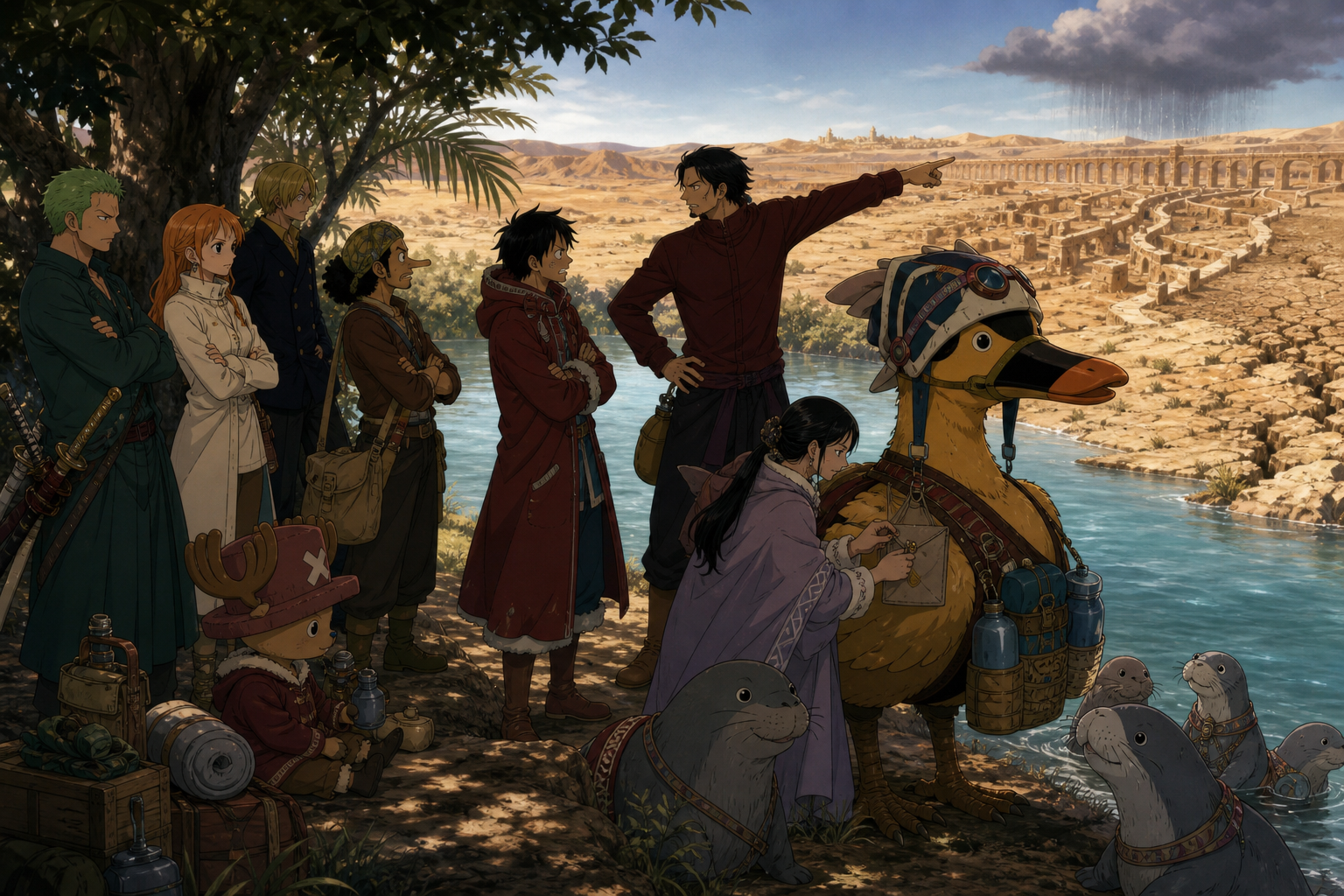
Vivi sends Karoo toward Alubarna with a letter for her father while the crew continues toward Yuba. The decision divides her two most urgent responsibilities: warn the king and reach the rebel army. Karoo has speed, loyalty, and a history of taking missions seriously. He is still a partner with a body that can overheat, become injured, or decide a route is unsafe.
RaeRae’s bottom line: this episode connects water theft, political reputation, animal partnership, and communication. Ace sees how Crocodile benefits from both the crisis and his hero image. Luffy finally understands Dance Powder. The Kung-Fu Dugongs provide comedy, but Erumalu remains the part that should follow everyone into the desert. You cannot restore a city by defeating one villain and pretending rain alone rebuilds what people lost.
The Sandora River carries the crew toward evidence
The group travels upriver from Nanohana before beginning the deeper desert crossing. Water offers transport and a visible measure of Alabasta’s environmental decline. Shallow channels, damaged docks, sediment, and abandoned irrigation routes can tell the crew where ordinary life began to break.
River water is not automatically safe to drink. Salt, pathogens, agricultural runoff, and residue from drought conditions may remain even when the surface looks clear. Chopper should keep sealed drinking supplies separate from water used for cooling, cleaning, or emergency tasks.
Nami’s navigation and Vivi’s local knowledge need to work together. A chart may show the historical river. Vivi may know which settlements once depended on particular branches. Neither source guarantees that drought has left those routes usable. The crew should compare the map with what the river now reveals.
The journey toward Erumalu turns geography into testimony. Crocodile’s scheme has changed where water falls, where boats can travel, and which communities remain connected to the country.
Vivi’s letter asks Karoo to carry a national warning alone
Vivi needs Cobra to know where she is going, what Baroque Works has done, and what actions may prevent civil war. Direct contact could expose the mission, so a written message becomes the safest available bridge between daughter and king.
The letter needs more than urgency. Bon Clay has already proved that appearance can be copied, and an intercepted message could be altered or replaced. Vivi and Cobra need a private authentication method that confirms authorship without exposing memories anybody can weaponize later.
Cobra also needs actionable information. The message should separate what Vivi observed from what she suspects, identify Baroque Works infiltration, explain the Dance Powder frame, and warn against a panicked military response. A frightened palace can help Crocodile if vague news produces force before verification.
Karoo receives the task because he is fast, loyal, and familiar with both Vivi and the capital. Those strengths make him capable. They do not make him disposable. The mission should include safe water points, shelter, patrol risks, a return threshold, and permission to abandon the route if conditions become impossible.
Karoo’s loyalty cannot replace consent and care
Karoo has repeatedly placed himself in danger for Vivi. Their bond works because he is more than a royal animal assigned to carry orders. He reacts, complains, chooses, and keeps showing up. Sending him alone should recognize that agency instead of treating devotion as automatic permission.
The letter must be light, weatherproof, and secured without restricting breathing or movement. Karoo needs rest, shade, water, foot care, and an alternate route. A deadline cannot justify heat collapse, especially when the entire warning depends on one courier reaching Alubarna alive.
The crew also needs a plan if he does not arrive. A secondary message route, a time for concern, and a record of what he carries can help distinguish delay from interception. Secrecy should protect the mission, not erase responsibility for the messenger.
Vivi’s goodbye carries emotional weight because she cannot follow him. Leadership often means asking somebody you love to take a risk you would rather carry yourself. The ethical answer is not to refuse every risk. The answer is honest choice, preparation, and a plan that values the courier after the letter leaves his possession.
Erumalu shows what stolen rain leaves behind
Erumalu’s title as the City of Green turns the ruins into more than a generic abandoned town. The name records what people built around water: fields, markets, homes, routes, family memories, and expectations about the future. Drought does not simply remove vegetation. Drought scatters the community that depended on the vegetation.
Empty buildings should not become free supplies for passing heroes. Owners may return, relatives may still claim property, and displaced residents may have left possessions because survival forced a quick departure. The crew can search for people, hazards, and evidence without looting a city whose residents have already lost enough.
Irrigation channels, wells, reservoirs, crop lines, and dates of failure could help prove how the environmental collapse spread. Comparing those records with Dance Powder transport and use would support Vivi’s claim without asking people to trust the royal family on reputation alone.
Any residents still nearby deserve water and medical support before political questions. Their stories belong to them. Erumalu cannot exist only to make Crocodile look evil or Vivi look compassionate. The city represents people who paid for a conflict designed elsewhere.
Dance Powder turns weather into an unequal transaction
Luffy learns that Dance Powder forces rain in one place by depriving another area. The mechanism turns a public need into a hidden transfer. Somebody receives relief while another community loses crops, water, and the ability to remain home.
Crocodile’s political use makes the crime sharper. He frames Cobra as the person concentrating rain around the capital, then performs public heroism while trust in the king collapses. Citizens can reasonably resent visible inequality even when the evidence directing that resentment has been manufactured.
Ace recognizes the wider pattern. Crocodile benefits from fear, gratitude, scarcity, and the reputation of being the strongest reliable protector. Every staged rescue makes him look more necessary. Every ruined town makes the government look less capable.
Stopping the powder matters, but destroying every trace would erase proof. Stockpiles, transport records, samples, orders, and witness accounts can connect environmental harm to the people who planned the operation. Alabasta needs evidence strong enough to survive after Crocodile’s public image begins fighting back.
Luffy’s anger needs Vivi’s direction
Luffy understands the theft quickly because the moral shape is direct: one powerful person takes what other people need and hides behind a better story. His anger is justified. Anger alone does not tell the crew which route protects civilians, reaches Koza, or stops Baroque Works from triggering war.
Charging Crocodile immediately could strengthen the trap. A reckless confrontation may draw violence toward settlements, destroy evidence, or leave the rebel and royal armies moving toward each other without Vivi’s intervention. Luffy has to let her political priorities shape his strength.
That does not make Vivi the only decision-maker. Nami understands route and resources. Chopper understands health. Ace sees parts of the criminal pattern from outside Alabasta. The crew needs each role because Crocodile’s plan crosses environment, reputation, military movement, and private violence.
Luffy’s best contribution is his refusal to accept stolen survival as normal. His captain’s responsibility is holding that refusal long enough for the group to aim correctly.
The Kung-Fu Dugongs challenge more than the crew’s patience
The Kung-Fu Dugongs guard their riverbank space through learned combat rituals. Their challenge gives the episode a burst of classic One Piece creature comedy after Erumalu’s devastation. The shift works because Alabasta remains alive, strange, and inhabited even during political collapse.
A challenge does not make wild animals free training partners. The crew should avoid escalating contact, protect the boat and supplies, and leave a retreat route. If defense becomes necessary, minimal force should create space rather than turn the encounter into a tournament.
Chopper can communicate, but the group should not assign every animal problem to him by default. Translation is work, and speaking with an animal does not grant ownership or erase the animal’s territorial behavior. Ask whether he is willing and whether the situation is safe.
The river habitat also needs protection from waste, food scraps, medicine, and damaged boats. The dugongs are not decorations attached to a tourist stop. Their presence tells travelers that the bank already belongs to a living community.
Ace joins the group without replacing its leaders
Ace’s strength and confidence could pull every decision toward him, especially because he understands piracy and reads Crocodile’s strategy quickly. The episode works better when he adds perspective without displacing Vivi’s local authority or Nami’s navigation role.
He can explain how a powerful pirate uses reputation, agents, and staged protection. Vivi can explain the kingdom, rebel grievances, and the cost of wrong military movement. Their knowledge overlaps without becoming interchangeable.
Ace also changes how Luffy receives information. His older brother can challenge him in a familiar language, but family status does not automatically make Luffy listen. The whole crew has learned how to translate urgency into a plan the captain can act on.
Keeping roles clear prevents competence from becoming hierarchy. Ace is valuable because he sees part of the scheme. He does not need to become temporary captain for that insight to matter.
The production team turns a ruined city into the episode’s memory
Michiru Shimada’s script connects a courier mission, environmental evidence, political strategy, and animal comedy without losing the route toward Yuba. Erumalu provides the center. Every other choice now happens in a country where a green city has been emptied.
Yoko Ikeda’s episode direction has to let the ruins breathe before the dugong energy changes the pace. The audience needs enough time to understand absence through streets, channels, and silence. The later comedy should release pressure without canceling what the crew saw.
Kenji Yokoyama’s animation direction gives Karoo’s departure and the dugong encounter distinct physical language. Karoo carries purpose and strain. The dugongs bring compact, ritualized confidence. Both animal performances need personality without becoming human costumes.
Miyuki Sato’s art makes water history visible. Green remembered against dry present, river routes against failed irrigation, and inhabited banks against abandoned streets all support the episode’s argument. Environment becomes evidence before anyone finishes explaining Dance Powder.
What Episode 96 changes
Karoo separates from Vivi with a direct mission to Cobra, placing the capital inside the crew’s plan even while they continue toward the rebels. His route now carries the possibility of warning the palace before Crocodile’s final escalation.
Luffy learns what Dance Powder does and gains a clearer reason to target Crocodile. Ace understands that the Warlord’s hero reputation is part of the attack rather than a contradiction beside the attack.
Erumalu gives the crew physical evidence of national harm. Vivi no longer argues only from infiltration records and political theory. She has walked through a city emptied by the water theft used to frame her father.
The Kung-Fu Dugongs remind viewers that Alabasta’s living world continues around the crisis. Saving the country must include habitats, animals, river access, and communities that cannot vote in a royal-rebel settlement.
Episode details
Japanese title: Midori no Machi Erumaru to Kunfuu Jugon!
English title: Erumalu, the City of Green, and the Kung-Fu Dugongs
Japanese broadcast: January 13, 2002
Saga: Alabasta
Script: Michiru Shimada
Episode direction: Yoko Ikeda
Animation direction: Kenji Yokoyama
Art: Miyuki Sato
The official One Piece episode guide supplies the title, broadcast record, and production credits. RaeRae’s analysis connects Karoo’s courier mission, Erumalu’s environmental evidence, Dance Powder’s unequal transfer, Crocodile’s public reputation, and the Kung-Fu Dugongs to the episode’s wider Alabasta argument.
Final verdict
Episode 96 makes the drought impossible to treat as background. Erumalu remembers green life through absence, and the crew finally sees what Crocodile’s weather theft did to a city. The ruins give Vivi evidence and Luffy a reason for anger that even he cannot misunderstand.
Karoo’s mission may look smaller than the coming fights, but one authenticated letter could prevent royal forces from making Crocodile’s plan easier. His welfare belongs inside the strategy because a country-saving message still depends on the body carrying the envelope.
RaeRae rating: 9.1/10. Trust Karoo, prepare his route, preserve the evidence, and remember Erumalu after the rain returns. Crocodile stole more than weather. Alabasta will owe displaced people a rebuilding process long after Luffy wins the fight.