
RaeRae Reacts · One Piece Episode 94
Fire Fist Ace
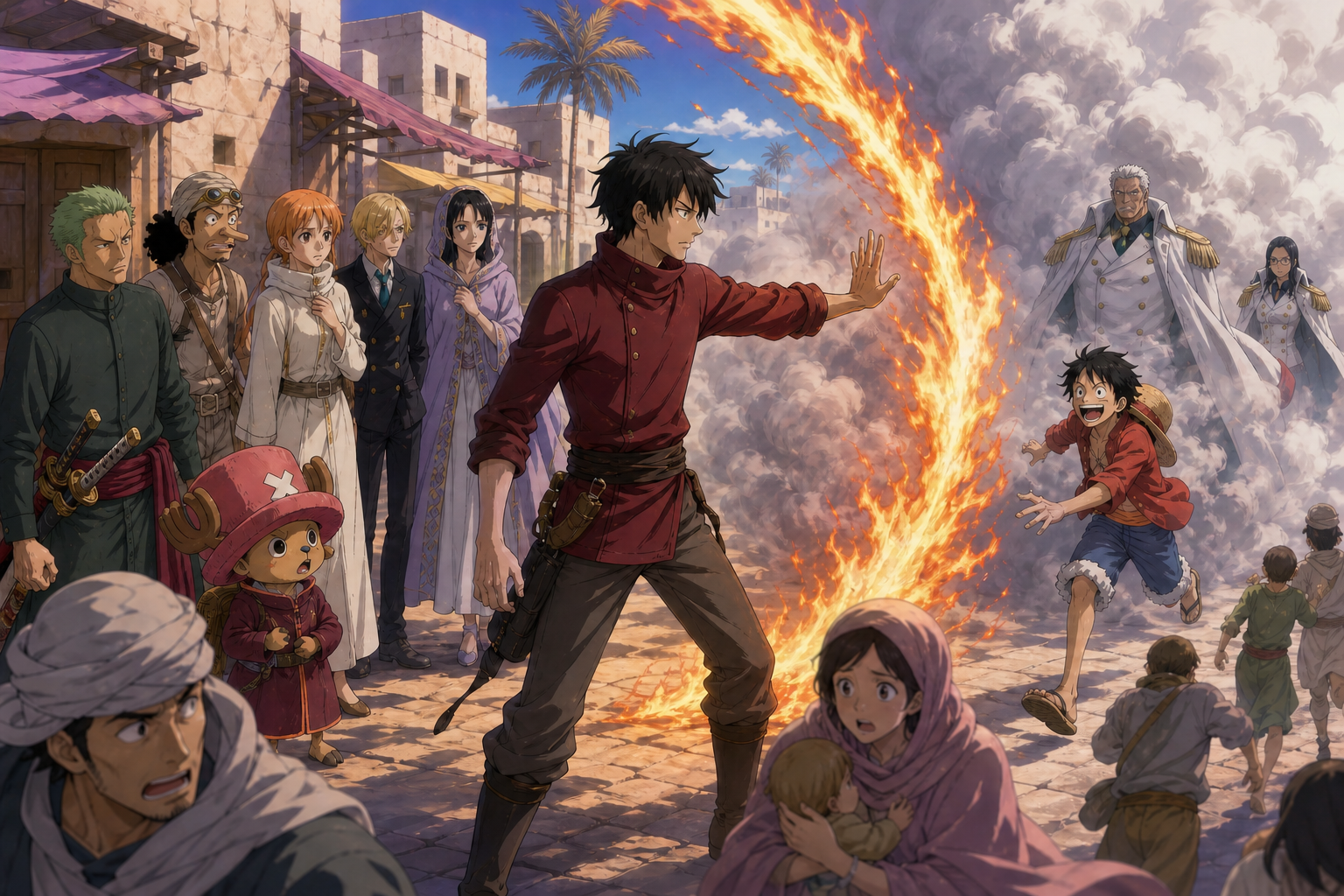
One Piece Episode 94 reunites Luffy with Fire Fist Ace as Smoker's restaurant pursuit spills into Nanohana and Ace protects the crew's escape.
Quick reaction
One Piece Episode 94 turns Nanohana into the funniest possible reunion trap. The Straw Hats search for Luffy. Ace searches for Luffy. Smoker hunts Luffy. All three routes crash into the same restaurant because the man everybody wants is busy eating and has apparently learned nothing from Loguetown, Whiskey Peak, or any previous meal-related disaster.
The comedy never erases the danger. Smoker brings Marine authority and a Logia body into a crowded business. Luffy brings momentum without awareness. Ace brings fire into a dry port city when he intervenes. Ordinary diners, workers, buildings, and Vivi’s mission all sit beneath a conflict whose strongest participants can survive consequences that the neighborhood cannot.
RaeRae’s bottom line: Ace’s entrance works because he protects Luffy before demanding any explanation, payment, or obedience. The episode gives viewers a famous brother, a Blackbeard pursuit, a Marine chase, and an elemental standoff, yet the emotional center stays wonderfully simple. Luffy sees Ace and becomes pure joy.
The crew searches for Luffy inside a city built for surveillance
Luffy running into Nanohana alone creates the predictable problem that everybody else must stop following Vivi’s plan and find him. The crew knows Baroque Works has agents throughout Alabasta, Smoker has arrived, and Vivi’s identity can place anyone near her in danger. An uncoordinated search makes those risks easier to exploit.
Pairs, fixed routes, a meeting point, and a return time would keep the group from scattering into separate emergencies. Somebody should stay with Vivi. Somebody should protect the supplies and the ship. Chopper has only recently suffered from heat exposure, so sending him alone through crowded streets would trade one missing person for a medical crisis.
The crew’s frustration with Luffy is earned, but anger cannot become the plan. They need to distinguish likely food stops, visible commotion, Marine activity, and routes back toward the Going Merry. Every minute spent wandering randomly gives Baroque Works more chances to recognize the princess or trace the group toward the harbor.
Ace arrives with his own mission and a name the story will not forget
Ace is not drifting through Alabasta solely to produce a family reveal. He is searching for Blackbeard, a former member of Whitebeard’s crew. That purpose tells viewers that Luffy’s older brother belongs to a much larger pirate structure and carries responsibilities that began before Nanohana.
The search should remain separate from Vivi’s mission unless reliable information creates a real connection. Sharing routes or rumors may help both sides, but Ace cannot quietly absorb the Straw Hats into Whitebeard business, and the crew should not treat his strength as free labor against Crocodile. Cooperation needs clear scope.
Blackbeard information also has public consequences. A powerful fugitive can expose towns to retaliation, false sightings, bounty hunters, and Marine pressure. Ace needs sources, dates, descriptions, and some way to separate a useful lead from a frightened rumor. His charm does not make every answer accurate.
Smoker and Tashigi bring different duties into the pursuit
Smoker sees Luffy as a pirate who escaped Loguetown and remains determined to arrest him. That legal frame exists inside the Marines, but authority does not remove proportionality. Filling a restaurant or public street with smoke can injure people who have no role in the chase. Arrest cannot become permission to make civilians absorb every tactical cost.
Tashigi should not become an extension of Smoker’s anger. She can secure exits, warn residents, document damage, and question whether a pursuit method creates more danger than the target at that moment. Her position gives her responsibility to observe what superior officers may overlook.
Their presence also threatens Vivi’s secrecy. A Marine who notices the princess traveling with wanted pirates may report the group before understanding Baroque Works infiltration. The crew needs distance, not a public argument about royal motives in front of witnesses and possible agents.
The restaurant collision is hilarious because the physical risk is real
Luffy barrels into the restaurant and crashes through the people between him and food. His arrival sends bodies, furniture, dishes, and attention in every direction. The timing is perfect comedy because Smoker and Ace are already there, but restaurant workers still inherit broken property, lost income, and a room full of frightened customers.
A hot kitchen multiplies the danger. Open flame, oil, knives, steam, glass, and narrow exits can turn one impact into burns or crowd crush. Staff should shut fuel sources, guide diners outside, and keep people away from damaged walls. Chopper should check anyone struck or exposed once the crew has space.
Luffy rarely intends the harm created by his entrances. Intent does not repair a business. The crew should compensate the owner when possible, help clear debris, and acknowledge the workers whose day became pirate theater. One Piece can enjoy physical chaos without pretending only named fighters live in the room.
Smoker’s smoke is not harmless because the target remains standing
Smoker resumes the pursuit as soon as he recognizes Luffy. His ability can restrain, obscure vision, and fill breathing space faster than ordinary people can escape. Luffy’s resistance and comic recovery do not prove that diners, children, older residents, or workers with respiratory conditions face the same risk.
Smoke exposure can cause coughing, panic, disorientation, and delayed breathing problems. Ventilation and evacuation should come before questioning witnesses. Marines controlling the scene should identify who needs care rather than treating every civilian as background once the wanted pirate reaches the street.
Smoker also needs a route that prevents pursuit from driving Luffy through more occupied spaces. Perimeter control, visible warnings, and an open civilian exit would serve his stated duty better than expanding the elemental conflict through the market. Chasing harder is not always the same as enforcing better.
Luffy reunites with the crew while bringing the entire chase behind him
The Straw Hats find Luffy, but reunion does not solve the problem because Smoker follows close behind. Everybody has to move at once while protecting Vivi and preserving a route back to the ship. Luffy’s speed creates distance for him, not automatically for crewmates carrying supplies or watching for the princess.
Nami needs control of direction. Vivi needs protection without being made visibly central. Sanji and Zoro can cover vulnerable movement, but neither should begin a pride contest while Marines close the gap. Usopp can watch intersections and communicate rather than improvising a separate escape story.
The group also needs to confirm who remains separated. Supply teams, Karoo, and anyone near the harbor must not become an afterthought once Luffy reappears. A successful escape means accounting for the whole traveling party, not merely keeping the captain ahead of Smoker.
Vivi cannot become the visible center of the formation. If every fighter circles her or waits for her command, observers can identify the person whose safety matters most. Nami can direct the route while several crewmates share protective positions. The group should look like pirates fleeing a Marine pursuit, not a royal escort advertising the princess Baroque Works wants erased.
Medical access must remain possible during movement. Chopper needs enough room to reach anyone who falls, while another crewmate carries the most urgent supplies if his small body becomes blocked by the crowd. Escape plans often fail when everybody assumes treatment begins later. Smoke, impact, heat, and panic can require care before the harbor comes into view.
Ace intervenes with fire and immediately changes the balance
Ace places himself between Smoker and the escaping crew, revealing the Fire-Fire Fruit through action rather than a long explanation. The moment tells viewers that his confidence has a physical basis. More importantly, he uses that power to create distance for Luffy without making help conditional.
Fire against smoke produces a visually clean standoff, but Nanohana remains dry, crowded, and vulnerable. Ace needs a defined boundary, controlled duration, and awareness of wind. A wall of flame can become a second hazard if embers reach roofs, awnings, stored oil, or ships.
His best objective is containment. He does not need to defeat Smoker in the middle of town. He needs to interrupt pursuit long enough for civilians to clear and Luffy’s group to move. Protection becomes credible when power remains aimed at escape rather than spectacle.
Once the barrier drops, the responsibility continues. Heat can remain inside beams, fabric, dust, or spilled fuel after visible flame disappears. Local responders need a fire watch, clear access to water, and an honest account of where Ace placed the hottest boundary. Leaving quickly may protect Luffy, but silence would leave residents guessing which surfaces remain dangerous.
Ace protects his brother without claiming his brother’s choices
Ace’s intervention arrives before the full reunion conversation. He does not demand gratitude, ask Luffy to prove their bond, or use rescue as leverage. That sequence matters. Help comes first because danger is immediate. Family questions can wait until everybody has breathing room.
Luffy’s joy confirms recognition, but excitement does not authorize sharing every detail of Vivi’s mission. The crew still needs a brief introduction, confirmation of Ace’s identity, and boundaries around sensitive information. Bon Clay has already shown why appearance and familiarity cannot serve as the only security test.
The brothers can authenticate one another through memories and habits that outsiders would struggle to reproduce, while the crew decides what Ace needs to know. Trusting Luffy’s happiness and protecting Vivi are not opposing choices. Mature loyalty can do both.
The production team makes coincidence feel like momentum
Michiru Shimada’s script layers four active searches: the crew wants Luffy, Ace wants Luffy, Smoker wants Luffy, and Luffy wants food. The restaurant collision feels absurd, yet every character arrives through an established motive. Comedy comes from convergence rather than random interruption.
Junji Shimizu’s direction accelerates the episode through recognition, impact, pursuit, and elemental reveal. The audience receives just enough time to register Ace before Luffy smashes the room’s balance. Once the chase begins, the visual route keeps family emotion attached to immediate danger.
Takeo Ide’s animation direction distinguishes Luffy’s elastic momentum, Smoker’s enveloping pressure, and Ace’s directional flame. Miyuki Sato’s art keeps Nanohana warm, busy, and physically combustible. The city never becomes an empty arena built for three Devil Fruit users.
What Episode 94 changes
Ace is confirmed as Luffy’s older brother and a commander connected to Whitebeard. His search for Blackbeard establishes a separate pursuit that will matter beyond the current city. The family reveal expands the world around Luffy without rewriting the crew he already chose.
Smoker catches Luffy again, proving that Alabasta will not pause Marine pressure simply because Crocodile presents the larger threat. Ace’s fire prevents the immediate arrest and introduces a Logia standoff that neither fighter can resolve casually in a crowded port.
The Straw Hats escape the restaurant area with a new ally behind them and fresh questions ahead. Vivi’s mission remains urgent, the Going Merry may need relocation, and the group must decide how much of the Alabasta crisis Ace should enter.
Episode details
Japanese title: Gouketsu-tachi no Saikai! Yatsu no Na wa Hiken no Eesu
English title: The Heroes Reunite! His Name Is Fire Fist Ace
Japanese broadcast: December 23, 2001
Saga: Alabasta
Script: Michiru Shimada
Episode direction: Junji Shimizu
Animation direction: Takeo Ide
Art: Miyuki Sato
The official One Piece episode guide supplies the title, broadcast record, and production credits. RaeRae’s analysis connects the overlapping searches, restaurant collision, Smoker’s pursuit, Ace’s Blackbeard mission, and the fire barrier to the episode’s wider argument about power, family, and public consequence.
Final verdict
Episode 94 introduces Ace through movement, responsibility, and the perfect amount of chaos. He has his own captain, his own target, and power strong enough to stop Smoker. None of those facts matters to Luffy as much as seeing his brother standing in Nanohana.
The reunion lands because the story does not slow down and announce how viewers should feel. Luffy’s face, Ace’s intervention, and the immediate familiarity do the work. Their history enters through recognition while the city continues reacting to the physical mess around them.
RaeRae rating: 9.3/10. Clear the restaurant, protect Vivi’s route, treat smoke exposure, contain the fire, repay the workers, and let Ace create distance without turning Nanohana into proof of his strength. A brother who helps first has earned the conversation that follows.