
Racing Lightning
Tobi weaponizes Itachi’s truth while Sasuke’s attack on the samurai sends the Raikage racing toward a collision.
Bottom line
Naruto Shippuden Episode 202, “Racing Lightning,” opens two fronts inside the Land of Iron. Tobi appears in Naruto’s room and offers the truth about Itachi as the price of a conversation about Sasuke. At the summit complex, White Zetsu’s announcement sends the samurai after Taka before Sasuke can reach Danzō.
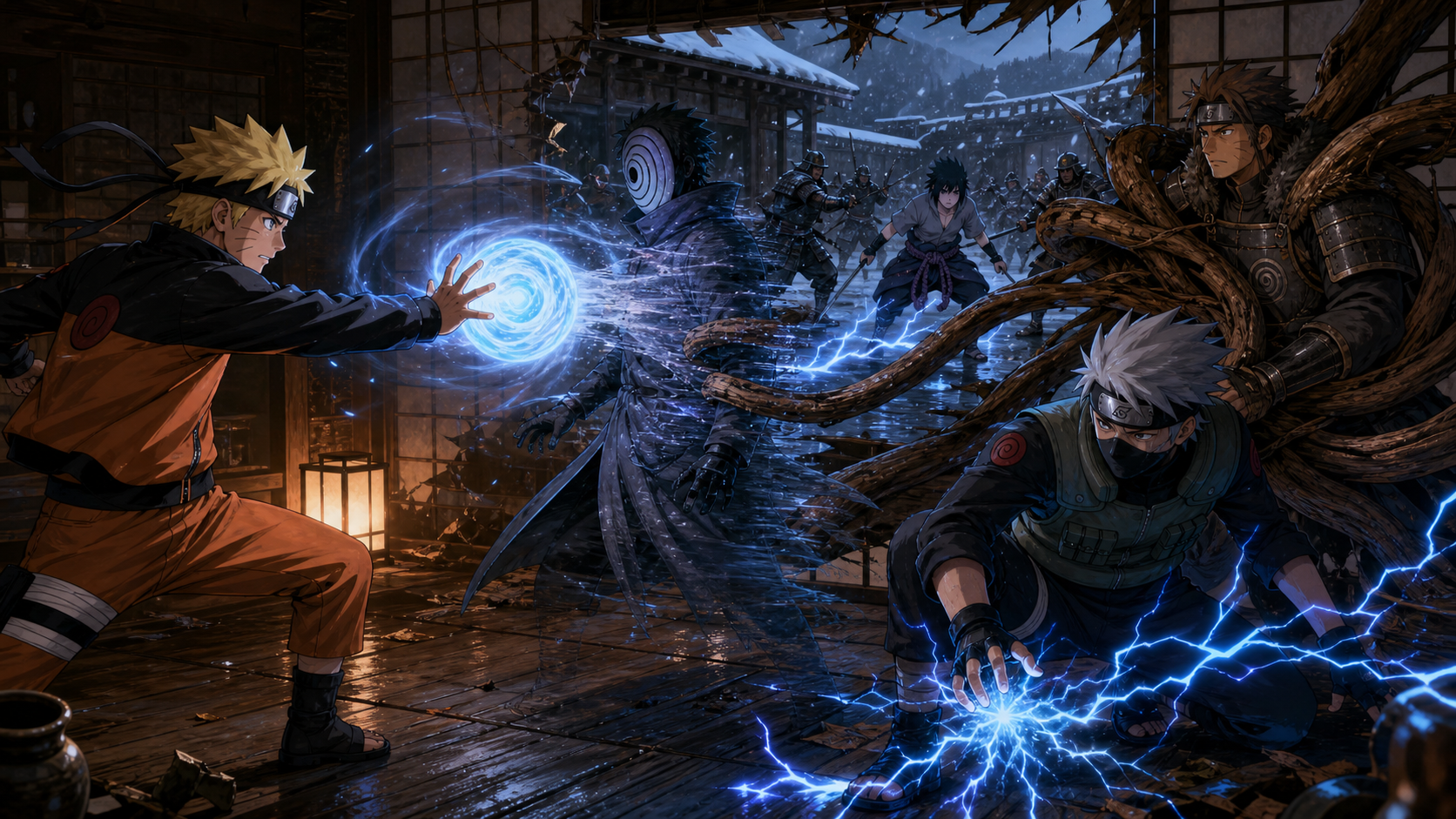
Naruto attacks Tobi with a Rasengan, but the technique passes through the masked man. Yamato’s Wood Release restraints and Kakashi’s Lightning Cutter fare no better. Tobi insists that he has not come to fight. He wants Naruto to understand why Sasuke chose revenge after learning what Konoha demanded of Itachi.
Meanwhile, Sasuke abandons stealth once the samurai surround Taka. He cuts through their formation with a coldness that unsettles Karin, Suigetsu, and Jūgo. The Fourth Raikage learns where Sasuke is and leaves the summit chamber at once, turning the infiltration into the confrontation Sasuke claimed to want.
Tobi enters the room as though walls and consent are optional
Tobi does not knock, negotiate, or wait for Naruto to choose the conversation. He appears in the room and speaks with the confidence of someone who believes every boundary is temporary.
That confidence is backed by his strange intangibility. Naruto’s Rasengan can reach the space where Tobi stands without reaching Tobi himself. Yamato can bind the shape in front of him, and Kakashi can prepare a killing strike, but the masked man controls whether any attack matters.
The power makes his behavior feel even more invasive. He is not only entering Naruto’s shelter; he is deciding the terms under which reality can touch him.
Kakashi hears “Madara” and prepares for the worst
Kakashi responds to the masked man as a battlefield threat, not a guest with useful information. His Lightning Cutter is ready because Akatsuki has already taken lives, hunted jinchūriki, and manipulated Sasuke.
Tobi’s claim that he only wants to talk does not erase that history. The claim does, however, create an ugly practical problem. Naruto needs answers about Sasuke, and the person offering them is someone no one in the room can reliably restrain.
Kakashi and Yamato remain poised while Naruto listens. Their vigilance keeps the conversation from looking like trust. This is an interrogation where the apparent prisoner can leave whenever he wishes.
Tobi uses Itachi’s pain to steer Naruto toward Sasuke
The truth about Itachi is devastating because the revelation rearranges the moral shape of Sasuke’s entire life. The brother Sasuke was taught to hate carried out Konoha’s order, protected the village’s secrets, and accepted the role of criminal so Sasuke could survive.
Tobi does not reveal this history as an act of care. He selects the account because he knows what Naruto will do with another person’s suffering. Naruto will search for the wound beneath Sasuke’s violence and treat that wound as evidence that Sasuke can still be reached.
The facts may be true while the framing remains manipulative. Tobi understands that the strongest hook for Naruto is compassion.
Naruto’s bond with Sasuke becomes Tobi’s subject
Tobi is curious about why Naruto refuses to give up. To him, Sasuke’s path appears to prove that hatred reproduces itself. Itachi sacrificed everything for the village, Sasuke learned the truth, and love became fuel for revenge.
Naruto keeps insisting on a different outcome. He believes a bond can survive betrayal without becoming permission for endless harm. That belief is not simple optimism anymore. The commitment has already cost him blood, humiliation, and arguments with nearly everyone who cares about him.
Tobi is not merely explaining Sasuke. He is studying the person whose answer might disrupt the cycle he expects.
The samurai meet a Sasuke who no longer wants an exit
Taka entered the summit territory to assassinate Danzō, which required secrecy. Once discovered, they could still have tried to escape, regroup, or find another route. Sasuke chooses force.
The samurai are not responsible for the Uchiha massacre. They are guards defending neutral ground after an intruder has been exposed. Sasuke treats them as obstacles and cuts them down with little hesitation.
That distinction matters. Revenge has expanded beyond the people who harmed his clan. Anyone standing between Sasuke and Danzō can now be absorbed into the punishment.
Karin recognizes that Sasuke’s chakra has changed
Karin has followed Sasuke through dangerous fights and watched him make ruthless choices, but this version of him frightens her. His chakra feels colder and darker than before.
Her reaction gives the audience a measurement that combat alone cannot. Sasuke has always been intense, and he has killed when he believed killing necessary. Here the violence feels less like a calculated mission and more like a willingness to erase whoever enters his path.
Suigetsu and Jūgo also have to adjust around that change. Taka was never a gentle team, but Sasuke once assembled them around a defined target. His rage is now becoming the team’s environment.
“Racing Lightning” belongs to more than the Raikage
The title points most directly toward the Fourth Raikage, who launches himself from the summit the moment Sasuke’s location is confirmed. His speed and Lightning Release turn political outrage into physical pursuit.
But lightning also describes the episode’s structure. Information strikes, and everyone moves before there is time to absorb the shock. Tobi drops Itachi’s history into Naruto’s room. Zetsu exposes Taka. The samurai attack. The Raikage abandons diplomacy for the hunt.
Every thread carries stored energy toward a collision. The episode does not resolve the charge; the structure shows how quickly revelation becomes action.
The Raikage has no reason to offer Sasuke patience
Naruto asked the Raikage to spare Sasuke, but the summit leader has received no evidence that Sasuke wants peace. From his perspective, the Akatsuki member who attacked Killer B has now invaded a meeting meant to answer Akatsuki’s threat.
Sasuke’s presence confirms every reason the Raikage rejected Naruto’s plea. Worse, the attack arrives immediately after Danzō’s manipulation is exposed, when trust between the villages is already breaking apart.
The Raikage’s anger is personal, political, and strategically justified. Justification does not guarantee his next choice will be wise, but the context explains why Naruto’s appeal could not stop this pursuit.
Tobi and Sasuke use different forms of untouchability
Tobi makes attacks pass through his body. Sasuke acts as though ordinary moral limits can pass through him.
One stands still in a room full of threats because he knows they cannot hold him. The other advances through armed guards because he no longer accepts their lives as a reason to slow down.
The parallel is not exact. Tobi engineers conflicts while Sasuke is still being manipulated by them, but the comparison shows why their alliance is so dangerous. Tobi offers information without accountability, and Sasuke converts pain into action without restraint.
Naruto is caught between them, trying to learn the truth without adopting either man’s relationship to power.
Intangibility lets Tobi perform honesty without vulnerability
Tobi can disclose painful history while remaining physically unreachable. Naruto, Kakashi, and Yamato must absorb the account with bodies exposed in the room, while the speaker controls when contact becomes possible. The imbalance shapes every sentence.
Honest conversation normally involves mutual risk. A person may be challenged, contradicted, detained, or forced to remain with another person’s response. Tobi has removed those conditions. He can reveal enough truth to provoke movement and leave before accountability arrives.
That makes his calm misleading. He does not sound composed because the subject costs him less emotionally. He sounds composed because his power keeps everyone else from changing the terms.
Naruto’s compassion is a strength with an exposed pressure point
Naruto reaches people by looking for pain beneath behavior. That instinct helped him understand Gaara, Nagato, and villagers who once rejected him. Tobi correctly identifies the same instinct as the fastest route into Naruto’s decision-making.
The danger does not mean Naruto should become less compassionate. Compassion needs evidence, boundaries, and attention to people harmed by the person being understood. Sasuke’s wound explains his direction without granting unlimited permission.
Tobi wants Naruto focused so completely on Sasuke’s pain that the masked man can control the frame. Naruto’s challenge is to keep seeing Sasuke without losing sight of Killer B, the samurai, Sakura, and every person caught in the revenge path.
White Zetsu destroys stealth because spectacle serves Tobi
Taka entered the Land of Iron with a narrow assassination goal. White Zetsu’s announcement removes secrecy and sends every summit security force toward Sasuke. The exposure looks like sabotage because sabotage is exactly what Sasuke experiences.
For Tobi, open conflict produces useful data. Sasuke tests Mangekyō abilities against elite opponents, the Kage reveal techniques, summit trust collapses further, and Danzō becomes easier to isolate during the disorder.
Sasuke calls the pursuit his own ninja way, but another Akatsuki operative chooses when the hidden mission becomes public theater. Freedom keeps shrinking around him while every new fight feels self-directed.
The samurai make collateral damage impossible to romanticize
The Land of Iron is neutral ground, and its guards are responding to an armed intruder exposed inside a diplomatic summit. They do not represent Konoha’s massacre policy or Danzō’s private crimes.
Sasuke’s violence against them shows revenge expanding from target to route. Once Danzō becomes the only meaningful destination, every body in the corridor can be treated as part of Danzō’s protection.
That moral expansion is why Karin’s fear matters. She is not shocked that Sasuke can kill. She senses that the boundaries governing who counts as necessary opposition are disappearing.
The Raikage turns Naruto’s request into an immediate test
Naruto asked for patience by appealing to the cycle of revenge. The Raikage now learns that Sasuke is inside the summit complex cutting through guards. No institution could reasonably interpret that action as evidence of readiness for reconciliation.
The timing makes Naruto’s position harder without making the underlying concern foolish. Executing Sasuke may answer immediate danger while extending the same retaliatory logic Naruto fears. Waiting may expose more people to harm.
A credible alternative must respond fast enough to protect others and deep enough to address the cause. Naruto has moral conviction, but Episode 202 shows how little operational answer he currently possesses.
The Japanese performances separate information from trust
Nobuo Tobita gives Tobi an easy conversational rhythm that clashes with the forced entry and physical threat. The voice invites listening while the power arrangement prevents genuine exchange. Junko Takeuchi gives Naruto anger first, then a quieter attention once Itachi’s name changes the stakes.
Kazuhiko Inoue keeps Kakashi alert throughout the exposition, never allowing useful facts to soften his assessment of the source. Rikiya Koyama gives Yamato protective authority without pretending Wood Release can solve the information crisis.
Noriaki Sugiyama’s Sasuke sounds increasingly detached from the samurai around him. The two locations share a performance question: who controls the story while other people absorb the consequences?
Tobi calls it conversation after removing every condition of consent
He enters Naruto’s room without permission, controls whether attacks can touch him, and decides when the exchange ends. Saying he did not come to fight does not make the situation mutual.
His intangibility turns physical dominance into conversational framing. Everyone else risks a body while he offers information from beyond consequence.
Useful truth remains dangerous when the source controls its purpose
Itachi’s history matters because it rearranges Sasuke’s grief and Konoha’s moral responsibility. Tobi selects that truth to produce movement, not understanding for its own sake.
Facts do not become false because a manipulator speaks them. Listeners must examine what was included, what remains hidden, and which action the framing is trying to make inevitable.
Naruto’s compassion is the opening Tobi came to exploit
Naruto searches beneath violence for pain because that instinct reached Gaara and Nagato. Tobi knows another wounded person will keep him listening after every boundary violation.
The answer is not less compassion. It is compassion wide enough to include B, Sakura, the samurai, and everyone Sasuke harms while his wound is being understood.
Kakashi keeps information separate from trust
He listens because Naruto needs the account and remains ready because Akatsuki benefits from every reaction it provokes. Valuable disclosure does not rehabilitate the speaker.
That vigilance models the balance Naruto needs. Understanding a story never requires surrendering judgment about the person choosing how to tell it.
Sasuke’s revenge expands from target to route
The samurai did not order the massacre, take Shisui’s eye, or shape Itachi’s mission. They defend neutral ground after an armed infiltration is exposed.
Sasuke cuts through them because Danzō has become the only meaningful destination. Anyone between pain and target is absorbed into punishment.
Karin measures a moral change through chakra
She has seen Sasuke fight ruthlessly before, so her fear cannot be dismissed as surprise that combat is violent. His chakra feels colder and less bounded.
The sensory reaction tells us necessity no longer governs who counts as acceptable damage. Rage is becoming the atmosphere Taka must breathe.
Zetsu converts a secret mission into an experiment
Announcing Sasuke’s location destroys stealth and exposes him to samurai plus multiple Kage. From Taka’s perspective, the act is obvious sabotage.
For Tobi, open conflict reveals techniques, destabilizes diplomacy, and drives Sasuke deeper into powers that isolate him. Another person’s revenge becomes field research.
The Raikage’s pursuit confirms why Naruto’s plea failed
Ay was asked to believe Sasuke could become more than the attack on B. He now learns that Sasuke entered a summit about Akatsuki and attacked its guards.
No responsible institution could read that conduct as readiness for mercy. Naruto’s hope requires an operational answer he still cannot supply.
Naruto and Sasuke reject authority toward opposite relationships
Naruto follows Ay without permission to ask for dialogue and accepts that the answer may remain no. Sasuke infiltrates with assassination fixed as success.
Both disobey, proving rule-breaking carries no automatic morality. Purpose, means, and treatment of other people determine what rebellion becomes.
RaeRae’s reaction to Racing Lightning
This episode makes me angry in two completely different directions. Tobi walks into Naruto’s room, lets everyone waste their strongest opening moves, and then presents himself as the reasonable person because he says he only wants to talk. Sir, you arrived through the boundary like boundaries were a cute suggestion.
And then the Itachi truth lands again. Naruto absolutely deserves to know what shaped Sasuke, but Tobi knows exactly which part of Naruto he is pressing. Give Naruto one wounded person and he will start building a bridge with his bare hands, even if that person is currently setting the bridge on fire.
Sasuke’s side is harder to watch. The samurai are doing their jobs. They did not create his grief, and they are not Danzō. Karin’s fear tells us this is not merely Sasuke being efficient under pressure. Something in him is curdling.
The Raikage racing toward him feels inevitable. Naruto just begged this man to believe Sasuke could be more than his worst act, and Sasuke answers by invading the summit and cutting through its guards. The tragedy is not that Naruto cares too much. Tobi keeps turning care into leverage while Sasuke keeps making hope more expensive.
Lightning describes information becoming action too quickly
Tobi names Itachi and Naruto’s attention shifts. Zetsu names Sasuke and summit security moves. Ay hears the location and leaves diplomacy for pursuit.
Every revelation releases stored force before anyone has time to question the person who supplied it. Speed becomes a strategy for preventing reflection.
Intangibility is Tobi’s emotional method as well as his jutsu
He reveals suffering while remaining unreachable by challenge, grief, or consequence. Other people must absorb the history through vulnerable bodies.
Real honesty risks being changed by another person’s response. Tobi wants the effect of disclosure without mutual exposure, making calm sound trustworthy when it is actually protected control.
The episode asks whether explanation can survive accountability
Tobi wants Sasuke’s suffering understood because understanding helps direct Naruto toward the response he prefers. He has no interest in letting the same compassion widen toward people Sasuke is hurting now.
A responsible account must hold both truths without using one to silence the other. Konoha exploited Itachi, concealed atrocity, and helped manufacture Sasuke’s rage. The samurai did not deserve to become bodies on his route toward Danzō.
Explanation becomes dangerous when it is treated as acquittal or when accountability is treated as refusal to understand. Naruto needs a language capable of naming institutional guilt, personal injury, present choice, and collateral harm together.
Tobi keeps separating those pieces because separation gives him leverage. Sasuke can believe pain authorizes everything. Naruto can become so focused on saving the wounded friend that every newer victim disappears from the frame. Racing Lightning shows how quickly that narrowed story becomes action before anybody can put the picture back together.
RaeRae’s final word on Racing Lightning
Tobi walks through a boundary, lets everyone waste an opening attack, and then calls himself reasonable because he only wants to talk. Sir, consent was missing before the first sentence.
Naruto deserves the truth about Itachi. Tobi also knows exactly which part of him that truth will capture. Give Naruto one wounded person and he starts building a bridge while they set it on fire.
Sasuke’s side is harder to watch. The samurai did not create his grief. Karin’s fear tells us this is not ordinary efficiency under pressure.
Zetsu makes sure Sasuke’s revenge becomes public spectacle, and Sasuke keeps calling each manipulated collision his own path.
Ay racing toward him feels inevitable. Naruto begged for patience; Sasuke answers by proving how expensive patience has become for everyone standing in his way.
RaeRae’s call
Tobi offers truth without vulnerability and turns Naruto’s compassion into access. Across the complex, Sasuke turns pain into permission, making every innocent obstacle part of Danzō’s punishment.