
Painful Decision
Sakura faces what Naruto’s promise has cost while the summit discovers Danzō manufactured the consent he wanted to lead.
Bottom line
Naruto Shippuden Episode 201, “Painful Decision,” divides its attention between Konoha’s private reckoning with Sasuke and the Five Kage Summit’s public argument about power.
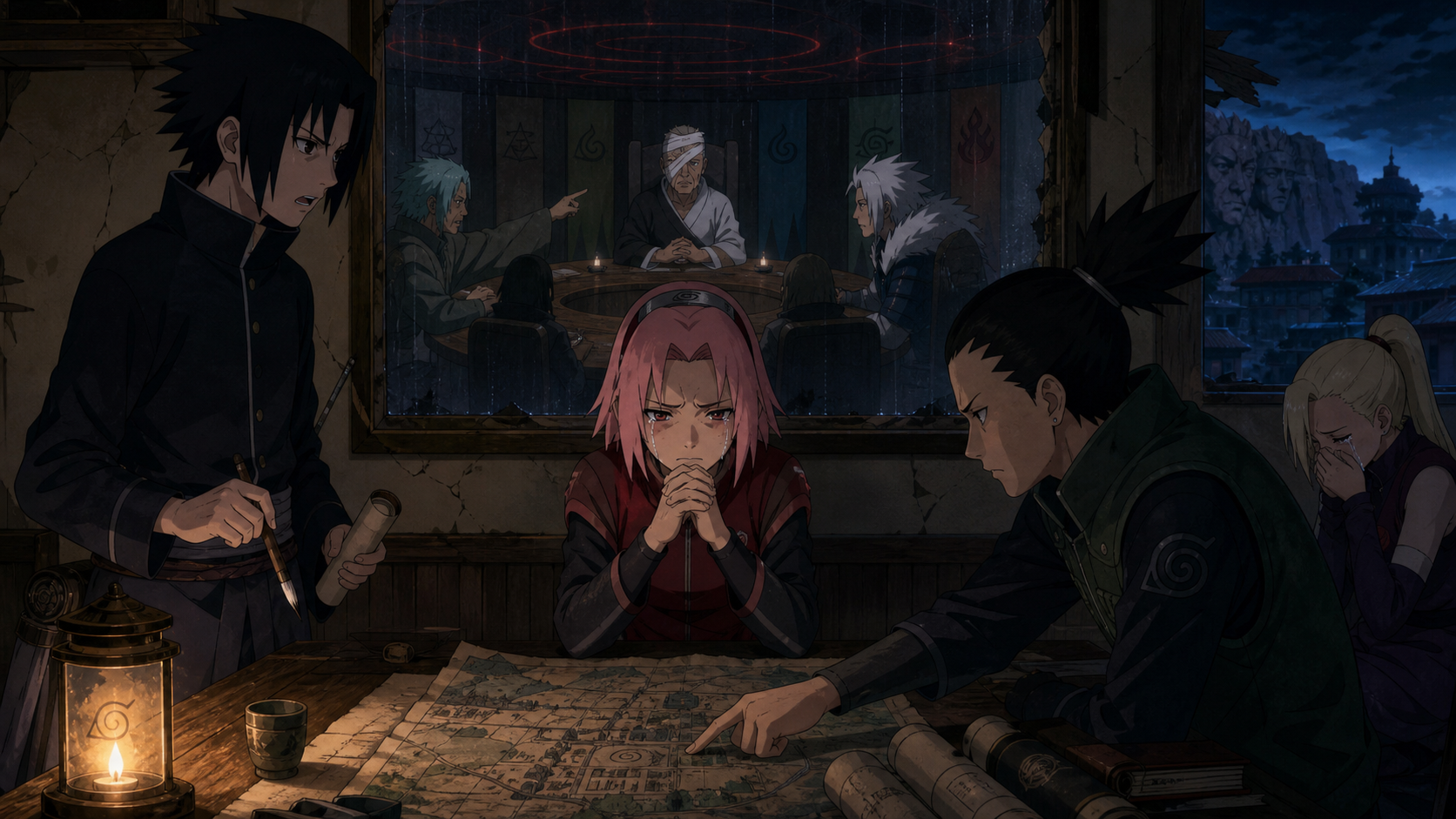
Shikamaru tells Sakura that the Leaf rookies can no longer protect Sasuke from the consequences of his actions. If the Cloud kills him, Konoha friends may seek revenge and extend the conflict. Shikamaru believes their generation must decide how to stop that chain, even if dealing with Sasuke themselves becomes necessary.
Sai tells Sakura that Naruto allowed Karui to beat him and traveled to beg the Raikage for Sasuke’s life. Though Sai still struggles to interpret emotion, he is angry that Naruto keeps suffering under the promise he made Sakura.
Sakura agrees to find Naruto and tell him what has been decided. At the summit, Mifune proposes an Allied Shinobi Force led by Danzō. Ao detects that Danzō is manipulating Mifune with Shisui Uchiha’s eye. White Zetsu then interrupts the meeting by announcing that Sasuke is inside the building.
Shikamaru asks Sakura because this cannot be only an order
Shikamaru does not need Sakura’s legal permission to classify Sasuke as a threat. He asks because she is one of the people most deeply tied to him and because their generation has shared the burden of trying to bring him home.
The conversation is an act of respect and a warning. If they move against Sasuke, they may be forced to kill someone Sakura still loves. Shikamaru refuses to hide that cost behind mission language.
Leadership here means making the person most likely to be hurt part of the decision rather than informing her after everything is over.
The rookie generation has inherited an adult failure
Sasuke left the village while they were children. Since then, adults have trained him, manipulated him, concealed the Uchiha massacre, and repeatedly treated his survival as a strategic problem.
Now his former classmates are expected to solve what those institutions produced. They must protect Konoha, answer the Cloud’s grievance, and decide whether their friend has crossed a boundary that cannot be repaired.
Shikamaru accepts that responsibility because refusal would leave the decision to Danzō or another village. Acceptance does not make the burden fair.
Sai’s anger proves how far he has traveled from Root
Sai once approached bonds as behaviors copied from a book. In this episode he names anger that comes from watching Naruto and Sakura hurt.
He does not understand why they keep fighting for someone who causes them pain, but uncertainty no longer makes him indifferent. Naruto taught Sai what a bond could feel like, and now Sai uses that lesson to challenge the way Naruto is spending himself.
Root trained him to suppress emotion for obedience. His anger is evidence that Danzō’s conditioning did not get the final word.
The promise has become larger than Sakura intended
Naruto promised Sakura that he would bring Sasuke back. At the time, the promise sounded like devotion and hope. Years of failure have turned the vow into something Naruto treats as a permanent personal debt.
Sakura did not order him to accept Karui’s beating or kneel before the Raikage. Even so, Sai’s account forces her to see how often Naruto connects his suffering to the promise he made her.
Her painful decision begins with the belief that releasing him from that promise might release him from the pain. The problem is that Naruto’s bond with Sasuke was never borrowed from Sakura.
Ino’s grief refuses to make Sasuke only a target
Ino cries when the group discusses killing Sasuke. Her reaction can seem inconvenient beside Shikamaru’s strategic clarity, but the grief preserves something the mission framework cannot.
Sasuke was a classmate, a crush, and part of the future these young ninja imagined before the village’s secrets swallowed him. Mourning that person does not deny what he has done.
The tears make the decision honest. If eliminating Sasuke becomes easy to say, the group risks adopting the emotional numbness Danzō calls strength.
Mifune’s alliance proposal answers a real problem
Akatsuki has defeated villages one target at a time because the great powers guarded information, hired dangerous proxies, and treated cooperation as weakness. A unified force could pool intelligence and protect the remaining jinchūriki.
Mifune’s proposal therefore makes strategic sense. The samurai leader is trying to build a structure capable of answering a threat no village can contain alone.
The danger lies not in alliance itself but in who controls the coalition. A necessary institution can still become a weapon when its founding decision is manipulated.
Danzō tries to manufacture consent
Danzō does not merely argue that the Hokage should lead the alliance. He uses Shisui’s eye to influence Mifune without the samurai realizing his judgment has been altered.
That method reveals Danzō’s idea of leadership. Agreement is useful, but authentic consent is optional if he believes his preferred outcome protects the world.
He wants authority granted through a neutral moderator while secretly removing the moderator’s neutrality. The alliance would begin with the exact kind of hidden coercion the coalition claims to overcome.
Ao’s stolen Byakugan exposes Danzō’s stolen Sharingan
Ao recognizes the genjutsu because the Byakugan he carries lets him see the chakra disturbance and identify Shisui’s eye. The discovery is layered with the violent history of bloodline theft.
The Mist sensor obtained his eye as a war trophy. Danzō obtained Shisui’s power through the Uchiha tragedy. Both men carry another clan’s body into a diplomatic chamber.
Ao uses that stolen perception to expose manipulation, but the moment refuses a simple moral division. The shinobi system has made human inheritance into military equipment across village lines.
White Zetsu turns accusation into immediate crisis
Before the Kage can resolve Danzō’s deception, White Zetsu appears and announces that Sasuke is inside the summit complex.
The intrusion feels almost playful, but Zetsu detonates the room. The rogue ninja they have discussed as policy is suddenly a nearby target, and every guard must move from diplomacy to combat readiness.
Zetsu’s announcement also exposes Sasuke to forces Taka hoped to evade. Akatsuki is not protecting him; the organization is using his rage to accelerate conflict.
Sakura chooses action before she understands the full answer
Sakura agrees to find Naruto and take responsibility for ending the promise’s hold on him. That decision comes from care, guilt, and fear rather than a fully honest plan.
She knows Naruto is suffering and knows Sasuke has become dangerous. What she has not resolved is how to speak about her own feelings without turning them into another tool for controlling Naruto’s choices.
The episode does not celebrate certainty. Its title recognizes that action can become necessary while every available option still hurts someone.
The rookies are building policy from personal grief
Shikamaru’s proposal is more than a friend-group intervention. Sasuke has become an international security problem, and the people who knew him as a classmate are trying to decide Konoha’s response before Danzō or another village defines the terms.
Their closeness creates knowledge and bias at once. They understand Naruto’s loyalty, Sakura’s grief, and the boy Sasuke used to be. They also carry memories that could delay action while other people face danger.
Shikamaru does not pretend affection has disappeared. He argues that affection now creates responsibility to prevent a larger revenge chain. The decision hurts because friendship has become part of governance before any of them were ready.
Ino protects mourning from being treated as obstruction
Ino’s tears interrupt the efficient language of threat assessment. She does not offer a tactical alternative, but grief performs necessary work. Killing Sasuke would be a loss even if the mission became justified.
Shinobi institutions often reward the ability to suppress visible feeling and continue. Danzō built Root around that ideal. Ino’s response refuses the claim that emotional difficulty proves political weakness.
A group capable of mourning may still choose lethal force. The mourning prevents that force from being rewritten as clean, inevitable, or free of responsibility.
Sai identifies pain without understanding ownership
Sai correctly sees Naruto’s injuries and correctly recognizes that the promise to Sakura has become one language Naruto uses for self-punishment. His anger comes from genuine attachment, which marks enormous growth beyond Root.
He still frames the problem as though Sakura can cancel the promise and therefore remove Naruto’s bond. Emotional insight has arrived before a complete understanding of how relationships develop beyond their original words.
Sai’s mistake is productive rather than malicious. He gives Sakura information she needed, but his explanation helps push her toward a confession designed to manage Naruto rather than an honest conversation designed to include him.
Danzō tries to found cooperation on invisible coercion
Mifune’s alliance proposal answers Akatsuki’s cross-border power with shared command. Danzō recognizes the strategic need and immediately decides that manufactured consent is acceptable if the outcome places him in control.
That choice poisons more than his candidacy. An alliance formed through undetectable manipulation would reproduce the mistrust Akatsuki exploited. Every later disagreement could be interpreted as another hidden technique rather than ordinary political conflict.
Danzō calls coercion efficient because genuine negotiation risks an answer he dislikes. His version of unity removes the uncertainty that makes consent meaningful.
Ao’s eye makes exposure morally uncomfortable
Ao uses a Byakugan taken during war to identify a Sharingan Danzō took through violence against Shisui. A stolen bloodline exposes another stolen bloodline inside a summit meant to build peace.
The symmetry does not make both men identical. Ao uses the perception to restore Mifune’s awareness, while Danzō uses Shisui’s technique to remove awareness. Purpose matters.
The scene still reveals how normalized bodily appropriation has become. Villages carry clan inheritance as military equipment, then speak about trust without acknowledging whose bodies supplied the advantage.
White Zetsu converts accountability into emergency
Ao’s exposure creates a rare opening for the Kage to question Danzō in public. White Zetsu arrives before the room can establish facts, consequences, or a new leadership path. Sasuke’s presence forces every participant back into immediate defense.
Akatsuki benefits when institutions cannot remain focused on their own wrongdoing. Crisis turns reflection into delay and makes whoever offers the fastest response look necessary.
Zetsu’s announcement therefore does more than betray Taka’s location. The interruption helps Danzō escape the political moment when hidden control was finally visible.
The Japanese performances preserve competing forms of care
Showtaro Morikubo gives Shikamaru a tired steadiness. His proposal sounds considered rather than eager, keeping responsibility separate from bloodlust. Chie Nakamura lets Sakura absorb each name and consequence before resolve takes shape.
Ryōka Yuzuki gives Ino’s grief no strategic disguise, while Satoshi Hino makes Sai’s anger blunt enough to reveal both care and incomplete understanding. The group scene works because nobody sounds emotionally interchangeable.
At the summit, Hiroshi Ito keeps Danzō composed while the manipulation is exposed. The calm is not innocence; the performance communicates a man who expected necessity to excuse the method.
Shikamaru refuses to hide lethal responsibility inside procedure
He could tell Sakura that Sasuke has become a threat and let mission language carry the emotional violence. Instead, he asks her to participate in what their generation may decide.
The conversation respects her bond enough to name the cost. Leadership means involving the person most likely to be hurt before the outcome becomes irreversible.
The rookies inherit consequences created by adults
Sasuke left as a child after institutions concealed the massacre and Orochimaru exploited his grief. Now former classmates must answer international harm produced by the person that history helped shape.
Taking responsibility may be necessary. It is not fair. Their adulthood begins inside failures older authorities never repaired.
Ino’s tears keep killing from becoming administrative
She offers no tactical alternative, and grief remains valuable anyway. Sasuke was a classmate, a crush, and part of the future they once imagined.
Mourning does not deny danger. It prevents lethal force from being described as clean, painless, or emotionally proof that the group has matured.
Sai’s anger is evidence Root failed to finish him
He once studied emotion as an external system. Now Naruto’s injuries make him angry enough to confront Sakura with information she does not want.
The feeling is imperfectly interpreted but genuine. Danzō trained obedience into him, while friendship produced judgment strong enough to challenge how another person is being harmed.
Sai sees the promise and misses who owns the bond
He correctly recognizes that Naruto invokes Sakura’s request while accepting punishment. He assumes she can cancel the original sentence and release him.
Naruto’s relationship with Sasuke grew beyond that promise long ago. Accurate concern leads toward a false solution when emotional ownership remains misunderstood.
Sakura chooses action before choosing honesty
She wants Naruto’s suffering to stop and believes removing herself as the reason will help. Care, guilt, and urgency combine into a plan built around managing his decision.
The episode lets motivation remain sympathetic without blessing the method. A painful choice can still be the wrong one when truth is withheld.
Mifune proposes the institution the crisis actually requires
Akatsuki defeats villages separately while those villages hoard intelligence and outsource violence. Shared command could protect remaining jinchūriki and coordinate response.
The alliance is not the problem. Founding it through manipulated consent would reproduce the secrecy and mistrust it exists to overcome.
Danzō removes uncertainty from consent
Shisui’s eye lets him make Mifune’s judgment appear voluntary while narrowing it toward Danzō’s desired answer. He treats agreement as an output rather than a relationship.
His idea of unity is control without visible coercion. The method reveals what his alliance leadership would become whenever negotiation risked refusal.
Ao restores awareness using another stolen bloodline
The Byakugan taken in war detects the Sharingan Danzō acquired through violence. A stolen eye exposes a stolen eye inside a peace summit.
Purpose differentiates the acts: Ao restores Mifune’s ability to judge, while Danzō removes it. The room still rests on histories of bodies treated as military equipment.
Zetsu interrupts accountability at exactly the useful moment
Danzō’s manipulation has become visible and could finally receive scrutiny. Announcing Sasuke inside the complex converts political reflection into immediate defense.
Crisis rewards whoever offers rapid control and postpones investigation of the authority that failed moments earlier. Akatsuki understands interruption as strategy.
RaeRae’s reaction to Painful Decision
This episode is uncomfortable because nobody in Konoha gets a clean position. Shikamaru is right that they cannot keep asking other villages to absorb Sasuke’s violence. Ino is right to grieve. Sai is right to be angry that Naruto has turned loyalty into punishment.
Sakura’s face says more than any speech. She is trying to untangle love, guilt, duty, and a promise that Naruto made freely but carries as though she owns the obligation.
The summit provides the colder mirror. Danzō has none of Sakura’s hesitation because he treats other people’s choices as material to shape. He can manufacture agreement and call the result unity.
Ao exposing the genjutsu should settle the room, but Zetsu makes sure nobody gets time to process the discovery. Sasuke’s presence converts every painful decision into an immediate one. That is the trap closing around all of them.
Both storylines ask who gets to make another person’s choice
Sakura prepares to change Naruto’s path through a confession she does not mean. Danzō changes Mifune’s judgment through genjutsu. Their motives and scale are profoundly different.
The parallel concerns method. Care and necessity do not make manipulated consent authentic. Another person’s agency remains inconvenient and essential.
Sasuke enters as the crisis everybody was discussing abstractly
The rookies debate whether to stop him. The Kage debate Akatsuki and shared force. Zetsu announces that the person carrying those questions is already inside.
Policy becomes immediate danger before either room has completed its moral reasoning. Urgency is about to choose for them.
The generation’s decision cannot remain only about friendship
Shikamaru understands that Sasuke’s choices now affect diplomatic safety, village defense, and people who never shared their classroom. Their private history gives the rookies knowledge of him, but it cannot give them exclusive authority over everyone harmed.
At the same time, treating Sasuke as a target with no history would hand the decision to Danzō’s preferred kind of certainty. The group must hold memory and present danger together without using either to erase the other.
That is why the conversation hurts. Friendship no longer means unconditional protection from consequence. Responsibility does not require pretending the friendship was imaginary. They are deciding what love owes the world when the person loved has become dangerous inside it.
Shikamaru’s seriousness prevents the choice from becoming revenge disguised as maturity. Ino’s grief prevents strategy from becoming numbness disguised as strength. Sakura’s uncertainty proves there is no painless sentence capable of settling what their generation inherited.
No honest answer here leaves every bond untouched or every person unhurt.
RaeRae’s final word on Painful Decision
Nobody in Konoha gets a clean position. Shikamaru is right that another village cannot keep absorbing Sasuke’s violence. Ino is right to grieve him anyway.
Sai is right that Naruto has turned loyalty into punishment, and wrong that Sakura owns enough of the bond to cancel it.
Sakura’s face carries love, guilt, duty, and panic all at once. She chooses movement before finding an honest way to include Naruto in the choice.
The summit provides the colder mirror. Danzō has no hesitation because he treats consent as material he can shape toward the correct result.
Ao exposes him, then Zetsu ensures nobody gets time to decide what exposure means. Sasuke’s presence turns every painful choice into an immediate one, which is exactly how bad decisions start feeling inevitable.
RaeRae’s call
Everyone wants to prevent more pain, yet several people begin by controlling somebody else’s choice. Care, alliance, and necessity mean nothing if consent becomes another obstacle to manipulate.