
Naruto’s Plea
Naruto brings the Raikage humility, history, and a warning about revenge, but none of them yet answers what justice for the Cloud should be.
Bottom line
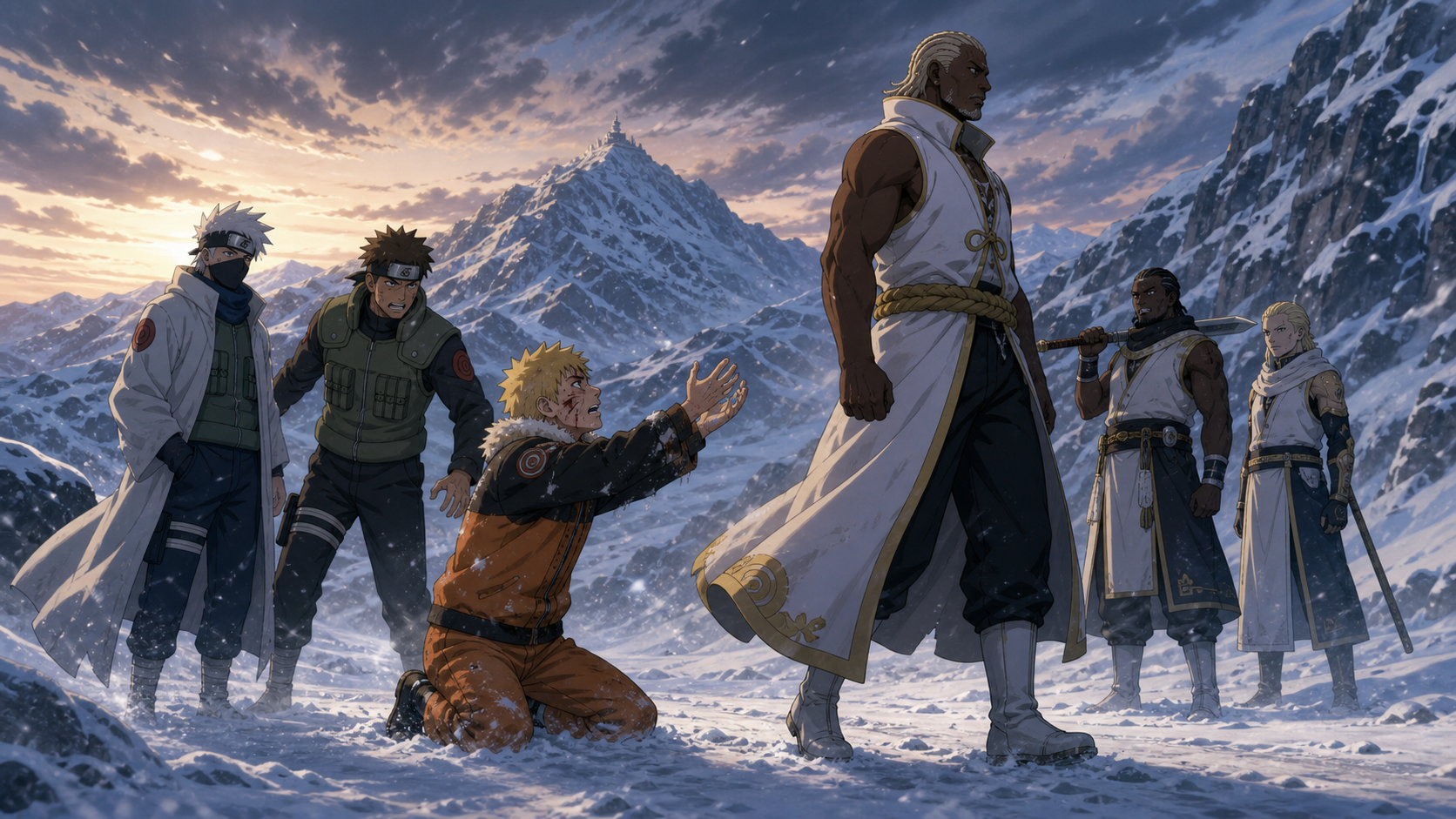
Naruto Shippuden Episode 200, “Naruto’s Plea,” brings Naruto, Kakashi, and Yamato face to face with the Fourth Raikage in the snowy Land of Iron. They have followed Team Samui because Naruto wants the execution order on Sasuke stopped before the summit makes the decision irreversible.
Kakashi makes clear that they were not sent by the Hokage. He asks only that the Raikage hear Naruto. Naruto explains that Sasuke is his friend and warns that killing him could trigger retaliation between Konoha and Kumogakure.
The Raikage refuses. Sasuke attacked Killer B and chose to join Akatsuki; forgiveness cannot be demanded from the village he harmed. Naruto repeatedly blocks the road, then drops to his knees and begs.
Yamato challenges the Cloud’s moral certainty by invoking the old attempt to steal the Hyūga Byakugan, which ended with Hizashi’s sacrifice. The Raikage remains unmoved and continues toward the summit. Inside the meeting chamber, the Kage begin debating Akatsuki, jinchūriki, and a possible unified alliance.
Naruto arrives without the protection of an official mission
Kakashi immediately tells the Raikage that Danzō did not send them. That honesty removes the strongest diplomatic shield they could have claimed.
Naruto is not speaking for the Leaf government. He is a young shinobi asking a foreign leader to reconsider a lawful response to an attack on his village. Kakashi’s presence earns him a hearing, but that support cannot turn personal conviction into policy.
The scene matters because Naruto chooses to make the appeal anyway. He knows there is no convenient authority behind him and no guarantee that sincerity will count.
The Raikage refuses to make Sasuke’s consequences disappear
Ay does not misunderstand Naruto’s feelings. He rejects the idea that those feelings outweigh what Sasuke has done.
From the Cloud’s perspective, Sasuke invaded their territory, fought Killer B, and left everyone believing the jinchūriki had been taken by Akatsuki. The Raikage is responsible for the fear and security of his own people.
Naruto asks him to stop a cycle of revenge, but Ay hears a request for the injured party to surrender justice first. That difference is why the plea cannot move him.
Kneeling changes the image, not the argument
Naruto is famous for confronting power with noise, defiance, and a raised fist. Here he lowers himself into the snow.
The posture is shocking because Naruto abandons pride without abandoning purpose. He is willing to look weak if humility might keep Sasuke alive and prevent another war.
Yet the gesture cannot supply what the argument lacks. The kneeling demonstrates how much Naruto cares, not why the Cloud should accept the risk of leaving Sasuke unpunished. Emotional cost is not the same thing as restitution.
Naruto sees a cycle while the Raikage sees a broken boundary
After listening to Nagato, Naruto understands revenge as a chain. Every killing creates grief that can authorize the next killing in someone else’s mind.
The Raikage sees a different immediate problem. A rogue Leaf ninja attacked his brother and aligned himself with an organization hunting every jinchūriki. If a Kage declines to act, deterrence and trust begin to collapse.
Both positions contain truth. The tragedy is that Naruto has not yet found a proposal that protects the Cloud while interrupting the cycle he fears.
Yamato refuses selective memory
When Naruto’s plea is dismissed, Yamato invokes the Hyūga incident. A Cloud operative once tried to abduct Hinata and steal the Byakugan. The political settlement forced Konoha to surrender Hizashi’s body in place of Hiashi.
Yamato is not arguing that an old crime makes Sasuke innocent. He is challenging the idea that the Cloud approaches this conflict with clean hands while Konoha alone owes restraint.
His anger gives the encounter historical depth. Great villages often call their own past violence necessity and another village’s violence proof of barbarism.
Kakashi supports Naruto without promising success
Kakashi does not interrupt Naruto’s plea or translate the appeal into safer political language. He gives Naruto the chance to speak in his own voice.
That trust is different from blind agreement. Kakashi understands the Raikage’s position and knows Sasuke’s actions cannot be wished away. He also believes Naruto deserves the chance to try the kind of direct understanding Minato trusted him to pursue.
When the answer is no, Kakashi does not force a confrontation. Support means helping Naruto reach the conversation, not manufacturing the outcome he wants.
Darui and C show that the Raikage is not traveling alone in judgment
The Raikage’s guards remain alert while Naruto repeatedly enters their leader’s path. They could reasonably treat the behavior as a security threat.
Darui’s restraint and C’s observation keep the encounter from becoming a fight. Their discipline gives the Raikage room to answer rather than react.
They also represent the people Naruto’s request affects. Sparing Sasuke would not be a private favor between two powerful men; the Cloud delegation must carry that decision back to comrades who believe Killer B was taken.
The summit turns missing jinchūriki into shared strategy
Inside the Land of Iron, the Kage begin comparing what Akatsuki has taken and how their villages responded. The conversation exposes old reliance on jinchūriki as weapons and the secrecy that kept the villages from coordinating sooner.
Danzō identifies rare figures who achieved unusual control over tailed beasts, including Killer B. The information is strategic, but the framing also turns living people into assets whose control determines military balance.
The alliance discussion begins because separate defenses have failed. Cooperation is necessary, yet every leader enters the room with reasons to distrust the others.
Mifune’s neutrality cannot erase the Kage’s histories
The samurai leader provides neutral ground and procedures for the meeting. That structure prevents one hidden village from controlling the room.
Neutral procedure cannot remove the grudges seated at the table. The villages have hired Akatsuki, concealed jinchūriki, fought proxy conflicts, and treated one another’s bloodlines as prizes.
The summit asks them to build shared security from institutions designed around secrecy. Naruto’s failed roadside plea is a smaller version of the same problem: wanting peace is not enough without a structure that makes trust survivable.
Sasuke’s absence controls both conversations
Sasuke is not present before the Raikage or at the summit table, yet his choices shape both spaces. Naruto kneels because of him. The Cloud demands action because of him. Danzō benefits politically from authorizing his death.
This is the point where Team 7’s private fracture becomes international policy. Sasuke can no longer be discussed only as a lost friend or a revenge-driven survivor.
He has become an actor whose decisions impose costs on people far beyond Konoha.
Naruto brings mercy without an accountability plan
Naruto understands the emotional machinery of revenge after facing Nagato. He knows punishment can generate another bereaved person who calls retaliation justice. That insight gives his plea moral seriousness.
The Raikage needs more than diagnosis. Naruto cannot explain how Sasuke will be stopped, what protection the Cloud receives, who answers for Killer B’s apparent capture, or why another delay will not create more victims. Mercy without a structure asks the injured party to carry all immediate risk.
Naruto’s failure is therefore useful. He has identified the cycle but has not yet built a political answer capable of interrupting the cycle while protecting people inside the present danger.
Kneeling exposes the limits of personal sacrifice
Naruto often treats his own suffering as the resource he can offer when no other solution exists. He accepts Karui’s blows, crosses the snow, and gives up pride before the Raikage. Every cost lands on his body.
That strategy cannot repay damage done to the Cloud. The Raikage did not ask Naruto to suffer, and Naruto’s humiliation does not restore Killer B or guarantee future safety. Self-sacrifice becomes another attempt to control an outcome through pain.
The scene remains moving because Naruto means every gesture. Sincerity and effectiveness are separate questions, and Episode 200 refuses to confuse them.
The Hyūga incident proves grievance has a longer archive
Yamato’s intervention prevents the Cloud from presenting the current conflict as though Konoha alone exports harm. A Cloud operative attempted to take Hinata and her Byakugan, then the peace settlement demanded a Hyūga body after Hiashi killed the intruder.
Hizashi’s death shows how villages convert individual bodies into diplomatic currency. The old settlement ended open conflict without creating justice for the family that paid.
Yamato does not use history to excuse Sasuke. He shows why selective memory cannot support a durable moral claim. Every village needs accountability for inherited harm, including Konoha.
The Raikage’s refusal protects people Naruto cannot see
Naruto speaks from direct love for Sasuke. Ay speaks for Cloud shinobi, Killer B’s students, officials who responded to the attack, and a village forced to interpret a missing jinchūriki as an Akatsuki victory.
Those people are absent from the snowy road, but leadership requires the Raikage to keep them present. Granting Naruto’s request would create consequences he must explain to citizens who never shared Team 7’s bond.
That broader constituency makes his harshness politically legible. Empathy for Naruto cannot replace duty toward people whose trust depends on a credible response.
Kakashi demonstrates support without emotional takeover
Kakashi secures the hearing through reputation and then allows Naruto to make his own argument. He does not polish the plea into diplomacy, speak over the kneeling, or promise the Raikage an outcome Naruto cannot deliver.
That restraint contrasts with adults who repeatedly decide what younger people should know or feel. Kakashi protects the opportunity without manufacturing consent from either side.
When Ay refuses, Kakashi accepts the boundary. Supporting Naruto means accompanying him through a failed attempt as well as helping him reach the conversation.
The summit needs institutions stronger than individual sincerity
Mifune’s procedures create neutral space, but procedure alone cannot undo proxy wars, bloodline theft, and competing jinchūriki policies. The Kage must build mechanisms for shared intelligence, command, and accountability among states trained to conceal weakness.
Naruto’s roadside meeting contains the same challenge at human scale. Honest feeling opens conversation but cannot settle competing duties without commitments both sides can trust.
Peace requires more than good people wanting conflict to stop. Peace needs structures capable of protecting vulnerable parties when trust is incomplete.
The Japanese performances refuse an easy villain
Junko Takeuchi gives Naruto’s plea urgency that gradually loses volume as he recognizes force cannot move Ay. The kneeling sounds exposed rather than theatrical. Unshō Ishizuka gives the Raikage anger, grief, and command without reducing him to an obstacle in Naruto’s story.
Kazuhiko Inoue lets Kakashi’s respect for both speakers sit inside careful restraint. Rikiya Koyama gives Yamato the sharpest historical anger, making the Hyūga reference feel like a boundary against convenient innocence.
The scene works because every voice carries a defensible responsibility. Nobody can solve the encounter by simply caring more loudly.
Kakashi begins by removing a diplomatic fiction
He tells Ay that Danzō did not authorize the meeting. Naruto cannot borrow the Leaf government’s legitimacy or imply promises the acting Hokage will honor.
The honesty weakens their leverage and protects the conversation from deception. Naruto receives a hearing as himself, which means sincerity must stand without institutional cover.
Ay hears risk where Naruto speaks relationship
Naruto says friend and remembers Team 7. The Raikage hears an Akatsuki operative who attacked his brother, crossed a national border, and threatened confidence in Cloud security.
Neither description is false. The plea fails because personal history does not answer the public consequences attached to the same person.
Kneeling spends pride without creating restitution
Naruto lowers himself because he believes visible sacrifice might prove the depth of his request. The posture communicates love, desperation, and willingness to endure humiliation.
It does not locate B, restrain Sasuke, compensate the Cloud, or guarantee another attack will not occur. Emotional cost cannot substitute for an accountability plan.
The Raikage protects constituents outside the frame
Ay must answer to B’s students, Cloud shinobi, officials, and families who understand the attack as an Akatsuki assault. None shared Team 7’s childhood.
Granting mercy is not a private favor between powerful men. The decision distributes risk toward people whose trust depends on their leader treating harm seriously.
Naruto has diagnosed revenge without designing justice
He can see how killing Sasuke may provoke Leaf retaliation and another Cloud response. Nagato taught him to recognize the machinery.
Ay needs to know what replaces execution. Naruto has no enforceable answer for stopping Sasuke, repairing harm, or protecting the village while hope remains uncertain.
Yamato breaks the Cloud’s claim to clean history
The Hyūga incident exposes an earlier attempt to steal Hinata’s Byakugan and the body Konoha surrendered to preserve peace. Great villages have all converted people into strategic currency.
The history cannot acquit Sasuke. It prevents present judgment from being built on selective innocence.
Old wrongdoing and present harm must remain visible together
Using the past only to cancel current responsibility would repeat the same cycle Naruto wants to end. Forgetting the past lets powerful states pretend their own violence never shaped today’s grievance.
Durable justice needs memory without arithmetic that treats one injury as payment for another.
Kakashi supports the attempt without hijacking its failure
His reputation opens the conversation, then he lets Naruto speak, kneel, and hear no. He does not translate the plea into promises they cannot keep.
Accompaniment includes allowing an honest effort to fail. Kakashi protects Naruto’s agency without forcing Ay to surrender his own.
Darui and C keep a roadside plea from becoming combat
Naruto repeatedly blocks the route, behavior guards could reasonably interpret as threat. Their restraint gives Ay space to answer rather than react.
They also embody the people affected by mercy. The Raikage is never deciding only for himself, even in the snow outside formal chambers.
The summit repeats Naruto’s problem at governmental scale
Villages need shared security against Akatsuki while carrying bloodline theft, proxy wars, secret jinchūriki policies, and reasons to distrust one another.
Mifune can provide neutral procedure. The Kage still need commitments capable of protecting everyone when goodwill fails.
RaeRae’s reaction to Naruto’s Plea
Naruto kneeling in the snow hurts because I understand exactly why he chooses the gesture and exactly why the plea fails. He brings the Raikage his whole heart, but the Raikage is responsible for more than Naruto’s heart.
Ay’s refusal is harsh, not irrational. Sasuke attacked his brother, and Naruto has no plan for accountability beyond asking everyone to wait for the friend he believes is still reachable.
Yamato naming the Hyūga incident is necessary. The Cloud cannot act as though revenge entered the world with Sasuke. Still, old guilt does not cancel present harm; history proves how long these villages have been passing harm forward.
What I love is that Kakashi lets Naruto try without pretending sincerity guarantees victory. Naruto has learned to recognize the cycle. His next challenge is harder: finding an answer that asks injured people for something other than silence.
Sasuke’s absence makes him more politically present
He never enters the road or chamber, yet Naruto kneels, Ay refuses, Danzō benefits, and the summit’s agenda tightens around his actions.
Team 7’s fracture has become international policy. Any future return must address people who experienced Sasuke not as a wounded friend, but as the source of new wounds.
Mercy becomes credible only when somebody carries the risk
Naruto wants the Cloud to pause execution while he searches for another ending. He has not explained what happens if Sasuke refuses, attacks again, or uses that time to deepen Akatsuki’s reach.
The question is not whether compassion matters. It is how compassion becomes a structure that does not ask injured people to remain unprotected.
The snow makes Naruto’s humility visible without making it persuasive
Kneeling lowers him beneath a leader who measures resolve through force and responsibility. The image strips away Naruto’s usual challenge posture, but Ay does not mistake vulnerability for policy.
That refusal is important. A dramatic gesture can move viewers while leaving the person asked to accept risk with exactly the same unanswered questions. Naruto’s willingness to suffer proves sincerity only.
The scene also reveals how easily he treats his body as negotiable whenever another person’s life is threatened. Karui’s fists, the journey through snow, and the bowed position all come from a belief that he can pay emotional debts with himself.
Ay does not accept that currency because Naruto is not the person who harmed the Cloud. Making one loyal friend hurt cannot restore the missing brother or establish what happens if Sasuke attacks again.
Naruto leaves without the answer he wanted, but the failure is necessary growth. He must stop treating sacrifice as a complete peace plan and learn how empathy, accountability, safety, and mercy can share the same proposal.
The failed plea still teaches him.
RaeRae’s final word on Naruto’s Plea
Naruto kneeling in the snow hurts because I understand why he does it and why it cannot work. He brings Ay his whole heart. Ay is responsible for people outside that heart.
Sasuke attacked Killer B. Naruto has no plan for accountability beyond asking everyone to wait for the friend he believes remains reachable.
Yamato naming the Hyūga incident is necessary. Cloud history is not clean. That history also cannot become a coupon canceling present harm.
Kakashi lets Naruto try without promising sincerity will win. That support feels mature because failure belongs inside honest conversation too.
Naruto knows revenge creates another revenge. His next lesson is harder: mercy needs protection, commitments, and an answer for the people being asked to carry uncertainty.
RaeRae’s call
Naruto’s plea contains moral truth and no accountability structure. Kneeling proves love for Sasuke; it cannot tell the Cloud how mercy will protect everyone Sasuke has already endangered.