
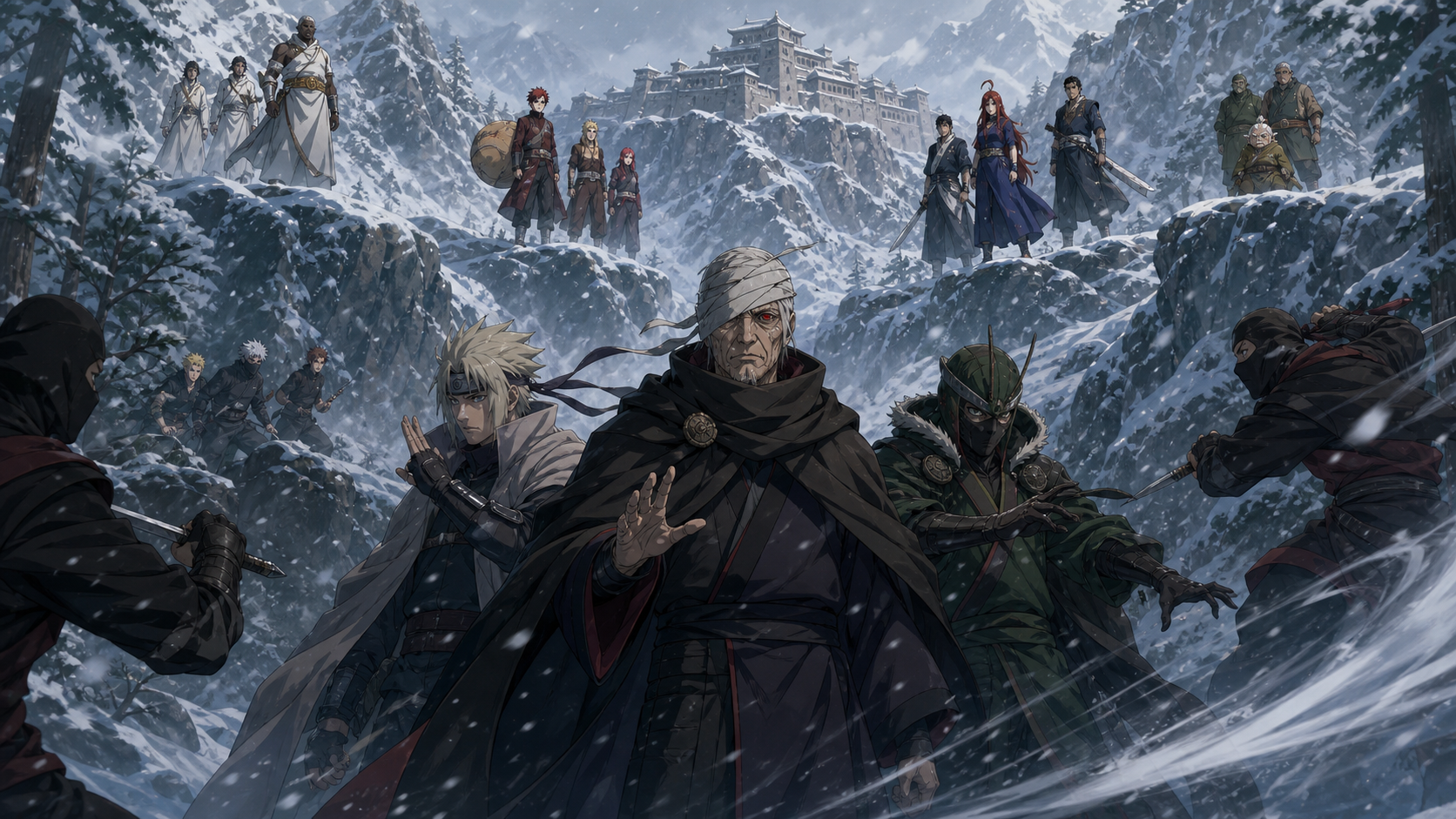
Enter the Five Kage!
Five leaders carry five kinds of authority toward the Land of Iron, while Danzō’s roadside ambush reveals what his diplomacy keeps hidden.
Bottom line
Naruto Shippuden Episode 199, “Enter the Five Kage!,” sends the leaders of the five great hidden villages toward the summit in the neutral Land of Iron. Each Kage travels with two guards, turning the journey into a first look at the people who will carry their village’s power into the meeting.
The Fourth Raikage departs with Darui and C. Gaara travels with Temari and Kankurō. Mei Terumī chooses Chōjūrō and Ao, while Ōnoki brings Kurotsuchi and Akatsuchi. Danzō leaves Konoha with Fū and Torune.
Danzō’s party is attacked by the Prajñā Group, assassins from the Wood Country who want his head. He reveals the Sharingan hidden beneath his bandages and defeats them with ruthless efficiency.
Team Samui also heads toward the Land of Iron. Yamato plants tracking seeds on them so Naruto, Kakashi, and Yamato can secretly follow. Naruto intends to ask the Raikage to spare Sasuke, while Taka enters the same territory to reach Danzō.
Five roads reveal five styles of authority
The episode does not introduce the Kage through speeches around a table. Their departures show how they leave home, who walks beside them, and how their villages respond.
Those choices communicate leadership before debate begins. The Raikage moves like force given a destination. Gaara carries quiet confidence earned through a transformed relationship with his people. Mei balances grace with the burden of a village emerging from a brutal past. Ōnoki brings age, pride, and skepticism. Danzō travels behind secrecy and controlled operatives.
The summit will call them equals, but the roads make clear that they are not interchangeable.
The Raikage brings urgency that refuses to sit still
Ay is not approaching the summit as a detached statesman. He believes Killer B was taken by Sasuke and Akatsuki. His personal fear and official duty point in the same direction.
Darui and C complement that intensity. Darui’s outward ease hides reliable judgment, while C supplies sensory awareness and analytical support. They are not decorations around the Raikage; they are the people capable of keeping pace with him.
Naruto’s planned appeal will have to reach a leader already moving under the weight of a brother’s apparent loss.
Gaara arrives as proof that a Kage can change
Gaara once treated strength as isolation. Now he travels as the Kazekage with Temari and Kankurō beside him, representing a village that has chosen to trust him.
His presence matters beyond the Sand. Gaara knows what Naruto’s recognition can do because that recognition changed the course of his life. He also knows what Akatsuki takes from a jinchūriki and from the people left behind.
Among the five leaders, he is uniquely positioned to understand both Naruto’s hope and the other villages’ demand for action.
Mei carries a village out of the Bloody Mist’s shadow
The Mizukage’s delegation introduces a different kind of political transition. Mei leads a Hidden Mist still defined in outsiders’ memories by blood-soaked institutions and internal purges.
Ao brings veteran suspicion and sensory expertise. Chōjūrō brings immense potential wrapped in hesitation. Together they show a village trying to move forward without pretending its old violence vanished.
Mei’s warmth should not be mistaken for weakness. Rebuilding a political culture demands a steadier strength than simply preserving fear.
Ōnoki treats experience as both armor and burden
The Tsuchikage is the oldest leader traveling to the summit, and he carries decades of alliances, betrayals, and mercenary calculations. That history makes him difficult to surprise and easy to harden.
Kurotsuchi challenges his stiffness with blunt confidence, while Akatsuchi supplies dependable physical support. Their family-like rhythm contrasts with Danzō’s controlled Root formation.
Ōnoki’s experience will be valuable at the table, but the episode hints at the danger of treating every new crisis as confirmation that trust was always foolish.
Danzō’s guards embody the village he wants
Fū and Torune are highly capable, quiet, and shaped by Root. They operate with the discipline Danzō values: personal identity subordinated to mission, emotion concealed, and obedience treated as virtue.
Choosing them is practical because their sensory and clan techniques are formidable. The selection is also symbolic. Danzō enters an international summit accompanied by the model of citizenship he would impose on Konoha.
Naruto’s influence grows through bonds people choose. Danzō’s influence grows through people trained not to question the hand giving orders.
The roadside attack strips diplomacy away
The Prajñā Group does not wait for the summit’s rules. They attack Danzō on the road, hoping to settle an old grievance before neutral territory can protect him.
Danzō responds without hesitation and reveals the Sharingan under his bandage. The eye is a startling contradiction: the man positioning himself as Konoha’s legitimate leader carries the stolen power of the Uchiha he helped destroy.
His efficiency confirms that he is not merely an old politician. The ambush also deepens the question of what he has hidden behind claims of serving the village.
Taka turns diplomacy into a hunting ground
Sasuke is not traveling to negotiate. He wants Danzō, and the summit gives him a rare chance to reach the new Hokage outside Konoha’s defenses.
Taka’s arrival changes the Land of Iron from neutral meeting place to collision point. Five leaders are gathering to discuss Akatsuki while an Akatsuki-aligned team slips toward them carrying a revenge mission.
Sasuke’s target may be specific, but entering the summit’s orbit guarantees that every village will experience his revenge as an international threat.
Naruto follows without permission because the official route is closed
Danzō has ordered Naruto kept in the village, and Team Samui cannot simply escort him to the Raikage. Naruto responds by leaving with Kakashi and Yamato.
Yamato’s tracking seeds let them follow the Cloud team without obstructing its mission. Kakashi asks Sai to preserve the appearance that Naruto remains in Konoha, creating a narrow window before Root recognizes the deception.
The choice is risky, but Naruto understands that an appeal delivered through ordinary channels will arrive too late. The Raikage is already moving toward decisions that could make Sasuke’s death a shared policy.
Kakashi chooses faith over the new Hokage’s order
Kakashi is not casually rebelling. He knows Danzō’s authority, the diplomatic stakes, and Naruto’s tendency to act before every consequence is visible.
He still accompanies him. Part of that choice comes from Minato’s faith in Naruto, and part comes from Kakashi’s own experience watching institutions fail the people they claim to protect.
Rather than sending Naruto alone or forcing him to stay, Kakashi gives his conviction adult support. That support does not guarantee the appeal will work. Kakashi ensures Naruto reaches the conversation alive and prepared.
The Land of Iron is neutral ground full of non-neutral people
The samurai nation offers a place outside the five villages where leaders can meet without granting one host an advantage. Neutral geography, however, cannot remove the motives arriving with them.
The Raikage carries grief. Danzō carries ambition and secrets. Gaara carries lived faith in Naruto. Ōnoki carries suspicion. Mei carries reform. Sasuke carries revenge, and Naruto carries a plea.
The summit’s danger comes from everything the roads have accumulated before the doors open.
The escorts reveal what each leader believes power needs
Every Kage chooses two people who extend a leadership style. The selections function as political portraits. Darui and C give the Raikage judgment and sensory reach around his physical force. Temari and Kankurō give Gaara family members capable of disagreement as well as protection.
Mei brings veteran perception and emerging confidence through Ao and Chōjūrō. Ōnoki’s delegation balances youthful bluntness with dependable strength. Danzō brings agents shaped to disappear behind his command.
The contrast asks whether authority becomes safer through trusted people who retain personality or through operatives trained to erase themselves. No entourage is merely decoration.
Gaara’s procession shows reform made visible
The Sand once feared Gaara, weaponized him, and isolated him inside the Kazekage family. Traveling with Temari and Kankurō now turns repaired relationship into public statecraft. His siblings are not guards assigned to contain a monster; they are advisers and family walking beside a leader.
That transformation gives Gaara unusual credibility at a summit about jinchūriki. He has lived as village weapon, Akatsuki target, corpse, rescued leader, and person restored through communal effort.
Naruto’s influence is present without Naruto occupying the frame. Gaara’s delegation proves one relationship can alter how an entire office behaves.
Mei’s delegation refuses the Bloody Mist as permanent identity
Ao carries the habits of a veteran who survived the Mist’s violence, including suspicion sharpened by bloodline warfare. Chōjūrō represents a younger strength not yet organized around terror. Mei needs both perspectives while rebuilding legitimacy.
Reform does not require pretending the old system vanished. The delegation carries evidence of survival and evidence of possibility together. Their warmth and awkwardness are politically meaningful because the Bloody Mist treated fear as governance.
Mei’s authority grows from proving that a village can remember brutality without making brutality the only available future.
Danzō’s Sharingan turns the ambush into evidence
The Prajñā Group attacks for its own grievance, but Danzō’s response reveals more than combat skill. The Sharingan beneath his bandages is bodily evidence that the acting Hokage’s power depends on a clan destroyed under Konoha policy.
His secrecy protects the contradiction. Danzō presents himself as the leader willing to defend the village from dangerous Uchiha power while privately using that power to secure his own position.
Winning the ambush does not resolve the moral question. Efficiency shows why hidden tools tempt institutions to excuse the way those tools were acquired.
Neutral ground cannot neutralize unequal histories
The Land of Iron removes home-field advantage and places summit security under samurai control. That architecture matters, but none of the delegates arrives historically equal. Some villages have hired Akatsuki. Others lost jinchūriki. Several stole bloodline techniques or used proxy violence.
Neutral procedure can manage who speaks and where guards stand. Procedure cannot make memory disappear. Durable agreement requires those histories to become part of negotiation rather than inconvenient baggage checked at the border.
Sasuke’s infiltration tests the neutral promise immediately. A personal revenge target enters a space built to keep national conflict from becoming combat.
Naruto and Sasuke approach the same country through opposite methods
Naruto follows the Cloud delegation because formal authority under Danzō has closed the route to appeal. His disobedience aims toward conversation, recognition, and a request he expects may fail.
Sasuke enters the same territory through concealment with assassination as his fixed goal. Both young men reject the official path, but purpose and treatment of other people separate their choices.
The parallel prevents rebellion from functioning as automatic virtue or guilt. Breaking an order matters less than what kind of relationship the action attempts to create.
The Japanese cast turns travel into characterization
Unshō Ishizuka gives the Raikage forward pressure even before combat begins. Akira Ishida gives Gaara settled authority that contrasts with the boy introduced years earlier. Yurika Hino balances Mei’s social warmth with unmistakable command.
Tomomichi Nishimura gives Ōnoki pride weighted by age, while Hiroshi Ito keeps Danzō controlled enough that the Sharingan reveal feels like a private system surfacing rather than a sudden transformation.
Junko Takeuchi, Kazuhiko Inoue, and Rikiya Koyama give Naruto’s smaller party a collaborative rhythm. Their secrecy carries tension, but the voices sound like people making a risky choice together rather than agents moving under one person’s command.
The processions are political portraits before speeches begin
Each leader chooses two people to carry power, caution, memory, and vulnerability toward the summit. The entourages reveal what each Kage believes authority needs nearby.
Equal titles do not produce equal cultures. Family, trust, fear, reform, hierarchy, and obedience all become visible in the space between leader and guards.
Ay’s speed begins in personal fear
The Raikage believes his brother was captured. Official urgency and private grief point toward the same destination, giving every movement physical pressure.
Darui and C keep that force useful through judgment and sensory information. Their personalities remain intact rather than disappearing behind his command.
Gaara’s guards make repaired family into public policy
Temari and Kankurō once lived beside a brother their village weaponized and feared. Now they walk beside him as advisers, protectors, and siblings.
The procession proves reform before Gaara says anything. His office no longer requires isolation to look powerful.
Mei carries survival and possibility together
Ao brings habits sharpened by the Bloody Mist, while Chōjūrō carries enormous power without organizing identity around terror. Mei needs both histories.
Reform cannot pretend violence never happened. It must keep veteran memory from making brutality feel like the only realistic future.
Ōnoki’s experience protects and hardens him
Decades of proxy conflict, betrayal, and hired violence make skepticism understandable. The same archive can turn every new proposal into proof that trust was always foolish.
Kurotsuchi’s bluntness and Akatsuchi’s steadiness keep age from becoming the only voice inside the delegation.
Fū and Torune embody Danzō’s preferred village
They are skilled, quiet, controlled, and trained to subordinate personhood to mission. Their excellence is inseparable from the system that shaped their obedience.
Danzō arrives beside citizens designed not to challenge him. The entourage makes his political philosophy walk.
The Sharingan reveals protection built from theft
Prajñā assassins force Danzō to expose the eye hidden beneath bandages. The acting Hokage defeats an attack using power taken from the clan his policies helped destroy.
Efficiency cannot clean the origin. Victory only demonstrates why institutions become tempted to excuse stolen tools once those tools prove useful.
Naruto and Sasuke enter neutral territory through opposite rebellions
Both reject official routes. Naruto disobeys in pursuit of conversation with someone entitled to refuse him. Sasuke infiltrates with assassination fixed as the outcome.
Breaking rules is not automatically brave or corrupt. The relationship an action attempts to create separates appeal from vengeance.
Kakashi turns Naruto’s conviction into supported risk
He could confine Naruto under Danzō’s order or let the boy run alone. Instead, he and Yamato accompany the appeal, bringing judgment to a decision they know may fail.
Adult support does not guarantee success. It keeps moral courage from being confused with solitary recklessness.
RaeRae’s reaction to Enter the Five Kage!
I love an episode that introduces power through movement. The five Kage do not need identical entrance speeches because their processions tell us who they are. Gaara travels with siblings who challenge and support him. Danzō travels with Root agents trained to disappear behind his purpose. That contrast alone says plenty.
The ambush is the ugly centerpiece. Danzō revealing a Sharingan while traveling as Hokage makes his claim feel even more contaminated. He talks about protecting Konoha while carrying evidence of what his version of protection cost the Uchiha.
Naruto, Kakashi, and Yamato following the Cloud team gives the episode its hopeful countercurrent. Their plan is imperfect and technically disobedient, but the plan aims at a conversation rather than another secret execution.
By the end, everyone is moving toward the same snowbound country for completely different reasons. The summit has not begun, yet diplomacy, revenge, grief, reform, and ambition are already sharing the road.
The Land of Iron can neutralize location, not history
Samurai control removes one village’s home advantage and gives diplomacy a protected room. The participants still bring stolen bloodlines, lost jinchūriki, old contracts, mercenary choices, and personal revenge.
Procedure can decide seating and security. Agreement requires the harder work of placing unequal histories inside the conversation rather than leaving them at the border.
The summit starts through intelligence and movement
Tracking seeds, secret orders, guard selections, assassination plans, and diplomatic letters already shape what can happen at the table. Arrival is not the beginning.
Every road carries a preferred outcome, and several travelers intend to bypass negotiation entirely. Snowbound neutrality becomes a container for conflicts already in motion.
Escorts make disagreement part of protection
Temari can challenge Gaara, Kurotsuchi can tease Ōnoki, and Darui can temper Ay without ceasing to be loyal. Their individuality gives each leader access to information command alone may miss.
Danzō’s guards operate through another model. Root discipline treats friction as inefficiency and emotional independence as risk. The silence around him may feel orderly, but order purchased by removing dissent leaves a leader protected from correction.
The contrast matters before the summit because diplomacy depends on receiving unwelcome facts without treating every challenge as betrayal. A guard is not only a weapon placed near authority. A trusted companion can become the last person able to say the leader is carrying private pain into judgment.
The episode lets these relationships enter through formation. Before policy reveals each government, the walk toward the meeting shows whether power expects company, counsel, family, or obedience.
RaeRae’s final word on Enter the Five Kage!
I love introductions through movement. Gaara does not need a speech when Temari and Kankurō walking beside him already show how much his leadership changed.
Danzō’s procession tells the opposite story. Root operatives disappear into his purpose, then the Sharingan surfaces as evidence that his version of protection has always required somebody else to pay.
Ay brings the urgency of a leader and the fear of a brother. Mei brings reform that remembers brutality. Ōnoki brings history heavy enough to become armor.
Naruto’s small party supplies the hopeful countercurrent. Their plan is disobedient and imperfect, but it aims toward a conversation instead of another secret death.
By the end, five governments, Taka, and Naruto are moving toward one country with incompatible needs. Nobody has entered the chamber, and diplomacy is already trying to survive the road.
RaeRae’s call
The Five Kage reveal themselves through who walks beside them. Trust, family, reform, suspicion, and control reach the summit before any leader takes a seat or names an agenda.