
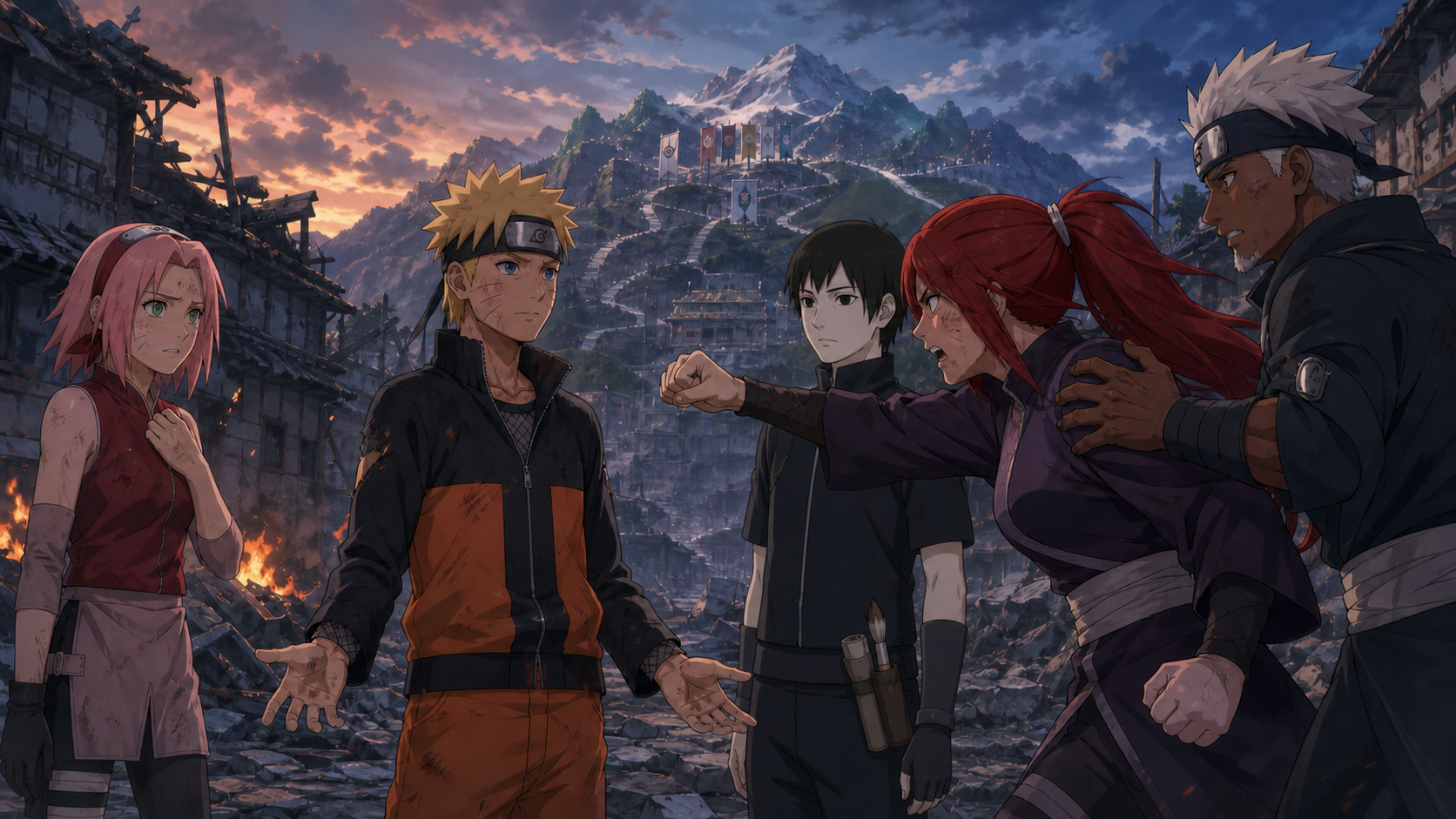
Five Kage Summit’s Eve
Naruto refuses to buy Sasuke’s life with betrayal, but offering himself as the place where Karui’s anger can land reveals the dangerous cost of his answer.
Bottom line
Naruto Shippuden Episode 198, “Five Kage Summit’s Eve,” begins with Karui demanding information about Sasuke. She and Omoi believe Killer B has been captured, and their anger is rooted in the fear that their teacher may already be dead.
Naruto refuses to betray Sasuke’s location. He explains that helping the Cloud kill Sasuke would invite retaliation from the Leaf friends who still care about him, which would provoke another answer from the Cloud. Instead of feeding that cycle, Naruto offers to absorb Karui’s hatred himself.
Karui beats him while he refuses to defend himself. Sai finally blocks another strike, and Omoi restrains his teammate before the punishment goes further. Samui arrives with new intelligence and recalls the group to continue its mission.
Elsewhere, Danzō prepares for the Five Kage Summit with Fū and Torune as his guards. He orders Root to keep Naruto confined to Konoha. Taka learns the summit’s location and redirects its pursuit toward Danzō, while Naruto decides he must personally ask the Raikage to spare Sasuke.
Karui’s anger begins with love, not cruelty
Karui is furious because Killer B is not an abstract military asset to her. He is her teacher, someone who shaped her team and gave their lives structure. Sasuke’s attack has left her with uncertainty instead of a body, explanation, or chance to help.
That context does not excuse everything she does, but the context matters. The scene would be much flatter if she were simply a bully. She is a student trying to turn helplessness into action, and Naruto is the only available person connected to the target she cannot reach.
The problem is that pain does not become justice merely because its origin is understandable.
Naruto refuses information because he sees the next retaliation
Naruto does not argue that Sasuke is innocent. He understands exactly what Karui wants to do with any useful information: find Sasuke and kill him.
His refusal comes from looking beyond the first act of revenge. If the Cloud kills Sasuke, people in Konoha who still love him may retaliate. The Cloud will answer that retaliation, and every new casualty will create another person with a reason to strike back.
Nagato’s story has changed the scale of Naruto’s thinking. He no longer sees hatred as a single villain’s flaw. He sees a chain built from grievances that can all feel justified to the person holding them.
Offering his body is compassionate and dangerously incomplete
Naruto’s solution is to let Karui hit him until her anger is exhausted. The offer is sincere. He wants to acknowledge her loss without sacrificing Sasuke or attacking someone who is grieving.
But taking the blows does not answer the Cloud’s questions, restore Killer B, or create accountability for Sasuke’s actions. The beating turns Naruto into a temporary container for pain that will still exist after Karui stops.
The gesture shows how far Naruto will go to prevent another cycle. The same gesture also shows that he has not yet learned the difference between interrupting violence and solving the cause.
Sai recognizes the point where endurance becomes harm
Sai initially respects Naruto’s choice enough not to interfere. He has learned that bonds matter to Naruto in ways Root never taught him to understand.
Watching the beating changes his judgment. Naruto’s loyalty has become self-punishment, and allowing the violence to continue would not honor the friendship that inspired the choice. Sai blocks Karui because a teammate’s decision can still be wrong when the decision is destroying him.
This is meaningful growth for someone once trained to erase emotion. Sai does not consult a rulebook. He looks at Naruto, recognizes suffering, and acts because he cares.
Omoi’s intervention matters because the Cloud supplies the boundary
Sai stopping Karui could be dismissed as the Leaf protecting its own. Omoi’s intervention carries different weight. He shares Karui’s fear for Killer B and wants answers just as badly, yet he can see they have reached a boundary.
Omoi respects Naruto’s refusal to sell out a comrade. That respect does not mean forgiving Sasuke. The intervention recognizes a principle he understands from his own bond with Killer B.
For one moment, the teams find common ground not through agreement about Sasuke, but through their shared refusal to abandon people they love.
Sakura is forced to watch the promise injure Naruto
Naruto’s determination to retrieve Sasuke has always been connected to the promise he made Sakura. She did not ask him to accept this beating, but the promise has grown into a burden he treats as entirely his.
Watching Karui strike him makes that burden visible. Naruto is not only chasing Sasuke across distance. He is absorbing consequences created by Sasuke’s choices and calling the suffering loyalty.
Sakura’s discomfort is important because the scene prepares her to question whether the promise is keeping Naruto trapped. The answer will not be as simple as releasing him from a sentence, because his bond with Sasuke belongs to him too.
Danzō prepares for diplomacy like a covert operation
The Five Kage Summit is meant to coordinate the great villages against Akatsuki. Danzō approaches the meeting with Fū and Torune, two elite Root operatives whose loyalty and specialized skills fit his preference for hidden control.
He also orders Naruto confined. The village’s greatest recent hero is treated as both a strategic asset and a political risk. Danzō does not trust Naruto to accept the Sasuke order or stay out of international negotiations.
His leadership style is visible before the summit begins: restrict unpredictable people, surround himself with operatives shaped by Root, and call secrecy protection.
Taka changes course toward the person behind the order
Sasuke’s group learns that Danzō will attend the summit in the Land of Iron. Their objective shifts from Konoha itself to a gathering where the new Hokage will be exposed outside the village.
That decision pulls a personal revenge mission into an international meeting. Sasuke is no longer moving around the political story; he is heading directly into its center.
Danzō sees Sasuke as a threat to eliminate. Sasuke sees Danzō as a target tied to the Uchiha massacre. Neither intends to let the summit remain a controlled diplomatic event.
Naruto decides conversation must happen face to face
Samui cannot simply take Naruto along, and the Raikage is already traveling. Naruto still concludes that he needs to speak with him directly.
This is both hopeful and naive. Naruto has changed enemies by understanding their pain, so he believes honest conversation can create another path. The Raikage, however, is not waiting for a lesson about Sasuke’s childhood. He believes his brother was attacked and has responsibilities to his own village.
Naruto’s willingness to go is admirable because he is finally moving beyond defending Sasuke only among friends. He is preparing to make that case to someone who has every reason to reject the plea.
The summit begins before anyone reaches the table
The episode’s title calls this the eve of the meeting, but the negotiations have already started through orders, intelligence, and movement. Danzō selects guards. Taka selects a target. The Cloud carries grief and evidence. Naruto chooses an appeal.
Each party approaches the Land of Iron with a different definition of what the summit should accomplish. That makes the gathering dangerous before a single Kage takes a seat.
The roads converging on neutral territory are carrying private wounds disguised as policy.
Naruto confuses absorbing hatred with transforming hatred
Naruto understands that returning Karui’s violence would deepen the grievance. He chooses nonretaliation, which prevents the immediate exchange from becoming a fight between Leaf and Cloud shinobi.
Absorption is not transformation. Karui still lacks information about Killer B, Sasuke remains unaccountable, and Naruto leaves with injuries rather than a shared plan. The hatred has changed location without changing structure.
Nagato asked Naruto to find an answer beyond revenge. Episode 198 shows an honest first attempt and the limitation inside that attempt. Refusing to strike back matters. Building justice after refusal remains unfinished work.
Karui’s fists reveal the cruelty of missing information
The Cloud team believes Killer B was captured because nobody knows he used Sasuke’s attack as an escape opportunity. Karui’s grief grows inside uncertainty created by B, Sasuke, Akatsuki, and incomplete intelligence.
Naruto knows Sasuke’s history but cannot offer facts about B. Karui knows the Cloud’s loss but not the truth of Sasuke’s own manipulation. Each person enters the confrontation holding only the part that makes the other side look unbearable.
Violence rushes into that gap because violence creates a feeling of action when knowledge offers no control. Samui’s arrival with intelligence demonstrates the better tool arriving late.
Sai learns that respecting a choice can become abandonment
Sai initially lets Naruto decide how to respond because Naruto’s bonds have taught him to respect emotional commitments he does not fully understand. Continued observation changes the ethical question.
Autonomy does not require friends to watch silently while self-sacrifice becomes injury. Sai blocks the strike without denying Naruto’s desire to interrupt revenge. He separates the goal from the harmful method.
That judgment marks growth beyond obedience. Root taught him that orders define right action. Friendship teaches him to evaluate what an order or personal choice is doing to a person in front of him.
Omoi creates a boundary without erasing Cloud grief
Omoi does not forgive Sasuke or tell Karui that her anger is illegitimate. He stops the beating because Naruto’s endurance has ceased to provide any answer. The intervention comes from inside the injured group, which prevents the boundary from looking like Leaf self-protection alone.
He also recognizes Naruto’s refusal as a form of loyalty familiar from Team Samui’s bond with B. Shared principle appears before shared conclusion.
That small recognition is more useful than Naruto becoming a punching bag. Peace begins when people can identify one another’s values without pretending the grievance has vanished.
Sakura sees how promises can outgrow their original owners
Naruto made the retrieval promise to Sakura, but years of choice have made the bond his own. Sakura still experiences guilt because her request gave the promise language and because Naruto repeatedly invokes that language while accepting pain.
Watching the beating creates urgency without giving her a sound solution. She begins to believe that withdrawing the request can release him, even though Naruto’s relationship with Sasuke no longer depends on her permission.
The episode prepares her false confession by showing the emotional logic behind the mistake. She wants to cancel a debt that cannot be reduced to a transaction.
Danzō treats Naruto’s agency as a security flaw
Naruto has just saved Konoha and earned public recognition, yet Danzō orders Root to confine him. The new Hokage values the Nine-Tails and fears the person capable of deciding where that power goes.
Confinement fits Danzō’s broader model. Predictability matters more than consent, and loyalty is safest when a subordinate lacks enough information or freedom to disagree.
Naruto’s journey toward the Raikage challenges that model. He risks failure through direct conversation rather than accepting a policy decided around him.
The Japanese performances prevent the beating from becoming spectacle
Junko Takeuchi gives Naruto restraint without serenity. Pain remains audible, which keeps nonretaliation from looking effortless or superhuman. Yū Kobayashi gives Karui anger rooted in fear rather than cartoon cruelty.
Satoshi Hino makes Sai’s intervention feel newly personal, carrying the surprise of someone discovering a boundary through attachment rather than training. Norihiko Kawamoto gives Omoi anxious thoughtfulness even during decisive restraint.
The scene works because nobody sounds victorious. The violence stops, but grief, guilt, and missing information remain in the snow.
Karui needs an answer and finds only another student
Killer B is teacher, family, and structure inside her life. Sasuke is unreachable, intelligence is incomplete, and Naruto is the nearest person connected to the name causing her fear.
That proximity makes him available, not responsible for every choice Sasuke made. Grief collapses the distinction because striking something feels closer to action than waiting.
Naruto sees retaliation as a chain before others see the next link
He understands that giving Sasuke’s location means authorizing death. Leaf friends may retaliate, Cloud shinobi will answer, and each loss will create another righteous grievance.
Nagato changed how Naruto reads violence. Every participant can have a legitimate wound while the structure produced by answering wounds remains catastrophic.
Absorbing pain is not the same as resolving it
Naruto’s refusal to strike back prevents an immediate inter-village fight. Letting Karui continue does not restore B, locate Sasuke, or establish accountability.
He moves hatred into his own body because that is the life he feels authorized to spend. Compassion becomes self-punishment when no shared solution follows.
Sai discovers that friendship can require interruption
Respecting Naruto’s agency initially means allowing him to choose nonretaliation. Watching injury accumulate changes the responsibility.
Sai blocks the next strike because loyalty cannot mean silently preserving every harmful decision a friend makes. He protects Naruto’s goal by rejecting the method destroying him.
Omoi makes the boundary belong to the Cloud too
He shares Karui’s fear and does not excuse Sasuke. He still recognizes that the beating has stopped producing information, justice, or relief.
His intervention prevents the moment from becoming Leaf defense against Cloud grief. Someone inside the injured group can validate anger and say this action has gone too far.
Sakura watches an old promise become a private punishment
Naruto first named the rescue as a promise to her. Years of attachment have made it his own, yet Sakura sees every injury as evidence that her request created the burden.
Her coming mistake grows from understandable guilt. She believes she can cancel a debt whose emotional meaning no longer belongs to her alone.
Danzō responds to uncertainty with confinement
Naruto’s popularity and power do not reassure him because both are attached to independent judgment. The hero who saved Konoha may reject the Sasuke order publicly.
Root treats agency as a security flaw. Restricting Naruto becomes easier than building a policy capable of surviving his disagreement.
Every road carries a private wound toward diplomacy
Danzō brings control, Sasuke brings vengeance, the Cloud brings fear for B, and Naruto brings a desperate appeal. The summit is already negotiating before anyone reaches the table.
Neutral territory cannot make participants neutral. It only provides one place where their different definitions of justice will collide.
RaeRae’s reaction to Five Kage Summit’s Eve
Naruto refusing to betray Sasuke makes sense to me. Handing Karui a location would be the same as agreeing to an execution. He has seen enough revenge to understand that one death would not close the account.
But watching him offer his face as the solution is painful. Karui’s grief deserves acknowledgment, yet Naruto cannot heal her grief by becoming another injured person. He is trying to purchase peace with himself because that is the only life he feels authorized to spend.
Sai stepping in is my favorite part. The boy trained not to feel is the person who recognizes that loyalty does not require standing still while your friend is harmed. Omoi joining him keeps the moment from becoming one village against another.
Meanwhile, every road is pointing toward the summit: Danzō with Root at his shoulders, Sasuke hunting Danzō, and Naruto chasing a conversation with the Raikage. Nobody is arriving neutral. The meeting has not started, and the gathering is already carrying enough grief to break the table.
Naruto chooses conversation because force cannot answer legitimacy
The Raikage has a duty to his village and a personal bond with B. Naruto cannot defeat those reasons without confirming every suspicion about Leaf arrogance.
Asking face to face is hopeful and incomplete, but it recognizes that the person carrying the grievance deserves more than a message routed through subordinates.
The beating ends without pretending the conflict ended
Sai and Omoi stop physical harm. Karui still lacks answers, Naruto still protects Sasuke, and the villages still approach a summit under pressure.
That lack of emotional cleanup is honest. A boundary can be necessary before anybody agrees on justice or feels remotely healed.
Karui and Naruto clearly mirror each other. Both are students terrified of losing someone central to their identity. Both understand loyalty as refusing to abandon that person when the situation becomes ugly. The difference is where available power points. Karui can reach Naruto, so anger lands there. Naruto can control only his own response, so he turns himself into the cost. Omoi and Sai interrupt the symmetry by protecting their teammates from methods grief made feel necessary. Their boundary does not choose Sasuke or erase B. It protects the people still standing in front of them.
RaeRae’s final word on Five Kage Summit’s Eve
Naruto refusing to hand over Sasuke makes sense. A location would become consent to an execution, and he knows one death will not close the account.
Watching him offer his face instead is brutal. Karui’s grief deserves recognition, but another injured student cannot become the repair for a missing teacher.
Sai stepping between them is my favorite moment. Root trained him to obey. Friendship teaches him to judge when respecting a choice has become abandonment.
Omoi joining him matters just as much. He shares the Cloud’s loss and still says the violence has crossed a line.
Meanwhile, Danzō, Sasuke, and Naruto all move toward the summit with different private wars. Nobody has taken a seat, and the table is already carrying more grief than diplomacy knows how to hold.
RaeRae’s call
Naruto can refuse retaliation without volunteering as a container for everyone’s pain. Sai and Omoi supply the boundary he cannot give himself, proving care sometimes means stopping the sacrifice.