
Gutsy Master and Student: The Training
Jiraiya teaches Naruto how to fight an illusion, then finds a village where fear has become Kandachi’s most effective form of control.
Bottom line
Naruto Shippuden Episode 187, "Gutsy Master and Student: The Training," returns to the period just before Naruto left the Hidden Leaf with Jiraiya. Naruto is still recovering from his fight with Sasuke when Jiraiya announces that their long training journey will begin as soon as the hospital releases him.
Jiraiya wants Naruto to prepare for the Akatsuki and stop chasing a teammate who chose to leave. Naruto answers that abandoning Sasuke is not an option, even if that makes him a fool. Once they are on the road, Jiraiya begins teaching him how to escape genjutsu, a skill Naruto will need if Sasuke develops the Sharingan under Orochimaru.
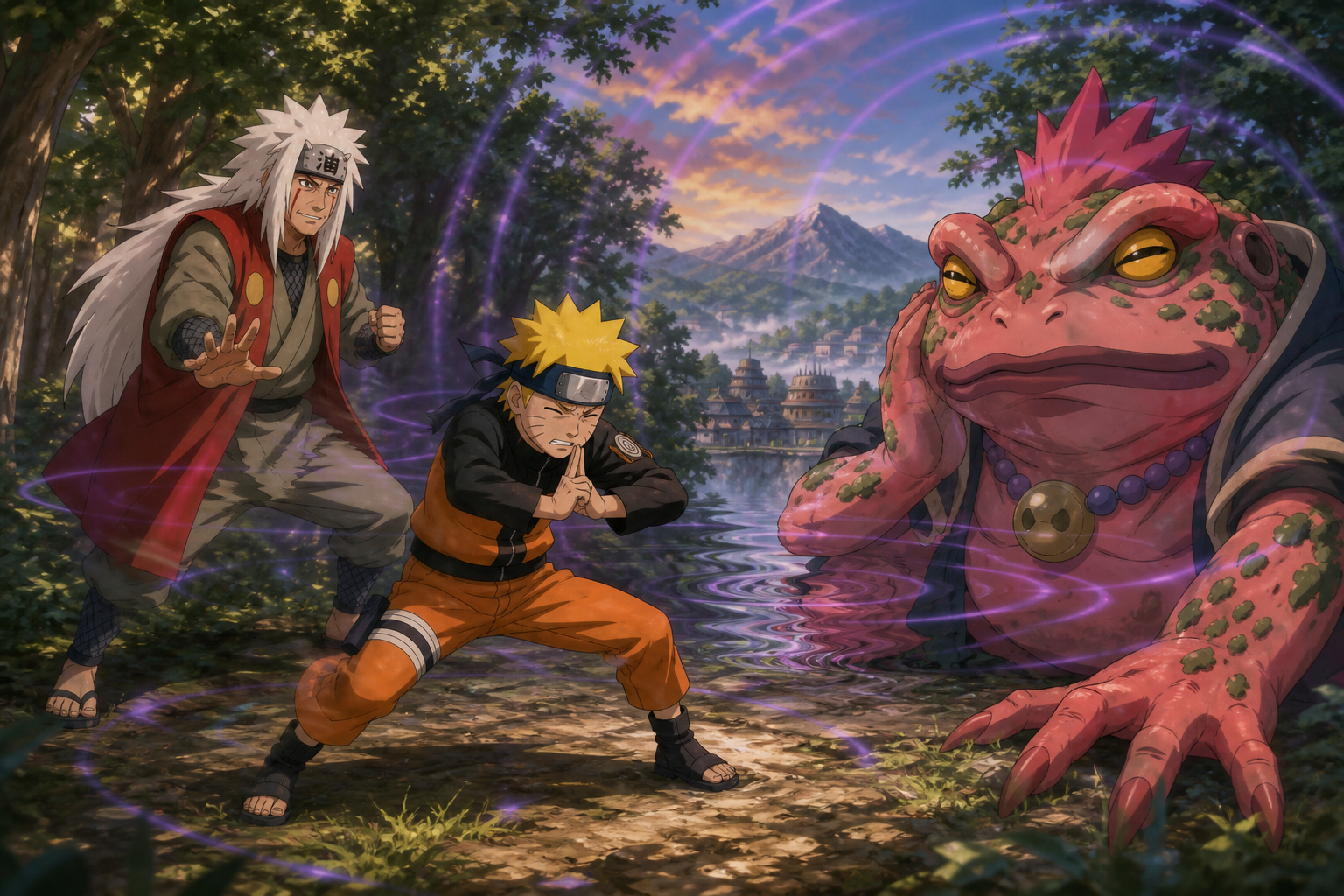
The lesson goes badly. Jiraiya summons the flamboyant toad Gamariki to trap Naruto in an illusion, but Naruto cannot disrupt his chakra flow cleanly enough to break free. Jiraiya takes him back to chakra-control basics and chooses a region known for naturally occurring illusion effects as their next training ground.
Their destination is no longer the peaceful village Jiraiya remembers. A boy named Tanishi turns travelers away at the gate, and armed Rain ninja watch the settlement. Jiraiya recognizes the boy and sneaks inside with Naruto. Tanishi reveals that Kandachi, a former subordinate of Hanzō, seized the village, took hostages, and killed his father. Training becomes a rescue mission before Naruto has mastered the very defense he will need.
Episode 187 begins as technical preparation for Sasuke and becomes a lesson about why Naruto needs strength in the first place. Genjutsu exposes a weakness that determination cannot simply overpower. Tanishi's occupied village then forces master and student to carry that unfinished training into a crisis where mistakes affect strangers, hostages, and a frightened child.
Jiraiya hears Naruto choose the difficult road
The hospital conversation matters because Jiraiya gives Naruto an exit. He can train for the threat aimed directly at him, accept Sasuke's decision, and conserve his energy for survival. The proposal is a practical argument from an adult who knows how brutally the shinobi world punishes attachment.
Naruto refuses the exit without pretending the choice is sensible. He calls himself a fool before anyone else can use the word against him. That admission is more honest than a polished speech about friendship. Naruto knows the promise may hurt him, knows Sasuke may reject him again, and still believes a bond carries responsibility after the bond becomes inconvenient.
Jiraiya does not win the argument, but he learns what kind of student will be traveling beside him. The training journey cannot simply manufacture a stronger weapon for Konoha. The journey has to shape a boy whose stubborn loyalty is inseparable from his strength.
Jiraiya's response is revealing. He disagrees with Naruto's goal yet agrees to train the person pursuing that goal. A lesser mentor might demand emotional obedience before offering instruction. Jiraiya instead accepts that Naruto's loyalty is part of the student, then works to keep that loyalty from becoming fatal incompetence.
Genjutsu exposes Naruto's weakest kind of control
Naruto understands effort when effort means more repetitions, more clones, or getting up after a hit. Genjutsu asks for something less comfortable: precision inside his own chakra system. He cannot punch the illusion or overwhelm the trap with enthusiasm. He has to recognize the manipulation, interrupt the flow, and regain control deliberately.
Gamariki makes the failure funny, but the lesson is serious. Naruto's enormous chakra reserves have often let him force his way through imperfect technique. Against an illusion, raw supply does not guarantee clear perception. A fighter who cannot trust his senses can turn all that power in the wrong direction.
Jiraiya's response is not to invent a glamorous shortcut. He returns Naruto to fundamentals. That decision feels like real teaching. A master is not someone who keeps producing more spectacular exercises. Sometimes a master notices the missing piece underneath every failed attempt and makes the student practice the thing he hoped he had outgrown.
Sasuke is present even when he is absent
Sasuke never needs to enter the scene for the episode to revolve around him. Jiraiya frames genjutsu training around the Sharingan because Naruto measures the road ahead by a future reunion. Naruto is not learning an abstract defensive category. He is preparing to stand before Sasuke again without being dismissed as the same boy from the Valley of the End.
That motivation is both useful and dangerous. The promised reunion keeps Naruto working after embarrassment, but the fixation can narrow his attention until every lesson becomes part of one rivalry. Jiraiya keeps widening the frame. Akatsuki is coming. Other people will need Naruto. The world beyond Konoha contains dangers and lives that do not pause for his unfinished promise.
The village they encounter proves Jiraiya's point before he has to repeat the warning. Naruto's private reason for training brings him into a public crisis. The skills meant for Sasuke may first be needed for strangers.
That widening does not make Sasuke irrelevant. Naruto's promise supplies fuel, while the journey teaches him that power developed for one bond carries obligations toward many people. Personal loyalty becomes the doorway into a larger ethic rather than a cage around his attention.
Jiraiya remembers more than he tells Naruto
While Naruto struggles through the night, Jiraiya sees Minato in him and thinks of Kushina too. The resemblance is not only visual. Naruto carries Minato's potential and Kushina's force of will without knowing how often his teacher is measuring the present against people he lost.
There is tenderness in Jiraiya keeping that history mostly to himself, but also distance. Naruto is traveling with someone who holds pieces of his family story that he has never been given. Jiraiya teaches him like a godfather, protects him like a guardian, and still speaks through exercises more easily than through grief.
That history makes the title's master-and-student language feel deliberately incomplete. Their bond contains teacher and pupil, but the relationship also contains an older man trying to honor two dead friends by helping their son survive.
The withheld family context creates a bittersweet imbalance. Jiraiya knows why certain expressions and habits affect him, while Naruto experiences the attention without understanding the full lineage behind the attention. Training becomes one of the few languages through which Jiraiya can express care without naming every loss.
Tanishi guards a village through fear
The gatekeeper's warning initially looks hostile. Tanishi tells outsiders to leave because open resistance has already cost his family and put the remaining villagers at risk. His fear is not cowardice in a vacuum. Kandachi has created a system in which every brave move can be answered through hostages.
Jiraiya recognizes Tanishi rather than judging the mask he wears at the gate. That recognition is important. A village under occupation does not announce the truth plainly, and frightened people do not always behave like grateful victims when help arrives. Jiraiya reads the changed behavior as evidence that something happened.
Naruto tends to trust direct declarations. This mission asks him to notice what pressure does to a person before demanding courage from that person.
Tanishi's behavior is adaptive under occupation. Turning travelers away may protect them, prevent retaliation, or keep Kandachi from noticing a possible alliance. Jiraiya reads the fear as information rather than a moral defect, showing Naruto that rescue begins with understanding the conditions shaping someone's choices.
Kandachi turns illusion into government
The episode links Naruto's training problem to the village's political problem. Genjutsu controls perception. Kandachi controls the settlement by making people believe resistance can only produce more loss. Both traps become stronger when the person inside accepts the imposed reality as the only reality available.
Naruto has not learned to break either trap yet. He cannot reliably release Gamariki's illusion, and he cannot storm the village without endangering hostages. The unfinished state is exactly why the episode works as the first half of a two-part story. Naruto does not receive mastery the moment innocent people appear. His limitations travel into the mission with him.
Jiraiya must build a plan around what Naruto can do now, not the hero Naruto will eventually become.
Gamariki keeps failure from becoming humiliation
The flamboyant summon gives Naruto room to fail without turning the entire lesson grim. Gamariki's personality makes the exercise funny, while the trapped student's frustration remains technically meaningful. Comedy lowers the emotional temperature enough for Jiraiya to diagnose the real weakness.
Naruto often responds to embarrassment by escalating effort. Genjutsu punishes that reflex because more chaotic chakra is not the same as controlled disruption. Gamariki's illusion makes the gap visible without placing civilians at risk.
The later crisis changes the stakes, which is why the training scene belongs first. Viewers understand exactly what Naruto cannot do before Kandachi's village makes that limitation dangerous.
Training reveals responsibility before mastery
Naruto might prefer to perfect a technique in isolation and arrive at the future confrontation fully prepared. The road refuses that schedule. People need help while he is unfinished, and Jiraiya must decide how to use a student whose courage exceeds his control.
That mismatch is not a reason to abandon the village. The mismatch is a planning constraint. Jiraiya gathers information, studies the occupation, and searches for roles Naruto can perform without pretending enthusiasm has erased the danger.
The episode therefore treats strength as judgment under imperfect conditions. Shinobi rarely receive crises tailored to the lesson they have already mastered. Growth includes knowing where a student needs support and where an incomplete skill can still serve someone.
The first half ends on a productive failure
Naruto finishes Episode 187 without a clean genjutsu release, a defeated villain, or a rescued village. The lack of closure protects the training from becoming decorative. His weakness remains active inside the coming operation.
At the same time, the episode has moved him forward. He understands the mechanism better, accepts a return to fundamentals, and sees how illusion can operate through both chakra and fear. Technical failure becomes preparation for a more complicated success.
That structure also gives Tanishi space to matter in the conclusion. If Naruto mastered every answer alone during the first half, the occupied villagers would become witnesses to someone else's power. Leaving a gap creates room for local courage to complete the lesson.
The journey becomes the lesson
Jiraiya chooses an illusion-rich region as a practical classroom. What he finds is a reminder that training outside the village cannot stay controlled. There are no clean boundaries between exercise, history, and responsibility. The road teaches by interrupting the curriculum.
That is likely part of why Naruto grows so much during these years even when individual techniques take time. He is not only repeating drills beside a campsite. He is seeing how different villages survive, how power changes daily life, and how Jiraiya gathers information before choosing a fight.
Episode 187 lets us watch the beginning of that education instead of jumping from departure to homecoming. Naruto still lunges toward problems. Jiraiya still has to convert impulse into strategy. Their rhythm as traveling partners is being built in real time.
Naruto names himself a fool before Jiraiya can dismiss him
There is power in how little polish Naruto gives the hospital promise. He does not prove rescuing Sasuke is strategically sound. He accepts that the choice may be foolish and refuses to let embarrassment become permission to abandon somebody.
That answer tells Jiraiya exactly what kind of strength needs shaping. Naruto’s loyalty will not disappear, so training must help it survive contact with consequences.
Jiraiya teaches the student he has instead of demanding another one
He disagrees, warns Naruto, and then begins preparing him for the path he chose. Instruction is not withheld until the student adopts the teacher’s emotional conclusions.
That restraint matters. Jiraiya recognizes stubborn attachment as both Naruto’s greatest risk and the moral engine that keeps him from accepting the world’s disposable categories.
Genjutsu requires an inward precision Naruto avoids
Most of Naruto’s favorite solutions expand outward: more clones, more force, another charge. Escaping illusion requires noticing corruption inside his own perception and interrupting chakra deliberately.
He cannot use determination as a substitute for self-awareness. The lesson asks him to become quiet enough to identify what feels wrong before power can answer it.
Gamariki makes technical failure survivable
The flamboyant summon turns embarrassment into comedy without making the weakness imaginary. Naruto can be frustrated, ridiculous, and genuinely unprepared at once.
That emotional safety gives Jiraiya room to diagnose instead of merely punish. Training works because failure produces information rather than a verdict about worth.
Returning to basics is respect, not demotion
Jiraiya does not decorate the problem with a new signature technique. He notices that chakra control beneath the release is unreliable and takes Naruto backward.
A responsible teacher would rather repair a foundation than let a talented student hide the gap behind spectacle. Naruto’s power deserves control sturdy enough to direct it.
Tanishi makes the road morally immediate
The training journey could remain a private bridge between Valley of the End and Naruto’s eventual return. A frightened child at an occupied gate breaks that neat timeline.
Strangers need help before Naruto feels ready. Strength developed for Sasuke acquires obligations that were never part of the original promise.
Occupation manipulates perception without casting one illusion
Kandachi controls the village by teaching residents that resistance leads only to punishment and hostage deaths. Fear narrows possible futures until obedience looks like reality itself.
The parallel with genjutsu is deliberate. Both forms of control become durable when the trapped person cannot imagine a trustworthy signal outside the imposed world.
Jiraiya reads fear as intelligence
Tanishi’s hostility could be mistaken for ingratitude. Jiraiya notices the boy, remembers the village, and asks what pressure would produce this behavior.
That is mature fieldwork. Rescue starts by understanding why people under threat may hide information, reject help, or perform loyalty to the person controlling them.
RaeRae's reaction to Gutsy Master and Student: The Training
I love that Naruto's anti-genjutsu lesson begins with an aggressively glamorous toad. Gamariki is funny enough to make Naruto's frustration entertaining, while the failure underneath the joke stays real. Naruto cannot sheer-force his way out, and Jiraiya refuses to flatter him about the weakness.
The hospital scene is the emotional anchor for me. Jiraiya says chasing Sasuke is foolish, and Naruto essentially answers, “Correct. Train me anyway.” That stubbornness can be exhausting, but the same stubbornness is also the reason Naruto does not sort people into worthy and disposable categories.
The turn toward Tanishi's village gives the flashback a purpose beyond nostalgia. Jiraiya is trying to prepare Naruto for one specific opponent, then the world immediately presents a frightened child and a hostage crisis. That collision is the real shape of becoming stronger: the power you imagined using for your own unfinished story becomes something other people may need first.
I also appreciate that the episode ends before pretending Naruto has solved genjutsu. He is still vulnerable, Kandachi is still in control, and Jiraiya has to make a rescue plan with an unfinished student. That unfinished lesson gives the next chapter something better than a larger attack to resolve. Naruto will have to prove that his guts can become discipline when someone else's family is at stake.
Jiraiya returning Naruto to chakra basics is another favorite choice. The story respects teaching enough to admit that a famous technique cannot cover every weak foundation. Naruto is allowed to be powerful, determined, and genuinely unprepared at the same time.
The unfinished lesson makes the rescue believable
Naruto does not master genjutsu because innocent people appear. His limitation remains part of Jiraiya’s planning, forcing the teacher to distinguish bravery from readiness.
That gap creates room for partnership in the conclusion. If Naruto already carried every answer, Tanishi and the villagers would become an audience for rescue rather than participants in their own release.
The title pairs master and student, but the episode keeps showing how each one changes the other. Naruto forces Jiraiya to teach beyond the future he would choose for him. Jiraiya forces Naruto to respect foundations his willpower cannot replace. Their journey works because neither affection nor authority ends the argument. Training becomes the place where disagreement is carried forward safely enough for both people to keep growing together beside it.
RaeRae’s final word on Gutsy Master and Student: The Training
Jiraiya tells Naruto that chasing Sasuke is foolish, and Naruto’s answer is basically, yes, now teach me how to survive doing it. That is exhausting, honest, and completely him.
I love that Jiraiya does not confuse disagreement with abandonment. He starts with the weakness most likely to matter against the Sharingan and refuses to flatter Naruto when enormous chakra cannot solve precise control.
Gamariki makes the failure funny, but the lesson stays sharp. Naruto cannot punch his way out of a corrupted perception. He has to recognize what is happening inside himself, which may be the harder battlefield for a boy who survives by moving outward.
Then the road interrupts the curriculum with Tanishi’s village. A frightened child, armed occupation, and hostages do not care that Naruto’s training arc is unfinished. Other people need whatever courage and discipline he can responsibly offer now.
That collision is the point. Naruto starts training for Sasuke. Jiraiya starts teaching him how strength built for one beloved person becomes responsibility toward people whose names he learned at the gate.
RaeRae’s call
Naruto’s guts choose the road, but guts cannot replace control. Jiraiya’s real lesson is teaching an unfinished student to carry stubborn loyalty into a world where strangers may need that strength first.