
Record of the Gutsy Ninja Master and Student
Tanishi breaks Kandachi’s illusion, Jiraiya creates the opening, and Naruto turns a failed Rasengan into the strike that frees a village.
Bottom line
Naruto Shippuden Episode 188, "Record of the Gutsy Ninja Master and Student," completes Naruto and Jiraiya's mission in the Genjutsu Tree Village. Their disguise gets them close to Kandachi, but the real Tanishi appears and exposes Naruto's Transformation Technique. Kandachi decides that the boy and the hostages must die together.
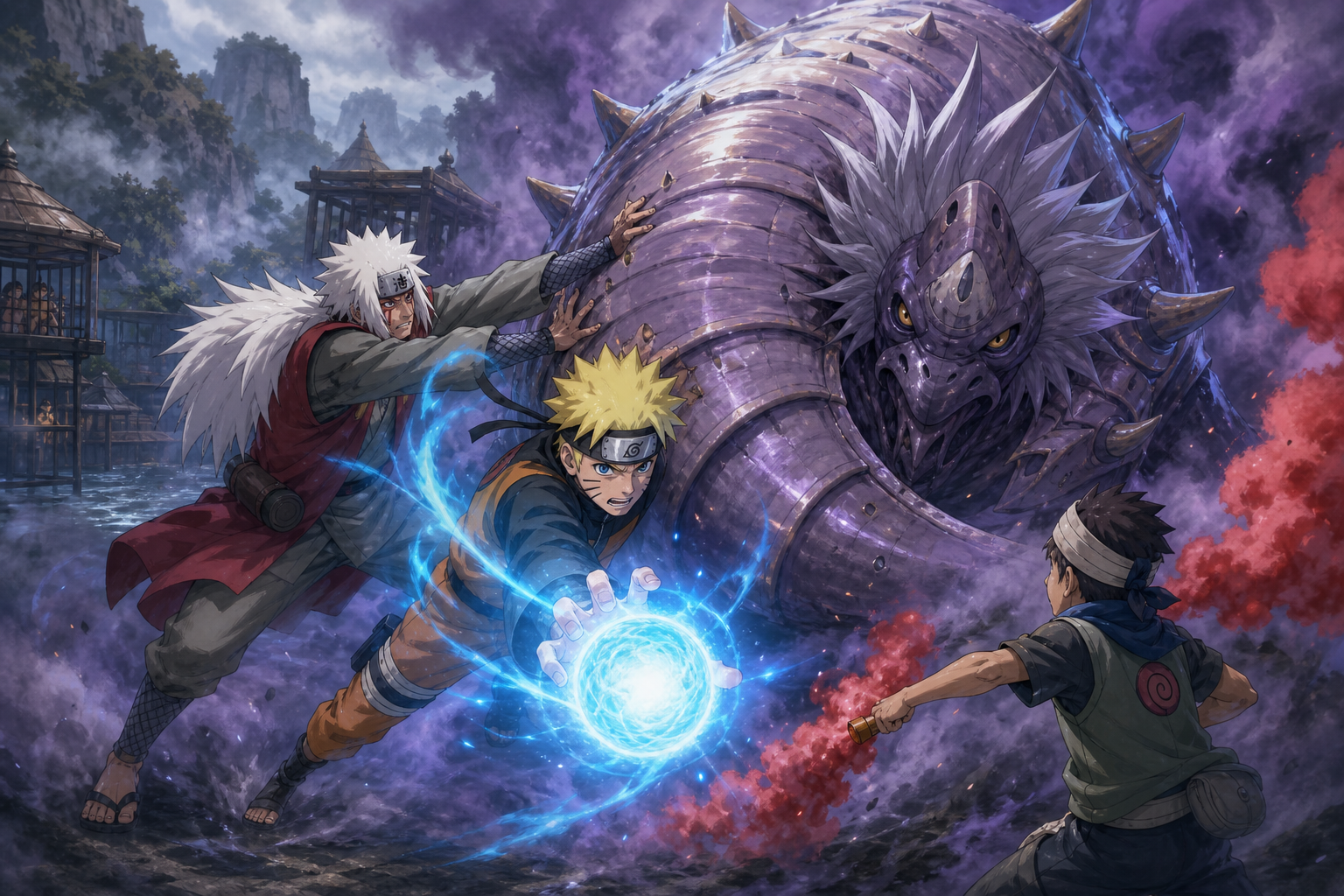
Kandachi summons the Conch King, a massive armored creature whose shell stops Naruto's Rasengan. Jiraiya cuts the suspended cages free and moves the villagers to safety while Naruto keeps the summon occupied. The Conch King's whip knocks Naruto down repeatedly, echoing the attack that killed Tanishi's father, Sukune.
Kandachi then traps Naruto and Jiraiya in a fog-based genjutsu. Tanishi finally chooses the kind of “foolish” resistance he once rejected and throws chili-pepper bombs into the mist. The irritation disrupts the illusion. Jiraiya restrains Kandachi and his summon long enough for Naruto to expand his technique into a Big Ball Rasengan, cracking through the Conch King's defense and ending the occupation.
The village regains control of its home. Naruto and Jiraiya honor Sukune before leaving, and Jiraiya privately connects Naruto's growth to Minato. His attempt to claim Naruto as a grandson becomes an awkward joke, but the feeling behind the claim is real.
Episode 188 finishes the mission by making courage collaborative. Naruto's persistence matters, but persistence cannot break the fog alone. Tanishi chooses to act, Jiraiya controls the battlefield, and Naruto adapts the Rasengan that failed against the Conch King's shell. The victory belongs to a chain of people supplying what the next person lacks.
Naruto's disguise buys time, not victory
The opening trick works exactly as long as necessary. Naruto impersonates Tanishi so Jiraiya can enter Kandachi's space without beginning with a frontal assault. The disguise is a small sign that the student who usually announces himself with shouting can participate in an actual infiltration plan.
The disguise was never going to hold forever. Its purpose is access, and the moment the deception breaks reveals Kandachi's governing instinct. He does not investigate uncertainty or negotiate. He threatens every hostage because terror is the only authority he understands.
Tanishi's arrival looks like a mistake, but the interruption also ends the part where other people act in his name. The boy has to become visible inside his own story before he can make a choice that belongs to him.
The disguise therefore succeeds without becoming a magic answer. Naruto and Jiraiya gain access, learn Kandachi's immediate intentions, and force the occupation into the open. Once Tanishi arrives, the mission has to stop borrowing his identity and start protecting his right to choose.
The Conch King's shell turns force into frustration
Naruto reaches for Rasengan because the technique has become his answer to a hard target. This time the impact disappears against a shell built to absorb the force. The failure is useful after Episode 187's genjutsu lesson. Naruto is confronting two different limits at once: he cannot trust his senses inside the fog, and his strongest familiar strike cannot pierce the enemy's defense.
Kandachi uses that failure theatrically. The Conch Whip keeps putting Naruto on the ground where Tanishi can see him. Kandachi wants the beating to prove that Sukune's resistance was pointless and that every person who stands up will receive the same ending.
Naruto's refusal to stay down changes the meaning of the spectacle. Kandachi intends repetition to teach obedience. Naruto turns repetition into evidence that pain has not settled the argument.
Tanishi watches the same weapon that killed Sukune strike another stubborn defender. Kandachi expects the repeated image to confirm his version of history. Naruto's survival introduces a different possibility: the whip is powerful, but power does not make the tyrant's conclusion true.
Tanishi is allowed to be afraid first
Tanishi does not transform into a fearless hero because Naruto gives one speech. He watches, remembers his father's death, pleads for his mother, and hesitates. The episode gives his fear enough room to make his eventual action believable.
Calling Sukune a fool helped Tanishi survive the contradiction of loving him and believing his death accomplished nothing. Naruto's stubbornness forces him to reconsider that defense. If resistance is foolish, then the fool in front of him is also the person risking everything for villagers he barely knows.
Tanishi's chili-pepper bombs are not an imitation of Naruto's power. They are an ordinary tool used at exactly the right moment. That distinction matters. Courage does not require the boy to become a shinobi overnight. He recognizes the prison, uses what he has, and gives two stronger people the opening they could not create from inside the illusion.
His action also repairs a painful misunderstanding about his father. Sukune's courage did not fail because one person could not defeat an occupation alone. Resistance can create a memory, a standard, or an opening that another person carries forward. Tanishi becomes part of that continuation without needing to repeat his father's death.
The genjutsu lesson finally leaves the classroom
Jiraiya brought Naruto here to practice disrupting illusions, yet both master and student are caught by the Conch King's fog. Reading that capture as a failed lesson would be easy. I think the rescue shows the larger truth of genjutsu defense: no shinobi is guaranteed perfect internal control, and sometimes release comes through an ally disturbing the trapped person's chakra or senses.
Naruto's first practical success is therefore communal. He does not suddenly master the technique by concentrating harder. His persistence inspires Tanishi, Tanishi breaks the fog, Jiraiya restrains the enemy, and Naruto supplies the finishing force. Everyone contributes the piece another person lacks.
That is a better preparation for the Sharingan than a neat solo victory would have been. Naruto wants to face Sasuke himself, but surviving dangerous illusions may depend on trusting someone outside his own perception.
The lesson is humbling in exactly the right way. Naruto cannot always determine whether his senses are reliable from inside a technique designed to corrupt those senses. Strength includes building relationships with people willing and able to interrupt the false reality.
Jiraiya creates the opening instead of taking the finish
Once the mist breaks, Jiraiya could probably dominate the scene. He is the legendary Sannin confronting a former Rain operative whose summon has already revealed its tricks. Instead, he restrains the Conch King and Kandachi so Naruto can complete the attack.
That is teaching under pressure. Jiraiya does not abandon the student to prove a point, and he does not erase Naruto's role by doing everything himself. He controls the variables Naruto cannot handle and leaves him responsible for the part he can.
The Big Ball Rasengan becomes more than a bigger sphere. The expanded technique shows Naruto adapting his known attack to the shell that stopped him. Jiraiya provides time, but Naruto has to use that time productively.
Their roles reflect a teacher who wants growth rather than applause. Jiraiya could seize the decisive image for himself. Instead, he makes the danger manageable enough for Naruto to solve the specific problem that defeated him earlier. Support and responsibility remain balanced.
Big Ball Rasengan answers Kandachi's false lesson
Kandachi's message is that resistance only increases suffering. Naruto answers without arguing philosophy. He takes the attack that failed, increases its scale, and breaks the object Kandachi treated as untouchable.
The visual is satisfying because the shell has carried so much symbolic weight. The barrier is physical armor, the Conch King's defense, and a representation of Kandachi's closed system. Hostages, fog, and public punishment all exist to convince the village that there is no point of entry.
Naruto does not win alone, but he is the visible proof that the defense can crack. Tanishi's choice makes that strike possible, which means the village begins defeating Kandachi before the Rasengan lands.
Kandachi's system depends on people accepting that every failed attempt proves permanent helplessness. The expanded Rasengan rejects that logic. A failed technique becomes information about the shell, and a frightened witness becomes the person who exposes the genjutsu's weakness.
Sukune's courage receives a different ending
The story does not pretend Sukune would have survived if he had simply fought better. His death is the wound Kandachi used to govern Tanishi. What changes is the conclusion attached to that loss.
Tanishi had treated his father's stand as meaningless foolishness. After Naruto, he can see courage as something that may outlive the person who acts. Sukune did not remove Kandachi, but the example remained available when his son was ready to understand the sacrifice.
Paying respects after the battle keeps the victory from swallowing the cost. The village is free, yet a family still lost someone. Naruto and Jiraiya leave only after acknowledging the man whose resistance came before theirs.
The memorial moment prevents Naruto from replacing Sukune in Tanishi's story. Naruto helps finish a struggle that began before he arrived. Honoring the dead keeps the village's liberation connected to local courage rather than turning the residents into spectators waiting for outside heroes.
Jiraiya recognizes family through teaching
Jiraiya sees Minato in Naruto throughout these episodes. At the end, the thought shifts from resemblance to relationship. If Minato regarded Jiraiya like a father, then Naruto occupies the place of a grandson, whether either of them knows how to say that gracefully.
The comedy of Naruto recoiling from Jiraiya's sudden affection protects both characters from sitting in the feeling too long. Jiraiya often hides sincerity behind performance. Naruto, who has wanted family his entire life, does not recognize the offer because the declaration arrives in the least dignified package imaginable.
Knowing where their story eventually goes makes the moment hurt. Jiraiya is not only training a promising student. He is choosing Naruto as family while the boy is still too embarrassed to recognize the declaration.
The village helps author its own freedom
Naruto and Jiraiya bring power that Kandachi cannot match, but the episode refuses to let outside strength become the whole solution. Tanishi breaks the fog using knowledge and tools available inside the village. His intervention changes the residents from hostages into participants.
That distinction matters after a long occupation. Freedom delivered entirely by strangers can leave people waiting for the next rescuer. Tanishi's choice proves Kandachi no longer controls every response. The village's political recovery begins before the final attack, at the moment fear stops determining the boy's action.
Naruto's role is catalytic. His repeated refusal gives Tanishi new evidence, but Tanishi decides what that evidence means. Inspiration respects agency when the inspired person authors the next move.
Kandachi mistakes suffering for proof
Kandachi treats Sukune's death as an argument. To him, the body proves resistance is foolish and obedience is rational. The Conch Whip repeats that message each time Naruto falls in front of Tanishi.
The flaw is that suffering demonstrates force, not moral truth. Naruto can be hurt without Kandachi becoming right. Sukune can die without his desire for freedom becoming meaningless. Tanishi's chili bombs separate outcome from value and deny the tyrant ownership of his father's memory.
That reversal is more damaging to Kandachi than the cracked shell alone. His authority depends on everyone accepting his interpretation of the past. Once Tanishi rejects that interpretation publicly, the occupation loses part of its emotional foundation.
The ending joins Minato, Jiraiya, and Naruto
Jiraiya sees Minato's qualities in Naruto, but the episode moves beyond resemblance. Teaching Naruto has created a relationship with its own history, jokes, irritation, trust, and affection. The awkward grandson claim is funny because Jiraiya reaches for a family word before either character knows how to hold the word comfortably.
Naruto's embarrassment fits a boy who craves family but has little practice receiving direct affection. Jiraiya's exaggeration fits a man who often uses comedy to retreat from sincerity. Beneath both reactions is a bond already proven in training and danger.
The scene gives their master-student title emotional depth. Techniques move from teacher to student, but so do protection, memory, and belonging. Jiraiya is not merely preparing Naruto for Sasuke. He is investing in the child of someone he loved and discovering that the child has become family too.
Tanishi ends the danger of being represented by others
Naruto’s disguise helps the infiltration, but it also places someone else inside Tanishi’s face. When the real boy appears, strategy becomes messier and his agency becomes unavoidable.
He can no longer remain the absent victim whose identity adults borrow for rescue. The final choice must happen through his own body, fear, memory, and wonderfully practical chili bombs.
The Conch Whip tries to make history repeat as obedience
Kandachi strikes Naruto with the weapon that killed Sukune while Tanishi watches. He wants the visual rhyme to close every argument: resistance leads to pain, fathers die, and boys should learn submission.
Naruto keeps standing, not because pain is unreal, but because injury cannot decide whether a cause was right. Endurance breaks Kandachi’s ownership of the lesson.
The fog proves why outside relationships matter
Genjutsu corrupts the information available from within. Naruto cannot simply trust his senses harder. Tanishi’s intervention reaches the trapped pair from outside the false reality.
That is essential preparation for Sasuke. Naruto imagines the future confrontation as a private test of devotion, yet surviving the Sharingan may require allies whose perception remains intact when his does not.
Big Ball Rasengan is adaptation supported by community
The larger technique answers the shell that absorbed Naruto’s first attempt. It looks like individual escalation, but the opening belongs to Tanishi and Jiraiya.
One breaks the illusion. One restrains the summon. Naruto converts their work into force capable of cracking the defense. The finishing image is his, while the victory remains shared.
Jiraiya’s family claim arrives disguised as embarrassment
He has spent the journey carrying memories of Minato and Kushina that Naruto cannot access. Calling Naruto a grandson briefly gives those memories a relationship in the present.
Then comedy rushes in because sincerity makes both of them vulnerable. Naruto recoils, Jiraiya performs, and the family bond remains true underneath the noise.
RaeRae's reaction to Record of the Gutsy Ninja Master and Student
Tanishi throwing the chili-pepper bombs is my favorite beat. Naruto and Jiraiya are the famous names, but the rescue stops until a scared child decides he can act. The tool is almost comically simple, which makes the point sharper: courage is not a bloodline limit. Sometimes courage is noticing that two legendary ninja cannot breathe and throwing the spiciest thing in your pocket.
I also like the division of labor in the finish. Jiraiya holds the impossible creature still. Naruto makes the Rasengan larger. Tanishi breaks the illusion. No one gets to claim the village was saved by individual greatness.
The final “grandson” joke lands differently after watching Jiraiya think about Minato. Naruto hears an embarrassing old man. Jiraiya is trying, badly, to name a family bond he has already been living. That mixture of ridiculous and tender is exactly where their relationship feels most honest.
This two-part detour starts as preparation for Sasuke and ends with Naruto helping a boy reinterpret his father's courage. That is the training Jiraiya cannot schedule: Naruto discovers that his refusal to give up is contagious, and that other people may use his example to escape prisons he cannot break by himself.
I love that Naruto's new technique still needs a village boy with pocket-sized chili bombs. The scale difference is hilarious, but the moral balance is exact. Enormous chakra does not make local knowledge or individual courage optional. Everyone gets a real part in the rescue.
The memorial keeps rescue from replacing local history
Naruto and Jiraiya honor Sukune before leaving. The gesture acknowledges that resistance existed before outsiders arrived and carried a cost the final victory cannot refund.
Tanishi can reinterpret his father’s courage without turning Naruto into a substitute father or sole author of freedom. The village receives help while retaining its own lineage of refusal.
Kandachi loses before the shell breaks because Tanishi rejects the meaning attached to his father’s death. Tyranny needs more than weapons. It needs victims to accept that suffering proved resistance foolish. The chili smoke interrupts the genjutsu and that political story together. Sukune remains dead, but his courage no longer belongs to the man who killed him. His son carries it forward without repeating the same sacrifice. That matters.
RaeRae’s final word on Record of the Gutsy Ninja Master and Student
The chili-pepper bombs win this episode for me. Two famous ninja are trapped in supernatural fog, and the person who changes the battle is a terrified boy using the most ordinary tool in reach.
That is not the story making Tanishi honorary decoration. His choice is the hinge. Naruto’s refusal gives him evidence, but Tanishi decides what his father’s courage will mean now.
Jiraiya then does exactly enough. He secures the enemy and lets Naruto solve the shell that rejected his first Rasengan. Teaching under pressure means creating a survivable opening without stealing the student’s responsibility.
The grandson joke hurts under the laughter. Jiraiya is looking at Minato’s son, recognizing family, and reaching for a word neither of them knows how to receive gracefully.
This detour finishes as real training because Naruto does not master everything alone. He learns that distorted perception needs trustworthy people outside it, and that strength built for Sasuke already belongs partly to strangers who need somebody to stand back up.
RaeRae’s call
Tanishi breaks the illusion, Jiraiya creates the opening, and Naruto cracks the shell. The gutsy record belongs to a chain of courage, not one hero pretending he never needed help.