
RaeRae Reacts · One Piece Episode 63
Luffy’s Promise to Laboon
One Piece Episode 63 reveals Laboon’s fifty-year wait for the Rumbar Pirates and asks whether Luffy’s promise can support grief care without replacing long-term welfare.
Episode information
Japanese title: Otoko no Yakusoku! Luffy to Kujira Saikai no Chikai (1 Jikan SP Kouhen)
English title: A Promise Between Men! Luffy and the Whale Vow to Meet Again
Japanese broadcast: March 21, 2001
Saga: Alabasta
Script: Michiru Shimada
Episode direction: Harume Kosaka
Animation direction: Kazuya Hisada
Art: Shoichiro Iriura
Crocus explains Laboon’s history
Episode 63 turns the impossible whale encounter into a story about waiting. Laboon came to the Twin Capes with the Rumbar Pirates, a crew whose music and companionship became his first home.
Understanding that bond changes every earlier behavior from random obstruction into communication shaped by loss.
The Rumbar Pirates left Laboon behind
The Grand Line was considered too dangerous for a young whale, so Captain Yorki entrusted him to Crocus while the crew sailed onward. The decision may have been protective, but separation still carried a cost Laboon could not consent to or fully understand.
Safety planning should have included realistic updates and a reliable reunion route.
They promised to return
The pirates planned to circle the world and come back from the far side of the Red Line. A promise gave the separation structure: Laboon was not abandoned, only waiting at a known meeting place.
For a social animal, repeated expectation can become part of daily survival.
Fifty years have passed
Half a century transforms delay into prolonged ambiguous loss. Laboon has no confirmed death, no reunion, and no way to search the entire sea.
Crocus has watched that uncertainty shape the whale’s body and routine while carrying his own unanswered questions.
Waiting is not simple loyalty. Laboon’s persistence can look inspiring from outside, but the wait also shows how an unclosed relationship can trap someone in repeating pain. Romanticizing the wait risks ignoring his distress.
The goal should be helping Laboon build a future without demanding that he forget the crew.
Laboon strikes the Red Line
The official account states that he rams his head against the continental wall while believing his friends will return. This is self-injurious behavior and should be named plainly without graphic replay.
Immediate care requires reducing access to impact, treating wounds, understanding triggers, and offering an alternative routine.
Scars are medical history. Marks across Laboon’s forehead document repeated harm. They should not become a decorative symbol of devotion or a reason to shame him.
Crocus needs ongoing wound care, infection monitoring, pain management, and environmental changes that lower recurrence.
Crocus has been providing care
The artificial environment, treatment access, and his knowledge show sustained commitment. Caring for an enormous whale alone is physically, emotionally, and logistically demanding.
He deserves support, supplies, and relief rather than judgment for not solving grief through one explanation.
Information did not end the behavior. Telling Laboon that the pirates may never return cannot automatically replace fifty years of attachment. Facts matter, but grief is not a logic error.
Care must pair honesty with new connection, predictable routine, and reasons to remain safe.
The crew hears the full story
Listening before acting lets the Straw Hats understand that Laboon is not attacking them. His body has become the place where an unresolved promise is expressed.
Their response should avoid using force to silence the symptom while leaving isolation untouched.
Luffy provokes Laboon
Luffy chooses a direct confrontation that may look irresponsible because the whale is already injured. Any strike toward a vulnerable animal needs scrutiny even when intended to interrupt a destructive pattern.
The tactic can only be defended if the tactic avoids serious harm and creates a genuinely safer relationship afterward.
The fight changes the meaning of waiting. Luffy positions himself as an unfinished opponent rather than a substitute for the Rumbar Pirates. Laboon now has a concrete future encounter tied to someone who is present and responding.
The shift does not erase grief, but the shift gives anticipation a second direction.
A promise must be specific. Luffy says they will complete the Grand Line and return for another match. The route, condition, and mutual recognition make the commitment clearer than vague reassurance.
Still, the crew faces real danger, so Crocus should not present the return as guaranteed certainty.
Do not promise what cannot be controlled. The Straw Hats can promise effort and intention, not survival or an exact date. Honest language protects Laboon from another rigid countdown built on information no one possesses.
Crocus can frame the vow as a new relationship while maintaining daily care regardless of outcome.
Laboon accepts the challenge
His response suggests engagement rather than passive distraction. The contest gives him agency inside the new bond instead of treating him as a patient to be managed.
Observation should confirm that excitement lowers rather than increases harmful impact behavior.
The Straw Hat symbol becomes a marker
Luffy’s visible mark on Laboon is intended to protect the promise by giving the whale a reason not to strike his head. Because marking an animal raises consent and welfare concerns, the act should remain symbolic and noninjurious.
Crocus must monitor skin condition and ensure no pigment or abrasion causes harm.
The mark is not ownership. A shared sign cannot become a brand declaring Laboon property of the crew. The mark’s ethical meaning depends on relationship and the whale’s acceptance.
Future visitors should not use the mark as permission to touch, photograph, or interfere.
Crocus needs a long-term care plan
Continue medical checks, track impact attempts, identify triggers, enrich the environment, and offer safe social contact. Record changes after the Straw Hats depart.
If behavior worsens, the plan should adapt rather than relying only on Luffy’s promise.
Laboon may need more than one bond. No single future reunion should carry his entire reason to live safely. Contact with compatible whales, stable routines, play, music, and responsive caretakers can widen his world.
Honoring the Rumbar Pirates does not require permanent isolation from new relationships.
Music may remain meaningful. The lost crew was associated with music and shared celebration. Familiar rhythms could offer enrichment or trigger painful expectation depending on context.
Crocus should observe Laboon’s response and use sound gently, never as a performance for tourists.
The Twin Capes need visitor rules. Ships entering the Grand Line may collide with or provoke Laboon. Warning systems, speed guidance, safe lanes, and a method to contact Crocus could prevent repeat emergencies.
The whale should not carry sole responsibility for avoiding every uncontrolled arrival.
Charts should identify a living hazard responsibly. Nami can mark the cape and recommended approach without reducing Laboon to an obstruction. Notes should include nonaggressive procedures and caretaker contact.
Sharing precise behavioral vulnerabilities could enable hunters, so distribution needs judgment.
The Merry still needs repair. A renewed friendship does not restore the broken bow. Usopp and the crew should inspect structural damage before entering open Grand Line weather.
Crocus may have tools or sheltered water, but assistance should be requested rather than assumed.
Repairs are part of accountability. The ship collided with Laboon and may have caused discomfort even if the whale appears stable. The crew should check for injury and clean debris from the water.
Adventure does not excuse leaving consequences behind.
Luffy offers presence, not explanation. He does not solve the Rumbar Pirates’ fate or argue Laboon out of memory. He creates a new unfinished story that requires both of them to remain available.
That instinct reaches the whale because Luffy respects relationship more than abstract advice.
The plan still depends on follow-through. If the crew returns, the promise becomes evidence that waiting can end differently. If they cannot, Crocus should have records and support ready so Laboon is not left with another silence.
Responsible hope needs contingency planning.
The crew gains its first Grand Line relationship
Before an island kingdom or rival pirate, the Straw Hats meet a whale and lighthouse keeper. Their first commitment in the new sea is to return, not to conquer.
That foundation fits a voyage defined by bonds across distance.
The episode reframes strength. Laboon’s size cannot protect him from abandonment, and Luffy’s strength cannot recover the missing pirates. What changes the crisis is a relationship with a future.
Power matters when power creates safer options rather than control.
Crocus carries caregiver grief. He has watched Laboon wait while likely sharing concern about the Rumbar Pirates. Caregivers can experience helplessness, fatigue, and sorrow without making the patient’s pain about themselves.
He needs someone who can hear that history without asking him to remain endlessly stoic.
Fifty years deserves investigation. Records, ports, survivor accounts, and Grand Line routes may clarify what happened to the Rumbar Pirates. Searching should not become a promise of reunion, but truth can matter.
The Straw Hats may encounter evidence later and should remember who is waiting at the cape.
Michiru Shimada centers the promise
Shimada’s script turns exposition into an active decision. Laboon’s history explains the danger, while Luffy creates a new condition that changes how the whale meets tomorrow.
The solution is emotionally bold but remains accountable only if the crew returns.
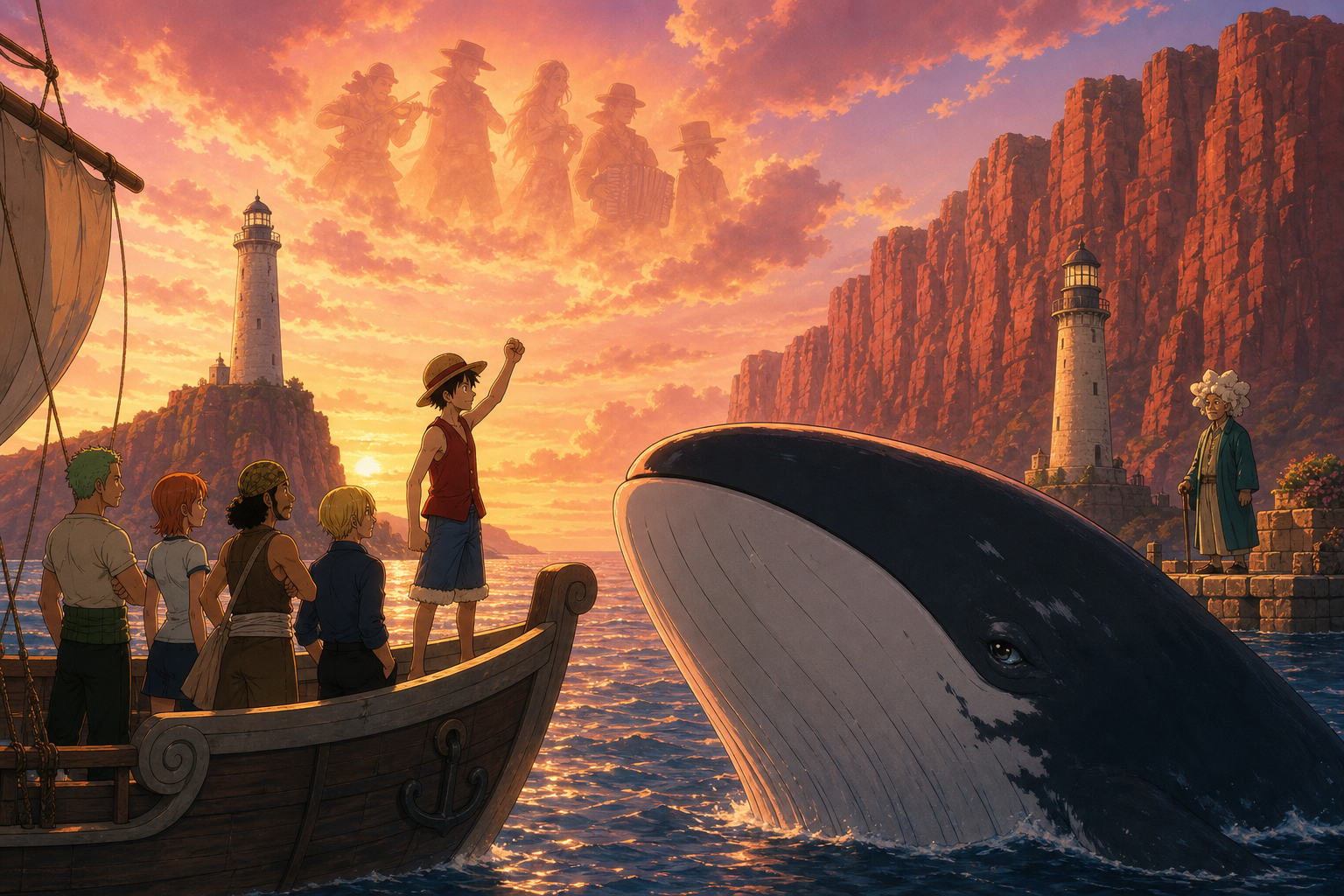
Harume Kosaka gives the story breathing room. Kosaka’s direction moves from enclosed confusion to open water, memory, physical confrontation, and quiet agreement. The whale’s scale remains visible while his emotional life becomes intimate.
Pauses around Crocus’s explanation keep fifty years from feeling like a trivia reveal.
Kazuya Hisada makes Laboon responsive. Animation direction uses eye movement, breath, posture, water displacement, and vocal response to show understanding without humanizing the whale into a speaking character.
Luffy’s smaller gestures become readable against the enormous face.
Shoichiro Iriura anchors the Twin Capes. The lighthouses, red wall, open sea, and weathered station make the cape feel like a place built around long waiting. Warm light can hold hope without denying the scars.
The setting becomes a promise marker at the edge of the world.
RaeRae’s real-time reaction
Fifty years is not a cute loyalty story when Laboon has been hurting himself against a continent. I need care, barriers, enrichment, and somebody besides Crocus carrying this responsibility.
Luffy’s challenge works because he gives Laboon a future relationship instead of ordering him to forget the old one. Now the crew has to earn that promise by remembering the promise.
The moment that lands. A tiny captain raises his fist to a whale larger than his ship and says their fight is not finished. The vow does not restore the Rumbar Pirates.
The vow tells Laboon that tomorrow contains someone who intends to come back.
What should happen immediately. Repair the Merry, assess Laboon’s scars, reduce access to high-impact surfaces, document the new behavior plan, and establish safe signals for arriving ships.
Crocus should receive supplies and a reliable way to request assistance.
What should happen while the crew is away. Track Laboon’s health and impact attempts, offer varied enrichment, maintain social contact, investigate the Rumbar Pirates carefully, and avoid turning the whale into an attraction.
The promise should support care, not replace ongoing care.
What the Straw Hats owe. They owe honest remembrance, any information they discover, and a sincere return attempt after circling the Grand Line. They do not own Laboon or his story.
Their promise is a relationship maintained across distance.
Hope needs more than a heroic visitor. Luffy can become an important friend without becoming Laboon’s only protective factor. The crew will be absent for an unknown length of time, and Grand Line travel makes communication uncertain. Crocus, safe routines, medical care, environmental protection, and other social contact must continue every day the ship is gone.
That wider support makes the promise kinder. Laboon can anticipate reunion without being asked to suspend his whole life until one sail appears on the horizon. Crocus should keep a shared care record with injury changes, feeding, rest, enrichment, impact attempts, and responses to music or visitors. If another trusted caretaker becomes available, training that person before an emergency would protect both Laboon and Crocus. One aging caregiver should never be the only line between grief and another collision with the Red Line.
Bottom line
Episode 63 reveals that Laboon has waited fifty years for the Rumbar Pirates after Captain Yorki left him with Crocus at the Twin Capes. His repeated collisions with the Red Line express unresolved loss, not hostility. Luffy interrupts the pattern by creating a new promise to return after the Grand Line.
RaeRae rating: 9.6/10. The episode gives hope without proving the old grief false. Laboon needs ongoing medical and behavioral care, Crocus needs support, and Luffy’s vow matters because the vow asks both friends to stay alive for a future meeting.