
RaeRae Reacts · One Piece Episode 62
The Giant Whale Laboon
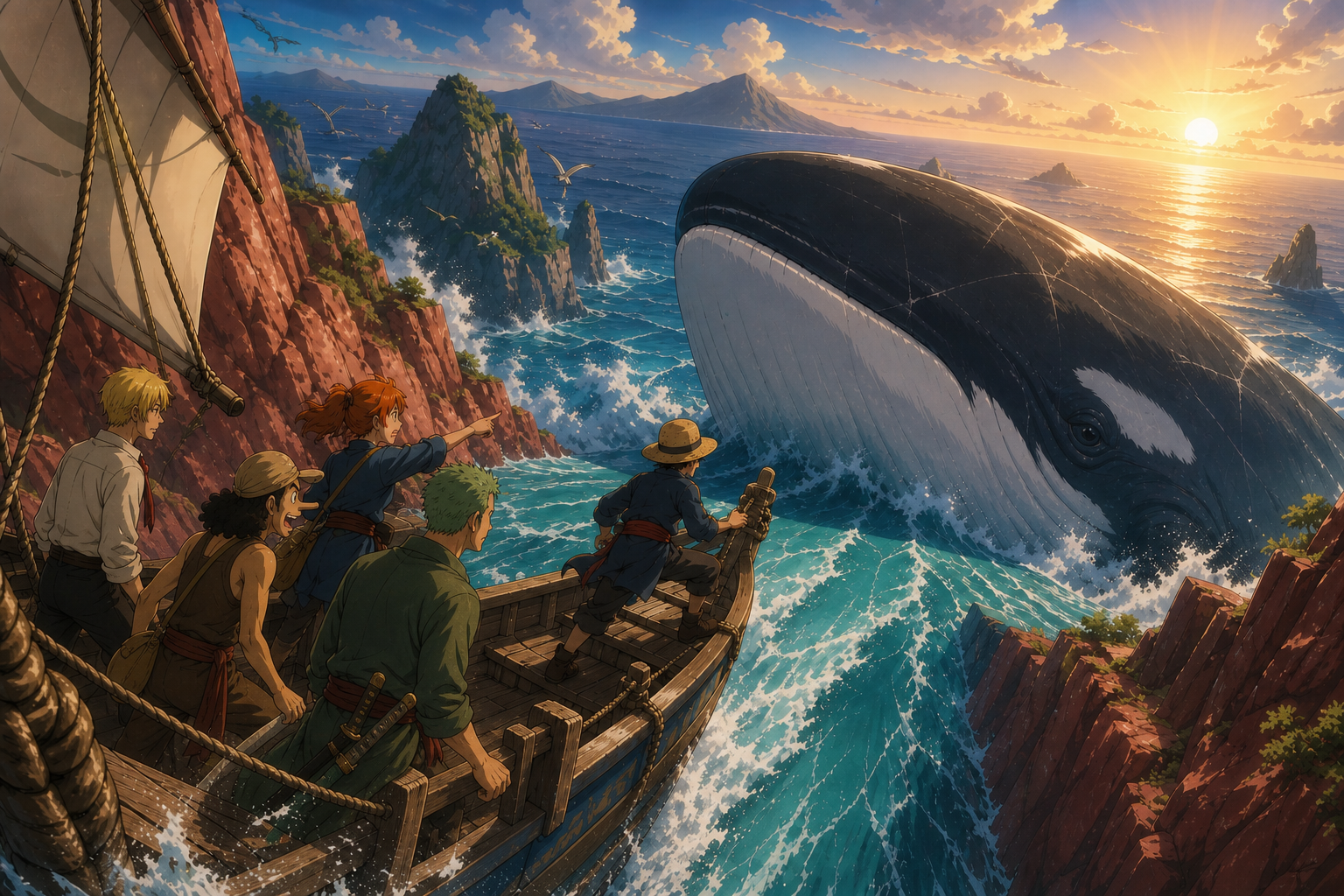
One Piece Episode 62 sends the Merry into Laboon, where an artificial sky, Crocus, and the whale’s distress turn Grand Line arrival into a rescue and welfare crisis.
Episode information
Japanese title: Saisho no Toride? Kyodai Kujira Laboon Arawaru (1 Jikan SP Zenpen)
English title: The First Line of Defense? The Giant Whale Laboon Appears
Japanese broadcast: March 21, 2001
Saga: Alabasta
Script: Michiru Shimada
Episode direction: Konosuke Uda
Animation direction: Masayuki Takagi
Art: Tomoko Yoshida
The Merry descends toward the Grand Line
Episode 62 begins with the ship committed to Reverse Mountain’s downward current. The climb was only half the passage. Gravity, water volume, narrow walls, and limited steering now combine to accelerate the Merry toward an exit the crew cannot yet see.
Excitement has to wait behind navigation discipline because one poor correction can turn a historic arrival into a hull breach.
Nami needs uninterrupted command
Every crewmate should repeat her steering calls and hold assigned positions. Extra movement changes trim, while competing instructions delay the one response that matters.
A navigator cannot negotiate with five people while a mountain current decides the ship’s speed.
The exit appears blocked
A dark mass fills the route at the base of the canal. At first the mass can resemble a wall or fortress because scale and spray hide its shape.
The crew needs range, motion, and biological cues before choosing a response. Firing at an unidentified obstruction would be reckless.
Laboon is an island whale
The obstacle is a living whale so large that the Merry appears tiny beside him. His presence creates immediate collision danger without making him an aggressor.
The ship has entered his space at high speed. Responsibility begins with reducing harm to both vessel and animal.
A whale is not a fortress. The episode title plays with the crew’s first interpretation, but Laboon cannot be treated as infrastructure guarding a border. He is a sentient animal with history, behavior, and reasons for remaining there.
Calling him an obstacle should not erase that the dangerous approach was created by the canal’s geometry.
Collision avoidance options are limited. Reverse Mountain supplies speed while rock walls constrain turning. Nami needs the smallest safe heading change that avoids Laboon without grounding the Merry.
Everyone should brace, lower unnecessary sail, and prepare damage control rather than lean over the rail to stare.
Sound signals may help. A horn or repeated nonthreatening signal can alert a whale to the vessel, but blasting at close range may cause distress. The crew should avoid chaotic shouting and explosive noise.
One consistent warning is safer than five people improvising.
The ship’s bow is vulnerable. A wooden figurehead and forward planking take the first force of impact. Crew should clear the bow, secure anchors and lines, and ready pumps and plugs.
Luffy’s attachment to the Merry does not make standing in the impact zone useful.
The Merry strikes Laboon
The official summary confirms that the ship’s bow breaks. Even at this scale, impact can hurt the whale and destabilize everyone aboard.
Immediate priorities are personnel count, flooding assessment, rigging inspection, and observation of Laboon’s breathing and movement.
Do not blame the animal. Laboon did not steer the Merry into the channel. His enormous body and stationary position make avoidance difficult, but fault cannot be assigned from inconvenience alone.
The crew should assess why he stays at the entrance before trying to force him away.
Damage control must be organized. Zoro and Sanji can stabilize damaged timber, Usopp can inspect fittings, Nami can keep the ship oriented, and Luffy should take the task that uses strength without widening the break.
Loose boards, nails, and lines need control before the current carries them into people or wildlife.
Laboon swallows the ship
The situation changes from exterior collision to enclosed biological environment. Panic, fire, weapons, and uncontrolled movement could harm the whale or the crew.
The goal is not to attack their way out before understanding where the Merry has gone.
Count every person and injury. Confirm Luffy, Zoro, Nami, Usopp, and Sanji, then check for head impacts, cuts, breathing distress, and shock. A person who answers may still be injured.
First aid and calm communication come before exploration.
Air quality becomes urgent
An enclosed space may contain unusual gases, humidity, low oxygen, digestive chemicals, or smoke from damaged equipment. Extinguish open flames and monitor symptoms.
No one should assume a visible sky means normal outside air.
The stomach contains a blue sky
Instead of darkness, the crew finds an environment painted or engineered to resemble open space. The impossible appearance signals deliberate human intervention.
They should distinguish visual surface from actual exit before sailing toward the painted surface.
An artificial environment needs inspection. Walls, liquid, platforms, ducts, doors, and structures may reveal how someone lives or works inside Laboon. Touch as little as possible until the purpose becomes clear.
The whale’s body is not an abandoned building available for exploration.
Consent still matters inside an animal. Laboon cannot offer human speech, but discomfort, movement, vocalization, and response to intervention communicate boundaries. Whoever built this space carries a duty to minimize harm.
The crew should not add damage simply because another person already altered the environment.
A giant squid appears. A large squid inside the same space introduces another animal and another set of risks. The squid’s presence could be accidental, predatory, or part of the stomach environment.
The crew should avoid assuming every unfamiliar animal is an enemy before the animal attacks.
Crocus kills the squid
The official account identifies Crocus as the person who dispatches the squid. His competence demonstrates that he understands the space and has prepared for intrusions.
That does not automatically answer whether lethal force was necessary, but Crocus becomes the most informed person available during the immediate emergency.
Who is Crocus?
An adult living near or inside a giant whale has knowledge the crew urgently needs. They should ask his name, role, Laboon’s condition, safe routes, and whether the ship can exit without causing injury.
Respectful questions are more useful than challenging him for appearing strange.
Crocus controls critical information. He may know the currents, internal channels, medical condition, and reason Laboon blocks the cape. That creates responsibility to communicate clearly when visitors arrive accidentally.
He should also explain emergency boundaries before the crew damages treatment equipment.
Laboon begins to thrash
The whale’s movement can throw people, capsize the Merry, and damage internal structures. Thrashing may indicate pain, distress, frustration, or a repeated behavioral pattern.
Secure every person and stop actions that add sound, pressure, or injury.
The behavior has a cause. A whale repeatedly striking or blocking a landmark is not simply being difficult. Physical illness, separation distress, conditioning, environmental cues, or unresolved routine may be involved.
Crocus should provide history while preserving Laboon’s dignity.
Do not turn distress into entertainment. The scale of the episode invites comedy and awe, but Laboon’s agitation affects a living body. Viewers and characters can laugh at confusion without laughing at pain.
The React needs to keep the welfare question visible beneath the spectacle.
The crew must protect the Merry without attacking. Lines, anchors, controlled sail, and communication can reduce movement. Cutting through tissue or firing weapons creates unacceptable escalation unless an immediate life threat leaves no alternative.
Escape planning should follow Crocus’s safest known route.
Luffy’s impulse needs direction. His strength can help secure the ship or reach a control point, but impulsive force inside Laboon may worsen the animal’s pain. Someone needs to give him a specific objective.
Protecting friends includes not making the environment more dangerous for everyone.
Nami maps the impossible space
Even a biological interior has orientation, flow, fixed structures, and exits. She can record these features without claiming the place as navigable territory.
Her map should remain a rescue tool rather than a route for future intrusion.
Usopp can observe treatment equipment. Mechanical features may reveal pumps, gates, lighting, or channels. He should identify function before pulling levers or dismantling parts.
Crocus’s permission matters because equipment may be keeping Laboon alive.
Sanji should secure the galley. Collision and swallowing can spill fuel, food, knives, and hot material. Fire inside an enclosed animal is a threat to every being present.
Once secured, clean water and first aid can support the crew while they wait for a safe exit.
Zoro should guard without escalating. An unfamiliar person and animal do not require a drawn sword. Zoro can maintain awareness, keep people clear of hazards, and respond if a direct attack occurs.
Restraint demonstrates control better than threatening the only guide available.
Grand Line arrival rejects simple expectations. The crew imagined danger as storms, rivals, and impossible islands. Their first encounter instead combines a whale, a shipwreck, an artificial sky, a squid, and an eccentric caretaker.
The new sea announces that ordinary categories will not be enough.
The episode changes the adventure’s scale. East Blue measured danger through villages, restaurants, pirate crews, and a regional Marine presence. Laboon is larger than the Merry’s assumptions and connected to a history they have not heard.
The crew must learn before the crew can lead.
Michiru Shimada starts with consequence
Shimada’s script does not let the Reverse Mountain victory settle into celebration. The same current that carries the crew into the Grand Line delivers them directly into a welfare and navigation emergency.
Discovery remains inseparable from responsibility.
Konosuke Uda keeps scale understandable. Uda’s direction uses the canal, ship, whale, and interior horizon to reset size repeatedly. Viewers understand why the crew mistakes Laboon for a structure and why force would be absurd.
The episode stays readable while reality changes around the characters.
Masayuki Takagi sells impact and instability. Animation direction needs weight in rushing water, sudden braking, broken timber, swallowing, and internal thrashing. Character reactions remain distinct without turning injury into graphic display.
Laboon’s movement feels bodily rather than mechanical.
Tomoko Yoshida makes the interior uncanny. A blue sky inside a whale should feel inviting for one second and impossible the next. Color and painted distance create that disorientation.
The environment is whimsical, but its beauty does not erase that the crew is inside a living patient.
RaeRae’s real-time reaction
You cannot race out of a mountain canal, hit a whale, break your own ship, get swallowed, and then decide the whale is the problem. I need everyone to lower the weapons and listen to the person who clearly understands this situation.
Also, an artificial sky inside Laboon tells me somebody has been providing long-term care. That deserves questions before judgment.
The moment that lands. The Merry enters the Grand Line and immediately disappears into a whale whose stomach contains blue sky. The destination promised freedom, but the first lesson is humility.
The crew has arrived somewhere its usual map cannot explain.
What should happen immediately. Count the crew, control flooding and fire, secure the ship, stop unnecessary force, ask Crocus for instructions, and reduce anything worsening Laboon’s distress.
Prepare a calm exit route that protects the whale as well as the people aboard.
What needs investigation. Determine why Laboon remains at the cape, what injuries or conditions Crocus treats, how the internal space functions, and whether the whale’s thrashing follows a predictable trigger.
History should guide care rather than provide an excuse for exploitation.
What the crew should carry forward. Grand Line navigation requires more than charts. Living beings, local knowledge, strange environments, and old promises can reshape every route.
The safest crew will be the one capable of listening before acting.
Arrival does not grant expertise. Crossing the Red Line proves that the crew can reach the Grand Line. Reaching the route does not make them authorities on Grand Line animals, caretakers, currents, or communities. Crocus has years of direct knowledge, while Laboon communicates through behavior the newcomers have barely begun to observe.
The strongest response is provisional: stabilize the danger, ask what they do not know, and revise assumptions when evidence changes. That habit will matter far beyond this cape.
Bottom line
Episode 62 makes the Straw Hats’ Grand Line arrival immediate, absurd, and ethically complicated. The Merry descends Reverse Mountain, collides with Laboon, loses part of its bow, and is swallowed into an artificial interior where Crocus appears and the whale begins to thrash.
RaeRae rating: 9.4/10. The scale is funny until you remember Laboon is alive and distressed. Repair the ship, listen to Crocus, stop treating the animal as a fortress, and learn why the first guardian of the Grand Line refuses to leave.