
RaeRae Reacts · One Piece Episode 61
Cross the Red Line
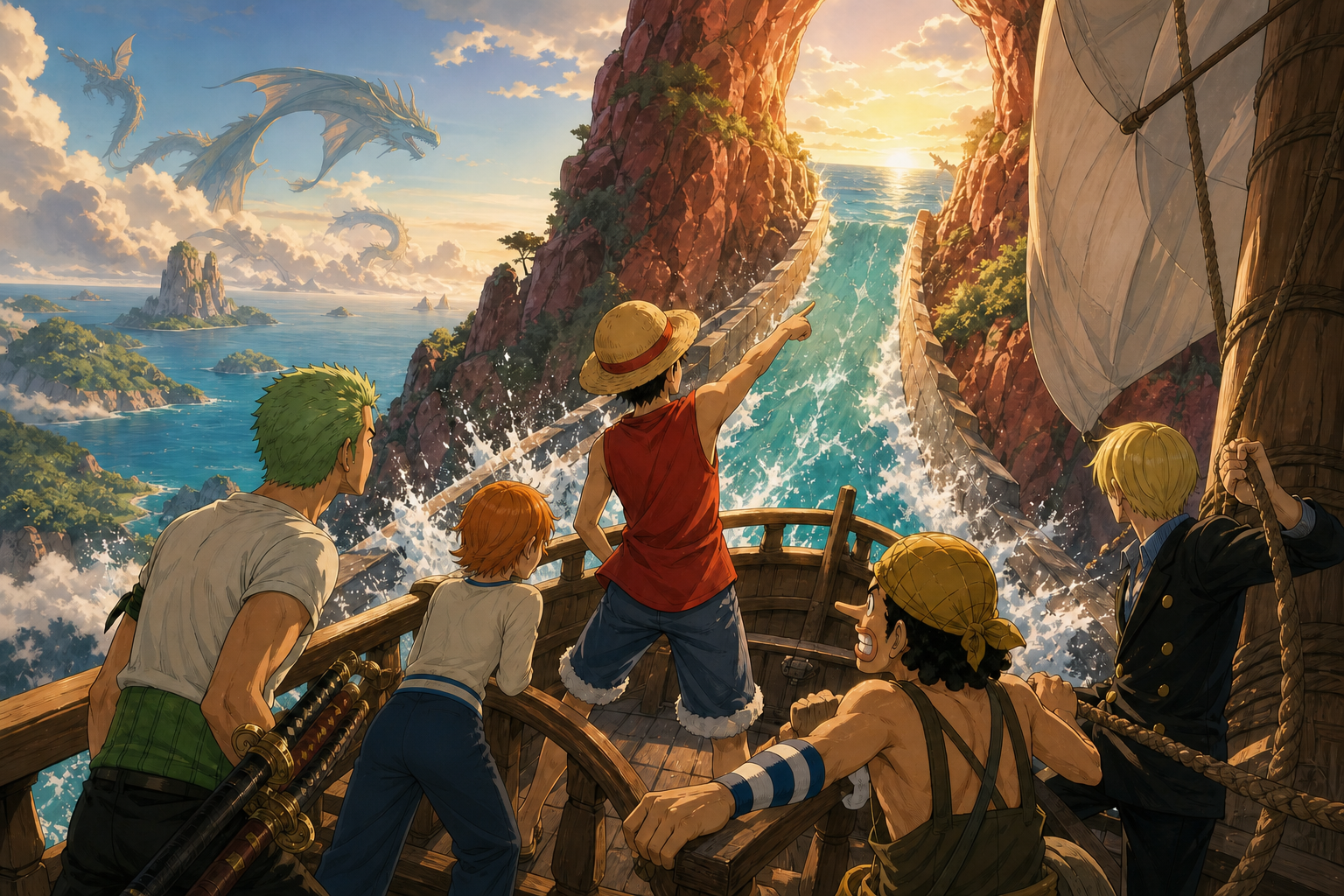
One Piece Episode 61 closes the Warship Island crisis, protects Apis and the Dragon’s Nest, and sends the Going Merry up Reverse Mountain toward the Grand Line.
Episode information
Japanese title: Ikari no Kecchaku! Red Line o Norikoero!
English title: An Angry Showdown! Cross the Red Line!
Japanese broadcast: March 7, 2001
Saga: East Blue
Script: Junki Takegami
Episode direction: Hidehiko Kadota
Animation direction: Kenji Yokoyama
Art: Kunihiro Senda
The Warship Island crisis is not over
Episode 61 follows the Millennium Dragons’ arrival with unfinished danger on the water. Ryu has reached the end of his journey, but Nelson, Eric, damaged ships, and exposed habitat information remain active risks.
A moving farewell does not erase the need for rescue, accountability, and safe departure.
Eric survives
Eric returns after falling from control, showing that separation did not equal containment. Anyone known to assault a child, traffic wildlife, and betray an employer should be treated as an ongoing threat until safely secured.
The crew should confirm Apis’s location first, establish a boundary, and keep Eric away from every vessel that can carry him toward the Dragon’s Nest.
Nelson remains part of the harm. Eric’s next action does not make the admiral an innocent victim. Nelson assembled the fleet, pursued Ryu, authorized force, and gave a dangerous contractor access.
Accountability needs to preserve the entire chain of decisions instead of blaming only the person who makes the final betrayal visible.
Eric attacks Nelson
The official account describes Eric cutting down the admiral after Nelson survives the earlier chaos. This is violence between collaborators whose alliance was always based on extraction rather than trust.
The injury requires emergency care and investigation, but the attack does not restore Nelson’s authority over Ryu, Apis, or the island.
Marine crews need a lawful command transition. When a commander is incapacitated, subordinate officers should shift immediately to rescue, cease fire, and personnel accountability. They should not continue a harmful mission merely because no cancellation order arrived.
Logs, communications, weapon use, and contractor access need preservation for independent review.
Eric wants dragon bone
His motive becomes explicit: he seeks material associated with immortality. Ryu’s death and the flock’s arrival do not inspire respect because he still reduces living history to a commodity.
The crew must prevent access to remains without treating the dragons as property they now own.
Immortality claims increase trafficking risk. A rumor can be enough to create poaching markets even when the promised effect is false. Nelson’s fleet has supplied witnesses, routes, and official-looking interest that may make the story spread faster.
Protective steps should include restricted coordinates, confiscated contractor records, and clear public rejection of commercial claims.
The Dragon’s Nest needs privacy
Apis wants to protect the place where the dragons return. That goal is consistent with Ryu’s journey and the community’s safety, but a child cannot enforce protection alone.
Warship Island residents, trusted conservation allies, and accountable authorities should build safeguards without publishing the habitat.
Luffy accepts a promise
Protecting Apis and the nest honors Ryu without pretending Luffy can control every future visitor. A promise is meaningful when the promise becomes practical action rather than a dramatic line.
For now, that means stopping Eric, clearing pursuit, and leaving no trail that points traffickers back to the island.
Apis should define what protection means. Adults may assume she wants secrecy, relocation, armed defense, or constant supervision. She should be offered choices in language she understands and supported by people she trusts.
Her safety cannot be used as a reason to take control of her home or silence her completely.
Luffy confronts Eric
The fight is necessary because Eric continues an immediate attempt to exploit the dragons and endanger the child. The objective is to end access and create safe distance.
Once the threat is stopped, the crew should not prolong violence for revenge or spectacle.
Wind-based attacks complicate the deck. Sharp air pressure around sails, rigging, loose timber, and crowded footing can cause harm beyond the intended target. Nami should call wind changes while everyone secures lines and protects exposed passengers.
Apis belongs away from the combat zone with cover and a clear evacuation route.
The crew needs assigned roles. Luffy handles the immediate threat, Zoro guards the approach, Nami manages ship position, Usopp watches range and warnings, and Sanji supports evacuation and first aid.
Clear responsibilities keep five capable people from creating one crowded response around Eric.
Do not turn Apis into bait. Eric’s interest in her connection to the dragons makes her predictable leverage. She should never be positioned visibly to draw him away, even if she volunteers under pressure.
Adults must find a safer plan that does not make the child responsible for containing her attacker.
Luffy wins the confrontation
Defeating Eric prevents immediate access to dragon remains and fulfills the protective part of Ryu’s final relationship with the crew. Victory should lead directly to secure separation.
Check whether Eric can still move, remove weapons safely, and transfer custody only to people who will not resume Nelson’s mission.
Custody cannot return to Nelson’s loyalists. Marine personnel involved in the hunt may have conflicts of interest or orders to preserve evidence for the wrong purpose. An independent officer or local authority should oversee detention.
Apis should not be required to confront Eric or give a detailed statement before she is ready.
Warship Island deserves repair
Military pursuit exposed residents to danger and disrupted their waters. Departure should include emergency supplies, damage assessment, and a way to report future traffickers.
Compensation cannot depend on residents surrendering information about the dragons.
The Straw Hats prepare to leave
Remaining longer may increase the island’s visibility and keep Apis connected publicly to pirates. A careful departure can reduce pressure while respecting her choice about goodbye.
The crew should ensure she has safe housing, trusted support, and a plan if danger returns.
Farewell needs room for grief. Apis has completed the journey she believed would save Ryu by bringing him home. The outcome contains both success and loss, and no cheerful sendoff should force her to choose one feeling.
The crew can acknowledge the relationship without promising that pain will disappear quickly.
The Going Merry turns toward the Grand Line
Leaving Warship Island returns the story to the route announced since the beginning. The next threshold is not a normal stretch of sea but a current climbing the Red Line.
Nami’s preparation becomes the difference between wonder and disaster.
The Red Line changes the scale
A continent-spanning wall divides seas and makes familiar island navigation feel small. Charts must account for constrained entrances, powerful currents, limited turning room, and rapidly changing elevation.
The crew cannot approach the Red Line as another shoreline.
Reverse Mountain is an engineered hazard. Water flowing uphill through a narrow canal creates immense force against rock walls. A ship that enters off-center may strike before its rudder can correct.
Rigging, cargo, hatches, and every person need securing well before the current takes control.
Nami needs authority at the helm. During a high-risk approach, navigation calls must override excitement and improvisation. The crew should repeat instructions, confirm line assignments, and avoid sudden shifts in weight.
Luffy can celebrate after the ship is stable rather than while Nami is calculating survival.
The approach requires a go or no-go check. Hull integrity, mast, rudder, sails, lines, weather, daylight, crew fatigue, and current alignment should all be assessed. Warship Island damage cannot be ignored because the destination feels urgent.
If essential steering is compromised, repair before entry.
Everyone needs a secure position. Use fixed handholds and safety lines that can release in an emergency. Keep walkways clear and heavy gear low.
No one should stand at the bow merely for a better view while the ship accelerates into confined water.
Usopp can monitor the canal walls. Distance calls from both sides help Nami detect drift before collision. His observation skills are more valuable here than trying to attack the mountain or current.
Signals should be short, standardized, and loud enough to carry over rushing water.
Zoro should manage force, not direction. Strength can tension lines, move cargo, or respond to structural damage, but pulling without Nami’s order may yaw the ship. He needs a defined station.
Swords remain secured because a fall among exposed blades would compound the emergency.
Sanji prepares for impact and recovery. Secure the galley fire, sharp tools, boiling liquids, and storage before the climb. First-aid supplies should be accessible even if cabinets shift.
Food service can wait until the ship clears the most violent current.
Luffy must respect the mast and lines. Elastic movement around taut rigging can injure crewmates or change sail load. He should hold a designated position and respond only to clear calls.
His strength becomes useful if the hull needs immediate support, not as a substitute for steering.
The current takes the Merry upward
Once the ship enters, water supplies most of its movement. The crew’s task becomes alignment, stability, and damage prevention rather than generating speed.
The visual impossibility of climbing a mountain by sea marks a clean transition into a larger world.
Excitement and fear coexist. The crew has spent sixty episodes gathering people, skills, and reasons to continue. Crossing the Red Line validates that effort while introducing risks none of them fully knows.
Courage here is coordinated action despite uncertainty, not pretending the danger is small.
The East Blue remains behind them. Every village, conflict, promise, and recruit now forms the crew’s shared history. Departure does not reduce those places to prologue.
Their lessons about coercion, corruption, hunger, grief, and community should shape how they meet the Grand Line.
Warship Island closes the anime-original route. The arc adds a child, an elderly dragon, trafficking, habitat secrecy, and a final test before Reverse Mountain. Its strongest contribution is asking what protection looks like when wonder attracts exploitation.
Episode 61 connects that answer back to the main voyage.
Junki Takegami closes two movements
Takegami resolves Eric and the Dragon’s Nest promise, then redirects momentum toward the Red Line. The episode must finish grief without trapping the series in farewell.
The structure lets accountability and adventure share the same hour.
Hidehiko Kadota keeps the transition legible. Kadota’s direction separates the final confrontation, island departure, navigation briefing, and mountain ascent. Each shift has a clear objective and geography.
The climb gains force because viewers understand how carefully the crew must enter the current.
Kenji Yokoyama emphasizes opposing motion. Eric’s attacks cut across the deck while Reverse Mountain drives the ship in one overwhelming direction. Character animation gives way to environmental force without losing crew reactions.
Body positions and line tension help sell the canal’s speed.
Kunihiro Senda makes the Red Line a threshold. The art turns red rock, white water, narrow stone, and open light into a boundary between known and unknown seas. The Merry appears small but purposeful.
That scale invites wonder without hiding the collision risk.
RaeRae’s real-time reaction
Eric cutting down Nelson does not make him the only villain in the room. Nelson built the operation that let this man reach a child and a protected species in the first place.
I am relieved Luffy keeps the promise to Apis, but the real victory is not possession of dragon bone. The victory is getting the trafficker away from the nest and letting the Merry move on.
The moment that lands. The ship enters a canal that runs up the Red Line. After so many islands and promises, the Grand Line stops being an idea and becomes a physical force under the hull.
The crew does not cross alone. Every East Blue bond travels with them.
What accountability still requires. Investigate Eric’s violence and trafficking, Nelson’s command decisions, weapons use, unlawful detention, and damage to Warship Island. Preserve records and protect witnesses.
Do not publish habitat coordinates as part of the case file.
What Apis deserves next. She needs safety, grief support, medical follow-up, privacy, and a meaningful role in community decisions. She does not need to become a permanent guide for outsiders curious about dragons.
Her life should be allowed to grow beyond the crisis.
What the crew needs next. Structural inspection after the climb, updated charts, rest, dry supplies, and a clear watch rotation should follow. The Grand Line will punish a crew that treats arrival as completion.
Their first responsibility is keeping the Merry and one another ready.
Bottom line
Episode 61 ends the Warship Island pursuit by exposing Eric’s immortality motive, honoring Luffy’s promise to protect Apis and the Dragon’s Nest, and sending the Going Merry into Reverse Mountain. Nelson’s fall does not erase command responsibility, and Eric’s defeat should lead to secure custody rather than revenge.
RaeRae rating: 9.2/10. The farewell earns its forward motion. The crew protects a home they cannot own, leaves the East Blue behind, and climbs toward the Grand Line with navigation, trust, and every earlier promise under the same small hull.