
RaeRae Reacts · One Piece Episode 60
The Millennium Dragons Return
One Piece Episode 60 brings the Millennium Dragons home for Ryu’s final call, exposing Nelson’s pursuit as exploitation and demanding grief care and habitat protection.
Episode information
Japanese title: Oozora o Mau Mono! Yomigaeru Sennen no Densetsu!
English title: Those Who Soar in the Open Skies! The Revived Millennium Legend
Japanese broadcast: February 28, 2001
Saga: East Blue
Script: Junki Takegami
Episode direction: Yoshihiro Ueda
Animation direction: Hideaki Maniwa
Art: Yuri Sanami
Ryu is sinking
Episode 60 begins where triumph would be the wrong word. Ryu used his remaining strength to protect Apis, but the elderly dragon is now descending toward the sea. Ryu’s movement is not proof of recovery. The movement is a final expenditure made under extreme stress.
The first responsibility is to reduce further strain, clear the water around him, and keep Apis from being pushed into another unsafe rescue attempt.
Nelson fires a harpoon
Nelson responds to a dying animal by trying to seize the body. A harpoon is not a medical tool, and its use cannot be reframed as recovery merely because Ryu is slipping beneath the surface.
The weapon creates puncture, entanglement, towing, and collision hazards while confirming that the admiral values possession over welfare.
Luffy intercepts the line
Luffy catches the harpoon and sends the weapon back before the projectile can reach Ryu. The action protects the dragon from immediate harm, but a heavy projectile remains dangerous wherever the harpoon travels.
Everyone on both vessels should move away from the line path, release tension safely, and preserve the weapon as evidence after the emergency.
Protection is not ownership. Luffy does not claim Ryu for the crew. He blocks Nelson from turning the dragon into material. That distinction matters because rescue should restore choice and safety rather than transfer control to a more sympathetic captor.
Apis’s bond with Ryu guides care, but even she cannot be made responsible for deciding every risk alone.
The sea around Warship Island begins to move
Sudden vibration around an island can indicate current changes, seabed displacement, surf amplification, or a larger environmental event. Ships should stop aggressive maneuvering and monitor depth immediately.
Residents need warning to move away from unstable shoreline, while lookouts watch for falling rock, unusual waves, and changes in safe channels.
A fleet becomes vulnerable in changing water. Nelson’s chained formation was already hazardous. Seabed motion makes the formation worse by forcing connected ships to rise, yaw, and drift at different rates.
Command should release the chains in a controlled sequence, establish separation, and open an emergency corridor instead of preserving a failed blockade.
The Going Merry needs sea room. Nami cannot navigate a small sailing ship through shifting water if warships, loose chains, and damaged craft crowd every option. The crew needs a clear route with enough distance to turn.
Usopp can track floating hazards, Sanji can secure loose equipment, Zoro can manage lines, and Luffy must avoid sudden pulls that destabilize the deck.
Ryu calls with his last strength
The elderly dragon’s roar carries across the changing sea. The roar can be understood as distress, recognition, location, or farewell without pretending people know every part of the call’s meaning.
Apis may understand more through her ability, but she deserves time to listen without being interrogated while grieving.
The call reaches beyond the island. A signal answered across distance shows that Ryu was never the only surviving Millennium Dragon. The scattered animals retained a shared route or memory even when people declared the legend lost.
The revelation should lead to habitat protection, not a new race to capture the flock.
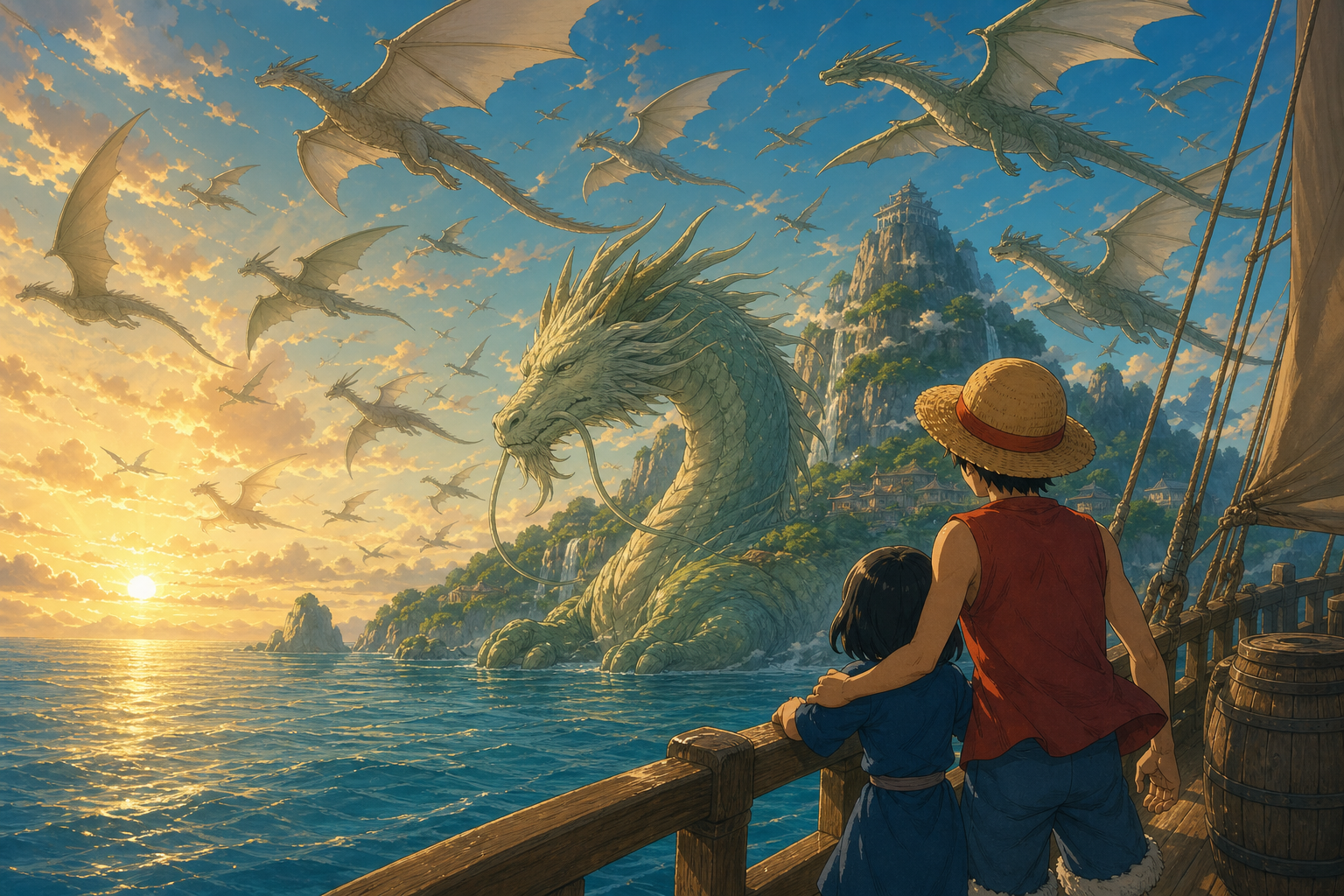
Millennium Dragons fill the sky
Dragons arrive in groups from different directions until open air becomes a moving community. The scale changes the scene from one rare specimen to a living population with relationships and migration patterns.
Nelson’s plan depended on scarcity. The flock exposes how little his operation understood about the beings the operation targeted.
Their arrival is not public permission. Witnessing a hidden species does not grant sailors, Marines, researchers, or collectors access to nesting grounds. Coordinates, photographs, remains, and routes can all be exploited.
Records should be restricted to people responsible for protection, with community consent and safeguards against trafficking.
Airspace safety matters. Hundreds of large animals approaching ships create wake, wing, mast, sail, and visibility hazards even without hostility. Crews should lower unnecessary canvas, avoid firing, reduce noise, and stay clear of flight paths.
No one should launch ropes, nets, flares, or projectiles toward the flock.
The dragons answer Ryu
The response transforms his final effort into reconnection. He is no longer isolated as a relic carried by humans. His own kind surrounds him at the end.
That dignity matters more than Nelson’s fantasy of extracting immortality from a body.
Ryu closes his eyes
The official account presents a final roar followed by stillness. The crew should confirm death without invasive handling, maintain distance from the flock, and support Apis through what she is witnessing.
Do not rush to declare the moment beautiful in a way that erases loss. She has lost a friend after a long, dangerous effort to bring him home.
Apis needs a trusted adult beside her
She should not be left alone at the rail, surrounded by armed adults, or expected to explain the dragons’ behavior. A calm person can offer warmth, water, and presence without forcing conversation.
Her grief may include relief, anger, guilt, exhaustion, and fear. None of those reactions needs correction.
Do not make Apis responsible for Ryu’s death. She acted on the information and resources available to a child while adults pursued, manipulated, and endangered them. Ryu chose to protect her and call the flock.
Responsibility rests with those who created the chase and denied safe care, not with the child who tried to help.
The Straw Hats need to slow down. The crew’s instinct is action, but grief sometimes requires restraint. Secure the ship, watch the flock, protect Apis, and let the moment remain hers.
Questions about the nest, the island, and the next route can wait until the immediate danger is stable.
Ryu’s body is not salvage
Nelson may still view remains as a source of dragon bone. The flock’s presence makes any attempt to retrieve, cut, tow, or sample the body even more dangerous and unethical.
Handling should follow the dragons’ behavior and Apis’s informed wishes, with no commercial claim.
The Marines should secure their own weapons. Harpoons, cannons, loose powder, and broken chain are active hazards in moving water beneath a dense flock. Officers should order cease fire, unload exposed weapons, and account for personnel.
Preserving life is the only defensible mission left.
Nelson’s authority has failed
He used a fleet, a contractor, artillery, and a containment ring to pursue one vulnerable animal. Every choice widened the emergency while providing no legitimate care.
Subordinates should document orders and refuse further attempts to attack the dragons or island residents.
The flock disproves the immortality story. A living community is not a warehouse of magical ingredients. Even if legends attach special properties to bones, killing animals for speculative personal benefit remains exploitation.
The ethical response to a rediscovered population is protection, research restraint, and local stewardship.
A rediscovered species needs immediate safeguards
Close the area to hunting, restrict route data, monitor from a distance, and create penalties for trafficking. Independent conservation specialists can advise without taking custody away from the habitat.
Warship Island residents should lead decisions that affect their waters and safety.
The island community already paid the cost. Residents faced surveillance, pursuit, military presence, and the risk that their home would be treated as a resource site. Any response must include repair and accountability.
Protection cannot mean replacing Nelson with another outside authority that ignores the community.
Nami should preserve navigational privacy. Her charts may now contain the clearest route to the area. She can retain what is necessary for safe departure while removing details that could expose the dragons.
Copies should not remain on captured Marine vessels or in contractor records.
Usopp can document without publishing. Witness notes may support accountability, but dramatic stories can reveal location clues. He should separate evidence from material intended for general retelling.
Apis should approve any personal details attributed to her.
Sanji’s care should be practical. Food, warm clothes, hydration, and a quiet place can help after prolonged stress, but he should not use care to demand emotional disclosure.
Simple choices restore control: where to sit, who stays nearby, and whether she wants to speak.
Zoro can create a protective boundary. Curious sailors or Marines may approach Apis, Ryu, or the flock. A visible boundary discourages intrusion without escalating toward combat.
Weapons should remain sheathed unless an immediate threat leaves no safer option.
Luffy understands the essential line. He may not use policy language, but he recognizes that Nelson cannot take Ryu. His intervention centers the living being rather than the admiral’s title.
The next step is letting the dragons determine what happens to their elder.
The flock may perform its own ritual. Circular flight, calls, landing, or carrying behavior could have social meaning. Humans should observe quietly and avoid imposing a familiar funeral narrative as certainty.
Respect includes admitting what remains unknown.
The episode makes scale emotional. One dragon’s labored movement prepared viewers to feel the arrival of hundreds. The spectacle works because the spectacle answers an intimate relationship rather than appearing only as a surprise.
Ryu’s small remaining strength connects a whole sky.
Junki Takegami turns legend into community
Takegami’s script shifts the Millennium Dragon idea away from a single object of pursuit. Ryu’s call reveals kinship, memory, and a population beyond Nelson’s limited map.
The same beat resolves the mystery while deepening the loss.
Yoshihiro Ueda balances danger and wonder. Ueda’s direction keeps the harpoon, moving sea, ship positions, Ryu, and approaching dragons legible. The scene can expand without losing the child at the scene’s emotional center.
Wonder does not cancel the practical danger beneath the spectacle.
Hideaki Maniwa gives the flock distinct weight. The animation direction must sell different distances, wing rhythms, turns, and sizes so the sky feels populated rather than copied. Ryu’s final motion remains slower and more costly.
That contrast lets viewers read age and community at once.
Yuri Sanami opens the horizon. The art moves from the fleet’s hard geometry into broad sky and changing water. Ships that appeared enormous become small beneath the migrating flock.
The environment corrects Nelson’s belief that command rank makes him the center of the world.
The title emphasizes those who soar. The plural matters. Episode 59 showed one elderly dragon rising; Episode 60 reveals a collective that remained alive beyond human knowledge.
The legend revives through living presence, not through harvested bones.
RaeRae’s real-time reaction
Nelson seeing Ryu sink and immediately choosing a harpoon tells me everything. He is still trying to convert a death into inventory while Apis is right there watching.
Then the whole sky answers Ryu. I love the awe, but I am not forgetting that a child needs protection and a fleet full of witnesses now knows this habitat exists.
The moment that lands. Ryu calls once more, dragons arrive from across the world, and he closes his eyes surrounded by his own kind. The nest was never valuable because the nest promised immortality.
The nest mattered because the place was home.
What should happen immediately. Cease fire, release the chained formation, stabilize every vessel, protect Apis from questioning, keep people away from Ryu, and allow the flock an unobstructed path.
Medical teams should treat injured people while wildlife contact remains minimal.
What should happen after departure. Restrict location data, investigate Nelson and Eric, return seized property, support Warship Island, and establish community-led protection against hunting and trafficking.
Apis should receive continuing care and a choice about whether she participates in any inquiry.
What the crew carries forward. The Straw Hats have seen another institution mistake power for entitlement. They also learned that a being dismissed as weak can still choose how to use a final act.
The memory should sharpen how they protect vulnerable people without speaking over them.
Bottom line
Episode 60 turns Ryu’s last call into a homecoming that exposes Nelson’s entire project as small and cruel. Luffy blocks the harpoon, the sea changes, and Millennium Dragons arrive from around the world before their elder rests.
RaeRae rating: 9.5/10. The spectacle earns emotion because the arrival returns Ryu to community. The necessary next response is grief care, habitat privacy, fleet accountability, and no human claim over the dragons or their remains.