
RaeRae Reacts · One Piece Episode 55
Apis’s Secret and the Legendary Island
One Piece Episode 55 connects a Calm Belt mistake to Apis’s protected secret, Warship Island oral history, Lost Island, and dangerous dragon-bone immortality rumors.
Episode information
Japanese title: Kiseki no Seibutsu! Apis no Himitsu to Densetsu no Shima
English title: Miraculous Creature! Apis’s Secret and the Legendary Island
Japanese broadcast: January 24, 2001
Saga: East Blue
Script: Junki Takegami
Episode direction: Harume Kosaka
Animation direction: Masayuki Takagi
Art: Miyuki Sato
The Going Merry enters the Calm Belt
Episode 55 places the ship in a region where ordinary wind and current assumptions stop working. The water becomes unnaturally still, leaving a sailing vessel without its usual means of propulsion.
The navigation error is serious because the crew has just declared its readiness for the Grand Line. New seas require new information, not confidence based on East Blue experience.
Calm water is not automatically safe water. Surface stillness can hide ecological, current, depth, and mobility hazards. Without wind, the crew cannot rely on sail response, and delayed movement affects food, water, exposure, and pursuit.
Visual calm should prompt environmental assessment rather than relaxation.
The crew needs a position audit. Nami should compare charts, compass behavior, sun position, drift, last known heading, elapsed time, and any unusual wildlife. The goal is to identify how they entered and what conditions limit exit.
Everyone else should reduce distractions and support observations instead of assigning blame during the emergency.
Sea Kings reveal the ecological risk
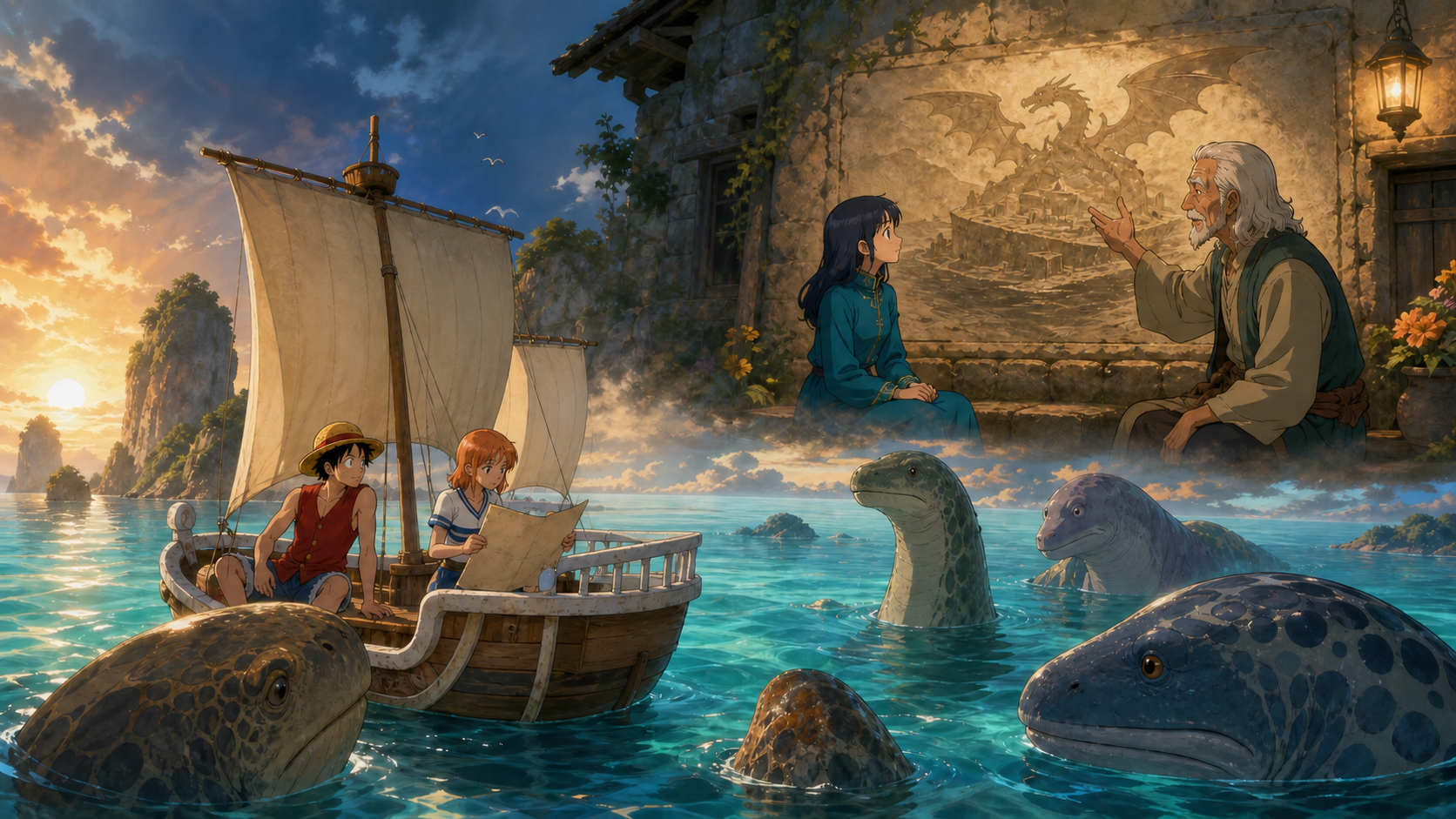
Enormous creatures surface around the Going Merry. Their scale makes the ship physically vulnerable even if no animal intends to attack.
The crew has entered a habitat. The animals are not trespassers surrounding human property.
Do not interpret curiosity as aggression. Sea Kings may investigate sound, shape, scent, motion, or novelty. Sudden weapons, shouting, food dumping, or impact could turn observation into defensive behavior.
The safest first response is minimizing disturbance and identifying an exit that does not require harm.
The ship should reduce its sensory footprint. Secure loose objects, lower unnecessary noise, avoid bright flashes, stop throwing waste, and keep everyone behind the rail. Stable weight distribution matters when nearby movement changes the water.
Prepared quiet is more useful than several crewmates improvising separately.
Luffy cannot solve scale through strength alone. Elastic attacks against animals larger than the ship could provoke multiple creatures and damage the vessel through recoil. Winning a fight is not a realistic objective.
The mission is safe withdrawal from habitat, not dominance.
Apis may understand more than she can safely disclose
Her relationship with birds and animals suggests an unusual communication ability. That could help interpret Sea King behavior or identify a nonviolent route.
Need does not erase her right to control disclosure. Adults should ask whether she wants to help and explain the risk without pressure.
A child’s ability is not emergency equipment. Even if Apis can communicate with animals, the crew remains responsible for navigation and safety. They cannot transfer the burden of saving everyone to her.
Participation should be supported, time-limited, and stopped if she becomes frightened or exhausted.
The sneeze escape is extraordinary improvisation
The crew uses a Sea King’s involuntary reaction to generate the force needed to leave the still region. The plan takes advantage of scale without attempting to injure the animal.
The escape remains highly unpredictable. Direction, force, collision, crew falls, and animal distress could all produce disaster.
Do not repeat the sneeze as standard procedure. One successful escape does not establish a safe navigation method. Deliberately irritating animals can harm sensitive tissue and change behavior.
The crew should document the event as an emergency anomaly while seeking reliable Calm Belt avoidance practices.
Everyone needs to brace before sudden propulsion. Lines, cargo, swords, cookware, charts, and people can become projectiles when the ship accelerates unexpectedly. The deck should be cleared and essential crew clipped or braced.
Apis needs a protected position with a trusted adult rather than being left at the rail.
The Going Merry needs inspection afterward. Hull seams, mast, rigging, rudder, deck fittings, cargo restraints, and keel may have absorbed forces beyond normal sailing. Damage can remain hidden until the next storm.
Usopp and Nami should record and prioritize repairs before continuing.
Warship Island is not an uncontested handoff point
When the crew arrives, Marines are already present. That confirms the pursuit or official interest did not end with Apis’s sea rescue.
Announcing her return at the harbor could expose her immediately.
Approach should remain discreet. Observe patrol routes, ask Apis for trusted landmarks, identify alternate landing places, and keep the Going Merry ready to move. Do not send her ashore alone to prove the location is safe.
A quiet arrival protects residents who may be punished for helping.
Apis leads the crew to Bokuden
The elder’s home provides familiar shelter and a trusted relationship. Her recognition of him is important evidence that the handoff has reached an intended contact.
The crew should still check whether Bokuden can safely assume care under current Marine pressure.
Bokuden’s age does not remove Apis’s agency. As an elder, he may carry authority, history, and affection. Apis should still participate in decisions about disclosure, movement, and who hears her story.
Protection must not become a new form of silencing.
The island community descends from Lost Island
Bokuden presents an oral history in which ancestors came from a land that sank beneath the sea. Such traditions can preserve migration, disaster, geography, identity, and values across generations.
Oral transmission is evidence with context, not a disposable fairy tale or a perfect modern map.
Oral history deserves respectful documentation
Record the speaker, language, version, audience, consent, and conditions of telling. Do not publish sacred or sensitive details without community approval.
Multiple accounts may differ without one being fraudulent. Variation can reveal how memory serves different groups.
Lost Island requires independent verification
Bathymetry, old charts, sediment, architecture, artifacts, sea-level patterns, and local ecological knowledge could support or challenge parts of the story.
The crew should not launch an archaeological expedition based only on urgency and curiosity.
Community ownership of heritage comes first. If ruins exist, they belong within the history and governance of descendants, not to the first pirate, Marine, scholar, or collector who locates them.
Research access, artifact custody, and publication should be negotiated with residents.
The Dragon’s Nest is described as a habitat
Legend places Millennium Dragons at a site tied to Lost Island. The phrase should be understood as a living environment rather than a treasure room.
Location secrecy may be essential if hunters believe the animals have valuable bodies.
Dragon-bone immortality is an unverified medical claim
The story says bones are believed to produce medicine that grants eternal youth or life. Tradition about healing can be culturally important without constituting clinical evidence.
No one should consume, sell, prescribe, or hunt based on that claim.
Extraordinary claims create predictable exploitation. Wealthy buyers, military interests, desperate patients, traffickers, and collectors may pay for dragon remains. Demand can exist even when the medicine does not work.
Rumor alone therefore threatens animals and communities.
False medicine can harm people directly. Products may be toxic, contaminated, fraudulent, or replace effective care. Sellers can exploit fear of aging or death.
Public health messaging should distinguish heritage from evidence without insulting the community that preserved the story.
A living Millennium Dragon is not a supply source. If the crew encounters one, the priorities are welfare, habitat, consent where communication is possible, and protection from capture. Age or rarity increases conservation responsibility.
No body part becomes available merely because someone imagines a cure.
Naturally shed material still needs ethical review. Even a found feather, scale, or bone can reveal location, genetics, migration, or market value. Collecting found material may disturb habitat or feed trafficking.
Community and conservation authorities should decide what, if anything, can be studied.
Apis’s secret may attract the same exploiters
An ability to understand animals could help locate a rare dragon. Adults may treat her as a tracking device or interrogation tool.
Protecting the dragon therefore includes protecting her privacy.
Do not ask Apis to prove communication. Threatening an animal, staging a test, or demanding repeated demonstrations would be coercive. Her account can be heard without immediate verification through performance.
Operational decisions should use the minimum disclosure necessary.
Bokuden should know the information risk. Sharing the legend with trusted visitors may feel different from knowing Marines or hunters are present. Bokuden deserves a clear explanation of who may be searching and what the crew can realistically protect.
Consent to tell a story is not consent to broadcast the story.
The house needs a security plan. Identify exits, safe rooms, trusted neighbors, signals, medical supplies, and what records should be moved or hidden. Avoid turning Bokuden’s home into a fortified battlefield that endangers residents.
The Going Merry should remain an available extraction option.
Marines need lawful grounds for searches. Presence on the island does not authorize entry into every home, seizure of oral histories, or questioning of a child without safeguards. Officers should identify authority and scope.
Residents need a way to document searches and report misconduct.
The crew should not impersonate local authority. Protecting Apis does not give pirates control over the village. Bokuden and residents should guide which routes, people, and cultural information can be trusted.
Outside force must remain subordinate to local safety goals.
Nami’s navigation error needs a no-blame review. Entering the Calm Belt is serious, but punishing the navigator would discourage reporting uncertainty. Review charts, information gaps, fatigue, instruments, and decision points.
Accountability means improving the system, not pretending expertise prevents every error.
The crew needs Grand Line orientation
Calm Belts, magnetic navigation, unusual currents, large fauna, weather discontinuities, and limited charts require training and specialized equipment. East Blue routines may not transfer.
The detour provides time to prepare if the crew uses the detour deliberately.
Sea King behavior should be logged. Record location, time, weather, number, movement, sounds, ship response, and escape conditions without claiming the animals’ motives. The data may help avoid future disturbance.
Do not publish precise habitat coordinates where hunters could exploit them.
Junki Takegami expands mystery through ecology
Takegami’s script connects still water, giant animals, Apis’s ability, island history, sunken land, dragons, and immortality rumor. Each mystery creates a responsibility before each mystery creates an answer.
The plot grows through information that dangerous people may want.
Harume Kosaka balances scale and shelter. Kosaka’s direction moves from Sea Kings surrounding a tiny ship to an elder speaking inside a familiar home. The contrast shows why Apis needs both physical rescue and cultural context.
Wonder never fully removes threat.
Masayuki Takagi keeps large creatures non-gory. The animation direction emphasizes eyes, breathing, water displacement, and curiosity rather than attack wounds. The Sea Kings feel alive within habitat.
The crew’s escape depends on motion and reaction, not slaughter.
Miyuki Sato gives oral history a material setting. Stone, relief imagery, lantern light, cottage objects, sea, and island contours make Bokuden’s account part of lived heritage. The legend does not float free of community.
That grounding strengthens the case for local ownership.
RaeRae’s real-time reaction
The Calm Belt is the fastest possible lesson that quiet water can be the most dangerous thing on the map. I do not want anybody punching Sea Kings because the ship entered their habitat without a plan.
The immortality rumor is exactly why the Dragon’s Nest location cannot become casual crew gossip. Whether the medicine works or not, somebody will hunt for dragon remains.
The moment that lands. Bokuden connects the present island to a homeland beneath the sea and living dragons beyond ordinary memory. Apis listens as someone whose secret may make that history newly actionable.
The story becomes dangerous the moment outsiders can turn the history into coordinates.
What the crew should do next. Inspect the Merry, document the Calm Belt error, secure Apis’s privacy, assess Marine presence, and ask Bokuden what help the community wants. Do not begin searching for dragons without a welfare and information plan.
Separate verified facts, oral history, rumor, and unknowns in the crew’s notes. Restrict access to sensitive locations.
What Warship Island should control. Its oral histories, heritage sites, maps, artifacts, contacts, and decisions about research or protection. Residents should determine whether the Straw Hats remain, move Apis, or assist further.
Outside interest in immortality does not override community governance.
Bottom line
Episode 55 turns a Calm Belt mistake into an ecological warning before bringing Apis home to an island already under Marine pressure. Bokuden’s history links residents to sunken Lost Island, the Dragon’s Nest, Millennium Dragons, and a dangerous claim that dragon bones grant immortality.
RaeRae rating: 9.0/10. Wonder creates duty. Sea Kings are not targets, Apis is not a tracking device, oral tradition is not public property, and an unverified medical rumor can threaten living creatures long before anyone proves the rumor true.