
RaeRae Reacts · One Piece Episode 56
Escape from Warship Island
One Piece Episode 56 turns Ryu’s evacuation into an animal-welfare, transport-engineering, environmental, blockade, and ship-recovery mission.
Episode information
Japanese title: Eric Shutsugeki! Gunkan Jima Kara no Dai Dasshutsu!
English title: Eric Attacks! Great Escape from Warship Island!
Japanese broadcast: January 31, 2001
Saga: East Blue
Script: Junki Takegami
Episode direction: Hidehiko Kadota
Animation direction: Kazuya Hisada
Art: Yuri Sanami
The Marine fleet blockades Warship Island
Episode 56 raises the pressure around Apis, Ryu, and the residents by controlling movement at sea. A blockade can restrict pursuit targets while also trapping civilians, disrupting food, preventing medical travel, and damaging local livelihoods.
Military objectives do not erase proportionality or humanitarian access.
The island needs its own emergency plan. Residents should know which harbors are watched, where supplies remain, how to request medical assistance, and what routes avoid exposing homes. Bokuden cannot carry every decision alone.
The Straw Hats should support local planning rather than make the village an uninformed backdrop to their escape.
Luffy promises to take Ryu to Lost Island
The promise responds to an elderly dragon’s longing and Apis’s care. The promise gives the crew a concrete objective beyond merely avoiding Marines.
Good intent is not enough. Ryu’s health, comprehension, willingness, pain, fatigue, and transport tolerance must shape whether the promise can be carried out safely.
Communication through Apis needs safeguards. If Apis interprets Ryu’s thoughts, she should transmit as accurately as possible and distinguish words, impressions, uncertainty, and her own hopes. Adults should not pressure her to produce the answer they want.
Ryu’s consent should be checked repeatedly as conditions change.
An elderly animal needs a welfare assessment
Before movement, evaluate breathing, hydration, ability to shift weight, wing condition, skin integrity, appetite, pain signals, and response to handling. Rest may be safer than immediate transport.
The crew lacks a dedicated veterinarian, so the crew should act conservatively and seek local knowledge.
Lost Island remains unverified. Bokuden’s oral history gives direction and meaning, but the exact location may be submerged, seasonal, migratory, or misunderstood. Transporting Ryu without route confidence could prolong distress.
Nami should identify decision points where the mission pauses or turns back.
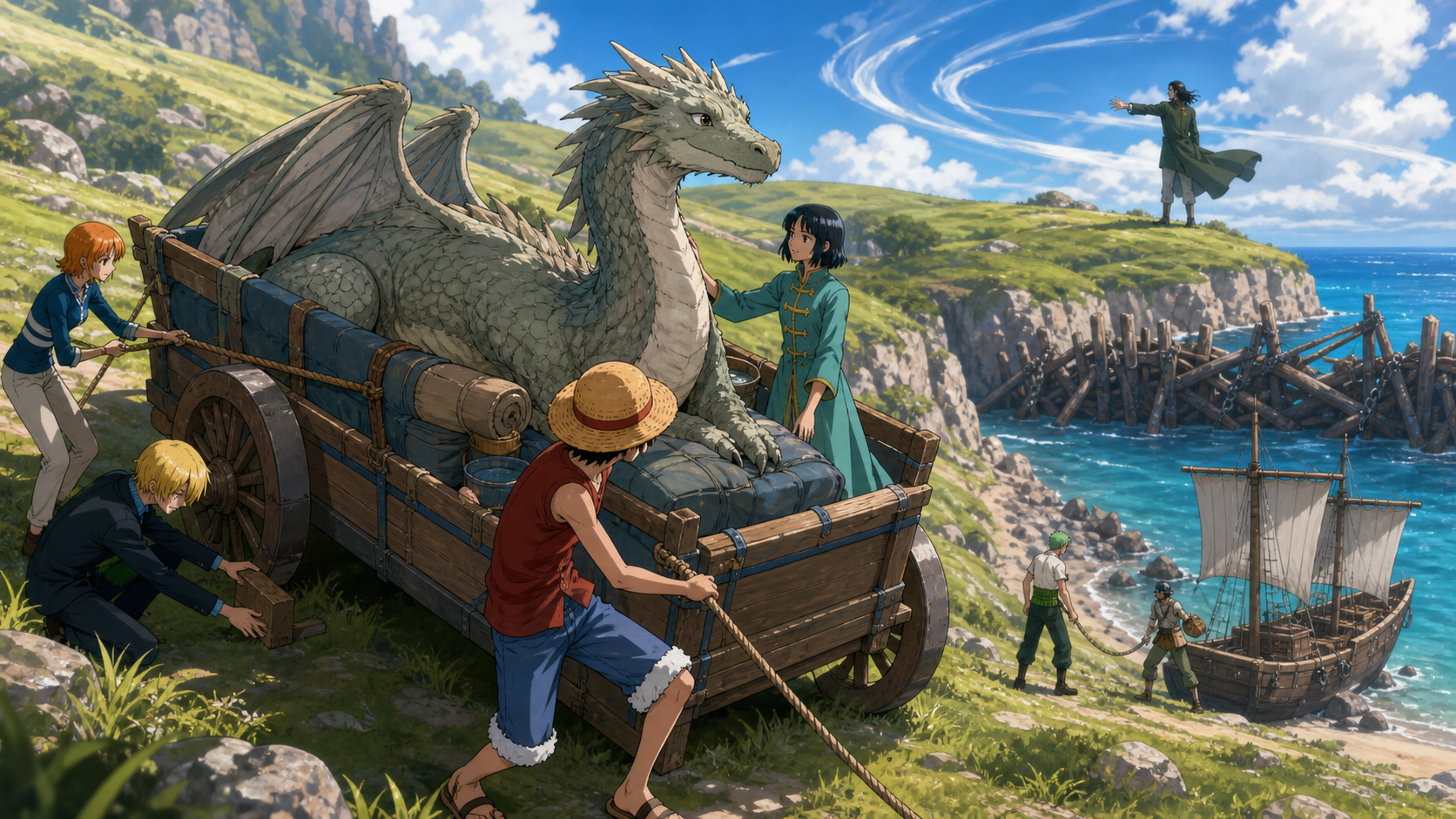
The crew builds a cart
A wheeled platform can distribute weight and reduce the need to make Ryu walk. Its design must account for body shape, center of mass, wings, breathing, vibration, slope, and emergency unloading.
A cart is medical transport, not ordinary freight.
Padding protects pressure points. Wooden surfaces can cause abrasions and concentrated pressure. Blankets, padding, rounded edges, and a stable resting posture reduce harm.
Straps should secure the cart structure and prevent shifting without binding Ryu’s body or restricting breathing.
Wide wheels improve stability. A large load on rough ground needs wide wheels, strong axles, braced joints, and clearance that prevents the frame from striking rocks. Each wheel should be inspected under static weight before descent.
Failure at speed could injure Ryu, crew, and anyone below.
Braking cannot depend on one person. Front and side ropes, wheel chocks, drag brakes, spotters, and predetermined stop points distribute control. Luffy’s strength is useful, but a single grip failure should not become catastrophic.
Commands need one agreed caller so the team does not pull against itself.
The felled tree has an environmental cost
Wood provides essential material quickly, yet trees stabilize soil, store carbon, shelter animals, and may hold cultural value. The crew should ask local permission and select the least harmful appropriate source.
Afterward, residents should receive usable surplus wood and support for replanting or restoration.
Do not cut the first convenient tree. Assess species, health, nesting, slope stability, ownership, and whether fallen timber could work. A diseased or storm-damaged tree may provide safer material than a mature living one.
Emergency urgency still allows a brief harm-reduction check.
Ryu needs protection from sun and wind. An exposed cart can create overheating, dehydration, cold stress, or debris injury. Shade cloth, water, blankets, and frequent checks should be available.
Apis should not remain beside a moving wheel where one slip could trap her.
Apis needs an age-appropriate role
She can reassure Ryu and relay consent from a protected position. She should not be responsible for braking, route security, or deciding whether adults continue through danger.
The mission remains adult responsibility even when her ability is essential.
Usopp and Zoro recover the Going Merry
The ship is the only practical extraction platform, so separating a team to reclaim and move the Merry makes tactical sense. Their objective is vessel access, readiness, and positioning at the cape.
They should avoid turning recovery into a prolonged battle that leaves the cart waiting on the slope.
Ship recovery needs a tamper inspection. Before sailing, check moorings, hull, rudder, sails, lines, cargo, bilge, and any evidence of Marine search or sabotage. A vessel can look intact while being unsafe.
Usopp’s repair knowledge and Zoro’s security role complement one another.
The cape must be evaluated before commitment. Depth, rocks, surf, wind, current, visibility, Marine firing lanes, and cart access determine whether pickup is possible. Nami should have current information rather than rely on a static map.
An alternate cove or beach should remain available.
Splitting the crew creates a communication gap. Cart and ship teams cannot easily see the same threats. Signals should communicate ready, delay, blocked, divert, and abort.
No signal should be confused with “continue at any cost.”
Eric joins the pursuit
His presence adds a specialized threat beyond ordinary blockade personnel. He is motivated by access to the dragon and the value attached to its body.
That motive confirms why location and biological information required protection from the beginning.
The Sickle-Sickle Fruit weaponizes air. Eric creates cutting gusts at distance, making open terrain and predictable routes dangerous. The attack can damage ropes, wheels, trees, people, buildings, and Ryu without direct contact.
Cover designed for solid projectiles may not block pressure moving around edges.
Wind attacks change cart handling
Crosswind can tip a high load, accelerate descent, shift padding, or frighten Ryu. Lower profile, side ropes, pauses behind terrain, and careful timing become essential.
The team should never continue simply because stopping makes a less dramatic scene.
Eric should not attack near the dragon. If he wants Ryu alive for exploitation, cutting the cart or animal is reckless even by his own objective. Eric’s attack also endangers Apis, residents, and evidence.
His conduct shows how greed can override the preservation claim used to justify pursuit.
The crew should prioritize shielding and movement
The crew does not need to defeat Eric before reaching the ship. Terrain, decoys, controlled pauses, and route changes can reduce exposure.
Combat is useful only when combat opens a safe transport window.
Sanji and Nami can manage lateral stability. Side ropes keep the cart aligned and communicate wheel behavior. Both need gloves, stable footing, and release methods that prevent being dragged.
No one should wrap a loaded rope around a hand or body.
Luffy controls forward speed. His elasticity and strength can absorb some momentum. He must avoid stretching so far that feedback arrives late or recoil destabilizes the cart.
A shorter controlled line with mechanical braking is safer than heroic body tension alone.
Wheel chocks create real rest points. On a slope, every medical check requires physical restraint of the cart. Chocks and brakes should be placed before anyone approaches Ryu.
Rest without a secured vehicle is not rest.
Downhill travel needs a route walk
Spotters should inspect turns, loose rock, soft soil, width, overhead branches, and escape areas before the cart arrives. Mark hazards without leaving debris that exposes residents later.
Speed should be set by the worst segment, not the smooth opening.
The rush down the mountain is an emergency compromise. Marine pressure and Eric’s attacks reduce the time available for ideal transport. The crew may accept controlled risk to avoid capture and likely exploitation.
The decision should be documented as a constrained choice, not promoted as the preferred way to move an elderly dragon.
Ryu’s response must be monitored in motion. Apis can watch for distress, while another adult tracks breathing, posture, and contact points. A stop signal should be honored immediately when possible.
Reaching Lost Island is not success if transport itself causes preventable collapse.
The village should not absorb retaliation alone. Once the Straw Hats leave with Ryu, Marines may question residents or damage property. Bokuden and local leaders need evidence, witnesses, supply plans, and safe places.
The crew should avoid leaving identifiable materials or routes that increase risk.
Marine personnel have duties during a blockade. Orders to contain pirates do not justify firing through homes, destroying food, blocking emergency care, or seizing wildlife without lawful process. Officers should document command decisions.
Residents deserve complaint and review mechanisms beyond the same unit conducting the operation.
The promise should include a stop condition. If Ryu deteriorates, the cart fails, the route becomes impassable, or Lost Island cannot be located, the crew needs authority to pause and provide care. A promise to help is not a promise to continue harming.
Apis should understand these limits before departure.
Arrival requires another transfer plan
The ship must accommodate Ryu without crushing deck structures, blocking crew movement, or exposing him to rigging. Weight distribution and secure padded space matter.
Moving from cart to deck may be the most dangerous lift of the mission.
Use ramps and distributed lift points. A stable ramp, block and tackle, multiple trained handlers, and clear commands reduce sudden drops. Never lift by wings, neck, tail, or painful tissue.
Apis should observe from safety while remaining available to communicate reassurance.
Lost Island location should remain confidential
Eric, corrupt officers, buyers, and hunters may follow. Route records should be limited, and false public claims should be avoided if they could endanger other communities.
Conservation secrecy is justified when disclosure enables poaching.
Junki Takegami converts a promise into logistics
Takegami’s script makes helping Ryu require timber, cart design, divided teams, ship recovery, slope control, and response to a ranged pursuer. Compassion becomes work.
The episode succeeds when the mission is more than Luffy declaring intention.
Hidehiko Kadota stages the island vertically. Kadota’s direction connects village height, mountain road, cape, cove, blockade, and ridge. Viewers understand why downhill speed helps and threatens at the same time.
Eric’s distant position makes air attacks difficult to localize.
Kazuya Hisada makes weight visible. The animation direction shows wheels compressing terrain, ropes loading, bodies bracing, and Ryu shifting within padding. The dragon does not move like an empty prop.
Wind affects the entire system rather than only the person targeted.
Yuri Sanami gives the escape ecological context. Grass, trees, cliff, harbor, cove, and sea show what the cart crosses and what construction removes. The island remains a habitat during pursuit.
The Merry below provides a visible destination without making the route simple.
RaeRae’s real-time reaction
I love that helping Ryu becomes an engineering problem, because “we promised” cannot carry an elderly dragon downhill. I need padding, brakes, wide wheels, a route walk, and permission before that first tree comes down.
Eric throwing cutting wind near the animal he wants to exploit tells me everything about his priorities. Protect the route, not his claim that capture is preservation.
The moment that lands. The cart begins moving with Luffy, Nami, Sanji, and Apis all holding different responsibilities while Usopp and Zoro prepare the Merry below. No one person can complete the promise.
The rescue becomes credible through coordination.
What the crew should do at the cape. Secure the cart on level ground, reassess Ryu, confirm the ship and route, suppress Eric only enough for safe loading, and establish a guarded lift zone. Keep civilians away from loaded lines.
Abort or relocate if surf, wind, gunfire, or structural limits make transfer unsafe.
What Warship Island should receive. A record of felled timber, repair or replanting support, cart materials not needed after departure, accurate information about the crew’s route only where safe, and a plan for Marine retaliation.
Residents should not pay the hidden cost of an outside rescue.
Bottom line
Episode 56 transforms Luffy’s promise to take Ryu to Lost Island into a blockade evacuation. The crew builds a padded cart, divides ship and transport teams, reclaims the Going Merry, and moves down a dangerous slope while Eric’s Sickle-Sickle power attacks from range.
RaeRae rating: 9.0/10. Compassion is not measured by speed alone. Ryu’s welfare, Apis’s protected role, environmental cost, safe engineering, and the island’s future all belong inside the promise.