
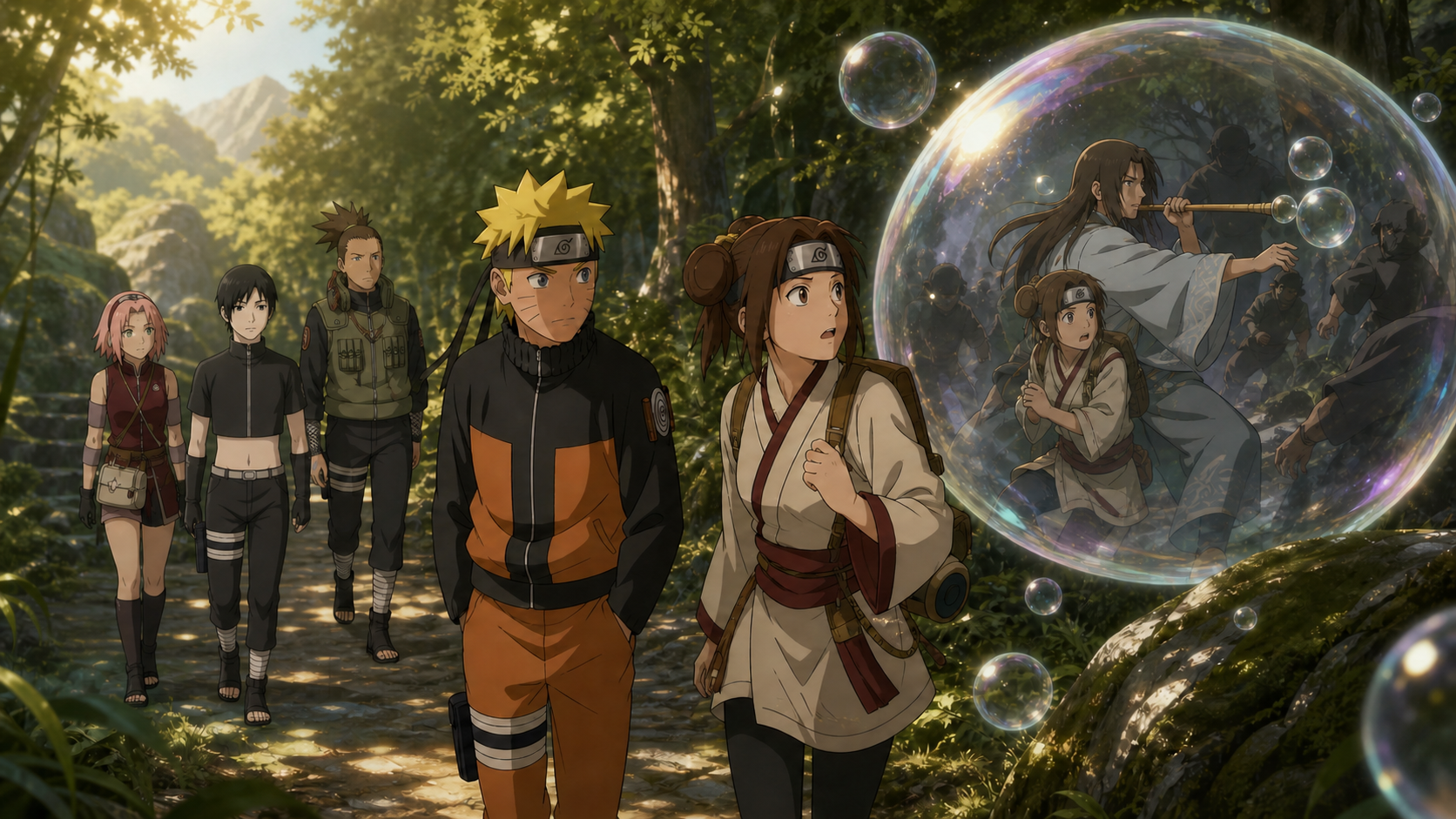
Successor of the Forbidden Jutsu
Hotaru’s road home becomes a conversation about the wanderer she calls master and the inherited power that makes belonging conditional.
What happens
Naruto, Sakura, Sai, and Yamato take responsibility for escorting Hotaru from the Tsuchigumo fort to her clan's mountain village. Utakata has already left, and Hotaru remains focused on the wanderer she considers her master.
As Naruto walks with her, Hotaru explains how Utakata once protected her from attackers and how his bubble techniques became associated with safety. She wants formal training from him, but Utakata repeatedly rejects the word “master” and avoids the obligation she believes their bond already contains.
The Leaf team moves carefully because the people seeking En no Gyoja's forbidden technique remain active. Hotaru is not merely a traveler returning home; she is the successor to a legacy other people intend to control.
Naruto recognizes the pain of wanting acknowledgment from a teacher who keeps emotional distance. The escort therefore becomes a conversation about what makes someone a successor and whether inheritance is chosen, assigned, or earned through relationship.
Hotaru names a bond Utakata will not
Hotaru calls Utakata her master because his actions changed the conditions of her life. He protected her, demonstrated power, and became the person she wants to learn from.
Utakata refuses the title, but refusal does not erase the expectation his protection created. Once someone repeatedly becomes the answer to danger, distance can feel like abandonment to the person left behind.
The episode does not make Hotaru's attachment childish or automatically correct. She may be asking Utakata to accept a role he never promised.
At the same time, his insistence on being unattached cannot fully explain why he continues to intervene. His behavior keeps producing the bond his language denies.
Naruto understands the desire for a teacher
Naruto's history makes him unusually receptive to Hotaru's frustration. Teachers gave structure to abilities and emotions that once frightened the people around him.
Iruka acknowledged him before the village did. Kakashi made Team 7 a place where he had to consider other lives. Jiraiya trained him while giving his ambition and loneliness room to grow.
Because those bonds mattered, Naruto does not treat “master” as a decorative title. It names trust, discipline, irritation, care, and the belief that another person will remain present long enough to help you change.
Hotaru's wish makes sense to him even when he cannot speak for Utakata.
A successor inherits more than technique
The episode title identifies Hotaru through the forbidden jutsu, but succession is not only possession. It includes the responsibility, fear, secrecy, and political attention attached to the technique.
En no Gyoja's agreement with the Third Hokage removed the jutsu from ordinary use, yet it could not remove other people's desire for it. Hotaru inherits the consequences of restraint as much as the power itself.
That makes protection complicated. Keeping her alive is essential, but treating her only as a vessel for the clan's legacy would repeat the logic of the attackers from another direction.
The escort must preserve Hotaru's ability to become a person with choices, not just deliver an inheritance to the next secure location.
The road creates room for testimony
The forest journey slows the plot enough for Hotaru to tell her own account. At the fort, other people discussed treaties, enemies, and succession around her. On the road, Naruto listens to what Utakata means from her perspective.
That shift matters because factual protection can still miss emotional reality. A mission report may say the former escort departed and the Leaf team assumed responsibility. Hotaru experiences the same event as the loss of the person she trusted most.
Naruto cannot solve that absence by promising safety. He can at least avoid pretending the new escort makes the old bond irrelevant.
Listening becomes part of protection rather than a delay before the “real” mission.
Utakata's distance suggests an earlier wound
Utakata's resistance to teaching feels larger than simple dislike of Hotaru. The title appears to trigger distrust in him, as though the master-student relationship carries a history he refuses to repeat.
The episode does not yet provide the full explanation, which keeps his behavior ambiguous. He may be protecting his freedom, protecting Hotaru from association with him, or reacting to betrayal attached to his own past.
His wandering therefore reads as a defense. Stable roles create expectations, and expectations create the possibility of control or loss.
Hotaru sees someone capable of guiding her. Utakata sees a title that may become another trap.
Safety at the village is not guaranteed belonging
The Tsuchigumo village is the assigned destination because clan territory should provide community and protection. But lineage does not automatically produce welcome.
Hotaru returns carrying a status that can make neighbors view her as burden, symbol, or danger. The forbidden technique separates her even from people who share the clan name.
That tension prevents the escort from ending with geography. Reaching the village may complete a route without answering whether Hotaru has a place where she is known beyond succession.
The contrast with Utakata is sharp: the wanderer belongs nowhere by choice, while the successor may discover that inherited belonging is conditional.
Hotaru gets to narrate the bond before anyone diagnoses it
The road gives her time to explain what Utakata did, how his bubbles became safety, and why the word master feels accurate. She is not a mission object being discussed by shinobi around a table.
Her testimony does not settle Utakata’s obligations, but it establishes that the relationship has consequences beyond whatever title he intended.
Calling someone master is a request and an interpretation
Hotaru asks for formal guidance. She also describes a pattern already lived: danger, rescue, instruction, and repeated return.
Utakata can decline the future role. He cannot make the past actions emotionally meaningless by rejecting the vocabulary she uses for them.
Consent matters on both sides of the bond
Hotaru deserves honesty, safety, and recognition. Utakata deserves the right not to accept a lifelong teaching role because somebody needs him.
The ethical answer is not forced attachment or unexplained disappearance. It is a boundary spoken clearly enough that the more vulnerable person can plan around it.
Naruto listens because he remembers begging adults to remain
His most important teachers did more than transfer techniques. They answered loneliness with presence, correction, irritation, food, trust, and expectations that assumed he had a future.
Hotaru’s longing does not look excessive to him. He knows the title can mean somebody finally sees a person worth the time required to teach.
Iruka proves acknowledgment can precede exceptional achievement
Iruka recognized Naruto before the village celebrated him. That order matters. Care was not payment for becoming useful.
Hotaru needs a relationship that sees her before mastery of the forbidden inheritance turns her into a clan success or a strategic danger.
Jiraiya complicates Naruto’s ideal of a master
He trained Naruto, protected him, teased him, failed him, and left absences that hurt. Love and mentorship were real without being tidy.
Naruto can understand Hotaru’s desire while knowing a teacher may wander, withhold, or carry private wounds that affect the student.
Succession without education is institutional abandonment
Hotaru inherits responsibility for a technique powerful people fear and covet. If the clan gives her the burden but not the knowledge to evaluate it, lineage becomes punishment.
A successor needs history, practical training, ethical context, and authority to question whether the inherited role should continue at all.
Forbidden does not mean forgotten
En no Gyoja banned use, but enemies kept the possibility alive through desire. Prohibition changes legal status, not the imagination of people seeking power.
Responsible containment must protect records, people, and knowledge of why the boundary exists. Silence alone leaves later generations vulnerable to anyone offering a simpler story.
The escort can deliver Hotaru home without delivering belonging
A completed route satisfies the mission report. It cannot guarantee the village sees her as a neighbor rather than a dangerous inheritance walking through the gate.
Safety includes social conditions after the guards leave. If community acceptance is conditional on hiding or surrendering part of herself, the destination is another enclosure.
Hotaru’s village may fear the same power enemies desire
One group wants to extract the technique. Another may resent the danger attached to protecting it. Both can reduce Hotaru to what her body or name represents.
Being unwanted and being coveted are opposite experiences built on the same refusal to see a whole person.
RaeRae reaction
I like that Naruto responds to Hotaru by listening instead of immediately promising to bring Utakata back. He knows what a teacher can mean, and that keeps him from dismissing her attachment as a distraction from the mission.
Hotaru's use of “master” is emotionally persuasive even when Utakata's consent remains important. She is naming the pattern she sees: he arrives, protects, demonstrates, and leaves her wanting the stability behind those actions.
The forbidden jutsu gives the story external stakes, but the more interesting inheritance is relational. Hotaru wants someone to teach her how to carry what her family left behind.
“Successor of the Forbidden Jutsu” asks whether succession can be complete without guidance. The Leaf can escort Hotaru to a village, but safety, belonging, and responsible control of power will require people willing to remain after the road ends.
Utakata’s absence controls the conversation anyway
He has left, yet Hotaru’s attention keeps returning to him. Distance does not end a relationship when the unanswered meaning of departure remains active.
His silence gives everyone else space to interpret his intention. Avoiding the conversation does not preserve neutrality; it transfers authorship.
Protection that creates attachment carries a duty of explanation
A rescuer cannot promise permanent presence in every crisis. Repeated intervention still teaches the endangered person where safety lives.
If the protector intends to leave, honest preparation matters. Otherwise the final rescue may create a new form of insecurity the moment it ends.
The team practices care through ordinary travel
Sakura monitors physical safety, Sai observes, Yamato leads, and Naruto listens. No enormous technique is required for their roles to matter.
Escort work turns protection into pace, attention, route choice, and willingness to hear a story that does not alter the tactical map.
Naruto should not promise what Utakata has not consented to give
Empathy can tempt him to solve Hotaru’s pain by guaranteeing a reunion or teaching bond. That would repeat the habit of deciding another person’s role through good intentions.
He can validate her experience, help create safety, and encourage honest conversation without treating Utakata as a reward to retrieve.
Hotaru deserves the right to redefine succession
Her grandfather’s legacy may matter deeply, but inheritance is not a command preserved in blood. She should be able to decide what to learn, restrain, transform, or refuse.
A worthy successor is not the person who repeats every earlier choice. It may be the person who understands the consequences well enough to choose differently.
The forbidden technique makes her body politically legible before her voice
Attackers track the successor because the title tells them where power may be accessed. The category travels faster than Hotaru’s own account.
The episode pushes back by slowing down for her memory. Voice becomes resistance to the label that arrived first.
Utakata’s wandering can be freedom and avoidance together
He may need distance from a village, master, or past that harmed him. Mobility protects his autonomy.
When movement prevents every difficult conversation, it also protects him from accountability. Trauma can explain the pattern without making Hotaru’s confusion costless.
The title asks who authorizes a successor
Bloodline names Hotaru. Enemies confirm the importance through pursuit. Retainers protect her. Utakata’s possible teaching could give practical skill.
None of those sources should outrank Hotaru’s own informed decision about the role. Succession becomes legitimate when the successor participates in defining it.
The road is safer because Hotaru is finally heard
Listening does not neutralize the attackers. It gives the Leaf team information about what protection will mean emotionally when they reach the village.
A guard who knows only the threat protects a body. A guard who hears the person can protect choices, relationships, and dignity too.
A successor needs access to the reason a technique was forbidden
A rule without history can look like fear, superstition, or an obstacle imposed by timid elders. Hotaru needs more than the instruction not to use her inheritance.
She deserves to know what the jutsu does, who was harmed, why En no Gyoja accepted restraint, and what conditions might tempt others to rationalize breaking it.
Knowledge can protect without becoming a lesson in deployment
Adults often treat ignorance as the safest answer when power is dangerous. Ignorance leaves the successor dependent on whoever controls the missing explanation.
Ethical teaching can explain consequences, safeguards, and political history without glorifying use. Refusing all education makes manipulation easier, not harder.
Hotaru’s attachment may contain gratitude, fear, and chosen family
Calling Utakata master organizes several feelings at once. He saved her, represents competence, understands pursuit, and appears outside the clan structures defining her.
The title may promise a relationship where she is chosen for herself rather than guarded because of lineage. That hope deserves respect even when Utakata cannot fulfill it.
Utakata should not have to become a cure for every abandonment
Hotaru’s need is real, but no single wanderer can repair clan isolation, inherited danger, and the failures of every adult around her.
A community should distribute care so one person’s departure does not collapse the entire structure of safety. Mentorship works better when it exists beside belonging, not in place of it.
The Leaf team can model support without claiming intimacy
They have a bounded mission and no right to pretend they already know Hotaru deeply. They can still listen, explain choices, respect fear, and avoid speaking about her as cargo.
Care does not require instant family language. Reliability during the promised period matters.
Returning home may force Hotaru to defend the relationship
People who distrust outsiders may describe Utakata as dangerous, irresponsible, or irrelevant. Hotaru’s memories will then compete with the clan’s preferred account.
She should not have to prove that rescue affected her. Others can question Utakata’s choices without erasing what his presence meant.
Naruto recognizes a student before the world recognizes a successor
He hears someone asking to learn, not merely someone assigned to carry a forbidden legacy. That distinction gives Hotaru a future beyond preservation.
A student can question, practice, fail, and change direction. A vessel is expected only to contain what others value.
The episode’s gentleness protects difficult questions
Walking, conversation, memory, and drifting bubbles create room for ideas about consent and responsibility without turning every disagreement into combat.
The quiet is not filler. It is where Hotaru becomes audible before the next threat tries to reduce her again.
What stays with me is how easily adults can describe Hotaru’s position as honor. She is the successor to a legendary creator, protected by an old treaty, and important enough for enemies to cross mountains seeking her. Every phrase sounds grand until we ask what daily life feels like for the girl inside it. Honor does not make fear lighter. Importance does not create companionship. A powerful inheritance can leave its owner lonelier than having nothing anybody wants.
That is why her insistence on Utakata matters beyond a crush on a mysterious wanderer or a student’s enthusiasm. She is trying to choose one relationship in a life dominated by assigned meaning. The word master may be imperfect, but it is hers. Utakata’s refusal deserves respect, yet he owes enough clarity that Hotaru can understand the difference between rejecting the title and rejecting her.
Naruto cannot solve that relationship from outside. What he can do is protect the space in which both people speak honestly and keep Hotaru from being captured before she gains the authority to decide anything. His empathy becomes useful when it does not race ahead of her voice.
The village at the end of the road will reveal whether clan belonging is strong enough to hold a successor as a whole person. If neighbors welcome the legacy but resent the danger, Hotaru will remain valuable without being accepted. If they fear the technique and blame her for carrying it, protection will become social exile. The best outcome would let her learn the history, choose responsible restraint, receive communal care, and pursue mentorship without making any one person’s presence the price of feeling at home.
A successor is not a locked room where the past stores property. She is a person who may honor earlier choices, revise them, or refuse the role. Hotaru’s safety will remain incomplete until the people guarding her accept that freedom. Anything less protects the technique’s future more than it protects hers, and that is exactly the hierarchy her enemies already believe in.
RaeRae’s final word on the successor
I believe Hotaru when she says Utakata’s actions felt like a master’s care. I also believe Utakata cannot be assigned a lifelong role through gratitude alone. The missing piece is honest conversation, not a verdict imposed on either person.
Naruto is the right listener because his teachers changed what survival meant. He understands that instruction without acknowledgment is incomplete and acknowledgment without continued honesty can still hurt.
The forbidden technique is the external danger, but the deeper inheritance is a life everyone else keeps defining. Hotaru is granddaughter, successor, target, treaty obligation, and student before she gets room to be herself.
Delivering her to the village will not finish the moral work. The real test is whether the adults around her can protect a person without claiming her power, choose guidance without demanding obedience, and let succession include refusal.
RaeRae’s call
Hotaru can name the care she received, Utakata can refuse a title, and both still deserve the honest conversation his wandering postpones. Succession must include Hotaru’s informed choice, not merely her bloodline.