
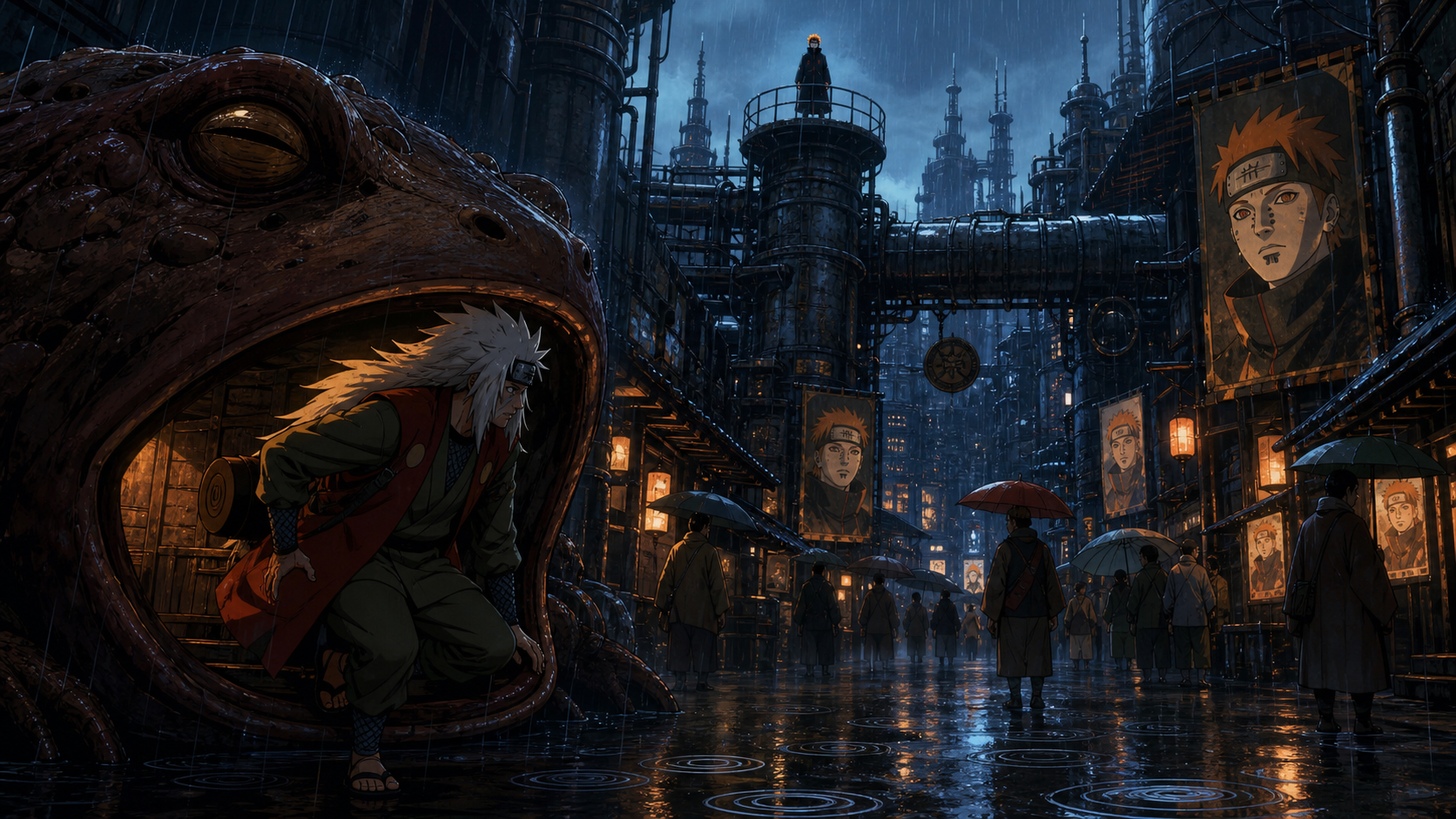
Infiltrate! The Village Hidden in the Rain
Jiraiya enters a city where the civil war has vanished from sight and the weather itself reports every disturbance.
What happens
Jiraiya enters the Hidden Rain inside Gamagoro, using the toad's body to bypass the village's defenses. He expects evidence of an active civil war and instead finds an orderly city where Hanzo's presence has been erased.
Residents speak of Pain as a godlike leader and Konan as his angel. The absence of visible resistance unsettles Jiraiya more than open conflict would. A regime that replaced Hanzo completely has also controlled the story people are permitted to tell.
Jiraiya captures two low-ranking Rain ninja and interrogates them inside a toad barrier. Their information confirms that Pain defeated Hanzo, eliminated his family and associates, and now governs through fear, devotion, and extraordinary surveillance.
The infiltration is not invisible. Pain senses an intruder through the rain itself and begins narrowing the search, while Konan prepares to respond.
Rain is infrastructure and surveillance
The Hidden Rain has always looked as though weather and architecture grew together. Pipes, towers, drains, metal walkways, and constant water make the village feel like a machine built to endure pressure.
Under Pain, rain becomes more than atmosphere. It is part of the detection system. Jiraiya can hide his face and entry route, but moving through the village means entering a field of chakra-informed observation.
That turns the title's simple word, “infiltrate,” into a technical problem. The village is not protected only by guards at gates. Its environment reports disturbance.
I like how this reframes Pain's authority. People call him a god because his power seems omnipresent, but omnipresence is also a political technology. If citizens believe the leader can feel every intrusion, resistance begins to police itself.
The clean streets are not proof of peace
Jiraiya looks for battle damage and finds order. The temptation would be to treat that as evidence the civil war ended successfully.
Instead, every missing trace raises another question. Hanzo's network did not merely lose power. Pain hunted relatives, supporters, and connected officials until the old regime could not regenerate.
The result may be stable, but stability created through total elimination carries its own violence. A quiet street can mean safety. It can also mean nobody believes speaking is survivable.
This matters because the Great Nations often define peace as the absence of conflict visible to them. Rain's people have repeatedly lived with the consequences of other villages' decisions. Their outward order tells us little about whether they possess agency.
Jiraiya interrogates the world he helped shape
Jiraiya enters as a spy seeking Akatsuki intelligence, but his personal history makes the mission inseparable from responsibility. He once taught three children here and left believing they could change the village.
The names Pain and Konan connect the current mystery to that unfinished relationship. Every answer threatens to reveal not only an enemy but what became of his students after he returned home.
His interrogation is effective and theatrical. The toad chamber isolates captives, and his transformations turn fear into information. It also reminds us that Jiraiya is not only a warm mentor. He is an experienced intelligence operative willing to coerce people during a dangerous mission.
The contradiction is important. Care and state violence can exist inside the same person. His affection for the Rain orphans does not place him outside the shinobi system that harmed their country.
Pain's divinity is a story with material support
Pain's image appears throughout the village, while residents describe him in religious language. The belief is not merely propaganda pasted over weakness. He defeated Hanzo, controls the rain, and can identify an intruder without ordinary patrols.
Power makes the myth credible. The myth then makes power easier to maintain.
Konan's role as angel adds familiarity to the structure. Jiraiya remembers a child who folded paper flowers; the village now understands that same visual language as the sign of a divine messenger.
That transformation is heartbreaking before he even sees her. A gesture associated with tenderness has become part of a regime's sacred imagery.
RaeRae reaction
This episode builds dread through competence. Jiraiya's infiltration is smart, his information gathering works, and every successful step proves the target is more dangerous than expected.
The Hidden Rain looks spectacular, but the beauty never feels welcoming. Reflections, towers, and endless water create a city where every surface seems capable of watching back.
I also appreciate the political discomfort. Pain removed a brutal ruler, and the story does not ask us to mourn Hanzo's government. It asks what happens when liberation becomes another absolute power that cannot tolerate witnesses, relatives, or competing memory.
Jiraiya came looking for Akatsuki's leader. He has entered a version of his own past that no longer recognizes him as a teacher. By the end, the village knows he is there before he understands what the village has become.
Jiraiya enters a country that remembers Konoha differently
My bottom line is that Episode 129 makes infiltration personal before Jiraiya confirms any identity. He comes as a Leaf intelligence operative seeking an enemy leader. The Rain receives another armed outsider from a great village that has repeatedly used its territory for war.
His love for the children he taught is real. His forehead protector still represents an institution implicated in the conditions that orphaned them. Both histories cross the border with him.
Gamagoro makes entry possible without making it innocent
Traveling inside a toad is clever concealment. It bypasses ordinary checkpoints and reduces the evidence of arrival. It also means Rain residents have no opportunity to consent to another foreign shinobi operating inside their city.
Espionage may be necessary to expose Akatsuki. Necessity does not erase sovereignty. The mission lives inside that discomfort.
The city looks orderly because Pain controls what can remain visible
Jiraiya expects open civil war and finds streets functioning beneath constant rain. Order can indicate that fighting stopped. It can also indicate that opposition, family networks, and public memory were systematically removed.
Hanzo was brutal, so his defeat is not the tragedy. The warning is Pain’s decision that nobody connected to the former regime could be allowed a future.
Peace without permission is another form of rule
Residents may genuinely prefer life after Hanzo. They may fear saying otherwise. A surveillance state makes those positions difficult to distinguish because public agreement becomes part of survival.
The absence of visible revolt cannot prove consent when the leader can sense disturbances through the weather.
Rain is atmosphere, infrastructure, and state power
The city’s pipes, towers, drains, and metal walkways have always reflected adaptation to relentless water. Pain adds chakra surveillance to that environment. Weather becomes an information network.
People do not merely pass guards. They move inside the leader’s field of attention. Omnipresence becomes technically credible enough to support religious language.
Calling Pain a god changes how resistance imagines itself
A dictator can be opposed as a person with forces and limits. A god appears woven into reality. If citizens believe the rain reports every intrusion, they may silence themselves before an enforcer arrives.
Myth is not decoration around power. It reduces how often power must be visibly used.
Konan’s angel image carries a stolen tenderness
Jiraiya remembers a child folding paper flowers in temporary shelter. The Rain now sees paper as the sign of Pain’s divine messenger. A language of care has become part of sacred authority.
Konan is not simply a symbol somebody dressed. She is a strategist and founder with reasons for remaining. Still, the transformation hurts because viewers know what the paper once protected.
The interrogation reminds us Jiraiya is a state operative
He isolates captured ninja inside a toad barrier, transforms them, applies fear, and extracts information. The procedure is skilled and coercive. Warm mentorship does not place him outside shinobi violence.
This matters when he confronts former students shaped by the same system. Everyone in that meeting will carry methods learned under claims of necessity.
Low-ranking ninja know consequences before they know policy
The captives can describe disappearances, leadership language, and what happens to people connected with Hanzo. They may not possess Pain’s full plan. Intelligence from below reveals how rule feels even when it cannot explain every decision above.
Fear is data. So is the careful way people repeat approved stories.
Jiraiya searches for facts and finds responsibility
He wants the identity and capability of Akatsuki’s leader. The names, imagery, and history keep pointing toward the children he left believing they could manage their future.
Information becomes personal without ceasing to be operational. That combination makes him more determined and more vulnerable to interpreting evidence through guilt.
The residents’ language matters because people living under surveillance learn to communicate on several levels. A statement of devotion may be sincere, rehearsed, protective, or all three. Jiraiya cannot treat one frightened source as a clean referendum on Pain’s legitimacy. He has to listen for what can be said, what disappears from the account, and what consequences follow a wrong answer.
That makes interrogation morally and analytically unstable. Fear can produce information, but it can also produce whatever the captive believes will end the threat. Jiraiya is experienced enough to compare details and test consistency. The episode still asks us to notice that a foreign operative is coercing low-ranking people in a country already organized around fear.
The toad barrier creates privacy from Pain while creating total control over the captives. Inside it, Jiraiya determines the space, appearance, questions, and exit. The technique is ingenious. It also mirrors, on a smaller scale, the political problem he is investigating: one powerful person controls what others may safely reveal.
I do not make that comparison to claim Jiraiya and Pain are equivalent. Purpose, scale, duration, and accountability matter. I make it because Naruto repeatedly shows caring people using the tools their violent institutions taught them. Good intentions do not make those tools ethically transparent.
Pain’s destruction of Hanzo’s network carries similar complexity. Hanzo betrayed the original Akatsuki and helped create Yahiko’s death. Removing his regime could genuinely liberate people. Killing relatives and associates because connection itself is treated as guilt turns revolution into inherited punishment. The new order reproduces the logic that innocent bodies can secure political control.
A government becomes accountable by allowing memory, disagreement, and futures it cannot completely manage. Pain’s Rain appears peaceful because competing power has been eliminated and observation reaches everywhere. That may reduce street violence. It also makes correction almost impossible when the ruler is wrong.
The divine language closes that gap further. A political leader can be questioned through policy, law, and public consequence. A god defines the moral frame that would judge him. Konan as angel turns administration into revelation, making obedience feel like recognition of reality rather than consent to rule.
Jiraiya knows enough mythology and performance to recognize constructed authority. He also knows Nagato once possessed eyes associated with the Sage of Six Paths. The truth behind the myth is therefore more dangerous than ordinary propaganda. Pain has material abilities capable of making religious claims feel empirically reasonable.
That is why the rain detection is such effective worldbuilding. Citizens do not need to understand every technique. They experience a leader who appears to notice disturbances across the village. Repeated evidence teaches them to anticipate observation. Surveillance becomes strongest when people carry the watcher inside their own decision making.
The architecture reinforces that feeling. Towers rise through mist, pipes connect structures, and water moves across every surface. There is little visual privacy. The village endured by adapting itself to rain, and Pain has attached his attention to the adaptation. Infrastructure built for survival becomes infrastructure for rule.
Jiraiya’s affection for the Rain children makes him susceptible to one comforting mistake: believing that if Nagato or Konan survived, some recognizable piece of his teaching must remain in control. People do carry teachers with them. They also reinterpret lessons through losses the teacher did not witness.
He taught the children strength so they could protect one another. Nagato may believe absolute force is the only honest extension of that lesson after Yahiko’s death. Jiraiya taught hope as persistence. Pain may describe imposed suffering as the mechanism that will force nations to understand. The vocabulary survives while the ethics change.
Konan’s paper creates another painful continuity. A flower once thanked an adult for food and shelter. Paper now scouts, attacks, carries messages, and supports the image of an angel. The medium did not betray its origin. History changed what survival required it to do.
I want more space for Konan’s reasoning than the story usually gives. She is not merely proof that Nagato kept one childhood friend. She helped found the first Akatsuki, survived the betrayal, watched Yahiko die, and chose how to respond to Nagato’s transformation. Loyalty is one decision among many, not the absence of decision.
Jiraiya enters before he knows any of this and must build the history from controlled fragments. That is the proper tension for an intelligence episode. Information does not arrive neutral. Every source has position, fear, limited access, and reasons to shape what is heard.
The mission also exposes a failure between villages. If the Rain’s ruler can operate Akatsuki, erase a former regime, and build pervasive surveillance without neighboring powers understanding the transition, then international intelligence has treated the smaller nation as strategically useful but politically unworthy of sustained attention.
Great villages notice the Rain when armies need passage, enemies need tracking, or threats cross borders. They are less reliable when residents need sovereignty, reconstruction, and protection from proxy conflict. Jiraiya’s late return is personal, but it belongs inside that larger pattern of selective attention.
I appreciate that he goes himself. He does not send a disposable subordinate into a place connected to his students. He accepts the danger and uses every tool available. Responsibility, however late, becomes action rather than private regret.
Courage does not guarantee that the mission is wise. Entering alone limits the risk to Konoha forces and improves secrecy, but it also removes witnesses, backup, and people who could challenge his interpretation. Jiraiya again chooses a solitary road toward an emotionally loaded answer.
That parallel with Sasuke matters. Both men approach someone tied to family-like history while keeping companions away. Both believe privacy will protect the meaning of the confrontation. Solitude reduces interference and increases the power of whatever story the other person controls.
Jiraiya’s humor during infiltration is therefore more than tonal relief. Performance helps him regulate fear and makes captives underestimate how carefully he is listening. The familiar clown remains available even when the teacher and spy are carrying grief. He has always used exaggeration to create room around vulnerability.
The problem is that performance can hide vulnerability from allies too. Tsunade knows the mission is dangerous, but Jiraiya does not fully share the emotional risk of discovering what became of the children. He protects others from worry by ensuring he carries the meaning alone. That habit looks noble until nobody is positioned to help when the burden becomes fatal.
Pain senses the intrusion before Jiraiya understands the system, reversing the confidence of the opening. The infiltrator believed concealment gave him time. The village’s ruler controls the detection field and decides when to close it. Every piece of intelligence Jiraiya gains occurs inside an encounter Pain already knows is coming.
That imbalance does not make investigation pointless. It makes the information costly. Jiraiya may not leave safely, but what he learns can still reach people capable of acting. Espionage becomes an exchange between one body and a future community, which is why recording and transmitting conclusions matter as much as winning a fight.
For me, the episode’s deepest dread comes from recognition arriving through institutions before faces. Jiraiya does not first meet the children he remembers. He meets their government, surveillance, symbols, and frightened subordinates. The adult versions are announced by the system they built or accepted.
That is a brutal answer to the optimism of Episode 128. The children did survive. They became powerful enough to change the Rain. Survival, power, and change were never guarantees of the peaceful future Jiraiya imagined. The question now is what losses transformed the dream, who benefited from that transformation, and whether teacher and students can still recognize the hope beneath it.
I am not asking the Rain to remain frozen in Jiraiya’s memory. The children had right to outgrow their teacher and define politics. I am asking what conditions made divinity, punishment, and observation feel like the available path to autonomy. Jiraiya came seeking a criminal leader. The city forces him to confront a possibility: the enemy may be built from a legitimate wound the great villages never repaired.
RaeRae’s final word on the infiltration
I love the dread of a mission that succeeds one answer at a time. Jiraiya gets inside, captures sources, and learns how Pain rules. Every competent step makes the danger larger.
The Hidden Rain is beautiful and suffocating. Its towers reflect in water while the weather itself reports disturbance. A city can look calm and still be organized around the fear of being noticed.
I am not mourning Hanzo’s government. I am questioning liberation that erases families, witnesses, and competing memory. Removing a tyrant does not make absolute power accountable.
Jiraiya entered looking for Akatsuki’s leader and found a country shaped by his unfinished past. Before he sees Nagato or Konan, the watched industrial city tells him the lesson: the children survived, but survival did not produce the future he imagined for them.
RaeRae’s call
Jiraiya’s clever infiltration enters a surveillance state built from the Rain itself. Every answer about Pain also exposes what became of the children and country he left behind.