
The Hunt
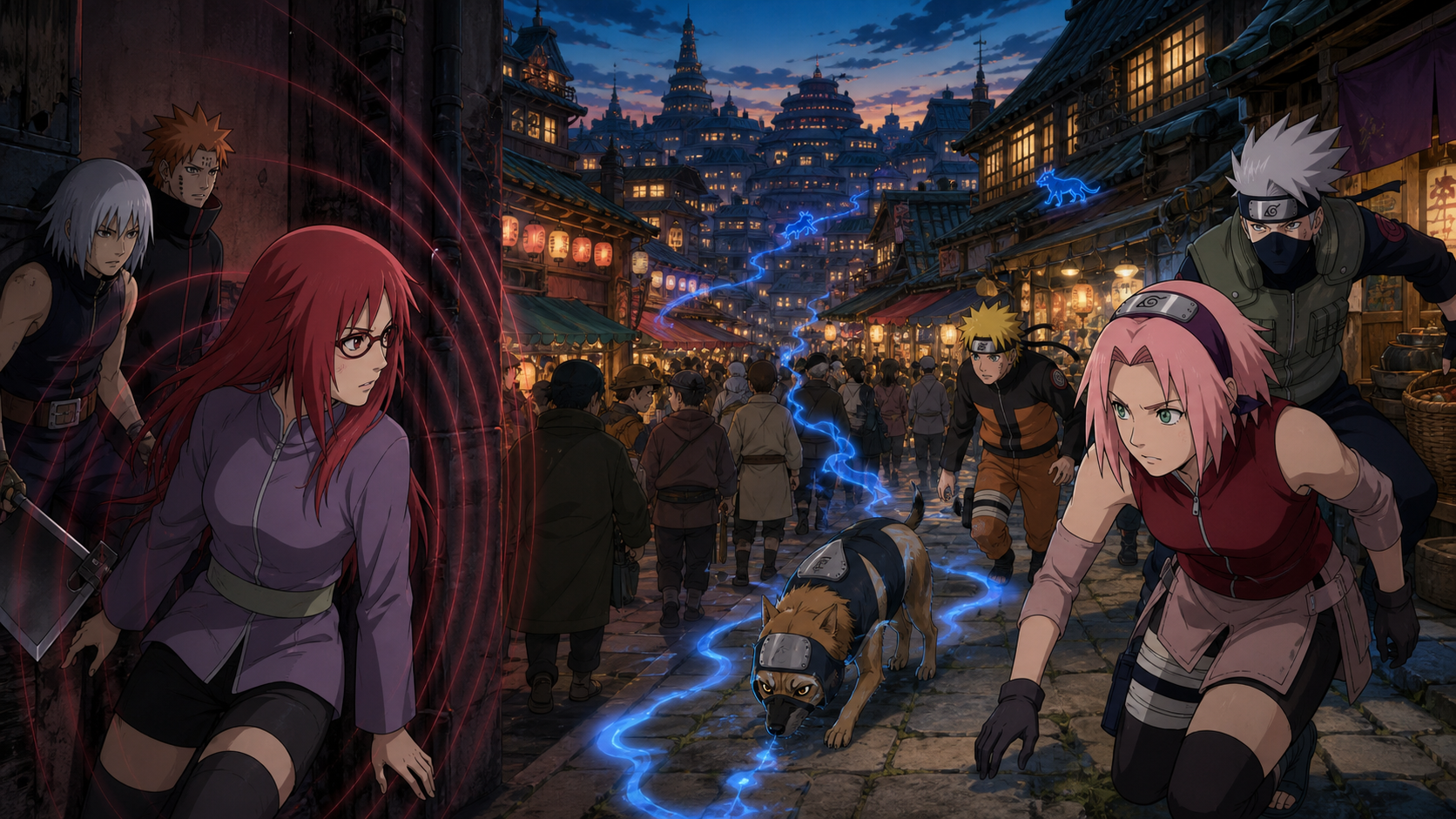
Konoha and Hebi split into specialist search teams, bringing Sakura and Karin within one street of discovering each other.
What happens
Kakashi divides the Leaf search force and deploys his ninja hounds to gather information about Itachi and follow traces connected to Sasuke. The mission depends on scent, witness reports, distributed teams, and disciplined communication rather than one dramatic pursuit.
Hebi also separates. Karin uses chakra sensing, while Suigetsu and Jugo follow assigned search routes. Sasuke wants Itachi located before Konoha or Akatsuki can interfere with the confrontation he has spent years preparing.
The parallel searches nearly intersect in a town. A ninja hound leads Sakura along Sasuke's scent while Karin moves close enough to detect unusual chakra activity. The two women orbit the same person from different sides without fully meeting.
Every group has information the others lack. Konoha knows Sasuke's history and wants to recover him. Hebi knows his current objective and supports the hunt for Itachi. Akatsuki knows more about Itachi's movements but has no interest in protecting either brother from the collision.
Tracking is skilled labor
The episode treats pursuit as a network instead of a magical arrow. Kakashi's hounds identify scent, but terrain, crowds, time, and deliberate concealment complicate the trail.
Karin's sensing provides a different data set. She can distinguish chakra signatures and recognize proximity without following a physical trace. That advantage still requires interpretation. A crowded town produces noise, and revealing her own attention may alert another sensor.
Neither system makes ordinary investigation irrelevant. Teams question people, map routes, compare clues, and decide where limited personnel should move next.
The hunt works because multiple specialists perform unglamorous tasks correctly. This is shinobi intelligence as labor, not plot convenience.
Sakura and Karin almost share a scene
The near-crossing matters because Sakura and Karin represent different relationships to Sasuke. Sakura knew the child in Team 7, the teammate who left, and the person she still hopes to bring home. Karin knows the current traveler who recruited her and leads Hebi toward Itachi.
Neither woman possesses a complete Sasuke. Their information comes from different periods, and their feelings shape what they notice.
I wish the story gave both women more space outside rivalry around him. Sakura is a medic and combat specialist. Karin is an extraordinary sensor and former hideout administrator. Their almost-meeting could have been an encounter between two capable intelligence operatives, not only romantic proximity.
The chase still creates an effective tension: the past and present versions of Sasuke are separated by one street and a scent trail.
Naruto follows a route to Sasuke
Naruto is officially hunting Itachi, but emotionally he is hunting access to Sasuke. He believes reaching the older brother may let him interrupt the revenge path.
That motive contains love and danger. Naruto refuses to abandon his friend, which has repeatedly saved people. He also risks treating Sasuke's choices as obstacles to overcome rather than decisions requiring honest engagement.
Kakashi brings more caution. After Obito, he knows what happens when a teammate's unresolved grief becomes the center of a mission. He wants to find Sasuke without repeating the abandonment that defined Kannabi Bridge.
The hounds therefore carry more than scent. They lead Kakashi toward another Uchiha teammate before revenge and secrecy decide the ending.
RaeRae's reaction
I enjoy the procedural rhythm here. Everybody is moving, but nobody has perfect information. The tension comes from routes nearly crossing and clues arriving seconds too late.
Kakashi's hounds are adorable professionals. They do not erase the difficulty of tracking; they make scent one tool inside a larger intelligence operation.
Karin's ability gives Hebi a serious advantage, and the episode reminds us why Sasuke recruited her. Swords can win a confrontation after you find it. Karin determines whether the team reaches the correct battlefield at all.
The Sakura-Karin near-miss is frustrating in a useful way. Sakura is close to the person who currently knows Sasuke's movements best. Karin is close to the teammate whose knowledge of his past could challenge Hebi's mission assumptions. Neither gets the exchange.
I also notice how every faction talks about Itachi as a target while he remains an active planner. The hunt creates the illusion that the searchers control the meeting. Itachi has spent years deciding what Sasuke will see and when.
Sasuke's decision to scatter Hebi is strategically sound and emotionally revealing. He trusts each member's capability enough to operate alone, but the separation keeps his central confrontation private. The team can locate Itachi; they may not be invited into what happens afterward.
Konoha's larger force looks protective, yet numbers can feel like containment from Sasuke's perspective. He left the village to pursue revenge and will not interpret a coordinated retrieval squad as neutral concern.
The Hunt moves everyone closer without pretending distance is only geographic. Sakura and Karin almost meet. Naruto and Sasuke remain separated by intention. Kakashi and Itachi carry older Uchiha history. The trails are converging faster than the people understand one another.
The hunt is a contest between different kinds of knowledge
My bottom line is that Episode 122 understands pursuit better than stories that turn tracking into a glowing arrow. Konoha has institutional reach, Kakashi’s field experience, ninja hounds, and people who remember Sasuke before he left. Hebi has Karin’s sensing, Sasuke’s current intentions, and a smaller team that can move without village procedure. Nobody has the whole person.
That missing whole matters. A scent can prove somebody passed through a street. Chakra can reveal that a powerful stranger is nearby. A witness can remember a cloak or direction. None of those clues explains what Sasuke will choose when he finally sees Itachi. The episode builds tension by letting every team mistake access to information for access to him.
Kakashi builds a network instead of chasing one dramatic clue
Dividing the search party is practical because Itachi and Sasuke may be moving across a wide region. Kakashi uses specialists, assigns routes, and keeps communication possible. The plan respects time. A trail grows colder while a large group debates which road looks promising.
It also creates vulnerability. Smaller teams cover more ground, but each one has less support if Akatsuki appears. Kakashi is balancing speed against survival with no perfect answer. That is leadership under uncertainty, not the fantasy of a commander who already knows which decision the plot will reward.
The ninja hounds deserve credit as shinobi partners
Pakkun and the other hounds are not equipment pulled from a scroll and forgotten. They interpret scent, communicate changes, navigate human spaces, and work independently after deployment. Their intelligence turns Kakashi’s summons into colleagues inside the mission.
I love that the series can put a tiny dog beside elite ninja without treating the dog as a joke. Pakkun’s size does not reduce his authority. He knows what the humans cannot smell, and the humans have to listen. Useful expertise does not need to look imposing.
Sakura brings more than her feelings for Sasuke
Sakura can read a dangerous scene, protect an injured teammate, survive direct combat, and process medical evidence. Pairing her with a hound gives the search team somebody capable of acting if the trail ends in violence. The mission should let those abilities remain visible.
Her history with Sasuke still shapes the pursuit, but it should not swallow her profession. She is not following a scent because longing is her only qualification. She is a trained shinobi whose emotional stake makes the assignment harder, not a girl who accidentally wandered into an intelligence operation.
Karin is the reason Hebi can compete with a village search force
Sasuke did not recruit Karin for decoration. Her sensory range turns vague geography into actionable routes. She can notice concentrations of chakra, distinguish signatures, and warn the team when another group enters the field. That is strategic power before anybody throws a punch.
The writing sometimes pushes Karin’s desire for Sasuke so loudly that her competence becomes background noise. Episode 122 gives us a chance to correct our attention. Hebi can split up because Karin makes reconnection and detection possible. Without her, Sasuke has strong fighters walking through an enormous country hoping rumor will do the work.
The near meeting between Sakura and Karin is loaded with missing context
Sakura knows Team 7, the curse mark, Orochimaru’s recruitment, and the grief surrounding Sasuke’s departure. Karin knows his movements after Orochimaru, his new team, his current discipline, and how his chakra feels now. Put their information together and each woman would have to revise part of her picture.
Instead, they pass close enough for the audience to feel the lost conversation. I do not need them reduced to romantic competitors. I want two capable women comparing what they know about a man who keeps deciding how much truth anybody around him receives.
Sasuke delegates labor but keeps the meaning of the mission private
Hebi members receive routes and tasks. They do not receive equal ownership of the confrontation. Sasuke wants their abilities to get him to Itachi, yet his emotional endgame remains sealed. That arrangement is efficient until somebody must decide how much danger is acceptable for a revenge they did not design.
Suigetsu, Karin, and Jugo consented to travel with Sasuke for different reasons. Consent to search does not automatically mean consent to die against Akatsuki. A leader who depends on personal loyalty still owes the team enough truth to judge the mission.
Naruto keeps translating rescue into arrival
Naruto believes finding Itachi will lead to Sasuke and finding Sasuke will create another chance to bring him home. That hope comes from real love. It also keeps compressing a political and emotional disaster into a problem of distance.
Sasuke did not leave because nobody could locate him. He left because revenge, secrecy, power, and the village’s failures became stronger than his reason to remain. Naruto can interrupt a road. He cannot make Konoha safe or honest by reaching the road first.
Konoha’s numbers can look like protection or containment
From Naruto’s position, a coordinated search force means friends refusing to abandon Sasuke. From Sasuke’s position, the same force may look like the institution that labeled him a missing ninja sending enough bodies to control his choices. Both readings can exist at once.
That ambiguity is why intent cannot be the only moral measure. Konoha may intend rescue and still reproduce the feeling that Sasuke belongs to the village before he belongs to himself. If they reach him, their first words will matter as much as their strength.
Itachi remains an actor while everybody calls him a target
The searchers discuss routes toward Itachi as though he is waiting at the center of a map. He has spent years managing what Sasuke believes, when information appears, and how their eventual confrontation will be framed. He is not a treasure chest at the end of a tracking mission.
This makes every successful clue dangerous. Closing the distance may be exactly what Itachi expects. Sasuke can win the hunt and still arrive inside somebody else’s design.
Akatsuki benefits from everybody else’s emotional tunnel vision
Konoha wants Sasuke. Sasuke wants Itachi. Hebi follows Sasuke. Those narrow objectives make movement easier to predict. Akatsuki understands obsession because the organization recruits people whose isolation can be turned into labor.
Pain does not need to control every searcher directly. He needs to understand what each one refuses to abandon. A person who believes only one destination matters can be guided by moving that destination.
Search work depends on ordinary people the story barely names
Teams ask questions in towns, study roads, and rely on memories from people who saw strangers pass. Those civilians become part of the intelligence chain without knowing the stakes. A mistaken description can redirect shinobi. A truthful answer can bring Akatsuki violence closer to somebody’s home.
The episode’s procedural texture works because the world contains more than combatants. Routes pass through markets and streets where people are living ordinary days. Ninja conflict keeps borrowing civilian space.
The women are allowed proximity but denied exchange
Sakura and Karin almost meeting is suspenseful, but it also repeats a frustrating habit. Women connected to Sasuke are positioned around him while the story delays letting them speak to each other as informed adults. Their knowledge could complicate his secrecy too efficiently.
I want the encounter the episode withholds. Sakura could learn that Sasuke formed a team rather than remaining Orochimaru’s captive. Karin could learn what Team 7 meant before the curse mark. Neither fact erases harm or guarantees agreement. Both would make their choices more informed.
A sensor still has to interpret what she feels
Karin’s ability is extraordinary, not infallible. Range, unfamiliar signatures, concealment, crowds, and her own expectations affect the conclusion she draws. Sensory information becomes useful through judgment. That keeps the power from replacing investigation.
It also gives Karin responsibility. If she recognizes Konoha nearby, she must decide what to tell Sasuke, how urgently to warn the others, and whether contact helps or threatens the mission. Information is never neutral once somebody can act on it.
The episode’s restraint makes the convergence sharper
There is no need for a giant fight to prove the arc is moving. A hound catches a trail. Karin senses activity. Teams change direction. Those small shifts tighten the same knot because viewers understand what will happen if the wrong people arrive together.
I prefer this to empty speed. The Hunt lets suspense grow from competence. Everyone is doing reasonable work, and reasonable work is bringing incompatible goals into the same territory.
The scent trail creates another question the episode leaves sitting in plain sight: who gets to define the person being followed? To the hounds, Sasuke is a recognizable trace moving through space. To Konoha, he is a teammate, citizen, security concern, and unresolved failure. To Hebi, he is the leader who opened cages and supplied a destination. To Akatsuki, he is Itachi’s brother and a variable with dangerous eyes. Sasuke is all of those things, but none of them alone.
That matters because retrieval stories can turn a person into an object everybody claims for a different reason. Naruto’s claim sounds warmest because it is grounded in love, yet love can still become possessive when it refuses to hear no. Hebi’s claim sounds voluntary because Sasuke recruited them, yet their freedom depends on whether he respects motives that do not match his own. The village’s claim carries law behind it. Akatsuki’s carries violence. The hunt becomes a struggle over who is allowed to interpret Sasuke before Sasuke speaks for himself.
I keep returning to Sakura’s position because she has grown since the hospital rooftop and the failed promise before Sasuke left. She knows wanting somebody back does not automatically provide the strength, plan, or language to reach them. Her medical training has taught her to assess damage before treatment. The same discipline should apply here. Sasuke’s isolation is not a wound that closes because Team 7 arrives together. The source includes grief, manipulation, institutional secrecy, and choices he made while surviving all three.
Karin carries a different danger. Her ability makes other people intensely legible while her own needs remain easy for the group to ignore. She can tell them where an enemy is, whether chakra changes, and when pursuit draws near. Who checks what the mission is costing her? Competence often becomes a trap when everyone treats the reliable person as an endless resource. Hebi needs Karin, but needing her is not the same as respecting her.
The best pursuit episodes make every mile change the moral pressure, and this one does. A clue does not simply bring the cast closer to a fight. It reduces the time available for truth. Itachi’s plan moves nearer to completion. Sasuke has fewer quiet hours in which to question what revenge promises. Naruto has fewer chances to decide what he will say if pleading fails. Sakura and Karin lose a possible exchange that could have altered both teams. The roads are narrowing, but the story’s real countdown is the shrinking space for anyone to choose differently.
That is why the town sequence lands harder than another empty promise. Sakura and Karin occupy spaces without knowing how much the other could explain. Their separation protects Sasuke’s compartmentalized life for another episode. It also protects the assumptions driving both searches. Konoha can keep imagining retrieval as restoration. Hebi can keep imagining the mission as a straightforward hunt. One honest conversation might not produce agreement, but it would force everybody to work with a fuller human being instead of the version most convenient to follow.
RaeRae’s final word on the hunt
I am here for an episode that respects tracking as labor. Kakashi does not point dramatically at the horizon and call it strategy. He deploys specialists. The hounds work scent. Human teams gather testimony. Karin reads chakra. Every clue needs somebody capable of understanding it.
I am also watching the story’s treatment of Sakura and Karin. Their near crossing is not interesting because two women like the same man. It is interesting because each holds a different archive of Sasuke’s life. A real conversation could expose how carefully he separates his past from his present.
Naruto’s determination remains moving, but determination cannot substitute for an answer. If he reaches Sasuke, what is he offering besides return? Friendship matters. So do truth, accountability, and the right to make a choice after learning what the village concealed.
The hunt narrows the map while widening the emotional distance. Konoha, Hebi, Akatsuki, and Itachi are all moving with partial knowledge. Everybody believes the next clue will create control. What it actually creates is proximity, and proximity is about to make every unfinished argument dangerous.
RaeRae’s call
Konoha tracks Sasuke’s past while Hebi protects his present mission. Sakura and Karin nearly connect those two versions, but the hunt keeps everyone moving before understanding can catch up.