
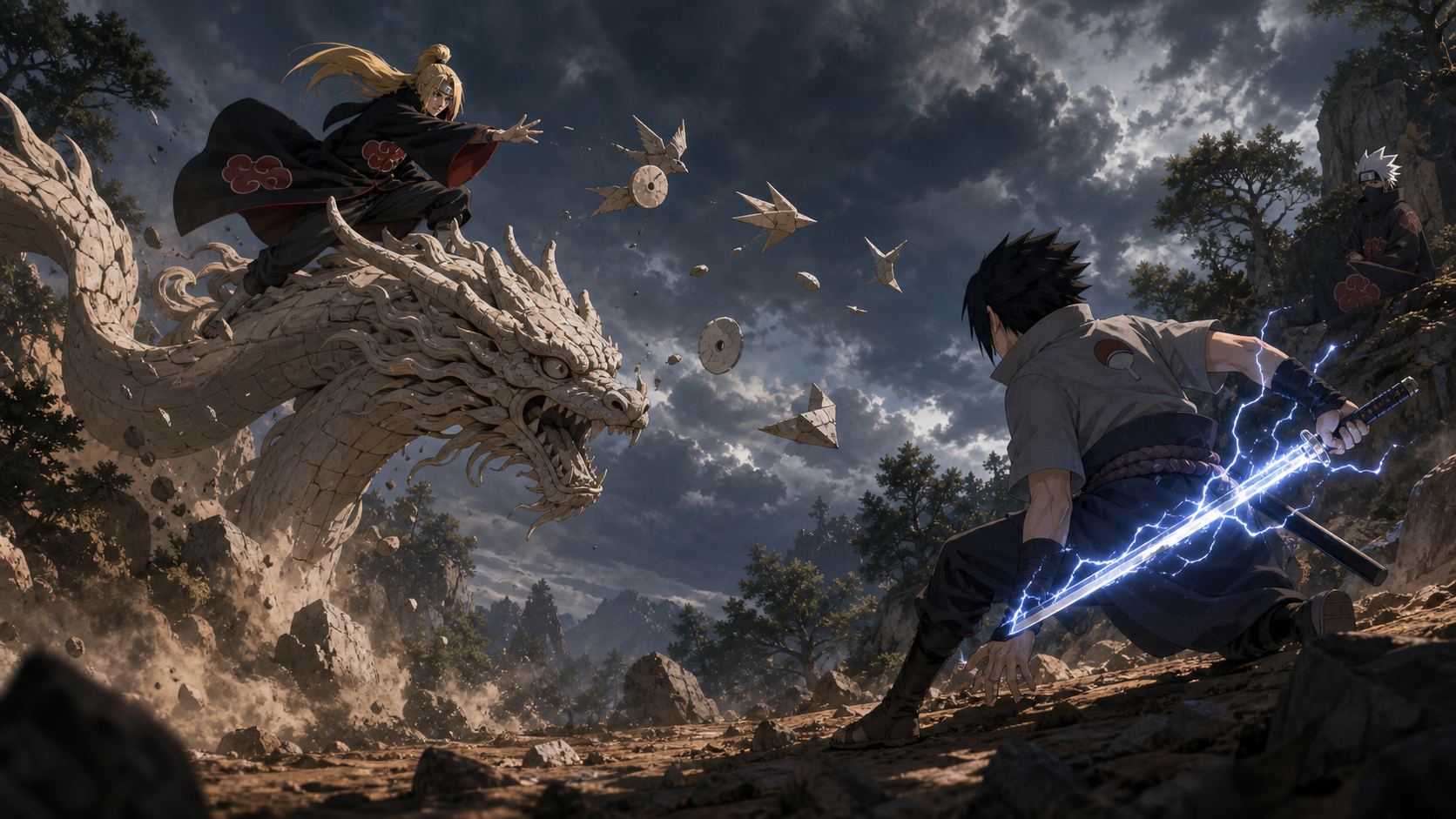
Clash!
Deidara fills the battlefield with explosive spectacle while Sasuke quietly turns every attack into evidence.
What happens
Sasuke's search for Itachi puts him directly in Deidara's path. Deidara begins with probing attacks, testing the Sharingan user before escalating to aerial bombardment from a clay dragon. Tobi supports him from the edges of the battlefield, helping shape the space Sasuke must cross.
Sasuke answers with speed, sword work, shuriken, and lightning. He is not simply enduring explosions. He watches how Deidara creates, controls, and detonates his clay, then starts building a theory about the technique's limits.
Deidara reads Sasuke through his own history. Itachi once defeated and humiliated him with genjutsu, so another Uchiha is never merely another opponent. Every calm glance from Sasuke presses on an old wound.
The fight therefore operates on two levels. Sasuke needs information and a route to Itachi. Deidara needs to prove that his art cannot be dismissed by the eyes that once made him feel powerless.
A battle about seeing
Deidara insists that an explosion is art because it exists for one perfect instant. His clay creatures are carefully shaped, but their purpose is disappearance. Creation becomes meaningful to him at the moment it destroys itself.
The Sharingan represents a rival claim about value. It observes, remembers, predicts, and exposes method. Sasuke's gaze turns spectacle into evidence. To Deidara, that scrutiny feels like contempt even when Sasuke says very little.
That makes the battle more interesting than a simple contest of destructive power. Deidara wants awe. Sasuke wants useful information. One fighter performs for an audience who refuses the role, while the other keeps reducing the performance to range, timing, elemental nature, and openings.
I love that incompatibility. Deidara's attacks become larger because Sasuke will not validate them emotionally. Sasuke becomes colder because Deidara is standing between him and the only confrontation he cares about.
Sasuke fights like an investigator
Sasuke's strongest weapon here is not lightning by itself. It is patience under pressure. He lets Deidara reveal habits, checks the results of each counter, and avoids announcing conclusions before he can use them.
His lightning release gives him an elemental advantage against earth-based clay, but recognizing that relationship is only the beginning. He still has to reach airborne targets, account for Tobi, protect himself from hidden explosives, and keep enough strength for whatever comes next.
The episode makes his intelligence physical. A sword planted in the ground, a wire route, a shuriken angle, or a burst of lightning can all become part of the same evolving answer. Sasuke is frightening because he turns observation into action with almost no visible delay.
That competence does not make him invulnerable. His focus on Itachi narrows him. He treats pain, risk, and other people as costs to calculate, which is effective in a duel and dangerous as a way to live.
Deidara's grievance is driving
Deidara presents himself as playful, but the Uchiha name strips away the joke. His anger at Itachi has hardened into a need to defeat the clan's eyes themselves. Sasuke becomes a substitute target for an injury he did not cause.
This is why Deidara keeps escalating. A practical mercenary could disengage, report Sasuke's position, or wait for a better advantage. Deidara instead needs the fight to deliver a verdict about his art and his worth.
Tobi's presence adds another layer. He acts foolish and deferential, yet he is never irrelevant. His support helps Deidara control the battlefield, and his apparent unseriousness makes it harder to measure what he actually understands.
Knowing more about Tobi later makes these scenes unsettling. The comedy is camouflage, but it also gives Deidara the audience he wants. Tobi praises, reacts, and irritates him while quietly surviving close to the blast radius.
RaeRae reaction
This episode trusts viewers to follow tactics without pausing for a lecture after every move. The pleasure comes from noticing a setup, revising an assumption, and realizing that a previous action had a second purpose.
I am not rooting for Sasuke's revenge spiral, but I understand why his combat writing became so influential. He does not win attention by shouting about potential. He creates pressure through control. Even when Deidara fills the screen, Sasuke determines the rhythm by refusing to panic.
Deidara remains compelling because the performance is sincere. His art philosophy is absurd, lethal, and emotionally revealing at the same time. He cannot tolerate being looked through, especially by an Uchiha, because recognition matters more to him than survival.
The title promises a clash and delivers more than colliding techniques. It is spectacle against analysis, wounded pride against obsessive purpose, and a battle between two men whose identities depend on someone who is not present.
Sasuke and Deidara are both moving toward self-destruction, just at different speeds. The frightening part is how beautiful and intelligent that movement can look while it is happening.
Deidara is fighting Itachi through Sasuke
My bottom line is that Deidara does not meet Sasuke as a stranger. He sees the younger brother through the humiliation Itachi left behind. The Sharingan once made his confidence feel childish, so defeating another Uchiha becomes a chance to rewrite a memory that never stopped controlling him.
That transfer is unfair to Sasuke and revealing about Deidara. Sasuke has not judged his art. He barely wants the conversation. Deidara supplies the contempt because he needs an audience whose defeat will certify that his life philosophy matters.
Sasuke refuses the audience role
Deidara stages each attack as a declaration. The clay has form, movement, timing, and spectacle before it explodes. Sasuke answers by studying range and elemental behavior. He turns a performance into a problem set.
That refusal wounds Deidara more than mockery would. Hatred at least admits emotional impact. Sasuke’s attention remains practical because Itachi is the only person whose recognition matters to him. Deidara cannot force himself into the center of that obsession.
Art and the Sharingan make competing claims about time
Deidara values the instant when shaped clay disappears into destruction. The Sharingan records movement, anticipates sequences, and extends an instant through memory. One philosophy worships vanishing. The other makes the vanishing available for analysis.
This is why being watched feels threatening to Deidara. Sasuke’s eyes do not merely see the artwork. They preserve its method long enough to expose repetition, weakness, and construction. Mystery becomes technique, and technique can be countered.
Lightning release matters because Sasuke earns the conclusion
The elemental advantage is satisfying because it arrives through testing. Sasuke does not receive a convenient announcement that lightning can neutralize earth-based clay. He observes what happens when techniques meet and builds his next choice from the result.
Knowledge still requires execution. He must deliver lightning into the correct space, survive long enough to confirm the effect, and hide how much he understands. A correct theory does not protect the body unless the fighter can use it under pressure.
The sword is a tool for thinking
Sasuke’s blade extends reach, channels lightning, redirects attention, and creates fixed points in the landscape. It is not only a symbol of how far he moved from Team 7. Every placement can establish the geometry of a later counter.
That physical intelligence distinguishes him from fighters who collect powerful attacks without building relationships between them. Sword, wire, shuriken, Sharingan, speed, and chakra nature belong to one system. The system changes as new evidence arrives.
Deidara’s altitude creates power and isolation
The clay dragon gives him distance, vision, and room to bombard the ground. It also reinforces his desire to place art above the viewer. Sasuke must look up while Deidara decides what falls.
Altitude is not control by itself. Aerial movement creates patterns and depends on a construct Sasuke can study. The higher Deidara goes, the more his need for dominance becomes visible. He is not simply seeking safety. He wants the battlefield arranged like a stage.
Tobi performs foolishness beside real danger
Tobi’s complaints and exaggerated reactions invite viewers to treat him as comic support. Meanwhile he helps set the field, survives near lethal explosives, and watches two Sharingan-related histories collide. The mask is doing political work.
Deidara believes he has an irritating junior partner. The audience gradually learns that the supposed fool has reasons to monitor Sasuke and Itachi. Comedy lowers everybody’s guard, including ours.
Sasuke’s calm is discipline, not proof that the fight costs nothing
He limits expression because emotion can reveal information and because his life has trained him to convert pain into focus. That control looks effortless from outside. It is still labor performed by a traumatized young man walking toward the person who defined his childhood.
I do not want competence used to erase the cost. Sasuke can make excellent tactical decisions while living inside a destructive purpose. Skill keeps him alive. It does not prove revenge is healing him.
Deidara keeps escalating because withdrawal feels like erasure
A professional could disengage after learning Sasuke is a dangerous elemental counter. Deidara cannot accept that choice because leaving would preserve the old verdict. Another Uchiha would have looked through his spectacle and continued toward something more important.
Pride turns tactical information into insult. The more evidence suggests he should change the mission, the more urgently he needs a decisive artistic answer. His philosophy stops being a source of freedom and becomes a cage.
Both men organize identity around Itachi
Sasuke built his life around killing the brother who massacred their clan. Deidara built part of his artistic grievance around defeating the eyes that humiliated him. Itachi is absent, yet he supplies the emotional gravity for both combatants.
That resemblance does not make their motives equal. Sasuke survived family annihilation. Deidara survived wounded pride. The episode can connect their fixation without flattening the moral difference between those wounds.
The fight asks whether being understood feels like being diminished
Deidara wants viewers to experience awe before analysis. Sasuke’s ability to identify mechanisms makes him feel reduced. Artists can recognize that fear even when Deidara expresses it through murder.
Understanding technique does not automatically empty art of meaning. Sometimes craft becomes more impressive after the method is visible. Deidara cannot tolerate that possibility because he needs mystery and shock to protect his superiority.
Sasuke controls rhythm by withholding reaction
Deidara owns most of the noise, color, and movement. Sasuke controls the emotional tempo. He does not give panic when Deidara expects panic or admiration when Deidara demands admiration. That silence forces the attacker to spend more chakra proving the same point.
Refusal becomes pressure. Sasuke does not have to insult Deidara directly because continuing to treat him as an obstacle says everything Deidara fears.
Battlefield analysis does not make Sasuke morally complete
Fans sometimes turn intelligence in combat into evidence that a character is correct about everything. Sasuke’s tactical brilliance deserves recognition. His treatment of comrades, his secrecy, and his willingness to risk himself for revenge still need separate judgment.
A person can read an enemy perfectly and misunderstand his own needs. That split is central to Sasuke. He can expose the structure of an explosive technique while remaining trapped inside the structure Itachi designed for his life.
Deidara’s art consumes the maker along with the material
His creed celebrates destruction as the final artistic instant. The logic always threatens to turn inward. If the greatest proof of art is complete disappearance, the artist eventually has to consider his own body as material.
That danger is already present in every escalation. Deidara is not merely choosing larger weapons. He is moving toward a standard no surviving performance can permanently satisfy.
Tobi gains information no matter who wins
Standing near the battle lets Tobi observe Sasuke’s speed, Sharingan use, elemental affinity, priorities, and tolerance for risk. Deidara thinks they are partners confronting an enemy. Tobi can treat the confrontation as reconnaissance.
This is one reason his foolish act is so effective. People explain themselves around somebody they do not respect. Deidara speaks openly, and Sasuke focuses on the obvious threat, while the masked observer collects the shape of both men.
The spectacle works because the tactics remain readable
Large attacks can become empty when viewers cannot understand position, cost, or consequence. Episode 123 keeps connecting each visual escalation to a choice. The dragon solves distance for Deidara. Lightning tests Sasuke’s theory. Movement changes who controls the next exchange.
Readability does not mean predictability. It means a surprise can feel earned after it happens because earlier actions supplied the pieces. The audience gets the pleasure of revising the fight alongside Sasuke.
There is another uncomfortable layer in the way Deidara talks about vision. He wants art to overwhelm judgment, but he chose an organization that converts creative skill into capture, intimidation, and extraction. Akatsuki gives him resources and an audience while narrowing what his work is allowed to accomplish. His clay can resemble birds, spiders, dragons, and tiny living things, yet all of that invention ends in the same command: detonate. The philosophy of freedom has become repetitive labor for a violent institution.
Sasuke sees that repetition because repetition is what tactical analysis needs. Deidara experiences every sculpture as a fresh artistic statement. Sasuke notices common ingredients, control signals, chakra nature, delivery systems, and timing. Neither view is entirely false. A work can be visually new while relying on a stable process. The tragedy is that Deidara believes exposing the process destroys the value, so every successful observation feels like theft.
I also keep thinking about how little Sasuke says. Silence protects his plan, but it makes other people fill the space with their own story. Deidara decides Sasuke is arrogant in precisely the way Itachi was arrogant. Team 7 decides his distance hides a teammate waiting to be recovered. Hebi decides his leadership means their individual goals still fit beside his. Sasuke gains control by withholding explanation, then becomes surrounded by interpretations he never corrected.
That pattern is useful in a fight and corrosive in a relationship. An enemy who cannot read your intention has less information. A teammate who cannot read your intention has less ability to consent. Sasuke has spent so long surviving people who wanted to own him that secrecy feels like autonomy. It is autonomy for him, but everyone traveling beside him pays part of the price.
Deidara’s anger also exposes a hierarchy of recognition inside Akatsuki. He can be feared across nations and still feel small beside Itachi’s effortless victory. Public reputation cannot repair a private humiliation when the injured person keeps granting one judge absolute authority. Sasuke does not have to repeat Itachi’s words. The family resemblance and the Sharingan are enough to make Deidara hear the verdict again.
This is where the episode’s visual excess earns its place. Every larger creature and wider blast announces that the previous proof did not work. Deidara is not escalating because Sasuke failed to notice him. He is escalating because Sasuke noticed the mechanics instead of surrendering judgment. The artist receives attention and discovers that attention without submission does not satisfy him.
Sasuke’s composure gives the audience a clean tactical line through the chaos, but I do not mistake composure for wellness. He is conserving everything for Itachi. Food, sleep, injury, teammates, and unrelated enemies become variables around the revenge mission. A life organized that tightly can look disciplined while leaving no room for a future after success.
The clash therefore carries a question neither fighter wants to answer. What remains when the absent Uchiha is removed from the center? Deidara has made Itachi’s judgment part of his artistic identity. Sasuke has made Itachi’s death the condition for his own next life. Both men can describe what they oppose more easily than what they hope to build. Their power is real. Their freedom is much less certain.
I want to give Sasuke credit for refusing Deidara’s script. He does not owe admiration to a man killing him, and he does not owe a reenactment of Itachi’s victory. The refusal works partly because Sasuke has narrowed his world to one destination. Deidara cannot become important because almost nobody can.
That narrowing protects Sasuke from manipulation during the duel. It also lets Itachi’s manipulation remain obscured. If every person and event is measured only by whether it advances revenge, then the architect of revenge still controls the scale. Sasuke is winning exchanges while walking deeper into the framework his brother built.
For me, that is the central suspense beneath the explosions. I trust Sasuke to solve the battlefield. I do not trust the battlefield to solve Sasuke. Lightning can neutralize clay. The Sharingan can expose movement. Neither technique can tell him who he is allowed to become after Itachi is gone.
RaeRae’s final word on the clash
I love a battle where intelligence has texture. Sasuke watches, tests, remembers, and builds. His calm does not shrink Deidara’s spectacle. It gives the spectacle something solid to break against.
Deidara is funny until the grievance underneath the performance becomes impossible to ignore. He does not need Sasuke dead only because Akatsuki has business with the Uchiha brothers. He needs an Uchiha to look at his art and lose. That emotional demand makes every tactical setback personal.
Sasuke is not emotionally free because he appears controlled. He and Deidara are both orbiting Itachi, one through catastrophic grief and one through humiliation. The difference is that Sasuke refuses to pretend this fight is the destination.
The title is right. Techniques clash, but so do ideas about art, sight, memory, and worth. Deidara wants one perfect instant that cannot be questioned. Sasuke keeps surviving long enough to question the mechanism. The louder Deidara becomes, the clearer it is that being understood frightens him more than being attacked.
RaeRae’s call
Deidara wants Sasuke’s awe because Itachi once denied him control. Sasuke answers spectacle with analysis, turning every explosion into evidence and every escalation into another confession.