
Assemble
Orochimaru’s death enters Akatsuki intelligence, and every faction starts moving toward Itachi for a different reason.
What happens
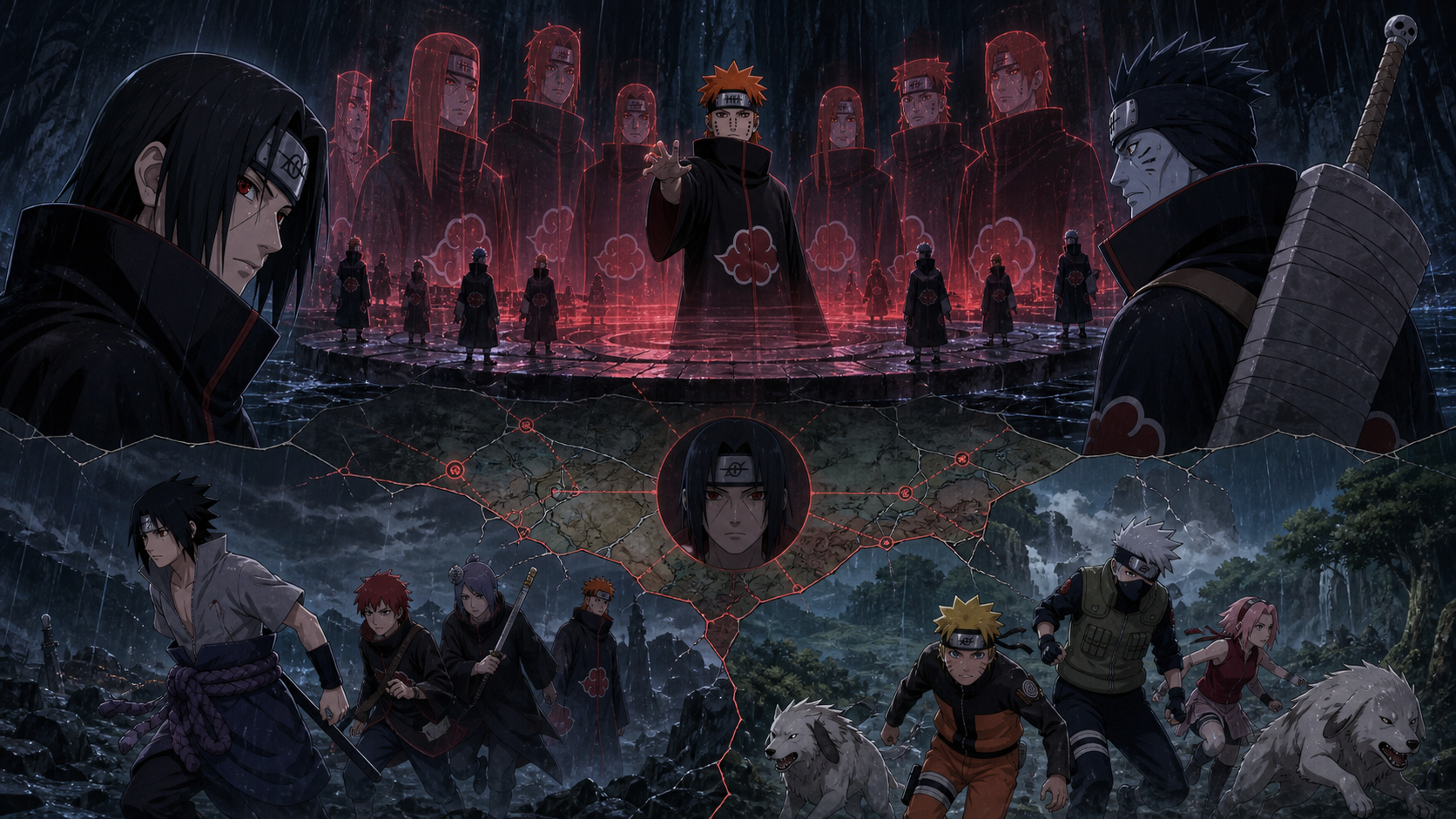
After capturing the Four-Tails jinchuriki, Itachi and Kisame receive an Akatsuki summons. Pain gathers the remaining members and announces that Orochimaru is dead. The likely killer is Sasuke Uchiha, and the organization recognizes that Sasuke may now target Akatsuki itself.
The information changes several moving pieces at once. Itachi's younger brother has escaped Orochimaru, assembled Hebi, and begun pursuing him. Akatsuki cannot treat Sasuke as a private Uchiha matter if his revenge crosses their operations.
Konoha also prepares a search. Naruto still sees finding Itachi as a route to Sasuke, while Kakashi understands that the two brothers are moving toward a confrontation. Separate teams begin assembling around the same target for completely different reasons.
Itachi remains composed during the Akatsuki meeting. He hears that Sasuke killed Orochimaru without publicly reacting, but the news confirms that the little brother he left alive has become strong enough to defeat one of the Sannin.
Akatsuki treats death as intelligence
Orochimaru's death is not mourned. He was a former member, defector, competitor, and security risk. Pain presents the event as a change in the threat map.
That response suits an organization whose relationships are structured around extraction assignments and paired capability. Members can have personal attachments, but the institution converts loss into operational data first.
Sasuke enters their awareness not because anybody cares what Orochimaru did to him. He matters because killing Orochimaru proves capacity and suggests an approaching attack.
The meeting demonstrates why Akatsuki remains dangerous despite losing members. It shares intelligence, updates assumptions, and coordinates people spread across enormous distance.
The Four-Tails capture stays in the room
Itachi and Kisame arrive after hunting Roshi, the Four-Tails jinchuriki. That capture is easy to treat as setup, but another person's freedom and tailed beast have just been absorbed into Akatsuki's larger plan.
The organization moves immediately from one exploited jinchuriki to discussion of an Uchiha family conflict. Both threads reveal the same habit: people become components in a strategic design.
Roshi's defeat also reminds us that Itachi and Kisame are not merely waiting for Sasuke. They continue advancing Akatsuki's extraction campaign while personal history closes in.
Itachi hears the countdown
Itachi's silence is loaded because we know the news concerns the one person he deliberately spared. Sasuke surviving Orochimaru could produce relief, concern, or confirmation that the planned confrontation is near. His face gives the organization none of it.
That control is part of how Itachi survives Akatsuki. Every visible attachment can become leverage. He has spent years presenting himself as the clan killer who severed ordinary feeling.
Sasuke's victory changes the balance. The younger brother is no longer simply training toward revenge. He has removed his mentor, recruited specialists, and started moving independently.
The meeting title applies as much to the Uchiha brothers as the organization. Everybody is assembling around a collision Itachi helped design.
Konoha and Hebi pursue different Sasuke futures
Naruto wants to reach Sasuke before revenge consumes whatever remains of their bond. Sasuke wants to reach Itachi without Konoha redirecting him. Itachi sits at the center of both routes.
Kakashi's involvement adds another layer after Kakashi Chronicles. He knows what an Uchiha teammate's grief can become when war, secrecy, and institutional failure leave it untreated.
Hebi is built to locate Itachi efficiently. Konoha's team carries tracking ability too, but its emotional objective is different. One formation supports Sasuke's chosen confrontation; the other hopes to interrupt it.
Neither group fully controls the schedule. Akatsuki has its own intelligence network, and Itachi has reasons he has not shared with either side.
RaeRae's reaction
I like episodes where information moves the plot as forcefully as a fight. Orochimaru's death travels through Akatsuki and instantly changes how they classify Sasuke.
Pain's meeting is cold because the organization never wastes time pretending to be a family. A former member is dead. His killer may be coming. Adjust the threat model and continue extracting tailed beasts.
Itachi's stillness remains the most interesting reaction in the room. Sasuke survived the predator who wanted his body and became strong enough to suppress him. That should matter deeply. Itachi protects whatever he feels behind the same face he uses for mission reports.
The Four-Tails capture deserves more weight than the episode gives it. Roshi is another jinchuriki whose life becomes background material for Akatsuki's progress. Naruto's world keeps revealing people only after organizations have already converted them into targets.
Konoha's search also makes me nervous because Naruto's love for Sasuke can become another refusal to hear what Sasuke actually wants. Saving someone does not mean ignoring his agency. It means reaching him with truth before revenge closes every alternative.
Hebi, meanwhile, is transparent about the immediate goal but not the larger consequences. Karin, Suigetsu, and Jugo are helping Sasuke enter a family confrontation whose history they do not fully know.
Assemble works as a convergence episode. Akatsuki shares intelligence. Hebi mobilizes. Konoha mobilizes. Itachi keeps moving after the Four-Tails. Sasuke becomes the line connecting every formation.
The dangerous part is that almost everyone believes finding Itachi will solve a different problem. For Sasuke, it is revenge. For Naruto, it is access to Sasuke. For Akatsuki, it is operational security. For Itachi, the answer remains hidden. All those agendas are now walking toward the same battlefield.
Information becomes the episode’s main weapon
My bottom line is that Episode 121 moves because one death changes every faction’s calculation. Orochimaru is gone. Sasuke probably killed him. Akatsuki now has to treat the younger Uchiha as an independent threat, Hebi has a clear route toward Itachi, and Konoha sees another narrow chance to reach Sasuke.
No explosion is required to create momentum. Intelligence changes priorities, team composition, travel, and risk. The people who receive the news reveal themselves through what they count first.
Pain reports Orochimaru’s death without granting him personhood
The former member becomes a data point: removed competitor, lost source of knowledge, possible opening, and evidence of Sasuke’s strength. Akatsuki does not pause for grief because the organization structured relationships around assignments rather than mutual care.
That coldness is efficient, but efficiency does not mean absence of feeling among individuals. Members may carry private reactions. The meeting allows only the operational version because visible attachment can become vulnerability.
Sasuke’s name changes category inside Akatsuki
Before Orochimaru’s death, Sasuke could be viewed as Itachi’s surviving brother and a valuable Sharingan under another predator’s control. Killing the Sannin proves he escaped that ownership and can disrupt powerful organizations. Akatsuki must reassess.
The new classification ignores why he fought Orochimaru or what possession he resisted. Institutions often notice a person’s agency only when that agency becomes dangerous to them. Sasuke becomes legible after he creates a security problem.
Itachi receives confirmation that his design is advancing
He spared Sasuke, encouraged hatred, and built a future confrontation into the massacre. News that Sasuke defeated Orochimaru may confirm the younger brother gained enough power to approach. Whatever relief or dread exists remains hidden behind the Akatsuki persona.
That control is not proof of emotional emptiness. Itachi operates inside an organization capable of using attachment against him. Silence protects information, but silence also keeps Sasuke trapped inside the story Itachi constructed.
The Four-Tails capture should not become a sentence of transition
Roshi has just lost freedom and faces Akatsuki’s extraction process. Son Goku will be torn from a host whose life existed before this defeat. The meeting moves on because the organization treats capture as routine progress. Viewers should resist that rhythm.
Every jinchuriki represents a person, a tailed beast, a village relationship, and years of adaptation. Akatsuki compresses all of that history into the next completed assignment.
Kisame’s presence keeps the meeting tied to physical violence
Pain discusses strategy, but Itachi and Kisame return from a hunt where another body paid for the organization’s plan. Kisame’s strength and Samehada make capture possible. Administrative language rests on work performed through force.
That connection matters because violent organizations often sound most ordinary during coordination. A meeting can discuss timelines and threats while the human cost remains outside the room.
Akatsuki adapts because no member assumes the old map remains true
Orochimaru’s death changes power, intelligence exposure, and possible routes into the organization. Pain updates the members instead of clinging to prior assumptions. That capacity makes Akatsuki more dangerous than a collection of strong personalities.
Konoha and Hebi need similar discipline. Love, revenge, or loyalty cannot substitute for current information. Everybody moving toward Itachi should ask what changed while they were preparing.
Naruto sees Itachi as a road to Sasuke
His goal remains bringing Sasuke home, so the older brother becomes a location problem. That focus is understandable. It also risks reducing Itachi to a key and Sasuke to somebody whose stated objective can be overridden for his own good.
Naruto needs to reach Sasuke with truth and a real alternative, not simply seize him before the fight. Care becomes control when the rescuer refuses to hear the person being rescued.
Kakashi carries a history that makes this pursuit personal
He knows the Uchiha massacre, Itachi’s danger, Sasuke’s defection, and the cost of a teammate organizing life around grief. Kakashi Chronicles also reminds viewers that his own philosophy came from an Uchiha boy lost during war.
That history should make him cautious about both abandonment and coercion. Kakashi cannot write Sasuke off as an enemy. He also cannot pretend affection alone will dissolve a revenge plan built over years.
Konoha’s search team needs a clear objective hierarchy
Finding Itachi, locating Sasuke, gathering Akatsuki intelligence, avoiding capture, and surviving contact are separate goals. If the team encounters one brother without the other, members need to know which objective controls the decision.
Ambiguity creates conflict under pressure. Naruto may chase Sasuke while another shinobi prioritizes Akatsuki intelligence. Kakashi should define the limits before emotion decides the formation.
Hebi has the cleanest stated mission and the least complete context
Sasuke tells the group they will find Itachi. Karin can sense, Suigetsu can fight, and Jugo can provide extraordinary force. The team understands the target but not the truth behind the massacre or the relationship Itachi intends to stage.
Clear orders can still rest on incomplete information. The recruits consent to a dangerous mission through Sasuke’s account, and Sasuke himself acts through a story deliberately built by his brother.
Karin’s work determines whether Hebi moves efficiently
Finding Itachi across a large region requires attention, rest, comparison of chakra signatures, and judgment about false leads. Sasuke cannot demand constant scanning without degrading the exact ability he recruited.
Her personal feelings also make honest reporting important. She may want to produce progress for him or hide uncertainty. The team should value accurate limits more than confident answers.
Suigetsu is entering an Akatsuki conflict with his own history nearby
Kisame is connected to Kirigakure and the Seven Ninja Swordsmen tradition Suigetsu wants to reclaim. Pursuing Itachi may bring him close to another legendary blade and a man whose reputation intersects his dream.
That overlap gives Suigetsu a reason beyond Sasuke’s revenge, but Sasuke should not assume the priorities will remain aligned. A sword-related opportunity could alter the route.
Jugo’s participation needs a transformation plan before Akatsuki contact
An encounter with elite enemies may deliberately trigger fear, anger, or natural-energy absorption. Hebi needs agreed warning signs, safe distances, and methods of restraint that do not treat Jugo as disposable. Improvising after transformation will endanger everyone.
The team also needs to know whether killing Itachi is a goal Jugo accepts. Kimimaro’s memory brought him outside, not automatic consent to every battle Sasuke chooses.
Every group thinks arrival will solve a different problem
Sasuke believes killing Itachi will answer the massacre and finish revenge. Naruto believes reaching the confrontation can restore Sasuke. Akatsuki believes monitoring or stopping Sasuke will protect operations. Itachi carries a plan nobody else fully sees.
Convergence creates danger because success has incompatible meanings. One group cannot win without interrupting another person’s intended outcome.
The title assembles motives, not merely bodies
Akatsuki gathers through projections. Hebi organizes its search. Konoha prepares trackers. The physical formations matter, but each team also gathers memory, loyalty, fear, intelligence, and assumptions around the target.
The episode works when viewers understand that Itachi is not a neutral destination. He is a different story to every person walking toward him.
Itachi’s silence protects the plan and harms Sasuke again
He may believe withholding truth protects Konoha, Sasuke, or the larger political arrangement. The silence also ensures his brother continues pursuing revenge without informed choice. Protection and manipulation coexist inside the same decision.
Hearing Orochimaru is dead gives Itachi another opportunity to reconsider. His stillness suggests he continues toward the confrontation rather than opening a path to truth.
Tracking Sasuke is not the same as understanding him
The pursuit also exposes a difference between tracking and understanding. Kakashi can read terrain, Pakkun can follow scent, and Konoha can deploy enough people to cover several routes. None of those skills answers the question Naruto keeps avoiding: what would make Sasuke choose the village after everything he has learned and everything the village failed to tell him?
Naruto still treats physical distance as the central problem. If he can get close enough, speak loudly enough, or block the next road, perhaps the bond will do the rest. I understand why he needs that hope. I also need the story to admit that love without an honest political reckoning cannot carry all this weight.
Hebi has cooperation, but it does not yet have shared purpose
Suigetsu wants access to swords and powerful opponents. Karin follows Sasuke with a mixture of desire, loyalty, and possessiveness. Jugo trusts Sasuke because Sasuke inherited a connection to Kimimaro and can calm his transformations. Sasuke wants Itachi. Those motives can travel together without becoming one motive.
That distinction gives Hebi its nervous energy. A formal village team has rules, rank, and an institution waiting behind it. Hebi has a destination and one person holding the center. If Sasuke makes a choice that contradicts what the others expected, there is no larger agreement to settle the conflict. Their strength is personal, and so is their instability.
Konoha enters the search carrying its own silence
The trackers do not know the full truth about the Uchiha massacre, but the audience already has reason to distrust the official story. That makes the mission more complicated than a rescue race. Konoha is trying to retrieve a survivor while remaining unable or unwilling to explain what produced his grief.
Naruto deserves help in reaching his friend. Sasuke deserves more than being treated as a missing possession. If the village wants his return to mean healing, somebody eventually has to name the systems, orders, and adults that failed him. Otherwise home is only the place asking him to stop reacting.
Pain’s authority depends on controlling the frame
Pain decides which facts enter the meeting and what those facts mean. Orochimaru’s death becomes an operational update. Sasuke becomes a variable. Roshi becomes progress. That framing lets Akatsuki members respond as workers managing a dangerous project instead of people participating in abduction and murder.
Control of language is part of leadership here. If Pain called Roshi a man or admitted that Sasuke survived two attempts at ownership, the moral shape of the conversation would change. Neutral vocabulary keeps the organization moving because it removes the victims from the sentence.
The next collision has already begun before anybody arrives
Once the same intelligence reaches multiple factions, they start affecting one another without direct contact. Akatsuki may change routes because Sasuke is mobile. Konoha may follow Akatsuki movement to find Itachi. Hebi may read Konoha trackers as interference. Every adjustment becomes new information for somebody else.
That is why this setup feels active rather than like a waiting room between battles. The chase is already a conflict over knowledge, timing, and interpretation. By the time two groups finally share a road, their decisions have been colliding for hours.
The episode makes patience feel dangerous. Every team believes movement proves commitment, yet speed can harden a bad assumption before anyone tests it. Naruto may reach Sasuke faster without learning what Sasuke needs. Sasuke may reach Itachi before asking whether revenge was designed for him. Akatsuki may contain a threat while creating a larger one. That is the tension I want from a pursuit arc: not people running because the plot needs another battlefield, but people carrying incomplete truths toward somebody who cannot satisfy all of them. Assemble is the moment those private stories become routes on the same map, and the map is already warning us that arrival will not mean resolution.
RaeRae’s final word on the assembly
I like convergence episodes when the information remains specific. Orochimaru’s death is not vague tension. The event changes how Akatsuki classifies Sasuke, confirms the transfer plan failed, and tells Itachi the brother he spared has become powerful enough to arrive.
I am not letting Roshi disappear behind that excitement. Akatsuki comes into the meeting after capturing another jinchuriki, and the organization treats a human life as completed work. That casual transition is part of the horror.
Naruto’s love needs boundaries. Finding Itachi can help locate Sasuke, but bringing somebody home requires more than intercepting him. Sasuke needs truth, options, and a reason to believe Konoha can face the failures surrounding the Uchiha massacre.
Everyone assembles with a different answer in mind. Sasuke wants revenge. Naruto wants recovery. Pain wants security. Itachi wants a private plan to reach its end. The episode tightens because none of those people controls the whole board anymore. Information has moved, and every formation starts walking.
RaeRae’s call
Orochimaru’s death turns Sasuke from somebody else’s asset into an independent threat. Every faction moves toward Itachi, but nobody agrees on what finding him should accomplish.