
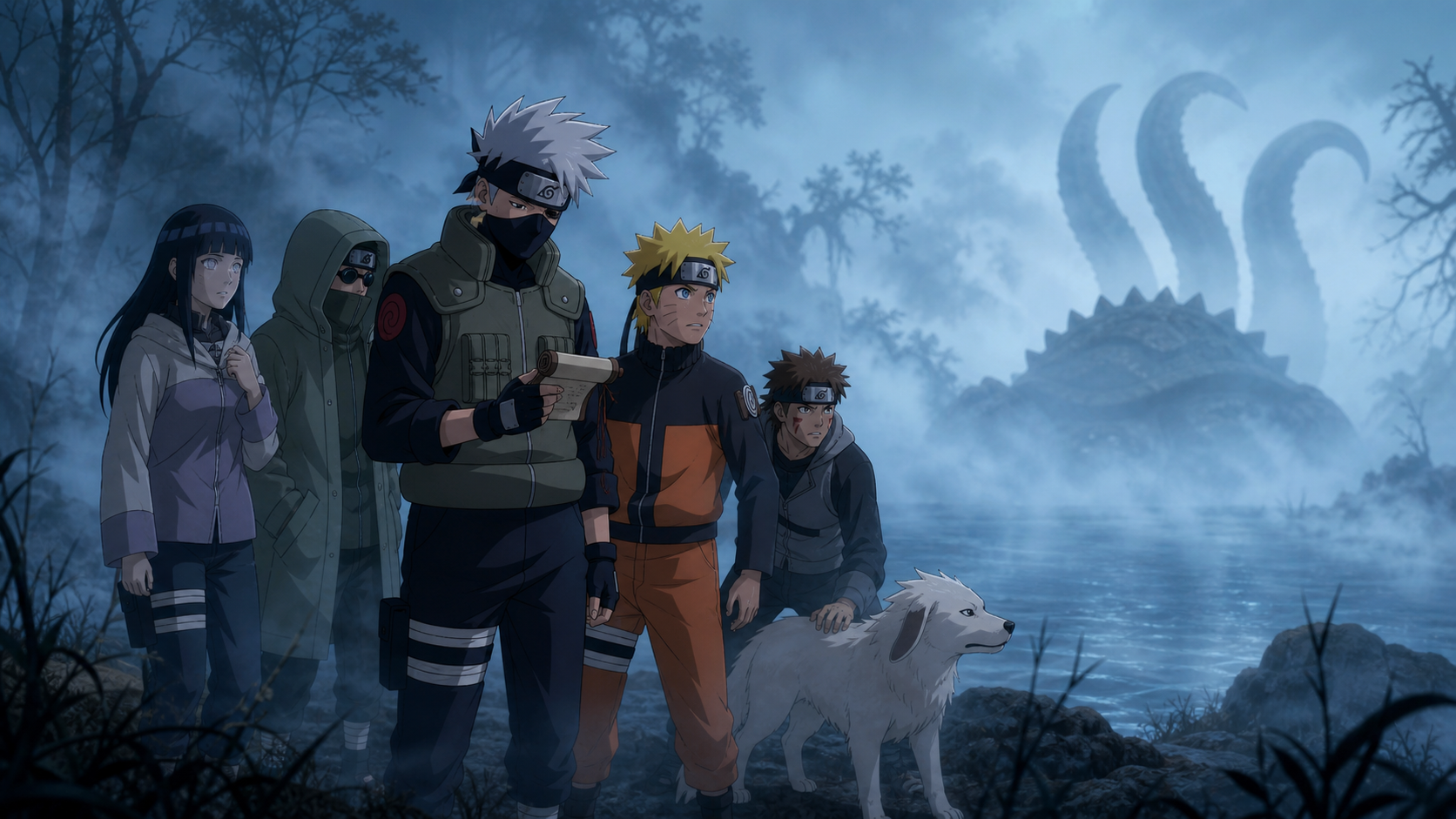
Inside the Mist
The team reunites at the lake, but illusion-filled fog and the discovery of Orochimaru’s true target transform pursuit into a mission requiring village-wide guidance.
When the landscape lies
Inside the Mist slows the Three-Tails mission at exactly the moment everyone wants clarity. The Leaf shinobi reunite with Naruto near the lake, but the heavy mist denies them a clean view of the water, the enemy, and even one another. Once they learn that the fog can create illusions, every silhouette becomes a question rather than an answer.
That discovery changes the team's posture. Kakashi cannot treat the lake like an ordinary battlefield where better eyesight or faster movement will solve the problem. A false image can pull one person away from the formation, make an ally look hostile, or turn a harmless sound into an apparent attack. The safest response is not passivity. It is disciplined proximity, repeated confirmation, and a willingness to distrust the most convincing first impression.
Naruto's reunion with the group matters because he is no longer the only person facing the unknown at the shore. The previous episode sent him toward the abnormal chakra alone, while Kakashi's team handled the pursuit. Now their information can be combined. Naruto has seen the lake's disturbance; the trackers know Guren's route; and Kakashi can finally interpret both facts as parts of one operation.
The Three-Tails becomes the mission
The central revelation is not simply that a tailed beast is present. It is that the enemy has come for it. This turns Guren's barriers, crystal maze, and delaying tactics into a coherent perimeter around Orochimaru's objective. The Leaf was chasing a dangerous shinobi. It is now intervening in an attempt to control one of the world's largest concentrations of chakra.
That distinction carries moral weight. A tailed beast is capable of catastrophic destruction, but it is also a living being repeatedly treated as a weapon or resource. Naruto understands that pattern more personally than anyone in the unit. He knows what it means for other people to see immense chakra before they see a consciousness attached to it.
The episode does not pretend that empathy removes the danger. The Three-Tails can overturn the lake, crush a formation, and make a direct approach impossible. Naruto's connection to tailed-beast power may help him understand the stakes, but Kakashi still has to protect the unit from the creature, the illusions, and Guren's forces at the same time.
Asking for guidance is a decision
Kakashi's choice to contact Tsunade is one of the episode's most responsible moments. Field leaders are often praised for improvising without help, yet the scale of this discovery exceeds the mission they were given. Continuing under the old plan would mean pretending the new information changes nothing.
Requesting guidance is not surrendering initiative. Kakashi keeps the team alert and preserves their position while making sure the village can decide how much support, containment equipment, and political authority the situation requires. A tailed beast cannot be handled like a fugitive shinobi, especially when Orochimaru is involved.
The scroll in Kakashi's hand therefore represents more than communication. It marks the point where observation becomes strategy. The team has identified the enemy's interest, recognized the environmental hazard, and acknowledged the limits of its current orders. That is exactly when a commander should widen the decision-making circle.
RaeRae's reaction
I like episodes where fog behaves as more than a visual filter. Here, the mist changes how every character must think. Hinata's vision, Shino's insects, Kiba's nose, and Akamaru's instincts remain valuable, but none receives automatic authority. When the environment can manufacture believable signals, the team's strongest advantage becomes comparison between senses.
The reunion is satisfying for the same reason. Naruto brings urgency, while Kakashi brings structure. Kiba and Akamaru bring the warning that the chakra is abnormal. Hinata and Shino bring ways to test the space around them. The scene works because everyone contributes a different part of the picture instead of waiting for one hero to solve it.
The Three-Tails in the distance is more unsettling than a clear close-up would be. Mist hides the boundaries of its body, so the visible shell and tails imply something larger than the frame can comfortably hold. The creature feels embedded in the lake rather than placed on top of it.
I also appreciate that Kakashi does not rush toward a dramatic confrontation once the enemy's goal becomes clear. He understands that discovering the objective is not the same as knowing how to stop it. The village needs to decide whether the priority is capture, protection, denial, or evacuation,and those choices affect everyone near the lake.
Inside the Mist turns uncertainty into the episode's real antagonist. The Leaf has found Naruto, identified the Three-Tails, and inferred Orochimaru's interest, yet each answer exposes a larger decision. The team cannot trust the air around it, cannot assume the beast will remain beneath the water, and cannot treat Guren as the only threat. Kakashi's request for guidance is the right ending because the mission has finally become too large to mistake for a simple pursuit.
Official episode reference: Naruto Official episode guide
Licensed episode route: Crunchyroll licensed episode page
The mist attacks the agreement between different senses
Hinata may see a chakra shape, Kiba and Akamaru may smell a familiar person, Shino’s insects may detect movement, and Naruto may hear a voice. Under ordinary conditions, those reports can strengthen one another. Illusion-filled mist can make the evidence disagree at the moment the team most needs certainty.
The danger grows when one specialist treats disagreement as proof that everybody else failed. Kakashi has to keep the reports separate long enough to identify which channel the illusion can manipulate. A trustworthy team does not vote for the most confident sense. The team asks what each observation can actually prove.
Reunion needs verification before relief
Naruto reaches people who look and sound like his team, but a deceptive environment turns recognition into a procedure. Shared memories, agreed signals, chakra patterns, scent, and physical position can confirm identity. No single detail should become an automatic pass when the enemy may have watched them long enough to copy behavior.
That caution can feel cold after separation. The team has to verify without treating every ally like an enemy. Good security preserves relationship while acknowledging the threat, which means explaining the check and completing it consistently rather than accusing whichever person appears least convincing.
Illusions become more effective when people are already tired
The trackers have fought through smoke, crystal reflections, ranged attacks, and Gozu’s pressure. Naruto’s unit has broken a barrier and faced Guren’s counter. Fatigue narrows attention and makes the first familiar shape more comforting than careful confirmation.
Rest may be impossible beside the lake, but leaders can rotate observation, check injuries, share food and water, and avoid asking one exhausted specialist to maintain every sensory defense. Endurance is not pretending a tired brain still processes danger perfectly.
Kakashi correctly recognizes that the mission’s legal and political scope changed
A tracking assignment can be led through field discretion. A tailed beast operation affects villages, borders, civilian safety, sealing policy, and the military balance between nations. Kakashi lacks authority to quietly decide who will control Isobu after the immediate danger ends.
Contacting Tsunade protects the team from being used as an undeclared capture force. Her instructions should define whether Konoha intends observation, denial of Orochimaru’s plan, rescue of Yukimaru, containment, or some combination. Those goals can conflict if nobody establishes priority.
Tsunade needs facts separated from assumptions
Kakashi can report that the team detected immense chakra, observed the Three-Tails, followed Guren to the lake, and encountered illusion-producing mist. He can infer Orochimaru’s interest from the operation. He cannot honestly report the entire experiment, Yukimaru’s precise role, or Isobu’s intention without stronger evidence.
Clear reporting gives Tsunade room to act without disguising uncertainty as certainty. A leader making a large decision needs to know which statements came from sight, which came from several confirming senses, and which remain the best current explanation.
Naruto’s personal knowledge belongs in the report without becoming universal expertise
He understands the terror of being valued for tailed-beast chakra and the physical consequences of power responding to emotional pressure. That experience can warn Tsunade against treating Isobu or Yukimaru as equipment. Naruto still cannot assume every tailed beast thinks like Kurama or every connection resembles his seal.
His testimony matters because institutions often call lived knowledge emotional and therefore less useful. The correct response is not to place Naruto in charge of everything. The village should combine his perspective with observation, sealing expertise, medical evidence, and the creature’s actual behavior.
Yukimaru should be named as a rescue priority
If the Leaf reports only a tailed beast and enemy squad, the child can disappear inside strategy. Orochimaru’s operation depends on Yukimaru’s unusual connection, and that makes him vulnerable to further drugs, coercion, and physical strain. He is not a secondary object beside the larger prize.
A mission plan should include locating him, separating him from Kabuto’s control, treating immediate illness, and explaining what the Leaf knows. Rescue loses meaning if Konoha simply inherits the experiment and begins asking how his ability can serve village security.
Isobu requires space as well as containment
A creature rising inside a confined lake may react violently to shinobi surrounding every shore, attacking from above, and constructing barriers. Defensive preparation should create an exit away from civilians rather than closing every route and then calling the trapped response a rampage.
The team may need to hold Isobu in place temporarily, but the purpose should remain explicit. A barrier built to protect evacuation differs morally from a seal built to claim permanent power. The material can look similar while the human intention changes the outcome.
Guren may know the mist better than anybody on the Leaf side
Her operation entered the area with preparation, which means she may understand where illusion effects begin, how long they last, and which signals remain reliable. The Leaf team cannot trust her, yet her movement through the fog still provides evidence.
If Guren protects Yukimaru from a danger created by the mist, that action may expose a safe route or confirm the child’s location. If she avoids one patch of water, the avoidance may reveal a boundary. Opponents communicate through choices even when they refuse conversation.
The team needs rules for false voices and familiar faces
An illusion may use Sakura’s voice to draw Naruto away, Naruto’s face to make Hinata lower her guard, or Kakashi’s authority to issue a dangerous order. Prearranged challenge phrases help, but the enemy can overhear repeated language.
Safer verification combines changing information with physical evidence. A command affecting the whole team should receive confirmation from more than one channel. Urgency cannot become the reason every safeguard disappears, because manufactured urgency is exactly how the mist wins.
Inside the mist, fear can become information without becoming command
Akamaru’s fear warned Kiba about abnormal chakra. A sudden feeling of dread inside an illusion may also be produced by the environment or by memory. The team should listen to fear as a signal that something changed, then investigate before letting the feeling select a target.
Naruto often acts because fear of losing somebody becomes unbearable. Kakashi’s structure gives that fear a safer route: report, confirm, assign, and move with support. Emotion remains part of intelligence without receiving unchecked control.
The mist protects Orochimaru by making delay look like confusion
Every minute spent verifying an ally, escaping a false route, or debating a sensory contradiction gives Kabuto more time with Yukimaru and Isobu. The Leaf team must be careful without becoming stationary. A perfect answer may arrive only after the experiment has advanced beyond interruption.
Kakashi’s request for guidance should therefore include what the team can safely do while waiting. Observation, perimeter protection, civilian warning, and tracking Guren’s movements can continue without pretending a full capture plan already exists.
RaeRae’s full take
Inside the Mist gives Kakashi one of those decisions I wish anime praised more often. He does not pretend the original assignment still covers a tailed beast, a coerced child, illusion fog, and Orochimaru’s larger operation. He asks Tsunade to widen the decision because responsibility has widened.
The mist works because this team usually trusts several senses. A false image alone would not defeat Hinata, Shino, Kiba, Akamaru, Kakashi, and Naruto. The danger comes from making their evidence disagree until somebody chooses private certainty over shared verification.
I also need Yukimaru kept in the report. A giant creature will dominate every briefing, but the child is the route Orochimaru intends to use. Forgetting him would let spectacle erase the most immediate victim.
Naruto’s role should be more than running at the largest chakra source. He carries experience no sealing manual can provide, but experience must stay curious. Isobu is not Kurama, and Yukimaru is not Naruto. Respect begins when he uses recognition to ask better questions instead of assuming pain made everybody identical.
A perimeter can protect civilians while trapping the creature
The lake perimeter creates another problem. Shinobi posted around every route may stop Isobu from reaching homes or roads, but the same formation can make the beast feel surrounded. A frightened animal or person often becomes more dangerous when every exit closes.
The village response will reveal whether Konoha learned anything from Naruto
Tsunade inherited an institution that treated the Nine-Tails as a weapon and Naruto as the container expected to endure public hatred quietly. She has shown more care for him than earlier leadership, but a free tailed beast tests policy beyond affection for one familiar child.
If the first response is permanent capture for village advantage, Konoha repeats the system that harmed Naruto. If leaders ignore real danger because they want to appear compassionate, civilians and shinobi pay. Ethical policy must hold safety and personhood together, which requires more work than choosing domination or denial.
Communication with headquarters can be intercepted or delayed
Orochimaru’s people know the Leaf will report a discovery this large. They may target messenger birds, chakra signals, scroll carriers, or the shinobi responsible for sending coordinates. Kakashi should assume the report creates a new vulnerability.
A secure message includes enough information for action without exposing every field position. A backup route matters if the first message never arrives. The team also needs a time boundary for acting without instructions, because waiting forever beside an unstable lake would hand control to the enemy.
Sakura’s evidence can help Tsunade connect crystal style to the lake operation
The surviving insect established that Guren’s technique has material limits. Field observations now show crystal interacting with barriers, reflections, and flowing water. Sakura can combine those findings with injuries and residue to help predict what Guren may attempt near Isobu.
The analysis should remain honest about scale. A small specimen does not prove crystal style will affect a tailed beast’s shell or chakra in the same way. Headquarters can propose tests and precautions without converting limited evidence into a confident promise.
Team reunification should include an immediate accountability check
Finding everyone alive is not enough. Kakashi needs to know who is injured, depleted, separated from equipment, affected by illusion, or carrying information the others lack. Naruto’s enthusiasm can make the reunion feel like the mission reset, but bodies and minds do not reset when groups meet again.
A short check prevents hidden damage from becoming a crisis during the next encounter. Sakura can triage. Yamato and Kakashi can clarify command. The trackers can report sensory limits. Gamakichi and Gamatatsu can describe how Guren altered their water. Every contribution changes what the team can safely promise headquarters.
The mist makes memory another contested sense
Writing or marking decisions can help, although Guren’s crystal and the damp environment may destroy physical records. Repeating key observations through several people gives the group a shared memory harder for one illusion to rewrite. The practice also protects an injured shinobi whose confusion might otherwise be treated as personal failure.
Naruto’s impatience can still serve the team if given a defined job
Asking him to stand quietly while Yukimaru and a tailed beast remain in danger is unrealistic. A good commander channels urgency into bounded action: maintain clones at marked points, help confirm identities, protect the messenger route, or watch for changes in Isobu’s chakra without approaching alone.
RaeRae’s final word from inside the fog
The episode understands that finding the objective creates responsibility faster than it creates answers. Kakashi now knows Orochimaru wants the Three-Tails, but he still lacks the full experiment, Yukimaru’s location, the mist’s limits, and a policy for what Konoha should do with a free tailed beast.
Requesting guidance is the adult decision because the consequences will outlive this team’s fight. I would rather watch Kakashi admit the mission changed than watch another anime commander gamble everybody’s bodies to protect his image of competence.
The mist also gives every specialist a reason to listen. Hinata’s eyes, Kiba and Akamaru’s noses, Shino’s insects, Naruto’s experience, Sakura’s analysis, and Kakashi’s judgment all remain incomplete. Their strength comes from letting one limit expose another clue.
Yukimaru and Isobu need to remain more than entries in Tsunade’s strategic briefing. The child deserves rescue without reassignment as an asset. The beast deserves protection from Orochimaru without automatic ownership by Konoha. If the Leaf can hold those truths while protecting people around the lake, then walking inside the mist may teach the village something larger than how to win one operation.
RaeRae checkpoint: Kakashi contacting Tsunade is action, not hesitation. The mission changed from tracking one enemy to protecting a child, a team, a lake, and a tailed beast from competing plans nobody in the field has authority to settle alone.
Receipts and official routes
- Official synopsis, licensed title, and episode placement: Naruto Official Site episode guide.
- Licensed episode title, number, and current watch route: Crunchyroll.