
The Rampaging Tailed Beast
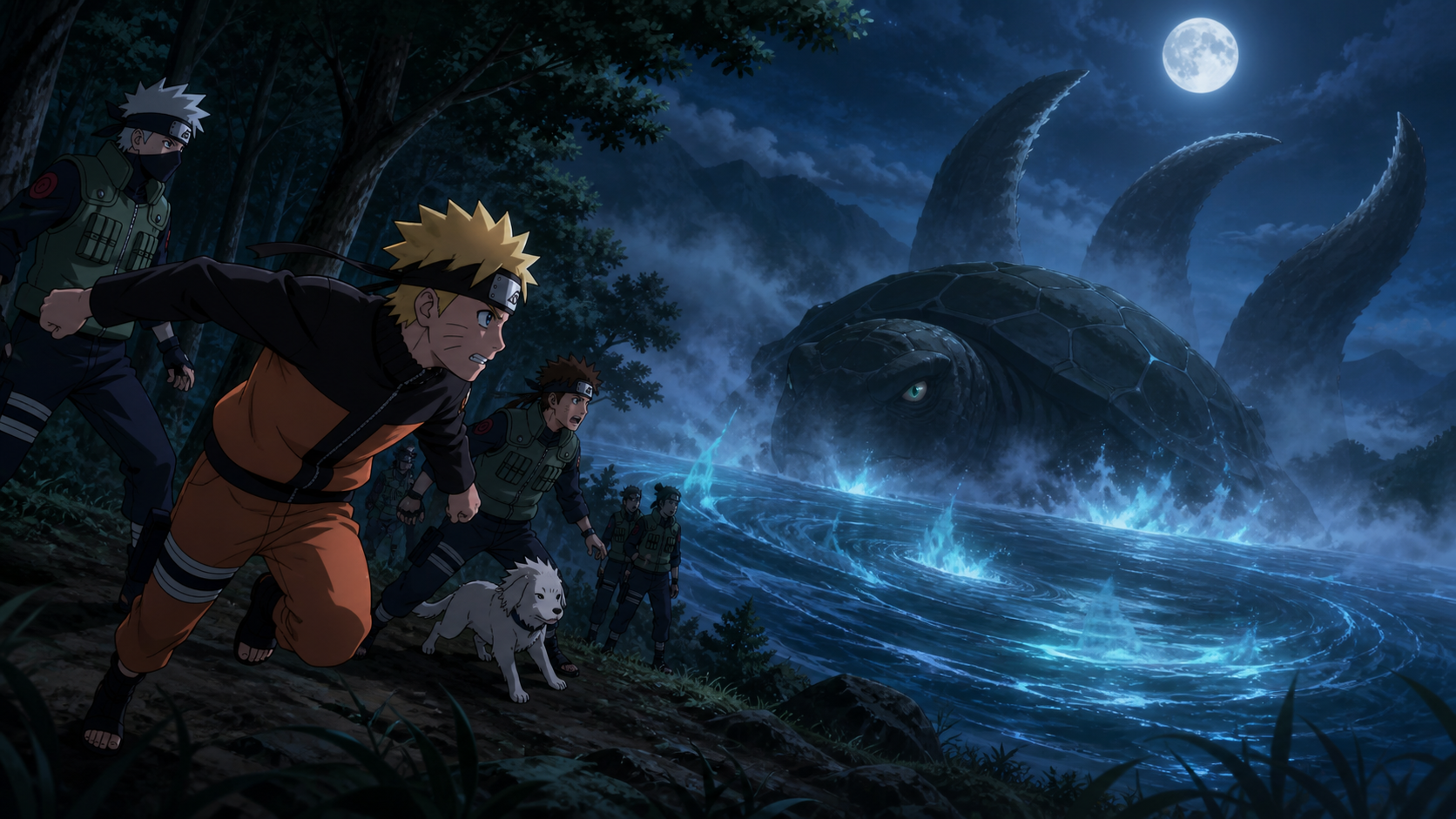
A pursuit through the forest reaches a lake where abnormal chakra turns the mission from tracking Guren into confronting a force of nature.
Following Guren into something larger
The Rampaging Tailed Beast begins as a pursuit and ends by changing the scale of the entire mission. The Leaf ninja use their tracking method to follow Guren, but Akamaru and Kiba sense an amount of chakra that does not belong to an ordinary enemy squad. Kakashi trusts that warning. He sends Naruto toward the lake before committing the rest of the team to another confrontation.
That decision captures Kakashi at his best. He does not know exactly what waits at the destination, yet he understands that abnormal evidence requires a different response. Guren remains dangerous, but the chakra ahead may be the reason she and Orochimaru's forces are here at all. Splitting Naruto from the immediate battle is risky; ignoring the lake would be worse.
Kiba and Akamaru earn the episode's turn. Their senses do more than point toward a trail. They recognize magnitude. The difference between finding a person and feeling an ecosystem bend around an immense chakra source is the difference between continuing the chase and realizing the chase has led to a tailed beast.
The lake refuses to stay quiet
The lake is an ideal setting for the Three-Tails' arrival. Mist hides distance, water conceals mass, and each wave can be mistaken for weather until the pattern becomes too deliberate. When the surface begins to churn, the environment stops behaving like scenery. It becomes the first visible expression of a creature too large to read all at once.
Naruto approaching that chakra carries special weight. He understands tailed-beast power from inside his own body, but recognition does not equal control. The presence in the lake is not Kurama, not a human opponent, and not a problem that can be solved by charging at the loudest point. Naruto's empathy may eventually matter, yet the immediate danger demands caution before connection.
The Three-Tails is frightening because it does not need a speech. Its armored body, enormous eye, and multiple tails turn the lake into a moving boundary. The title calls it rampaging, but the episode also leaves room to ask what disturbed it and who hopes to exploit that unrest. A beast can be dangerous and still be the object of someone else's plan.
Two battlefields, one objective
Kakashi's team entering combat while Naruto moves toward the lake creates parallel pressure. The visible enemy can occupy the Leaf shinobi while the true objective remains near the water. Guren's forces do not need to defeat everyone outright if they can delay the people most capable of interfering with Orochimaru's design.
That makes the earlier crystal battles look different in retrospect. The barriers, reflections, and counters were not isolated displays of power. They controlled access to a location. Guren has been shaping where the Leaf can see, move, and spend its attention. The lake reveals what that control was protecting.
The episode also respects the usefulness of a tracking team. Hinata's sight, Shino's insects, Kiba's scent, Akamaru's instincts, and Kakashi's judgment each provide a different kind of evidence. None alone explains the mission. Together they allow the group to notice when the facts no longer fit the original assumption.
RaeRae's reaction
I enjoy the way this episode lets a small sensory detail open into a massive reveal. Akamaru's alarm is more compelling than a narrator announcing that something powerful is nearby. We see a trained animal react first, watch Kiba trust him, and then watch Kakashi reorganize the mission around that information. Competence builds suspense because the characters understand enough to be afraid before the audience sees why.
Naruto being sent ahead also feels earned. His instinct is to pursue the person in front of him, but Kakashi gives him a responsibility tied to the unknown. It asks Naruto to move toward the strongest chakra without treating the assignment as a contest. After Guren repelled his new jutsu, that shift from proving power to investigating danger is exactly what he needs.
The Three-Tails' entrance works because the episode preserves scale. The Leaf shinobi look small at the shore. The lake becomes unstable before the beast is fully readable. Mist keeps parts of its body hidden, so every visible feature implies more mass beyond the frame. It feels like encountering a force of nature, not merely meeting the next opponent.
I also like that the reveal clarifies Orochimaru's interest without resolving it. A tailed beast is an obvious source of power, but the details of the plan remain uncertain. Guren may be guarding the operation, participating in it, or being tested by it. Her personal investment and Orochimaru's objective are connected, but they are not necessarily identical.
By the end, “target” has acquired a new meaning. Guren was the opponent the Leaf could follow, while the Three-Tails appears to be the prize that drew everyone toward the lake. The mission has crossed from pursuit into containment, protection, and competition over a living power. Naruto reaches the water just as the story makes clear that nobody on the shore fully controls what is waking beneath it.
Official episode reference: Naruto Official episode guide
Licensed episode route: Crunchyroll licensed episode page
Calling the Three-Tails a target reveals the human agenda immediately
The creature has not volunteered for anybody’s mission. Orochimaru’s network, the Leaf team, and later outside forces approach the lake with different plans, but each group risks reducing a living being to power that can be contained, studied, assigned, or captured. The word target belongs to the people arriving on shore, not to the beast’s identity.
Naruto should understand that distinction more quickly than most. Konoha spent his childhood seeing the Nine-Tails before seeing him. Empathy cannot remove the danger of an enormous frightened creature, yet experience should stop him from confusing containment with ownership.
Akamaru detects scale before the humans have language for it
His alarm carries information beyond direction. The scent and chakra ahead do not fit the enemy group they have been following. Kiba trusts the reaction because years of partnership let him recognize the difference between ordinary warning, confusion, and fear.
That trust saves time. Kakashi does not demand that Akamaru provide a human explanation before the evidence counts. He listens to Kiba’s interpretation and changes the mission. Respecting an animal partner means accepting communication in the form the partner can actually give.
Kakashi’s decision to send Naruto forward carries a serious risk
Naruto is a jinchuriki moving toward an unknown tailed beast while Orochimaru’s people operate nearby. His chakra may help him recognize the scale of the threat, but his body is also valuable to enemies who collect tailed beasts and study vessels. Kakashi cannot treat the assignment as an ordinary scouting run.
The decision makes sense only with clear boundaries: observe, report, protect civilians or teammates if necessary, and avoid committing to a contest nobody understands. Naruto’s courage is useful. His habit of meeting pain with immediate action can become another opening for manipulation.
The lake hides a body too large for one viewpoint
Mist, water, and distance prevent Naruto from reading the Three-Tails as a complete form. He sees an eye, armor, tails, waves, and sudden movement. Each fragment communicates danger while leaving the creature’s condition uncertain.
That staging matters because scale changes ethics. A person on shore can describe the beast as rampaging without seeing wounds, restraints, irritants, or people provoking movement elsewhere. The Leaf team needs several viewpoints before assigning intention to behavior produced under unknown pressure.
Rampage is a description of impact, not a diagnosis of motive
The Three-Tails can destroy bodies and terrain regardless of why it moves. Protecting people from that force is necessary. The title should not become permission to assume the beast is naturally malicious or incapable of responding to anything except domination.
Naruto knows what uncontrolled chakra feels like when fear, anger, isolation, and outside interference close around a host. Isobu’s situation is different because the beast is not currently sealed inside a known jinchuriki, but the principle remains: visible violence may be the consequence of a larger violation.
Guren’s barriers were buying time for an operation, not proving superiority
The lake reorganizes everything the Leaf team has seen. Smoke denied information. Crystal reflections delayed movement. Guren countered Naruto’s collaboration jutsu at the moment reinforcements arrived. Those techniques worked together to protect time and access around the Three-Tails.
Recognizing that pattern helps Kakashi avoid another narrow victory. Defeating Guren while Kabuto activates Yukimaru or moves the experiment forward would leave Orochimaru with the result he wanted. The team must measure success against the entire operation.
Yukimaru remains connected to the lake even when the camera emphasizes size
The spectacle of a tailed beast can make a sick child disappear from the audience’s attention. Orochimaru’s plan depends on Yukimaru’s unusual resonance, which means his body and fear are part of what may be disturbing the lake. The creature and child are both being positioned by adults with more power.
Protecting one cannot require spending the other. A strategy that saves Yukimaru by treating Isobu as mindless property repeats the same logic at a larger scale. Naruto’s best contribution may be recognizing two exploited lives where everyone else sees one weapon and one tool.
Guren faces a choice between the mission and the child she now remembers
Yukimaru’s charm and the crystal camellia gave their bond a meaning outside the assignment. The Three-Tails’ appearance makes that private feeling politically inconvenient. If the experiment requires greater strain, Guren will have to decide whether comfort was genuine enough to change obedience.
Care that never affects a dangerous decision remains limited. She may feel tenderness and still participate in harm. The story earns her complexity by refusing to treat emotion as completed redemption.
The Leaf team needs containment language that does not erase personhood
A tailed beast may need distance, barriers, evacuation, and defensive force. Those actions can protect lives without declaring permanent ownership. The difference depends on purpose, duration, communication, and what happens after immediate danger ends.
Konoha’s own history makes this difficult. The village has treated jinchuriki as military assets while asking them to perform loyalty. Naruto cannot fix that institution at the shore, but he can resist repeating its assumptions when meeting another tailed beast.
Mist gives every faction room to imagine control it does not possess
Orochimaru’s people believe research and Yukimaru’s power can direct Isobu. The Leaf shinobi may believe enough skilled bodies can contain the lake. Naruto may believe shared pain creates instant understanding. The mist hides evidence that would challenge all three forms of confidence.
The Three-Tails’ movement becomes the correction. A living force does not become predictable because somebody wrote a plan around it. Every faction needs a response for refusal, panic, injury, and behavior their model did not anticipate.
The reveal changes Naruto’s recent training without making it irrelevant
His collaboration jutsu taught him to coordinate with beings whose bodies and abilities differ from his own. The Three-Tails is not another summon partner, and approaching Isobu with that assumption would be foolish. Still, the discipline of listening before directing may matter more than the attack itself.
Naruto has just learned that hidden bodily processes shape visible power. He should carry that humility toward the lake. What appears to be random destruction may have causes beneath the surface.
RaeRae’s full take
The Rampaging Tailed Beast gets the reveal right because Akamaru’s fear arrives before the giant body. The tracking team has enough experience to know the evidence no longer fits an ordinary pursuit. Competent people becoming cautious makes the lake feel more dangerous than a narrator shouting about power levels.
I also need the word rampaging handled carefully. Isobu can kill people without being evil, and protection does not require sentimental denial of that danger. The question is who disturbed the beast, who plans to profit, and whose definition of control will place another body at risk.
Yukimaru cannot vanish behind the spectacle. His resonance is part of Orochimaru’s plan, and Guren’s care now faces a real test. A charm means very little if she keeps carrying the child toward the exact harm he needs protection from.
Naruto reaches the shore with more than force. He knows what happens when a village sees a tailed beast as the first and final truth about a living being. If the arc remembers that knowledge, the lake can become more than a boss arena. The encounter can expose how every institution on shore has learned to call ownership protection.
The lake has lives beyond the shinobi mission
A lake is not an empty container waiting for a tailed beast, a sealing team, or Orochimaru’s experiment. Fish, plants, birds, nearby communities, and people relying on the water all face consequences when chakra tears through the basin. Containment planning should include the environment and the civilians who may never know why the water changed.
Large anime battles often make landscape damage disappear after the episode. Isobu’s scale should prevent that convenience. Violent waves can destroy boats, roads, homes, crops, and drinking water. The Leaf team needs evacuation and damage assessment beside combat strategy, because saving shinobi while leaving ordinary families with a ruined water source is not a complete victory.
Naruto cannot assume shared jinchuriki experience where no host stands before him
His empathy is valuable, but the Three-Tails currently appears as an independent being rather than a human child carrying a sealed presence. Naruto knows isolation, involuntary containment, and fear of internal power. Isobu’s memories, senses, language, and relationship to humans may operate differently.
Real empathy begins by resisting the urge to make another life a mirror. Naruto can approach with respect for what he does not know. He should observe whether the beast responds to names, chakra, distance, Yukimaru’s resonance, or the removal of a threat before believing one heartfelt statement will create understanding.
Kakashi needs to reconnect the two battlefields quickly
Naruto reaches the lake while Kakashi’s group remains engaged with Guren’s forces. Information about the Three-Tails must travel back without exposing Naruto or drawing every fighter toward one crowded shore. A messenger, clone, summon, or agreed signal can keep both teams from acting on different versions of the mission.
Guren may know more about the lake than the Leaf does, which makes her movements another source of evidence. If she abandons one defensive position after Isobu appears, Kakashi should ask what changed. If her followers protect Yukimaru rather than pursue Naruto, that choice may reveal the operation’s immediate priority.
Yukimaru’s resonance raises questions about consent no adult has answered
A responsible rescue would not merely transfer control from one village to another. The Leaf would need medical care, truthful explanation, protection from retaliation, and a plan that does not immediately classify Yukimaru as a strategic asset. Naruto should recognize how easily a promise of safety can become another sealed life organized around institutional needs.
Guren’s followers may face the beast without knowing the complete plan
That does not remove responsibility for their attacks. The lack of information shows how the hierarchy distributes danger downward while preserving knowledge above. Followers are expected to risk bodies for an objective they may only understand as Guren’s order. Orochimaru keeps the power to redefine success after everyone else pays.
The beast’s armor changes what force can reasonably accomplish
Isobu’s shell and scale make ordinary strikes unlikely to stop movement safely. Attacking harder may create waves, ricochets, and panic without producing control. The Leaf team needs to distinguish drawing attention, creating distance, protecting a retreat, and causing injury. Those are different tactical jobs.
Naruto’s new collaboration jutsu moves water, which could interact unpredictably with a creature already controlling a lake through mass and chakra. Using the technique near Gamakichi and Gamatatsu also places summon partners beside an enormous tailed beast. No one should treat the visual match as proof the move belongs here.
The moonlit reveal makes Isobu look ancient rather than newly summoned
That visual perspective should shape the story. Orochimaru behaves as if finding power grants a right to experiment. The Leaf may behave as if identifying danger grants a right to contain. Isobu’s presence challenges both claims simply by existing beyond the plans made about the beast.
RaeRae’s final word on a living target
The episode succeeds because the tracking team’s fear arrives through professional knowledge. Akamaru reacts, Kiba understands the reaction, and Kakashi changes course. Nobody needs to pretend the Three-Tails is harmless for the reveal to carry moral weight.
The harder question begins after recognition. Every group at the lake will call its plan necessary. Orochimaru wants control through Yukimaru. The Leaf wants to prevent catastrophe. Naruto wants to help and may see a chance for connection. Isobu has not agreed to become the object that proves any of them right.
I need the arc to keep Yukimaru and Isobu visible as separate lives. One is a child whose rare ability attracts adults with plans. The other is an ancient being whose power attracts those same plans on a larger scale. Protection has to mean more than choosing which institution gets custody.
Naruto’s best preparation was not learning a stronger blast. His recent work taught him to ask what another body is doing, listen to a partner’s limits, and accept that shared power requires shared intention. The lake will show whether he carries that lesson toward a being who has every reason to distrust human hands.
RaeRae checkpoint: Isobu’s destructive power is real, but “rampaging” describes what frightened people experience on shore. The episode still owes the beast a cause, Yukimaru protection, and every faction an honest accounting of why they came.
Receipts and official routes
- Official synopsis, licensed title, and episode placement: Naruto Official Site episode guide.
- Licensed episode title, number, and current watch route: Crunchyroll.