
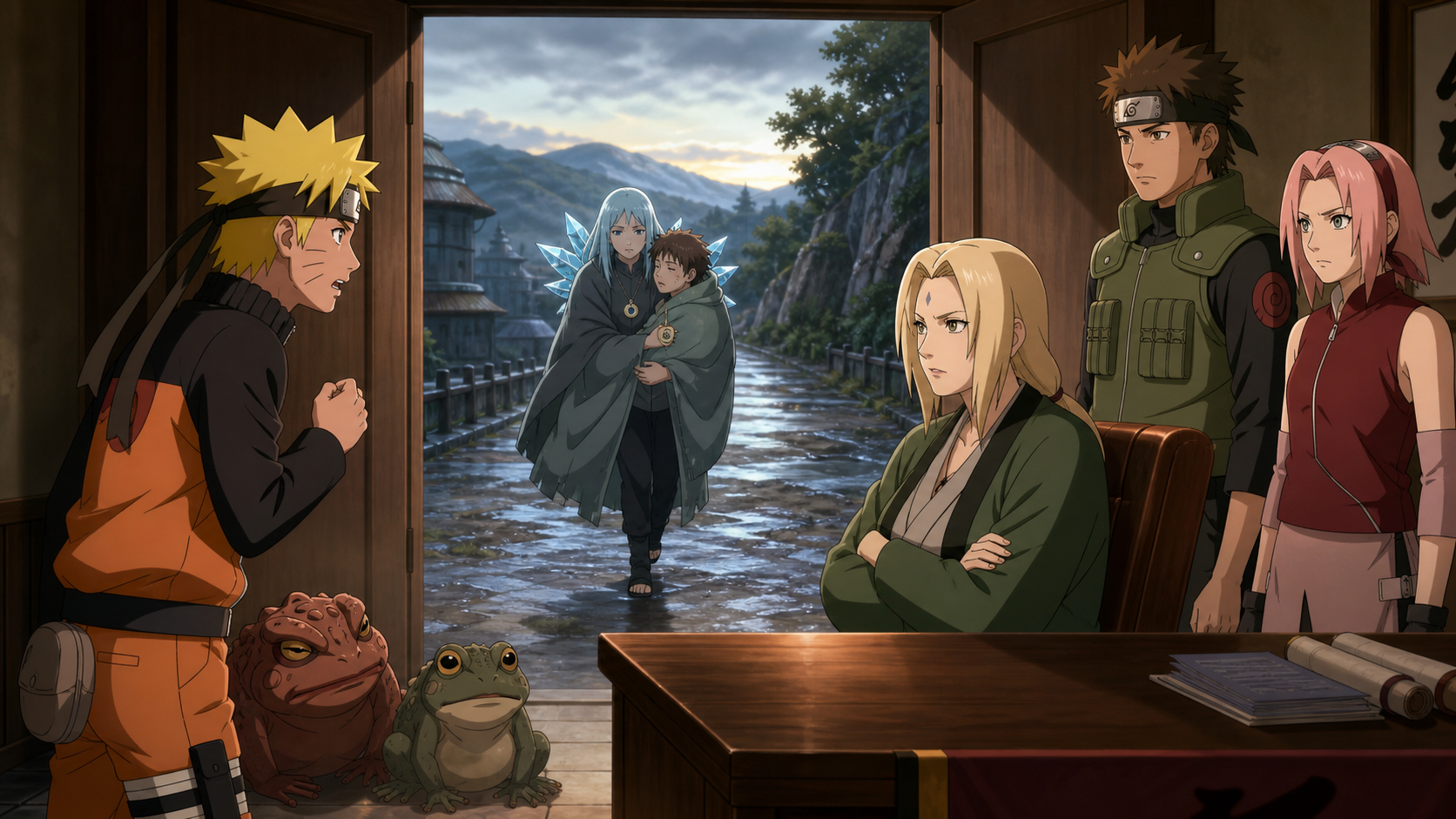
The Two Charms
Naruto asks how to help people already in the field while Yukimaru’s gift asks whether Guren will remember him beyond the mission that made him useful.
Naruto hears about the mission and immediately connects it to responsibility
Naruto learns that Kakashi, Hinata, Shino, Kiba, and Akamaru are tracking an Orochimaru hideout while he remains in the village refining collaboration ninjutsu.
His first impulse is to join them. The reaction contains his concern for teammates, his unresolved need to reach Sasuke, and his belief that new strength should become useful as quickly as possible.
The urgency is understandable, but usefulness still has to be evaluated by someone responsible for the whole mission.
Asking Tsunade is growth even when Naruto expects resistance
Earlier Naruto might have left first and argued later. Here he goes to the Hokage and requests permission.
That procedural choice matters. It recognizes that a tracking operation has a team design, an intelligence boundary, and risks that can increase when another person enters without coordination.
Determination begins to include asking how to help rather than deciding that desire creates authorization.
Tsunade evaluates readiness beyond raw power
Naruto has recovered physically and developed a promising collaboration technique, but neither fact automatically makes him appropriate for the current field conditions.
Tsunade must consider the incomplete jutsu, the danger of Orochimaru's network, and whether reinforcements will improve the search or expose more people.
Leadership often means delaying someone capable because capability is only one part of readiness.
Yamato and Sakura give the backup unit structure
If Naruto joins, he does not go alone. Yamato brings command experience and the ability to restrain Nine-Tails chakra if stress destabilizes Naruto. Sakura brings medical judgment, field strength, and direct knowledge of Team Seven's emotional pressures.
Their presence turns Naruto's urgency into a deployable unit.
Support is not an insult to his progress. It is the structure that allows progress to enter a dangerous mission responsibly.
Guren receives Yukimaru as an assignment before he becomes a person to her
Orochimaru's plan pairs Guren's crystal style with Yukimaru's connection to the Three-Tails. At first, she understands the boy through the task: keep him alive, move him to the destination, and deliver the result Orochimaru expects.
Yukimaru's fever disrupts that efficiency. A sick child cannot be reduced to a future output without someone deciding whether his immediate suffering matters.
Guren begins helping from obligation, but care often becomes visible through actions before a person has language for it.
The two charms carry memory that the system cannot measure
The matching charms appear small beside crystal techniques and tailed-beast experiments. Their importance comes from association rather than combat value.
For Yukimaru, a charm can hold the idea that someone remembers him and that remembrance may define a place to return to.
Orochimaru's laboratory can measure chakra resonance. It cannot measure why a child needs proof that he exists in another person's thoughts.
Yukimaru's question about home changes the journey
Yukimaru says he has nowhere to return to. The statement reveals why belonging is so vulnerable to manipulation.
If home means the place where someone thinks of you, then anyone offering attention can appear to provide one,even when the attention is tied to exploitation.
The episode begins separating genuine care from conditional usefulness by watching what Guren does when no superior is present to reward her.
Guren's protection conflicts with the role she was given
Keeping Yukimaru alive serves the mission, but warmth, shelter, and concern exceed the minimum when she could simply force him forward.
That does not instantly absolve Guren or make the assignment safe. It creates a contradiction inside her loyalty.
The more clearly she sees Yukimaru as a child, the harder it becomes to deliver him as equipment without recognizing the choice.
Two forms of asking to belong move toward the same battlefield
Naruto asks to join people he already considers his own. Yukimaru wonders how a person obtains someone who will think about him.
Naruto's bonds give him enough security to argue with authority. Yukimaru's isolation makes any offered bond feel like survival.
Their paths have not met, but the episode prepares that meeting through different relationships to home.
RaeRae's reaction
The charms work because they are ordinary. They cannot defeat a tailed beast or break a barrier. They can remind someone that attention existed before the current order and might continue afterward.
I also appreciate Naruto asking Tsunade instead of treating concern as a license to disappear from the village.
Both threads show that connection becomes safer when it recognizes another person's agency.
The episode turns reinforcement into an ethical question
Episode 95 moves Naruto toward the search mission and Guren toward deeper responsibility for Yukimaru. In both cases, being useful is not enough.
Naruto must enter a team whose leaders can account for his limits. Guren must decide whether protecting a child means more than preserving Orochimaru's experiment.
The two charms symbolize the question neither side can avoid: who remembers a person when their immediate usefulness ends?
Official episode reference: Naruto Official episode guide
Licensed episode route: Crunchyroll licensed episode page
Naruto’s request carries several motives at the same time
Concern for Kakashi’s team is real, but Sasuke and Orochimaru are never far from Naruto’s thinking. An Orochimaru hideout represents a possible route toward the friend he still refuses to abandon. Naruto also wants proof that his training has practical value. Those motives can coexist without becoming equally safe guides for a mission.
Tsunade has to judge the request Naruto actually makes and the pressure underneath it. A shinobi who believes one lead may finally reach Sasuke can take risks he would reject on an ordinary assignment. Sending Yamato and Sakura with him acknowledges both his value and the emotional conditions that may change his decisions.
Permission does not make Naruto smaller
Naruto asking the Hokage is a meaningful change because he has spent years treating rules as barriers placed between him and the right thing. Some rules deserved his anger. Konoha used procedure to conceal cruelty, isolation, and political cowardice. That history makes his distrust understandable, but distrust cannot become permission to endanger every team that leaves without him.
He argues, listens, and enters through an assigned unit. The scene lets maturity look practical. Naruto keeps his urgency while accepting that other people need to know where he is, what he can do, and which limits still matter.
Tsunade’s answer balances the child in front of her with the village behind him
She knows Naruto is a target, a jinchuriki, a student with a dangerous unfinished technique, and a person who will suffer if friends face Orochimaru without him. Any decision sacrifices something. Keeping him home may protect his body while wasting timely strength and damaging trust. Sending him may help the search while placing the Nine-Tails closer to enemy hands.
The Hokage’s job is ugly because no option arrives clean. Tsunade builds a team around the risk instead of pretending risk can be removed. Yamato provides containment and command. Sakura provides medical judgment and the authority of someone who knows Naruto well enough to challenge him.
Sakura’s place in the reinforcement team is emotional and technical
Sakura understands Orochimaru’s damage through Sasuke, Naruto, and her own encounter with the Sound. She also knows the Rasen Shuriken injury was not a dramatic warning that disappeared after healing. Her medical knowledge gives the group a boundary Naruto cannot dismiss as ordinary fear.
That combination matters. She is not there to watch Naruto from the sidelines or repeat Tsunade’s instructions. Sakura can assess injuries, read his behavior, fight, and recognize when the search for Sasuke begins narrowing his judgment. A strong team needs someone capable of saying stop before loyalty turns into self-destruction.
Yamato converts Naruto’s desire into an accountable mission
Yamato has already learned that managing Naruto requires more than suppressing chakra. He must explain decisions, set expectations, and notice the emotional trigger before a crisis reaches the point where wood style becomes the only answer. The reinforcement assignment gives him a clearer structure than their earlier pursuit of Sasuke.
His presence also protects Sakura from becoming the sole person responsible for Naruto’s feelings and body. Care work should not quietly fall onto the nearest girl because she knows the patient. Yamato holds command responsibility while Sakura brings expertise and a relationship he cannot duplicate.
Yukimaru gives away something precious because he has so little that belongs only to him
The charm is small enough to carry without permission. That portability matters to a child whose route, body, medicine, and destination are controlled by adults. Yukimaru can choose who receives the object even when he cannot choose where the group takes him.
Giving the charm to Guren is therefore affection and agency. He creates a relationship through an act Orochimaru did not order. The gift asks Guren to remember a person, not merely protect a source of power until the experiment succeeds.
Guren’s crystal camellia answers with labor rather than a promise
Guren can make a beautiful object through the same ability Orochimaru values for violence and control. The flower gives crystal style another meaning. Her technique can preserve shape, mark attention, and make a private gift instead of proving usefulness to a superior.
That does not erase what she has done. One tender act cannot settle responsibility. The camellia matters because Guren chooses to spend skill on Yukimaru’s emotional need when no mission requires that kindness. A different future becomes imaginable through the choice, although she still has to decide whether imagination will change her obedience.
The charms create a relationship neither Kabuto nor Orochimaru designed
Orochimaru paired Guren and Yukimaru because their abilities might control the Three-Tails. Kabuto watches the connection for measurable results. The charms make another bond inside that arrangement, one built from memory, illness, shelter, and the fear of being left.
Systems of exploitation often assume every relationship inside them will remain useful to the system. They miscalculate when workers, prisoners, patients, or followers begin caring about one another beyond assigned roles. Guren’s growing concern may interfere with the experiment precisely because genuine attachment creates obligations Orochimaru cannot fully predict.
Home becomes dangerous when a lonely child has to define it alone
Yukimaru’s belief that home exists wherever someone thinks of him is emotionally true and painfully incomplete. Remembrance can comfort a person across distance, but memory alone does not provide food, safety, choice, medical care, or protection from the adult doing the remembering.
A child deprived of stable care may accept a tiny sign of attention as the whole definition of home. That vulnerability does not make his feeling foolish. The adults around him failed to give the word a safer meaning. Guren now has a chance to turn remembrance into action, or she can keep the charm while delivering him toward harm.
Naruto understands the hunger behind Yukimaru’s definition before meeting him
Naruto grew up searching for proof that someone noticed his existence. Iruka’s attention mattered because Iruka eventually attached feeling to protection, food, honesty, and public recognition. The Third Hokage sometimes thought about Naruto, yet private concern did not repair the village conditions that left him isolated.
That difference prepares Naruto to recognize Yukimaru. Both boys know how quickly attention can feel like rescue. Naruto also carries evidence that belonging must become behavior. Someone has to show up, tell the truth, defend the child, and remain present when the child is inconvenient.
Guren’s care remains compromised while she obeys the mission
She tends Yukimaru’s fever and responds to his loneliness, but she continues carrying him toward an experiment designed around his body. The contradiction should stay uncomfortable. Fandom affection for Guren works best when the story does not pretend tenderness cancels participation.
People can care sincerely while helping a harmful institution. That fact makes accountability harder, not less necessary. Guren’s feelings create a reason to change course. They do not become proof that the course was harmless.
The episode refuses to make a keepsake magically protective
A charm cannot stop Kabuto, Orochimaru, the Three-Tails, illness, or violence. The object protects memory, and memory may influence a later choice. That is a smaller power than a barrier seal, but the smaller power fits the emotional story.
Yukimaru is trying to create continuity in a life where adults keep moving him. If the charm remains with Guren, a piece of his decision travels with her. If the crystal camellia remains with him, he carries evidence that her hands produced something meant for his comfort rather than somebody else’s plan.
The two story lines ask who gets to authorize care
Naruto asks Tsunade for authorization to help a field team. Yukimaru gives Guren a private reason to protect him that competes with Orochimaru’s authority. One relationship uses formal permission; the other grows beneath a violent command structure.
Neither form guarantees the correct outcome. Institutions can make cruel decisions, and private love can remain selfish or ineffective. Episode 95 places both beside each other so viewers can watch whether authority supports care or demands that care become disobedience.
RaeRae’s full take
The Two Charms could have drowned in sweetness, but the episode gives the gifts enough danger to keep them honest. Yukimaru is not exchanging friendship bracelets at school. He is trying to make sure somebody carries him in memory while that same person carries him toward people who plan to use him.
I appreciate Naruto going to Tsunade because concern does not excuse chaos. He has a right to care, argue, and volunteer. Kakashi’s team also has a right to receive reinforcements who arrive through a plan instead of another emergency created by Naruto’s refusal to communicate.
Guren hurts more. She is already treating Yukimaru like a child in small moments, but the mission still treats him like equipment. The crystal camellia proves she can imagine a bond outside Orochimaru’s measurements. The next question is whether she will accept the cost of honoring that bond.
Both charms ask for remembrance, yet the episode keeps pushing toward responsibility. Thinking about someone is the beginning of home. Protecting their body, choices, dignity, and future is how that thought becomes a place they can actually return to.
The charm will measure Guren by what she does after receiving it
She cannot honestly claim that he was only a mission after listening to him define home and taking the object meant to preserve their connection.
The burden should remain on the adult. Yukimaru does not owe perfect language, strategic judgment, or proof that he deserves rescue. Guren has more power, more information, and greater freedom of movement. Her response must eventually become larger than comfort during the journey. She has to decide whether Yukimaru’s trust will influence where she takes him and what she refuses to let others do.
Naruto’s backup team shows care with practical boundaries
Tsunade does not answer Naruto’s emotional urgency by dismissing him or sending him alone. She attaches the request to people, roles, and safeguards. That structure is what responsible care often looks like. The person who wants to help may need supervision, transportation, information, medical limits, and a clear point where somebody else takes command.
Naruto may experience those conditions as doubt, especially after proving himself repeatedly. The conditions are also evidence that Tsunade expects him to return. Konoha has often sent children into danger and praised sacrifice afterward. Building a unit around survival is a better use of authority than treating willingness to die as the highest form of loyalty.
The episode distinguishes being remembered from being claimed
Yukimaru wants somebody who will think of him, but Orochimaru’s people already think about him constantly. Kabuto studies his reactions. Orochimaru plans around his power. Their attention is intense and completely unsafe because they regard knowledge of the child as ownership of the child.
Guren’s growing care has to become different. She cannot prove love by deciding that Yukimaru belongs to her instead. A home worth returning to must make room for his fear, refusal, future choices, and relationships beyond the person who first offered protection. Otherwise one form of control merely replaces another with kinder language.
The camellia preserves softness inside a violent skill
Crystal style usually enters the story through sharp surfaces, traps, barriers, and weapons. The flower keeps the same material while changing the intention behind the shape. Guren does not stop being dangerous when she creates something beautiful. The scene simply proves danger is not the only use her hands can imagine.
That possibility is important because redemption cannot depend on discovering a hidden harmless self. Guren has made choices with real consequences. Growth will require those same capable hands to interrupt the system they once served. The camellia becomes meaningful if the tenderness expressed in private eventually changes what she is willing to do in public danger.
Both journeys now depend on whether connection changes a decision
Naruto’s bonds have already changed how he approaches the Hokage. He asks, accepts a team, and prepares to reinforce people rather than chasing one private goal alone. Yukimaru’s bond with Guren has created warmth, but the decisive proof still waits ahead.
Episode 95 leaves that difference visible. Feelings are real before they become brave, and gifts can carry real affection before anyone accepts the full responsibility attached to them. The story earns its next conflict by refusing to call the emotional beginning a completed rescue. Naruto is moving toward the field with accountable support. Guren is moving toward the experiment with a charm that may make obedience harder to survive.
RaeRae checkpoint: The charms matter because Yukimaru and Guren choose what they mean. Orochimaru arranged their usefulness. The gifts create an obligation that his experiment did not authorize and may not survive.
Receipts and official routes
- Official synopsis, licensed title, and episode placement: Naruto Official Site episode guide.
- Licensed episode title, number, and current watch route: Crunchyroll.