
The Unseeing Enemy
The enemy fractures Team Kakashi’s senses while Naruto learns that an unseen process inside his partner,not additional force,holds the missing answer.
Smoke removes the confidence that sight normally provides
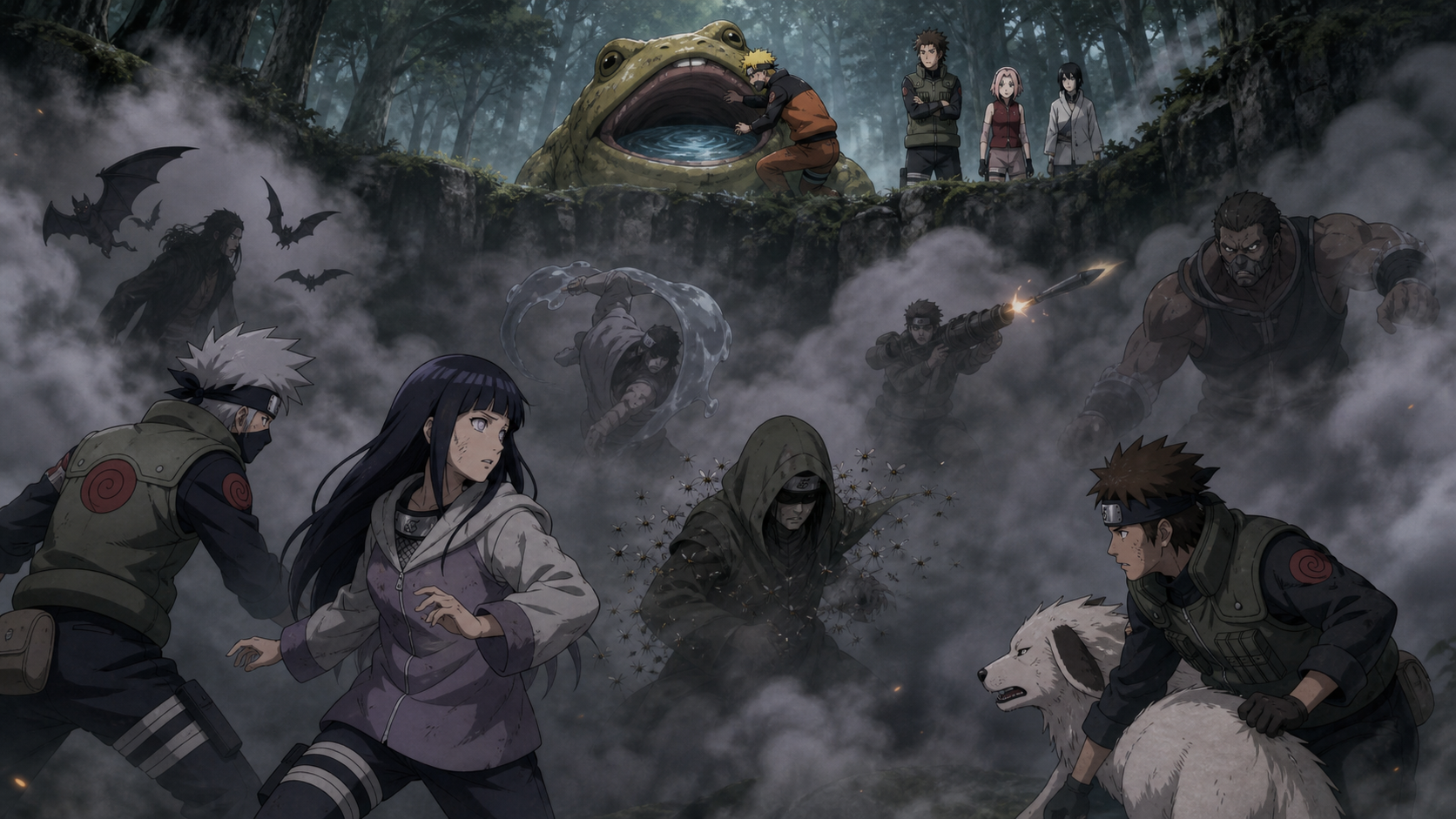
Guren's group attacks Team Kakashi through an environment engineered to make ordinary perception unreliable. Thick smoke breaks lines of sight, separates allies, and lets unfamiliar bodies approach from angles the defenders cannot confirm.
The danger is not only concealment. It is the pressure to act before enough information exists.
An unseeing enemy becomes most effective when fear supplies the conclusions vision cannot.
The ambush divides a team built around overlapping senses
Kakashi, Hinata, Shino, Kiba, and Akamaru were selected because their abilities can confirm one another. The smoke tries to prevent that overlap by forcing each specialist into a separate problem.
Kiba and Akamaru face scent disruption. Hinata's vision meets distorted movement and multiple chakra signatures. Shino's insects must survive unfamiliar techniques. Kakashi is drawn toward the strongest physical threat.
The attackers are not merely hiding. They are dismantling the team's method of knowing.
Kigiri weaponizes uncertainty before anyone reaches him
Kigiri's smoke screen has strategic value beyond cover. It creates a battlefield where his allies know the plan and the Leaf shinobi do not.
Every silhouette may be an attacker, an ally, or empty movement inside the haze.
He contributes control without needing to win a direct exchange, proving that support techniques can define the entire fight.
Nurari makes a reliable strike feel unreliable
Nurari's fluid body bends around attacks that should connect. The effect is especially disorienting when visibility is already poor.
A defender receives the physical information of impact without the expected result. That mismatch encourages harder, faster attacks before the technique is understood.
His body turns the team's own confidence in successful contact into another source of confusion.
Kiho applies pressure from outside the visible range
Long-range launchers make stopping to analyze the smoke dangerous. Projectiles can arrive from a position the team cannot immediately identify or reach.
Kiho's role prevents the Leaf shinobi from forming a stable defensive circle.
The ambush succeeds by combining sensory denial with punishment for anyone who pauses long enough to solve it.
Gozu forces Kakashi to spend attention on mass and durability
Gozu's strength creates the most obvious threat. That visibility can be tactical bait: Kakashi must respect a direct assault while subtler attackers work through smoke around the others.
The giant guard does not need elegance if occupying Kakashi keeps leadership away from the team.
His body becomes a wall between coordination and the people who need it.
Team Kakashi survives by rebuilding communication
The answer is not for each person to win an isolated duel as quickly as possible. The team has to share partial information and restore the overlapping evidence the ambush removed.
Hinata can identify movement. Shino can test the environment. Kiba and Akamaru can compare scent behavior. Kakashi can infer the structure behind the attackers' roles.
Their advantage returns when fragments become a common picture.
Naruto finds a solution by looking inside the technique
Before Team Yamato departs, Naruto receives an absurd-sounding clue: enter Gamatatsu's belly. The point is not spectacle for its own sake.
Gamatatsu stores and produces water internally. Understanding that physical process helps Naruto see why their combined release has lacked the correct pressure and continuity.
The missing answer was not more wind. It was knowledge of what his partner was already doing inside a body Naruto had treated as a simple source.
The toad's body is not a container to exploit
Entering Gamatatsu requires trust and consent. Naruto gains practical information because the partner lets him experience the mechanism directly.
That exchange remains different from Orochimaru's experiments. The body supplying power is involved in the solution rather than restrained for extraction.
Collaboration grows through access offered, not access taken.
RaeRae's reaction
I love that the episode pairs a battle about missing information with a training breakthrough based on finally seeking the right information.
Team Kakashi struggles because the enemy disrupts every channel they normally trust. Naruto improves because he stops assuming he already understands Gamatatsu's contribution.
Both stories reward curiosity disciplined by partnership.
The unseen becomes manageable when the team shares what each person knows
Episode 96 makes invisibility a tactical system rather than a single trick. Smoke, fluid movement, range, and brute force work together because they fracture perception and isolate decision-making.
The Leaf's response must therefore be collective. No one sense can solve the entire ambush.
Naruto's strange trip inside Gamatatsu offers the same lesson in miniature: power becomes reliable when hidden processes are understood instead of guessed. What cannot be seen is not automatically unknowable, but learning it requires another perspective.
Official episode reference: Naruto Official episode guide
Licensed episode route: Crunchyroll licensed episode page
The title names a failure of recognition, not literal invisibility
Guren’s specialists can be seen in fragments. Bodies move through smoke, attacks arrive, and chakra signatures remain present. The real problem is that Team Kakashi cannot identify the whole system quickly enough to predict the next move. An enemy becomes unseeing when the people under attack cannot connect action, role, location, and intention.
That distinction keeps the fight from becoming a simple contest against a smoke bomb. Kigiri, Nurari, Kiho, and Gozu make one another harder to understand. Remove one role and the others become less frightening. Together, they create a battlefield where every useful clue competes with an urgent threat.
Kigiri controls tempo by deciding when information disappears
Smoke does not injure the Leaf team by itself, but Kigiri determines when they can look, regroup, and choose a target. He turns visibility into a resource his side can withhold. The ability gives physically stronger allies time to approach and lets ranged attacks arrive before defenders know which direction deserves cover.
I appreciate support ninjutsu that changes everybody’s behavior. Kigiri does not need a grand finishing move to matter. His value comes from making each opponent spend more time and chakra confirming facts that would normally be obvious.
Nurari punishes the body’s expectation of resistance
A fighter learns through contact. A blocked strike, a solid hit, or a weapon meeting armor tells the attacker what kind of defense stands ahead. Nurari’s fluid movement corrupts that feedback. The blow appears to reach him, yet his body yields, shifts, or lets force pass without producing the expected damage.
Inside the smoke, the technique can make competent shinobi doubt their own senses. Repeating the attack harder may only waste strength and create a predictable rhythm. The answer requires observation and experimentation, not the emotional satisfaction of finally hitting something with enough force.
Kiho makes analysis feel like a luxury the team cannot afford
Ranged fire keeps everyone moving. A person trying to understand Nurari or trace Kigiri’s position may have to abandon the thought to avoid the next projectile. Kiho protects the group’s secrets by taxing attention. The weapon does not merely threaten bodies; it interrupts the mental work required to solve the formation.
That is why the ambush feels coordinated even when the attackers have different abilities and personalities. Each specialist covers the moment when another specialist might be understood. Their teamwork is dangerous because the roles were chosen around a shared purpose.
Gozu turns leadership into a private fight
Kakashi is the person most likely to reconstruct the enemy plan and redirect his team. Gozu’s mass and persistence demand his direct attention. The matchup separates command from communication without needing a formal barrier. Kakashi can survive the pressure, but every exchange gives the other attackers more time with shinobi who cannot easily hear his instructions.
Gozu’s role also shows how Orochimaru’s network spends people. His durability makes him useful as a living obstruction. The formation depends on his willingness to receive punishment so others can preserve distance and secrecy.
Hinata’s sight still needs interpretation when too many signals compete
The Byakugan can penetrate obstacles and locate chakra, but seeing several moving networks does not automatically reveal which movement is an attack, decoy, retreat, or preparation. Hinata has to prioritize information while defending herself. Every second spent looking farther away can leave the space beside her less protected.
Her strength therefore remains tied to teammates who can act on what she reports. Vision becomes tactical only after the group shares language, timing, and trust. The ambush tries to break those connections before her information can change the fight.
Shino answers confusion by testing instead of performing certainty
Insects can enter spaces human bodies cannot, sample the air, follow movement, and reveal how an unfamiliar technique responds. Shino’s habit of observing small changes is especially valuable against Nurari and Kigiri because both depend on opponents acting from a first impression.
His calm should not be mistaken for having no emotional stakes. Shino protects the team by resisting the panic that asks for an immediate dramatic answer. He lets evidence become specific before committing the insects and his own body.
Kiba and Akamaru need each other when smoke carries misleading scent
Smoke can overwhelm a nose, cover one trail with another, and make direction difficult as air moves through trees. Kiba and Akamaru do not overcome those conditions through a fantasy of perfect animal senses. Their advantage comes from comparison. One partner’s hesitation can prevent the other from charging after a false route.
Their bond preserves a channel of communication the enemy cannot fully erase. Touch, sound, posture, and long familiarity still carry meaning when vision disappears. That makes partnership a form of resistance to environmental control.
The attackers understand teamwork without offering one another safety
Kigiri, Nurari, Kiho, and Gozu coordinate effectively, but effective coordination does not prove a healthy group. Their formation serves Guren, Kabuto, and ultimately Orochimaru. Failure may carry punishment that the Leaf team does not immediately see.
This is one of the arc’s sharper contrasts. Harmful institutions can produce disciplined teamwork because people learn that usefulness is the route to survival. The skill remains real. The conditions determining whose body absorbs the risk remain cruel.
Naruto’s trip inside Gamatatsu is funny because the solution is bodily and inconvenient
Naruto wants a training answer he can attack directly. Instead, he has to enter a toad and pay attention to how water is stored and released. The episode refuses to package learning as a dignified lecture. Understanding another body can be awkward, wet, cramped, and impossible to separate from the person living in that body.
The comedy helps because collaboration should not become another solemn slogan. Naruto and the toads are building a working relationship through trial, embarrassment, appetite, and questions. Their method feels lived rather than announced.
Gamatatsu’s internal process changes the design of the jutsu
Naruto had treated water as a simple ingredient that should appear when requested. Looking inside reveals pressure, storage, timing, and physical preparation. Gamatatsu’s contribution begins before the visible release. The technique fails when Naruto coordinates only the moment he can see.
That lesson applies to teams as well. A finished action often hides training, fear, fatigue, translation, and preparation carried by somebody else. Respect begins when Naruto notices the hidden work instead of judging only the final output.
Consent makes this access different from Kabuto’s research
Both story lines involve learning from another person’s body. Kabuto and Orochimaru study Yukimaru to determine how much power can be extracted and directed. Naruto learns because Gamatatsu allows him close enough to understand a shared problem. The difference lies in purpose, permission, and who benefits from the knowledge.
Naruto still has responsibilities. Consent to one strange training attempt does not grant ownership of Gamatatsu’s body or ability forever. A collaborative technique must keep room for either toad to refuse when the conditions become unsafe.
The episode connects sensory intelligence with emotional intelligence
Team Kakashi must recognize what each specialist can and cannot perceive. Naruto must recognize that Gamatatsu’s behavior and body contain information he overlooked. Both tasks require people to stop treating their first interpretation as the whole truth.
Emotional intelligence does not replace tactics here. Listening produces better tactics. The person who understands how a partner communicates can coordinate faster, notice distress earlier, and avoid demanding an impossible contribution during danger.
RaeRae’s full take
The Unseeing Enemy works because nobody solves uncertainty by shouting louder. Guren’s team built an ambush that attacks information first. Smoke, fluid movement, ranged fire, and Gozu’s body each close a different route toward understanding.
Team Kakashi survives by recovering the thing the ambush tried to remove: shared interpretation. Hinata, Shino, Kiba, Akamaru, and Kakashi each hold part of the scene. The team becomes dangerous again when those parts can reach one another.
Naruto’s lesson is the funnier version of the same argument. He cannot coordinate water he never bothered to understand. Crawling inside Gamatatsu forces him to meet the hidden labor behind the visible stream.
I also need the consent contrast to stay clear. Orochimaru’s people investigate bodies to control them. Naruto gains access because a partner joins the experiment and shares the goal. Knowledge becomes safer when the person being studied can speak, refuse, benefit, and remain more important than the technique.
Mission planning has to include the moment the plan stops working
A capable team should discuss those failures before entering hostile ground. Signals, rendezvous points, protected phrases, and rules for retreat do not show distrust. They preserve trust after the environment removes ordinary contact. Kakashi can improvise under pressure, but leadership should not make one person the only emergency plan.
Smoke changes the ethics of every attack
When nobody can see clearly, a powerful strike may hit an ally, an animal partner, a restrained victim, or a decoy placed to draw force. The enemy benefits when fear makes the Leaf team forget those possibilities. Restraint becomes tactical because indiscriminate power gives Kigiri’s formation another weapon.
Hinata’s sight and Shino’s insects can reduce that danger, but neither gift removes responsibility from the person attacking. Each shinobi still has to identify a target and consider what lies beyond the visible outline. A battlefield designed around uncertainty tests judgment before strength.
The four attackers rely on labor that rarely receives equal credit
Gozu’s body and Kiho’s projectiles are easy to notice. Kigiri’s smoke creates the conditions that make both effective, while Nurari’s evasive body keeps the group from losing momentum when a defender lands a strike. The formation collapses if viewers treat the quieter roles as decoration.
That imbalance mirrors how institutions reward visible force. The person delivering a finishing blow receives a name and reputation, while scouts, medics, messengers, and people maintaining cover become background. Episode 96 makes the background impossible to ignore because control of the environment determines which blow can land.
Naruto has to translate bodily knowledge into shared timing
Seeing Gamatatsu’s water process is only the beginning. Naruto still has to explain what he learned in language the toads can use, listen when their experience corrects his interpretation, and convert internal preparation into an external count. Knowledge trapped inside Naruto’s head would leave the collaboration exactly where it started.
The next attempt must account for breath, pressure, fatigue, distance, and the moment each partner can safely release. Naruto cannot simply announce that he understands now. The jutsu will prove whether understanding became a plan that all three participants recognize.
Gamatatsu’s comic personality does not reduce his technical importance
The series often uses his appetite and confusion for laughter, though the combined technique depends on a process only his body performs. Naruto and Gamakichi may understand instructions faster, but neither can replace that contribution by claiming greater intelligence.
A fair partnership separates learning speed from human worth. Gamatatsu needs patience and clear practice. He also deserves credit when the water supply works, because the visible wind effect cannot exist without his preparation. Comedy should let him remain funny without turning him into equipment everybody is allowed to insult.
The episode’s two halves warn against treating hidden work as emptiness
Inside the smoke, Team Kakashi cannot see the coordination shaping each attack. Inside Gamatatsu, Naruto had not seen the process shaping each release. In both places, missing visibility encouraged a false conclusion. The Leaf team could assume the attackers were moving randomly. Naruto could assume Gamatatsu merely failed to produce enough water.
Closer attention reveals systems. Kigiri’s formation has roles, dependencies, and timing. Gamatatsu’s body has storage, pressure, and limits. The moral difference lies in what people do with that discovery. Kakashi studies an enemy system to protect his team. Naruto studies a consenting partner so their shared technique can work for everyone.
RaeRae’s final word on the fight
I do not need every battle to end with a crater. Sometimes the best tension comes from competent people realizing their normal method has been taken apart. Team Kakashi looks vulnerable because the attackers studied how perception becomes confidence and then attacked the connections between those senses.
The recovery has to be collective. Kakashi cannot punch visibility back into the forest. Hinata cannot look in every direction forever. Shino cannot ask insects to solve a projectile already moving, and Kiba cannot force rain and smoke to preserve a perfect scent trail. They survive by passing partial truth fast enough for another person to act.
Naruto gets the same lesson without the ambush. He thought wind was the impressive part and water was the ingredient waiting to obey. Gamatatsu’s belly teaches him that the partner carrying less visible glory may be carrying the entire process the group still needs to understand.
RaeRae checkpoint: Episode 96 makes information a team resource. The enemy wins while every Leaf shinobi holds an isolated clue. Kakashi’s side recovers when those clues become a conversation, and Naruto improves when Gamatatsu’s hidden work becomes part of the plan.
Receipts and official routes
- Official synopsis, licensed title, and episode placement: Naruto Official Site episode guide.
- Licensed episode title, number, and current watch route: Crunchyroll.