
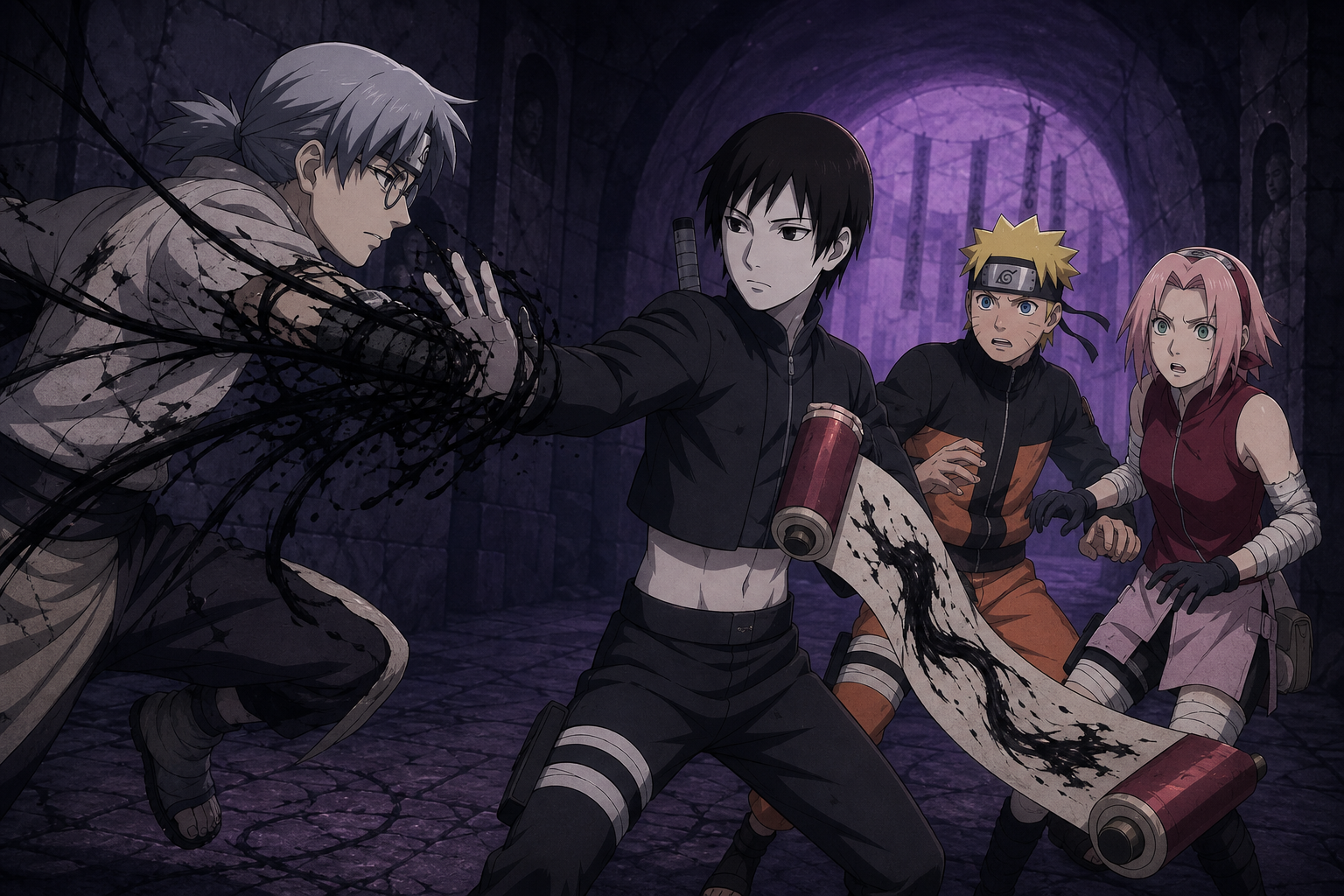
Something Important…
Sai lets a bond interfere with the order for the first time.
Kabuto attacks at the moment Sai can no longer remain neutral
Episode 49 turns Sai's internal contradiction into a visible choice. Kabuto arrives to take him back, treating Sai as an asset that has wandered outside its assigned function. The surprise attack gives Sai a clean opportunity to return to the mission Danzo gave him.
Instead, Sai resists.
That action matters more than another explanation of what he might feel. Root trained Sai to obey while hiding every private response. Choosing Team Kakashi in a dangerous moment means the change Sakura identified has begun to affect his behavior. He is no longer only carrying a bond in an unfinished book. He is allowing it to interfere with the order.
Sakura names the contradiction Sai could not see
Sakura's earlier observation stays with Sai because it is precise. He claims his brother no longer matters, yet he protects the picture book, remembers its intended story, and reacts when other people touch the subject. His behavior has been preserving something his language denies.
She does not hand him a sentimental answer. She points out evidence. That makes her challenge harder for Root conditioning to dismiss. Sai may not understand love, grief, or loyalty in the same terms Naruto and Sakura use, but he can recognize inconsistency.
Once he sees it, the contradiction becomes a choice: keep performing emptiness, or admit that something important survived.
Kabuto reveals how Orochimaru's world handles uncertainty
Kabuto's response to Sai is retrieval by force. Orochimaru accepted Sai because he was useful; once that usefulness becomes uncertain, Kabuto moves to control the risk. There is no concern for why Sai changed or what he wants.
This mirrors Danzo's relationship with him. Both systems value Sai as a function. Root calls him a loyal operative. Orochimaru's organization calls him a source, hostage, or bargaining piece. Neither needs him to become a full person.
Team Kakashi's messy questions offer something more dangerous and more humane: the possibility that Sai's answer matters.
Sai's ink becomes an expression of agency
Sai's techniques have always translated controlled lines into obedient creatures. In this fight, the ink carries a different meaning because he uses it to interrupt Kabuto and protect the people he was sent to deceive.
The ability has not changed. The purpose has. That is the clearest sign of agency the episode can give him. Sai does not need a new power to become different. He needs ownership of the reason he uses the power he already has.
It is a small rebellion against Danzo's belief that training determines every future action.
Naruto recognizes choice before trust is complete
Naruto wants to believe in people quickly, especially when their story echoes his own experience of isolation. That instinct can make him reckless, but here it lets him recognize the significance of Sai's decision. Sai stands between Kabuto and the team when obedience would have been easier.
Naruto does not need to erase everything Sai did in order to see what he is doing now. That is an important distinction. Trust can be rebuilt through a series of accountable choices. It does not require pretending betrayal never occurred.
For Naruto, whose entire pursuit of Sasuke depends on the belief that a person can choose differently, Sai becomes immediate proof that change is possible.
Sakura does not have to soften herself to reach Sai
Sakura's influence on Sai comes from honesty, not endless patience. She challenged his cruelty, questioned his claims, and refused to accept the false smile as evidence of connection. Her directness gives Sai information nobody in Root offered him.
This matters because stories often ask compassionate characters to absorb harm quietly in order to redeem someone else. Sakura does not do that here. Sai changes because she maintains a boundary and names what she sees.
Her role is not to manufacture his humanity. It is to stop cooperating with his denial of it.
Something important is allowed to interrupt the mission
Root teaches that attachment compromises performance. Episode 49 argues that attachment can also interrupt immoral obedience. Sai's memory of his brother, Naruto's refusal to abandon Sasuke, and Sakura's insistence on emotional truth all interfere with Danzo's clean plan.
That interference is the point. A person who feels nothing for anyone is easier to direct toward betrayal. Bonds create obligations that authority did not assign. They force Sai to compare the order with the people who will pay for it.
The important thing is not merely a lost memory. It is the part of Sai capable of deciding that another person should not be treated as disposable.
The team remains inside enemy territory
Sai's choice does not make the hideout safe. Kabuto's attack confirms that Orochimaru's network is alert, Sasuke remains somewhere deeper inside, and Team Kakashi has exposed its presence. Yamato still has to move the group through a structure designed to confuse and contain intruders.
The emotional turn therefore arrives under pressure. Nobody gets time to celebrate Sai's change. It has to prove useful immediately.
That urgency keeps the scene from becoming an easy redemption beat. Sai joins the team's side by accepting the danger that comes with opposing both Kabuto and Danzo's intended path.
RaeRae's reaction
This is the Sai moment I was waiting for. Not because one defensive move fixes everything, but because he finally lets the contradiction affect what he does. He could keep explaining that he has no feelings while carrying his brother's book forever. Stopping Kabuto is different. It costs him something.
Sakura deserves credit for reaching him without babying him. She saw that his story did not match his behavior and said so. That directness gives Sai a way to examine himself that is not based on orders or punishment.
I also love the irony of Root's training failing through observation. Sai was taught to study people without connecting to them. The more closely he studies Naruto and Sakura, the harder it becomes to maintain the lie that bonds are meaningless.
A new choice begins filling the blank page
Episode 49 does not complete Sai's picture book, but it gives the missing page a direction. The brother he lost remains important. The teammates in front of him are becoming important. His actions can connect those truths even before he has the language to explain them.
Kabuto arrives expecting to retrieve an operative. He encounters a person beginning to choose. That is the episode's real turn, and it is why Sai's resistance carries more weight than the attack itself.
Official episode reference: Naruto Official episode guide
Licensed episode route: Crunchyroll licensed episode page
Sai’s choice matters because obedience remains available
Kabuto’s arrival offers Sai a route back into the identity Root prepared for him. He could allow Team Kakashi to be subdued, continue Danzō’s assignment, and describe every consequence as necessary mission work.
Instead, he turns his technique against the person attempting to reclaim him for Orochimaru’s side. The decision is meaningful because the old path has not disappeared. Sai chooses while disobedience still carries danger.
Growth is not the absence of conditioning. Growth is acting differently while conditioning continues to speak.
Kabuto assumes people return to the function assigned to them
He approaches Sai as a compromised asset to secure, not a person whose motive may have changed. That assumption matches Orochimaru’s entire system. Bodies, information, and alliances possess value according to use.
Kabuto is surprised because he reads Sai through the deal that delivered him. Danzō sent an operative, so the operative should remain the sum of the order.
Sai’s resistance rejects that reduction. The technique proves the person carrying a function can withdraw cooperation.
The ink restraint rewrites the meaning of Sai’s skill
His drawings once felt like extensions of Root discipline: exact lines becoming obedient creatures, surveillance, and capture. The same practiced ability now protects people Root treated as cover.
No new power announces his transformation. Purpose changes before technique does.
That is a mature account of agency. Sai does not need to erase everything learned under Danzō. He can reclaim skill from the institution and decide what the skill serves.
Sakura’s challenge becomes useful because she did not flatter him
She pointed to a contradiction between Sai’s claim of emptiness and the care he gave the picture book. The observation stayed with him because it was specific, uncomfortable, and supported by evidence.
Sakura did not tell Sai that one hidden feeling made every harmful action acceptable. She asked him to stop lying about what his own behavior revealed.
Honesty can be a form of care without becoming gentleness at the expense of boundaries.
Naruto gives Sai an example of loyalty and a warning about excess
Naruto’s refusal to abandon Sasuke shows that bonds can survive distance, anger, and institutional pressure. His four-tailed transformation also shows how attachment can become destructive when shame and power remove judgment.
Sai is not being asked to copy Naruto without qualification. He is learning that relationship can interrupt immoral orders while Naruto learns that relationship cannot justify every method.
Both boys need the other side of the lesson.
Something important does not arrive as a complete emotion
Sai may not suddenly possess fluent language for love, grief, friendship, or betrayal. The title respects that uncertainty. He recognizes something important before he can define it fully.
People often act from emerging values before they can explain those values with confidence. The action can become part of learning what the feeling means.
Stopping Kabuto gives Sai evidence about himself: when forced to choose, Team Kakashi’s safety mattered enough to alter the mission.
The picture book becomes a guide rather than only a memorial
Until now, the book preserved a bond with Sai’s brother and the blank space left by death. The current choice connects that memory to living relationships.
Sai does not honor his brother merely by protecting old drawings. He begins honoring the bond by allowing what he learned through it to affect how he treats people now.
A memorial remains alive when memory changes present responsibility.
Root taught Sai that attachment produces hesitation
The doctrine is not entirely false. Sai hesitates because Naruto, Sakura, his brother, and the book have complicated the clean line of his assignment.
The lie is that hesitation has no value. Pausing before betrayal can protect lives. Doubting an abusive order can preserve moral judgment. Feeling conflict can reveal that the mission’s terms are wrong.
Efficiency is not automatically virtue when the efficient action harms people denied any voice.
Danzō’s control weakens when Sai creates an unauthorized obligation
Root defines what Sai owes and to whom. Team Kakashi was supposed to be temporary cover, outside the circle of real duty.
By protecting them, Sai acknowledges an obligation Danzō did not assign. That is politically significant. Private relationship has produced a reason to disobey centralized control.
Authoritarian systems fear bonds because people may begin answering to one another instead of only upward.
Sai’s action does not erase the exposed ANBU list
The classified packet remains part of the consequences. Choosing Team Kakashi now cannot retroactively protect every person whose information reached Orochimaru.
Redemption must include material repair. Sai will need to help recover information, prevent attacks, expose Danzō’s plan, or otherwise reduce the danger he helped create.
A story centered only on his emotional breakthrough would make endangered strangers into props for his growth.
Kabuto’s role reveals the danger of medical skill without reciprocal care
He can heal, analyze bodies, and understand vulnerability. In Orochimaru’s system, those abilities support capture and experimentation.
Sai’s restraint reverses the relationship between technical skill and authority. Kabuto uses expertise to preserve the system. Sai uses technique to interrupt it.
Competence becomes ethical only through the purpose and relationships governing its use.
Naruto recognizes the decision before Sai can explain it
Naruto has spent his life watching actions contradict the labels placed on people. The village called him dangerous while he kept choosing connection. Sasuke called bonds weakness while repeatedly protecting teammates before departure.
Sai can claim emotional ignorance, but standing against Kabuto supplies clearer evidence.
Naruto’s belief is strongest when it responds to behavior rather than substituting hope for evidence.
Sakura remains entitled to caution
She can appreciate Sai’s protection without immediately trusting every motive or forgiving the earlier betrayal. Gratitude and caution can coexist.
This matters because the burden of male redemption often lands on women being asked to declare someone safe after one decent act. Sakura does not owe that declaration.
Sai’s responsibility is to continue choosing differently whether or not reassurance arrives on his preferred schedule.
Yamato evaluates a changed tactical reality
As captain, he cannot base the plan only on emotional symbolism. Sai has demonstrated resistance to Kabuto, provided information, and become potentially useful to the shared objective.
Those facts justify revising how the team handles him. They do not eliminate surveillance inside an enemy hideout.
Yamato’s approach allows trust to grow in proportion to evidence, which protects everyone from both cynicism and wishful thinking.
Agency begins when Sai accepts conflicting obligations
Root offered a simple hierarchy: Danzō’s order outranks every person encountered. Team Kakashi introduces obligations that do not fit beneath that command.
Sai now has to judge among them. Judgment creates the possibility of error, regret, and responsibility. It also creates personhood Root tried to replace with function.
Freedom is not having no ties. Freedom includes deciding which ties deserve loyalty.
The choice protects Team Kakashi and exposes Sai
By opposing Kabuto, Sai makes his break visible to Orochimaru and potentially to Danzō. He loses the ambiguity that previously let every side imagine he still served its purpose.
Protection therefore costs him operational safety. The act is more than a convenient alliance because it narrows the routes back to unquestioned obedience.
A bond becomes credible when maintaining it carries a consequence the person knowingly accepts.
The team’s response should include Sai without centering him
Sai’s emerging humanity matters. Naruto’s recent loss of control, Sakura’s injury, Sasuke’s location, the ANBU exposure, and Danzō’s plan remain equally real.
The mission cannot pause so everyone can applaud the new choice. Sai joins a web of responsibilities already in motion.
Belonging means contributing to shared repair, not becoming the only emotional subject because change finally began.
Something important is also the right to revise yourself
Danzō’s model assumes training can settle identity permanently. Sai’s resistance shows that people can reinterpret memory, notice contradiction, and withdraw obedience.
The earlier betrayal remains part of his history. Revision does not mean pretending the page was never written.
It means the next page is not predetermined by the hand that wrote the first orders.
Sai’s protection creates a debt he must answer through consistency
Team Kakashi benefits immediately when Sai restrains Kabuto. That benefit does not require Naruto or Sakura to forget how the danger began. Sai helped carry Danzō’s plan into the hideout, and now he helps interrupt Orochimaru’s response.
The two actions belong to the same person. Growth becomes believable when the second decision leads to more responsible choices after the dramatic moment passes. Sai must keep sharing information, help locate Sasuke, and refuse the logic that made teammates expendable.
Consistency is where an important feeling becomes a trustworthy relationship.
Protecting people gives Sai a new way to understand his brother
The book has preserved memory as image, but Sai struggles to recover the emotion attached to the final page. Acting for Naruto and Sakura may give him another route into that lost knowledge.
He can learn what his brother meant not only by looking backward, but by noticing the impulse to shield someone now. Present care can illuminate past grief because both emerge from recognizing that another life cannot be reduced to function.
The missing page may need more than recovered memory. It may need Sai to become capable of drawing from a choice he finally understands as his own.
The restraint also gives Naruto and Sakura something Root never gave Sai: observable evidence that his priorities can change. They do not have to trust a claim about friendship. They can evaluate a choice made under pressure and watch whether the next choice supports it.
That evidence gives accountability a foundation stronger than hopeful interpretation alone.
RaeRae’s full take
This is the moment when Sai stops being interesting only as a mystery and becomes interesting as a person making a costly decision. He does not announce that friendship has healed him. He puts ink around Kabuto and chooses who the technique protects.
I love that Sakura’s honesty helps create the turn. She did not flatter him into goodness. She named the evidence he kept refusing: nobody carries an unfinished book about a dead brother through every mission because the bond means nothing.
Naruto offers the belief that people can choose differently. Yamato offers boundaries that keep the belief from becoming foolish. Sakura offers the truth Sai cannot perform his way around.
One protective action does not erase the ANBU list or the danger he brought into the team. Redemption that matters has receipts and repair. Sai has taken the first action capable of supporting both.
Root taught him that bonds interfere with missions, and Root was correct about the interference. The missing part was that some missions deserve to be interrupted. An order built on betrayal should become harder to complete once the people paying for it become real.
Something important is not a magic feeling floating above consequence. It is the recognition that another person matters enough to change what you do when obedience would be easier.
RaeRae checkpoint: Sai’s ink has not changed. The hand directing it has. Agency begins when the same skill serves a responsibility Danzō never authorized.
Receipts and official routes
- Episode placement, Kabuto’s intervention, Sakura’s challenge, Sai’s picture book, and Sai choosing to restrain Kabuto: Naruto Official Site episode guide.
- Licensed episode route: Crunchyroll.